

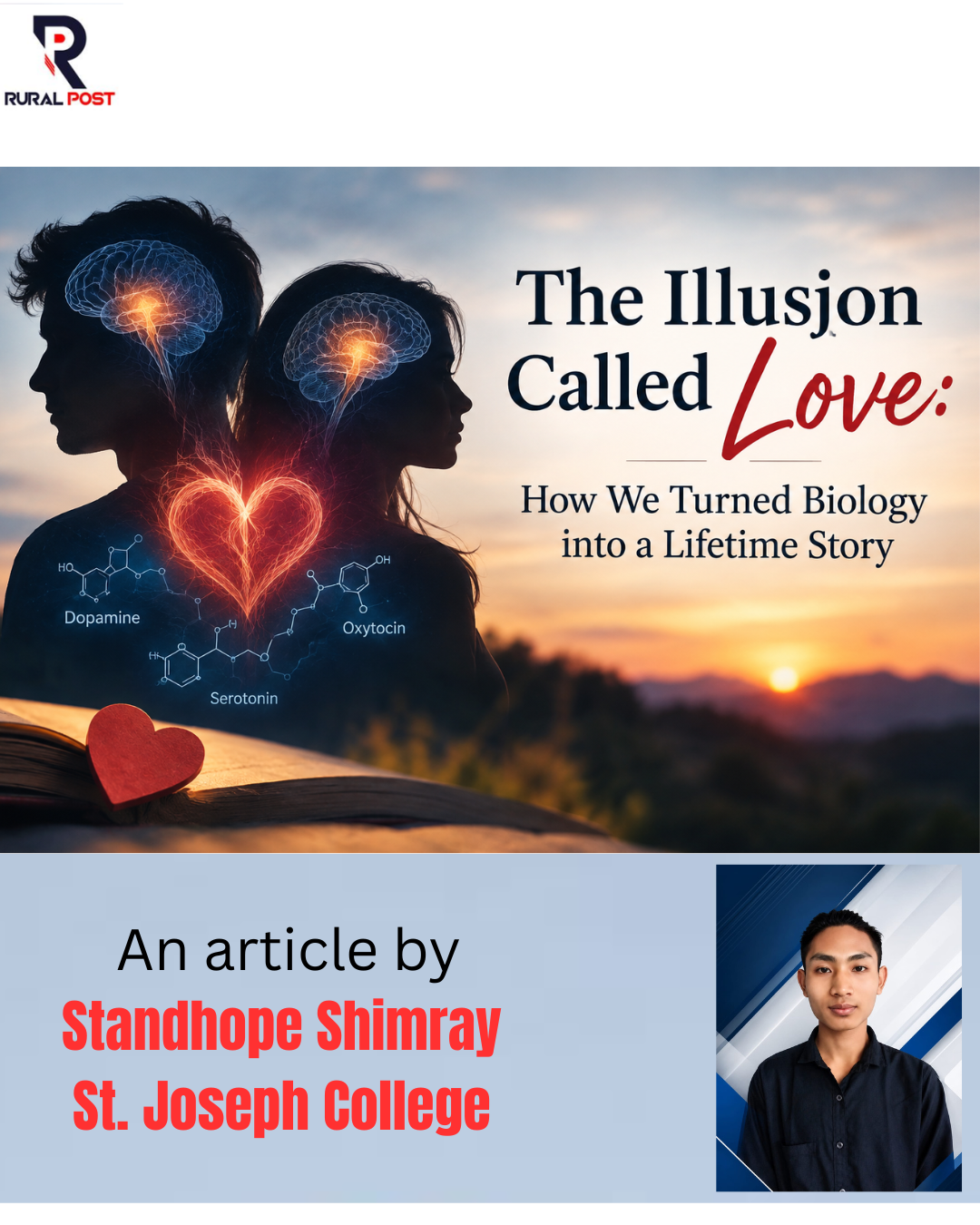
The Illusion Called Love: How We Turned Biology into a Lifetime Story
What if we have been wrong about love?
It is a strange question because love is rarely treated as something that needs to be questioned. We grow up surrounded by songs, films, novels, advertisements, family traditions and social expectations that present love as one of the most important realities of human life. We are taught to search for it, protect it, sacrifice for it and sometimes even define ourselves through it. The word itself carries enormous authority. Once an experience is called love, people often stop asking what is actually happening inside the human mind and body. We accept the feeling as an explanation in itself. I started wondering what would happen if we removed the word “love” and examined the experiences underneath it.
Science gives us an interesting starting point. It does not identify one single biological force or substance called love. Human beings experience attraction, sexual desire, attachment, affection, caregiving, companionship, reward, familiarity and social bonding. These experiences involve different biological and psychological processes. Romantic attraction can involve brain systems associated with motivation, reward, attention and learning. Dopamine plays an important role in reward and motivation. Norepinephrine is involved in arousal and attention. Oxytocin and vasopressin participate in social bonding and attachment in particular contexts. These systems interact with memory, personality, previous experience and social environment. There is no single “love chemical” that explains everything we call love.
This does not mean that the feelings are fake. Attraction is real. Desire is real. Attachment is real. Affection is real. The question is what we mean when we put all these different experiences under one word. Human beings have a strong tendency to name complicated experiences and then give those names meaning. We collect several different processes under the word “love” and then build an enormous story around it. Eventually love becomes more than a description of a feeling. It becomes an explanation, a justification and sometimes an authority over human decisions.
The idea of a “vibe” between two people is a good example. Two people meet, talk for a while, laugh at each other’s jokes and suddenly they have a “vibe.” Apparently, biology has now become a dating consultant. Attraction, familiarity, personality, social cues, expectations and reward processes can all influence how we respond to another person. Yet we often turn that feeling into something much. bigger. A good conversation becomes “a vibe,” the vibe becomes “chemistry” and suddenly we are talking about destiny and forever. Two people laugh at the same stupid joke twice and suddenly the brain announces, “Congratulations, you have found your soulmate.” Apparently, even the neurons have joined the matchmaking business. A vibe cannot tell us that the universe has selected our future spouse.
The same problem appears in the idea of love at first sight. Human beings can make rapid judgements about other people. Facial features, expressions, voice, movement and other social cues can influence attraction very quickly. Previous experiences and personal preferences also shape these judgements. Someone can therefore experience an immediate and powerful attraction to another person. The experience can be genuine. Calling it destiny adds another layer of meaning that science cannot establish.
Then there is the soulmate. Few ideas have given love more authority than the belief that somewhere in the world there is one person uniquely meant for us. The soulmate idea turns uncertainty into destiny. It makes a complicated human relationship appear predetermined. There is no established biological mechanism showing that every person has one uniquely destined romantic partner. People can form deep relationships with different individuals under different circumstances. Compatibility develops through communication, shared experiences, values, habits and mutual adjustment. The soulmate story gives these ordinary human processes a much grander meaning.
Love also has a strange relationship with obsession. When someone occupies our thoughts constantly we may interpret that mental preoccupation as proof that the person must be exceptionally important. Attraction and attachment can make a person highly salient to the mind. Reward, uncertainty, memory, anticipation and emotional significance can keep attention returning to the same person. The experience can become overwhelming. We then make a simple mistake: we treat intensity as evidence. “I cannot stop thinking about this person therefore I must truly love them.” The intensity tells us that the person has become highly significant to the mind. It does not automatically explain why.
People often say that love makes a person blind. I think there is a deeper truth in that statement. Intense emotions of any kind can become dangerous when they overwhelm human reasoning and intellectual judgement. Love is only one example. Anger, hatred, fear, jealousy, obsession, excitement and excessive admiration can also distort the way a person evaluates reality. When emotional intensity becomes strong enough to dominate attention and decision-making analytical thinking can become severely impaired. A person may ignore evidence, dismiss warnings, defend irrational behaviour and make decisions that would appear completely unreasonable in a calmer state. This is where emotion becomes dangerous. Human beings need emotions but they also need the intellectual ability to examine those emotions. Once an emotion gains complete control over judgement the consequences can become destructive. Anything that seriously weakens a person’s capacity to analyse, question and reason deserves suspicion. A mind that stops examining reality becomes vulnerable to its own impulses.
Jealousy gives us another example. Jealousy is often presented as proof of deep love. Someone becomes jealous because they fear losing the person they love and the jealousy is then treated as evidence of devotion. Psychology gives us a more complicated picture. Perceived threats, insecurity, competition, fear of rejection, attachment and concerns about losing a valued relationship can all contribute to jealousy. Jealousy can tell us something about a person’s emotional state. It cannot automatically prove the quality or depth of love.
Long-term relationships raise an even more uncomfortable question. What happens when the initial intensity changes? Human beings adapt to repeated experiences. Familiarity develops. Daily routines become established. Expectations become predictable. Shared memories accumulate. Behaviour becomes shaped by repeated interaction. A person becomes part of the structure of everyday life. A relationship may continue because affection remains because attachment remains because the people have built a life together or because familiarity and habit have become powerful forces. Calling all of this “eternal love” can hide the complexity of what is actually sustaining the relationship.
This also helps explain why the end of a long relationship can feel like the loss of an entire world. A relationship can become connected to daily routines, social circles, memories, plans and expectations. When it disappears the disruption reaches far beyond the absence of another person. The mind has to adjust to changed routines and expectations. Activities once performed together must suddenly be performed alone. Places carry memories. Ordinary habits become reminders. The pain is real. That pain does not automatically prove that the relationship was written into the structure of the universe.
Relationship inertia makes the picture even more complicated. People remain together because they genuinely want to remain together. People also remain together because they share a home, finances, children, family expectations, social identity, memories and years of accumulated experience. Starting again can be frightening. Leaving can be difficult. A familiar relationship can feel easier to maintain than an uncertain future. We often call the persistence of a relationship “love” without examining all the forces keeping it in place.
The idea that a romantic partner “completes” a person is equally difficult to defend as a universal truth. Human development occurs through many relationships and experiences. Family, friendship, education, work, community, interests, creativity, personal achievement and independent thought can all contribute to a person’s development. A human being does not have a biological requirement for one romantic partner to become psychologically complete. The idea of completion gives romance enormous authority over personal identity. It can also create unnecessary fear. If someone believes another person is responsible for completing them losing that person can feel like losing the self.
Love is also frequently associated with perfect understanding. We hear that two people who truly love each other should understand one another without words. Human beings do not possess a reliable form of emotional telepathy. Even people who have lived together for decades can misunderstand one another. Communication remains necessary because individuals have different experiences, memories, expectations and interpretations. Deep familiarity can improve understanding. It does not eliminate the need to speak, listen and clarify.
Sacrifice provides another example of how love acquires moral authority. We are often told that the amount a person sacrifices demonstrates the amount they love. Someone gives up opportunities, comfort, money, time or personal freedom and the sacrifice becomes evidence of romantic devotion. Sacrifice can arise from caregiving, responsibility, social expectations, reciprocity, personal values and fear of losing a relationship. Suffering itself is not a scientific measurement of love. Pain does not become proof of love simply because we attach the word to it.
Maybe love is like the famous Adam and Eve story. According to popular tradition Eve gave Adam the forbidden fruit and that simple story has come to represent temptation, desire and the beginning of human trouble. I sometimes wonder if love has followed the same pattern. Human beings. naturally feel attraction, desire and attachment but we gave these feelings the name “love” and then made the word almost sacred. We connected it with destiny, soulmates, sacrifice, jealousy, heartbreak and forever. We took something that can be examined through the human body, mind and behaviour and turned it into something almost untouchable. Perhaps love is our modern forbidden fruit. We keep consuming the idea even when it causes confusion, obsession and suffering because we have been taught that the feeling must be precious simply because we call it love. Maybe the real temptation was the word itself and humanity has been swallowing it ever since.
Perhaps love is a cosmic joke. The universe may never have promised us anything called romantic love. Human beings may simply have mistaken their own neurobiology for a cosmic message. A few neural circuits activate, hormones fluctuate, attention becomes intensely focused, attachment develops, habits accumulate and suddenly humanity announces that the universe has delivered “the one.” Then come the ceremonies, vows, photographs, anniversaries and years of treating a biological and psychological attachment as though the cosmos itself had approved the relationship. When the relationship ends we call it tragedy. When it survives we call it eternal love. The brain produces the experience, society gives it a story and we give that story enormous meaning. Perhaps that is the real cosmic joke: we created the story and then convinced ourselves that the universe wrote it.
Literature has often imagined people who live according to intellect, discipline and independence. Sherlock Holmes is one example. His life revolves around observation, deduction and intellectual concentration. In The Adventure of the Devil’s Foot Holmes tells Watson, “I have never loved, Watson.” Captain Nemo represents another form of independence. In Jules Verne’s Twenty Thousand Leagues Under the Sea Nemo declares, “There only is independence! There I recognise no masters! There I am free!” Phileas Fogg in Around the World in Eighty Days provides another interesting example. His life is highly disciplined, solitary and organised around routine. These characters show that literature has long imagined lives centred on intellect, purpose, independence and personal interests.
Marriage adds another layer to the question. Marriage is a social institution with functions involving family formation, property, inheritance, responsibility, reproduction and social organisation. Its connection with romantic love has changed across cultures and historical periods. Romantic love is strongly associated with marriage in many modern societies. Marriage itself is much older and broader than the modern romantic ideal. Society has therefore taken human relationships and surrounded them with institutions, rituals, legal obligations and moral expectations. Love became deeply connected to those structures.
Culture plays a major role in this process. Human beings do not discover love in isolation. We learn what love is supposed to look like. Films teach us what romance should feel like. Songs teach us how heartbreak should sound. Families teach expectations about relationships. Communities establish ideas about marriage and commitment. Literature gives us romantic archetypes. Social media adds another layer by turning relationships into visible performances. Over time people learn to interpret their own experiences through these existing narratives.
The process can become self-reinforcing. A person experiences attraction. Culture provides the word “love.” The word brings expectations of permanence, destiny, sacrifice and emotional intensity. The person then interprets ordinary relationship experiences through those expectations. Every strong emotion becomes evidence that the relationship is special. Every difficulty becomes a test of love. Every sacrifice becomes proof of devotion. The story strengthens the feeling and the feeling strengthens the story.
Questioning love therefore feels uncomfortable because the concept has become deeply connected to identity. People rarely defend love as though they are defending a scientific proposition. They defend it as though they are defending something sacred. To question love can sound like questioning human connection itself. Yet questioning a concept does not require denying every experience associated with it. It requires separating the experience from the explanation.
What if love itself is the illusion?
The attraction would still exist. Desire would still exist. Attachment would still exist. Affection would still exist. Companionship would still exist. Caregiving would still exist. Friendship would still exist. Human beings would continue to form relationships and develop deep emotional bonds. Removing the word would not erase those experiences. It would force us to examine them without automatically giving them the authority that the word “love” carries.
I believe that love ultimately has its source in God expressed in the Christian teaching that “God is love” (1 John 4:8). This is my personal belief. It belongs to faith and theology. Science works through observation, evidence and explanation. The theological meaning of love belongs to a different framework from the scientific study of attraction, attachment and bonding. For me keeping these frameworks distinct is important. Faith can address questions of spiritual meaning that scientific measurement cannot settle.
The more difficult questions therefore remain practical. Do we need romantic love to live meaningful lives? Do we need to believe in soulmates? Do we need to interpret intense attraction as destiny? Do jealousy and suffering prove devotion? Does heartbreak prove that a relationship was meant to last forever? Does marriage require romantic mythology to have meaning? These questions become easier to examine once we stop treating love as an unquestionable authority.
Human beings can build meaningful lives around knowledge, friendship, family, work, creativity, faith, community, independence and purpose. A person can live a rich life without making romantic attachment the centre of existence. Some people may choose relationships. Others may choose solitude or different forms of companionship. Human life has many possible centres of meaning.
For me this is where the real question begins. Human intelligence is supreme. It gives us the ability to question what we feel, examine what we believe and decide whether an emotion deserves to guide our actions. Love can become powerful enough to dominate thought especially when attachment, desire, fear or obsession become intense. Human intelligence gives us the capacity to step back and examine all of it. It allows us to question the stories we create around our emotions and the meanings society attaches to them. A human being can feel deeply and still think critically. That capacity is one of the highest expressions of our intelligence. In the end I would place my faith in the human capacity to think, reason and understand reality.
Perhaps this is the central problem with love. We have given a single word enormous authority over experiences that are far more complicated than the word suggests. Attraction, attachment, desire, affection, companionship, habit, dependence and social conditioning can exist without requiring the grand mythology that surrounds them. The feeling may be genuine. The interpretation can still be questioned.
Love may therefore be less a single force and more a conceptual shortcut. We use one word to gather together many human experiences then society adds stories, expectations and moral meanings around it. Eventually the concept becomes so powerful that questioning it feels almost impossible.
Yet human intelligence gives us the ability to question even the ideas that appear most sacred. That is where freedom begins. We can examine our emotions without worshipping them. We can experience attachment without turning it into destiny. We can care for another person without believing that the universe has assigned them to us. We can build relationships without surrendering our capacity for independent thought.
Maybe the greatest illusion is not the feeling itself. Maybe it is the authority we have given to the feeling.
Human intelligence is supreme. Love is not.
Only the highest degree of intelligence can free man from his illusion about love. Then, and only then, can there be crystal-clear clarity about love.
Standhope Shimray
B.A. VII Semester
Department of Political Science
St. Joseph College, Ukhrul, Manipur