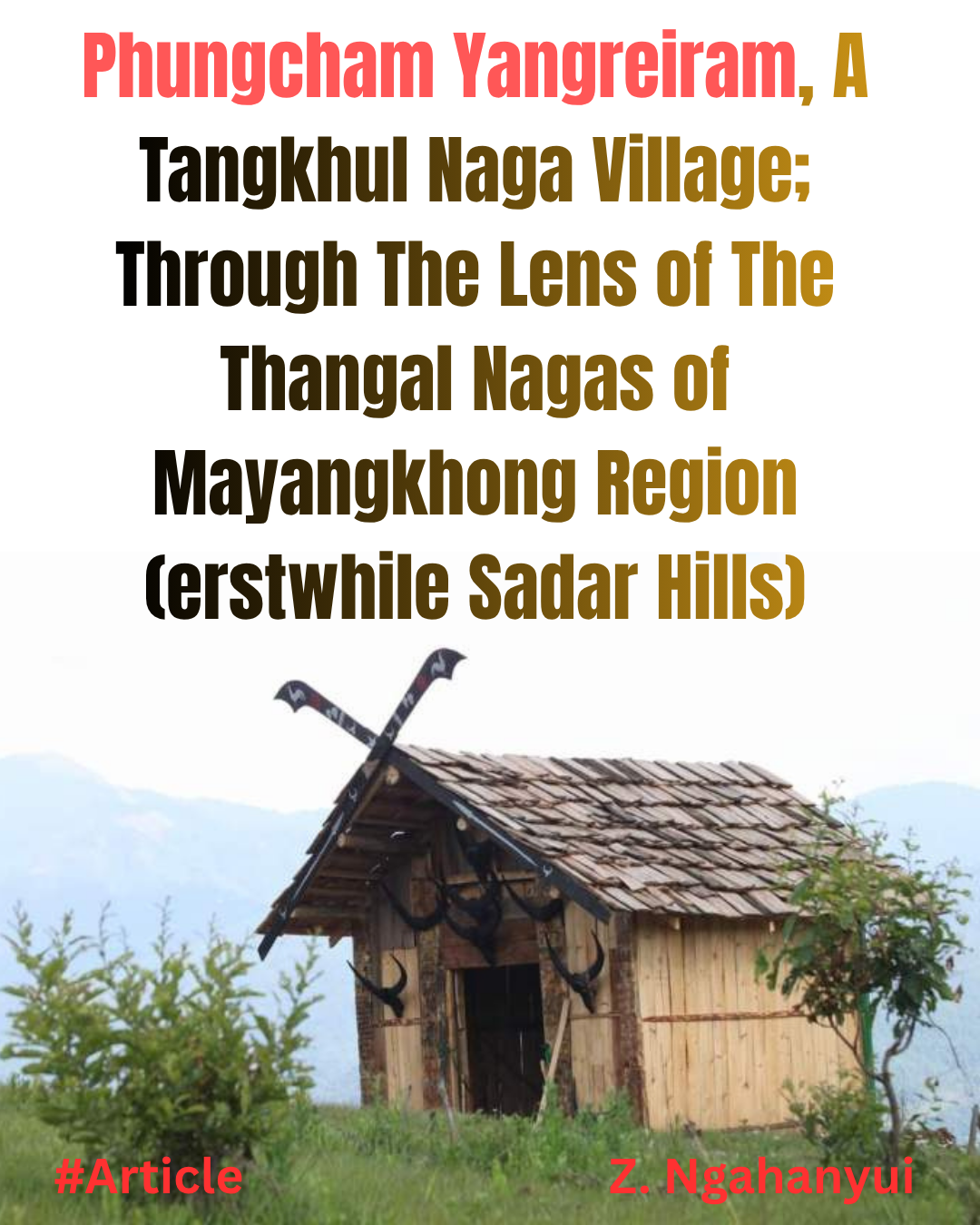

MARANGRA: 19th CENTURY FOLK SONG OF PHUNGCHAM YANGREIRAM
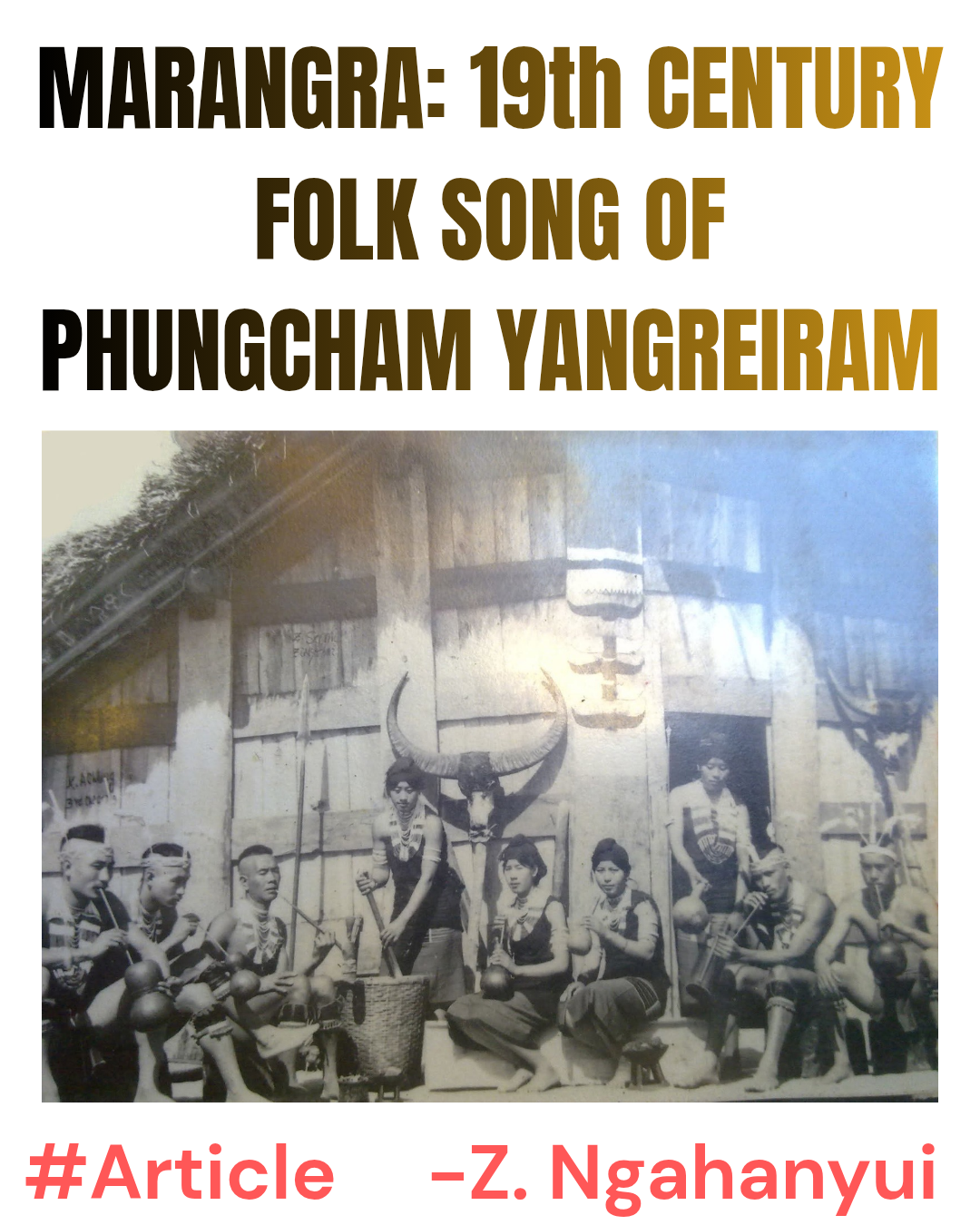
As per the version of the living octogenarians and septuagenarians of Phungcham Yangreiram, this folk song- composed in the Phungcham Village dialect- is approximately 200 years old. The theme of this folk song revolved around the preparations made for war and the declaration thereof, by a Coalition of 9 (nine) major Tangkhul Naga Villages, against, what was popularly believed or conceived to be, the most dominant Tangkhul Naga Village of the time, i.e. Phungcham Yangreiram.
The aforementioned war-coalition consisted of the following nine (9) Tangkhul Naga villages: Kuirei, Kanhang (Kalhang), Longpi, Lungher (Lunghar), Shiron- Langdang (Shiroi & Langdang), Hapum (Hundung/Hungpung), Afan (Hunphun/Ukhrul, basically, Kasom Tang & Luiyainao Tang), Ngaingiu (Ngainga), and Harang (Halang).
The chief reason for the formation of the abovementioned war coalition against the lone village of Phungcham Yangreiram was on account of the unilateral admission/induction of Paoyi village (modern Peh village) into the Leingaphu-Long (Smaller version or microcosm of modern day Tangkhul Naga Long), by the former, without prior consultation with the other nine (9) Villages.
From a few selected words of the song, it can be concluded that the citizens of Phungcham Yangreiram exuded confidence to take on the coalition, though the expression was laced with a tone of condescension;
“Teneichale, teseiramo” (Phungcham dialect)
Zangra chilala, zangshila” (Tangkhul dialect)
“Must you join the coalition, so be it” (English version)
But contrastingly, towards the end of the folk song, a plea was made to the nearest neighbouring or adjacent village of Halang;
“Eitao remkho, eite kharanga-shanlo.” (Phungcham dialect)
“Itao ramkho, ili rangashanlo” (Tangkhul dialect)
“Friendly neighbour, come watch me” (English version)
It was a war prayer to the neighbouring Village of Halang to come and watch the showdown or battle of head-hunting savages, instead of becoming one of the active participants.
PHUNGCHAM YANGREIRAM; THE BIGGEST TANGKHUL NAGA VILLAGE IN THE 17TH CENTURY
In the oral history of Phungcham Yangreiram, the village hosted more than 700 households, but the population was much reduced on account of migration and subsequently, the formation of new Tangkhul villages. A similar pattern was noticed among the Maram Nagas by the British officers in the 19th century AD. According to TC Hodson (page 19, 1911), the total number of houses in the famous Maram Village was reduced from 900 houses in 1859 AD to 200 houses in 1891 within a span of 30 years and to merely 120 houses by 1900 AD. According to Prof TC Hodson, the massive reduction in population of the famous Maram village from 900 houses to 120 houses occurred in less than two generations (41 years from 1859 to 1900 AD).
Population decline was also noticed among the Angami villages, during the British period. According James Johnstone (1886, Manipur and the Naga Hills, page-135 & 145), Angami Villages like Kohima and Viswema had 1200 and 1000 houses in 1879-1880, respectively. However, in less than four decades, the population of Kohima was reduced to merely 700 houses and larger Angami to 400 or more houses by 1921(The Sema Nagas, 1921, page-34). Dr. Henry Hutton (The Sema Nagas, 1921, page 7) wrote that the oldest and the biggest Ao Naga Village of Ungma had 700 houses, whereas, Longsa and Nankam had above 650 houses (The Semas Nagas, 1921, page.34).
The longest serving political agent of Manipur William Mc Culloch (22 years) wrote in his book (1859, page 66-67) that the most powerful Tangkhul/Luhupa Village of Phungcham Yangreiram, subjugated several Tangkhul villages and was feared by his congeners.
Professor Thomas Callan Hodson (1991, The Naga Tribes of Manipur, Page 113 ) wrote that prior to the advent of the British, there was no tribal organisation or combination thereof, among the tribes of Manipur, except among the Luhupas or Tangkhuls. For TC Hodson (1908, The Meitheis, page 74 ), the Luhupas or the Tangkhuls had already existed as an “organised tribe” by the first half of the 15th century(1432 AD), co-terminus with the establishment of the hegemony of the Ningthouja clan in the Imphal Valley, which means, before any Naga tribe or any other tribe in Manipur.
COUNTRY OF THE LUHUPAS: A TERRITORIAL ADMINISTRATION
Professor Thomas Callan Hodson observed that the Manipuris or Meitei Kings divided the Tangkhul country into three territorial administrations or lams; Luhupas, Southern Tangkhuls and the Weaving-villages (The Naga Tribes of Manipur, 1911, Page-84). According to Hodson(page 82, 1911), the six weaving villages of the Tangkhuls were; Talui/Taloi/Tolloi, Ukhrul, Ngaingu, Phadang, Shimtang & Teinem.
Luhupas (or termed as “Loohoopas” by William Mc Culloch, 1859) are those Tangkhul Nagas located in the northern and the north-eastern regions of the Tangkhul country, beyond the territoriality of Hunphun/Ukhrul Village. Whereas, for Maya Gachui (1986), the Luhupas were those who migrated from Phungcham Yangreiram, Dr. Nelson Vashum (December, 2023, Sangai Express) located them to the Tangkhuls of the Yang & Raphei regions and some Tangkhuls of the Kamo region, who migrated from Phungcham.
According to M Horam (Naga Polity, 1975, page 32), Phungcham is derived from two words (“Phung” means place and “cham” means oldest). However, Sochanphy Shimray wrote that ‘Yangreiram” is derived from “three words” of the Phungcham dialect (Yang=King, rei-greatest, & ram-land) and it means, “land of the greatest King.”(Heroes of time, An Ode to legends, page 36, Dr. Sochanphy Shimray & Makanmi Horam). Dr. Sochanphy(2025, page 37) also wrote that during the British Colonial period, Luhupa basically referred to Phungcham Yangreiram.
From a general reading of the Royal Chronicles of Manipur (Cheitharol Kumbaba, Vol. I, II & III, Saroj Nalini Arambam Parratt) and for all practical purposes, it can be concluded that the Tangkhuls in the Somrah tract or the Somrah basin were not included in the category of the Loohoopas or Luhupas, because, the Somrah Tangkhuls remained outside the pre-British conception of the geographical extent of Manipur kingdom, especially the period immediately preceding the arrival of the British in 1832 AD (Lt. Pemberton & Captain Grant). In other words, Tangkhuls of the Somrah tract, were not administered by the kings of Manipur and they did not directly come under the British administration of the Political Agent of Manipur.
LUHUPA/LOOHOOPA COUNTRY; LOCATED NORTH OF UKHRUL/HUNPHUN VILLAGE.
In the British geographical conception, the country of the Tangkhuls located north of Ukhrul village is the land of the Luhupas/Loohoopas. The term “Luhupa” is derived from the Manipuri word “Luhup”(head covering or hat or a peculiar helmet-shaped complicated head dress) and it also referred to the more savage section of the Tangkhuls(page 37, Dr Brown, 1873). Ukhrul/Hunphun village falls outside the category of the Luhupas, as categorised/classified even by the Kings of Manipur or Royal Chronicles.
In the manner that the Meitei or Ningthouja Kings do not indulge in some economic activities undertaken by the Loi-Chakpa population of the valley(The Meitheis, TC Hodson, 1908), the Luhupas do not undertake a few economic activities, but indulge only in warring and hunting expeditions, just like the Ningthouja clan of the Meiteis :
1)Mc Culloch, the longest serving Political Agent of Manipur (1840-1867, 1859, page ) and TC Hodson (1911, page 47) wrote that the Luhupas do not weave or do not manufacture clothes. According to them, “it was the boast of the Luhupas that their women did not weave cloth, because their subject villages kept them sufficiently supplied.”
According to TC Hodson (1991, page 47), weaving was like a “tabu which a prominent tribe or caste places upon the crafts and arts of a conquered tribe.”
Exactly in the manner that the Meitei or Ningthouja Kings do not indulge in some economic activities undertaken by the Loi-Chakpa population of the valley(TC Hodson, The Meitheis, 1908), the Luhupas do not indulge in the art of weaving. And like the Ningthouja clan of the Meiteis, Luhupa men only indulge in hunting & warring expeditions.
TC Hodson(1911, page 45) and James Johnstone (1886, page 146) had written that Ukhrul (Hunphun) Village was a major cloth-weaving Tangkhul village in the 19th century AD.
2)According to Dr. Henry Hutton (The Angami Nagas, 1921, page-66), the Luhupas are known for the “Cockscomb” head (“Hao-Kuirat” in the Tangkhul dialect) or the “Coiffure” (TC Hodson page 28, 1911). According to TC Hodson (1911, page 28), “no other tribe within the territory of Manipur state has hit on the style of coiffure adopted by the Tangkhuls.”
TC Hodson (1911, page-27) further continued that “the distinctive method of coiffure was invented to obviate the difficulty of distinguishing between the sexes among the Marings,” and in the past, the Tangkhuls of Ukhrul Village, including its Chief, designed or styled their heads like the Maring Nagas.
There is a common Tangkhul Naga Folklore/folk Song attributed to the courtship between the Chief of Ukhrul village and the princess of Lunghar Village. The Chief of Ukhrul village had to relinquish/abandon his Maring Naga style head-dress, re-style his head like the “Cockscomb” or “Coiffure” of the Luhupas, when the Lunghar Princess initially rebuked the former for having styled his hair like a woman.
This can be corroborated by the migration route of the Tangkhuls of Ukhrul Village from the south to the north (page 8, TC Hodson, 1911). According to TC Hodson (1911, page 15), some sections of the Maring Nagas were first settled in Habum Maruk & Laisangkhong, before they shifted to the present Tengnoupal area. These two places in the Imphal valley (Haubum Maruk & Leisang Khong), originally identified with some sections of Maring Nagas, have also been mentioned in the book written by Dr. Brown (Dr. Brown, 1873, page 43). The former place-Haobum Maruk-has also been identified with the Tangkhuls of Ukhrul Village, prior to their ascend to the Hills (Dr. Nelson Vashum, December 2023, Sangai Express).
The Tangkhuls of the Western & the Northern regions, including the Meitheis/Ningthouja clan, Angamis, Semas, Lothas, Poumais, Chakhesang, Rengmas, Mao, Maram and Thangals traversed or migrated through Makhel, but the Tangkhuls of Ukhrul Village (and some other Tangkhul villages), did not migrate through Makhel or Maikhel, but traversed directly from Imphal Valley to Ukhrul Village via Shokvao and Nungsangkong.
3)According to TC Hodson (1911, page 31), the Luhupa/Loohoopa women were tattooed and were greatly sought after by Tangkhuls of the South. Mc Culloch (1859, page 68) wrote that “a tatooed woman always go unscathed, for fear of the dire vengeance which would be exacted by her northern relations were she injured giving her this immunity.”
Captain Pemberton (1835, page 17) hinted that the Tangkhuls must have learnt this art from the Khyens/Kachin tribesmen (Kachin state) and the Karenni people (Kayin-Kayah region of Burma).
For TC Hodson (page 30, 1911), tattooing was an art practiced by the Tangkhuls only of the extreme north and the eastern regions in the 19th century AD and he concluded that the Tangkhuls must have learnt this art from either the Burmese or the Sans, “who, at various times in history of Manipur must have marched through the country” occupied by the Tangkhuls.
It may be brought to light that the Konyak Nagas(The Naked Nagas, Von Furer Haimendorf, 1939) and the Ao Nagas of Nagaland(JP Mills, The Ao Nagas, 1926) also tattooed their women, but the Angamis and Semas do not adopt this practice (Dr. Hutton, 1921).
4)According to Dr. M Horam (Naga Polity, 1970, page- 32.42) and AS. W Shimray (2001), the Ningthouja dynasty rulers are the descendants of the Luhupas or the northern Tangkhuls.
The Meiteis or the Ningthouja clan first arrived at Makhel village (Senapati), then settled down at the first Tangkhul Naga settlement/Village of Phungcham Village and subsequently marched towards Hundung (Hungpung). This is the route of migration of the Tangkhuls of the Zimik Clan, from which sprung the Ningthaja/Ningthouja Clan of the Meitheis.
Dr. Nelson Vashum concluded that the Ningthouja dynasty rulers of the Meiteis are the descendants of the Luhupas, referring to the Tangkhuls that traversed through the Phungcham-Hungpung migratory route (The Sangai Express, 06, November, 2023). This conclusion has been fairly established by reading of several British accounts and Monographs (TC, Hodson, The Meitheis-1908, Mc Culloch-1859, Dr. Brown-1873, James Johnstone-1886, and TC Hodson-1911).
According to Dr. M Horam (Page 30 & 42, Naga Polity, 1970), the Meiteis or the Ningthouja clan first settled at Makhel, like most of the major Naga Tribes, then migrated to “Phungcham Yangreiram” and finally arrived at Hungpung/Hundung, before its southward descend to Yaingangpokpi and Kangla (Imphal Valley).
This has also been corroborated by my interviews with the Chief of the Zimik clan of Phungcham (Yangreiram), current Chief of Hungpung (Hundung) and the Meitei King.
On the other hand, unlike the Luhupas/Loohoopas, the Tangkhuls of Shokvao and Ukhrul Villages-not necessarily limited these two major and important Tangkhul villages-migrated from the opposite direction, i.e. from the south (Imphal Valley) to the northern hills (Ukhrul).
LEGENDS OF KHONOMA AND PHUNGCHAM YANGREIRAM
Dr. Visier Sanyu (History of Nagas and Nagaland, Ph. D Thesis, 1987, page-80. 81) wrote that the political ascendance or rise of Khonoma vis-à-vis neighbouring Angami or “Tegima” villages in the Angami country was marked by the rise of legendary tales, associated with legendary historical figures of the village; Yalie, Meruno, Pelhu, Pukahie and Saruu. Visier Sanyu (page 80, 1995) also wrote that Khonoma was the first village in the Angami country that successfully “built up a kind of state apparatus without dissolving the indigenous organisation.”
Likewise, according to historians of Manipur and British anthropologists, Mc Culloch (1859) included, the epicentre of the Luhupa Country was Phungcham Yangreiram, which, according to him, subjugated several Tangkhul Villages. According to former headmen and current headman of Phungcham Yangreiram, the village was the first halting ground/original settlement of seventeen (17) Principal Tangkhul Naga Clans (including Shingnaisui, Ragui & Kasom Clans of Hunphun/Ukhrul Village), with marked original territories, within the precinct of the Village boundaries.
Similarly, Dr. Sochanphy Shimray, a native of Chingjaroi village, had written about the rise of few legends-within the Tangkhul Naga cultural context- from Phungcham Yangreiram, who became household names among the Tangkhuls; Shimreishang/ “Ashang, scion of the Zimik Chief’s household,” the guileful trickster Lengthui Farem, popularly known for his skill-full romantic exploits (Echoes of time, An ode to legends, 2025, page 13-20).
Z. Ngahanyui
N B: The Author is a Doctoral student from Phungcham Village. He can be reached at: zimikayui@gmail.com