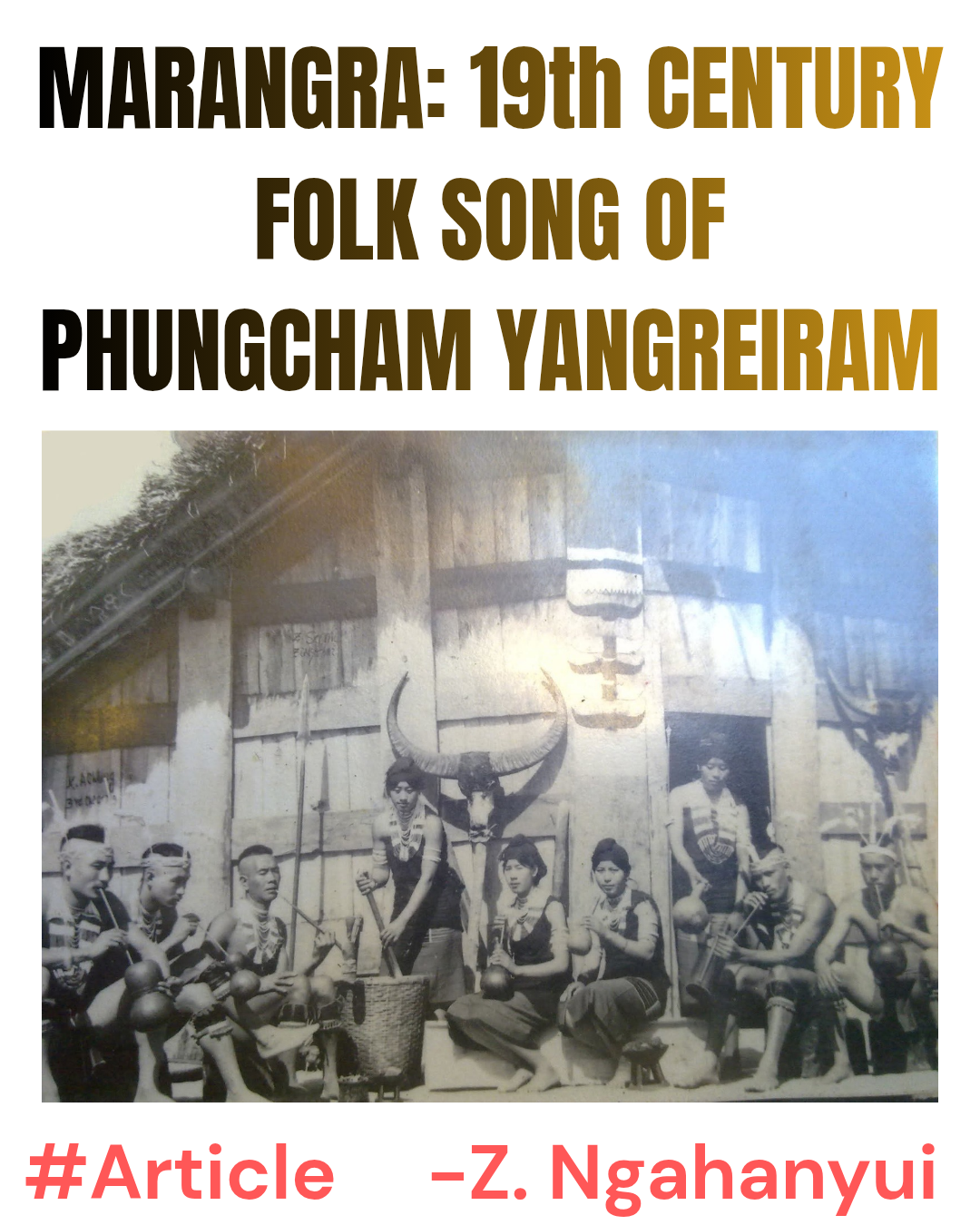

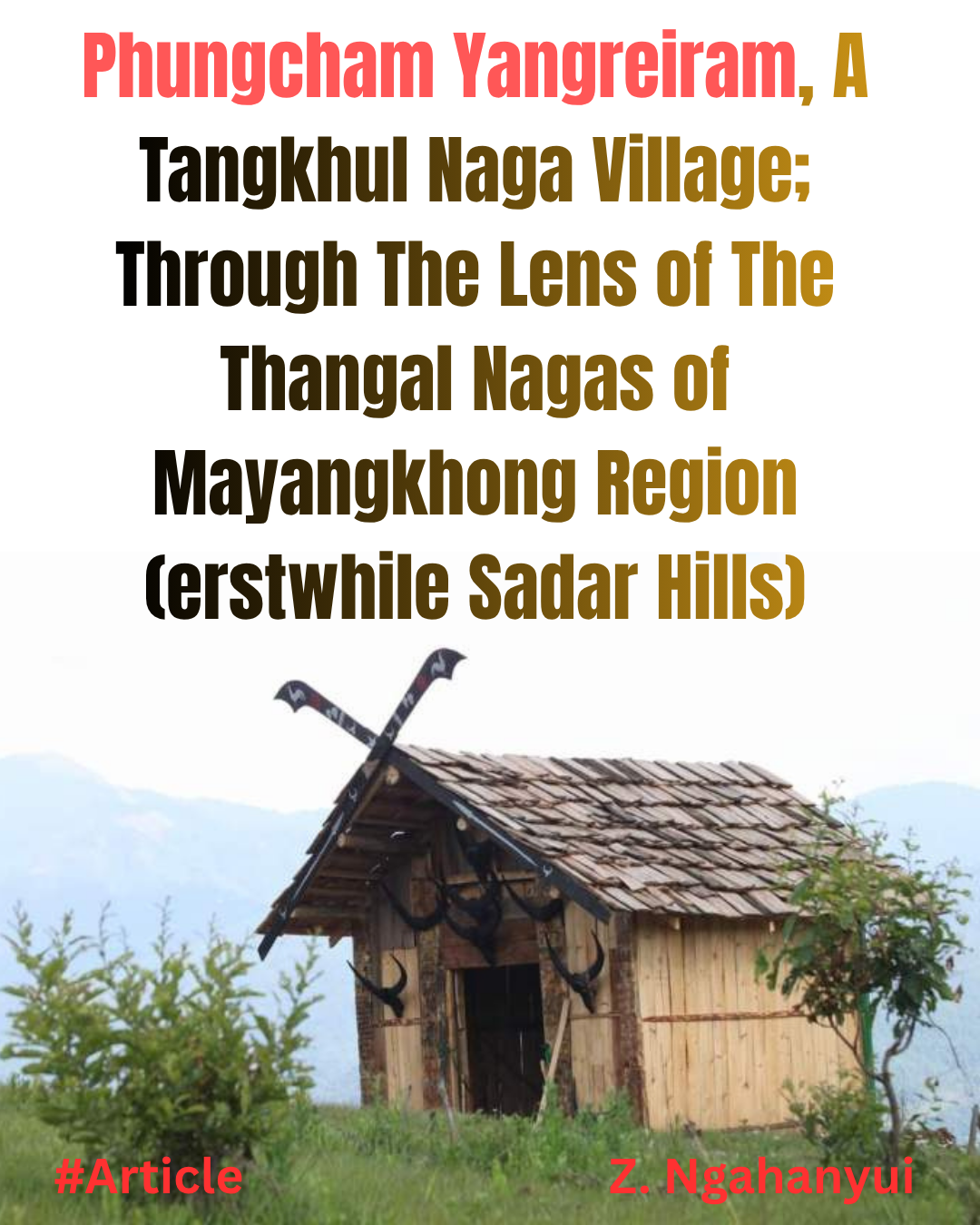
Phungcham Yangreiram, A Tangkhul Naga Village; Through The Lens of The Thangal Nagas of Mayangkhong Region (erstwhile Sadar Hills)
This folk song was composed in the Thangal Naga dialect and in honour of Ngavaophung Farem, then Headman of Phungcham Yangreiram, by the Thangal Nagas (erstwhile Koirao tribe) who were then settled in the Mayangkhong region of Kangpokpi district (erstwhile SADAR hills) and the song is almost a century old folk song.
“Dafairem, Dafairem, Shaiyu rateya
Ameiphungwo Shaiyu rateye…
Ameiphung, Khayakashiyo…
Amei Phung Pemkhong chikaro…
Pemkhong chikaro, Ameiphung…
Matepemrengye, Ameiphung….
Dafairem, Dafairem, Rapuk ngahorye.”
ROUGH TRANSLATION OF THE TEXT FROM THANGAL-PHUNGCHAM TO ENGLISH:
“Dafairem,” the name given by the people of Phungcham for Mayangkhong region.
Ngavaophung, headman of Phungcham, was addressed as “Amei”/ “elder brother” (Ameiphung), by the Thangal Nagas.
“Shaiyu rateye”, means entitlement of Ameiphung for the share of tribute from the Thangal Nagas.
“Khayakashiyo”, would mean the “respected one” (Ameiphung).
“Pemkhong Chikaro”, means to vacate/empty the seat for Ameiphung.
“Matepemrengye” would imply the nervousness/unease to be seated next to Ameiphung.
“Rapuk ngahorye”, a huge crowd of Thangal Nagas gathered to pay homage to Ameiphung.
REVIEW OF EXISTING LITERATURE ON THE HISTORY OF THE THANGAL NAGAS AND THE TANGKHULS OF PHUNGCHAM YANGREIRAM:
Three Manipuri Scholars (Arundhati Maibam, Manoranjan Maibam and Bojen Akoijam) wrote that the Tangkhuls, Thangals and Meiteis (Ningthouja dynasty or the Royal Family of the Meiteis) were all “blood-brothers” who descended from the same male progenitor ( IJHSS, Vol. II, No.8, 2017).
The aforementioned three Manipuri/Meitei Scholars have also studied on the myths of Thangal Naga origin from an anthropological perspective and wrote that the Thangal Nagas also migrated from Makhel Village, just like other major Naga tribes; Chakhesang, Tangkhuls, Angamis, Semas, Maram, Poumai, Rengmas etc. This blood-brotherhood of the founding clan of Thangal Surung village, the Chief of Hungpung Village which migrated from Phungcham Yangreiram and the Meitei King has been affirmed by the clan genealogy of all the three clans, including the Ningthouja Clan genealogy.
Along similar lines, Professor Dr. Horam (Naga Polity, 1970, page-32, 42) had also written that the Tangkhuls of the Western and the Northern Regions and the Meiteis/Ningthouja clan both, first arrived at Phungcham Village, after their departure from Makhel and according to him, Phungcham was the earliest Tangkhul Naga Settlement and the same conclusion was arrived at by RR Shimray(Origin and Culture of the Nagas, 1985).
Dr. Horam further wrote that the Meitheis (Ningthouja Dynasty) and the Tangkhuls first arrived at Phungcham and then, reached Hundung/Hungpung Village. The Meiteis moved further south towards Imphal Valley. This has also been Corroborated by the Oral history of the Zimik Clan of the Tangkhuls in the major villages (Shangshak Phunghon, Ramva/Lambui, Sirarakhong, Phungcham Yangreiram etc.), oral history shared by the current Headman of Hungpung/Hundung Mr. AS Peter Zimik and the former Headman of the same village Lt. AS Wungnaoyo Zimik and, as recorded by AS.W Shimray (The Tangkhul Nagas, Ph. D Thesis, 2001, page-49. 54).
NATURE, DURATION AND THE TYPE OF TRIBUTE COLLECTED:
Dr. Sochanphy Shimray mentioned about two kinds of Tributes or “Shai” in Phungcham dialect; “Chinaoshai” & “Pangpumshai”, which were exacted from the Thangal Nagas of erstwhile SADAR Hills. She concluded that the former was a “form of intra-clan tribute exchanged among members of the same lineage group across different settlements”, whereas, the latter would mean “tribute offered in exchanged for protection or safeguarding.”( 2025, Echoes of time, An Ode to Legends, page-40-44).
Prof. Arundhati Maibam Devi (2017, International Journal of Humanities and Social Sciences) wrote that even though the Thangal Naga clans were at Angakailongdi Kanakpa, “they deserted and returned back to Angkailongdi seven times, following frequent raids of Phongkam Tangkhuls.”
From Google Mapping, it can be gauged that the approximate distance between Phungcham to Mayangkhong is 150 Kilometres (Phungcham to Ukhrul is 28 KMs).
It may be also brought to light that in the Royal Chronicles and the British documents/records (TC Hodson, 1911 and EW Dun, 1886), Phungcham village was recorded as “Phungam/Phunggam/Phungkam” and this biggest northern Tangkhul village, constituted one of the four biggest Tangkhul Naga Villages of Manipur in the latter part of the 19th century AD, along side Ukhrul/Hunphun, Talui/Taloi and Hundung/Hungpung Villages(EW Dun, Gazetteer of Manipur, 1886).
The Collection of this “Shai” or “Tribute” by the Clans of Phungcham Yangreiram, ceased as per the order of the then SDO of Ukhrul Mr. L L Peters in 1929 (Dr.Sochanphy Shimray and Makanmi Horam), because of which, Ngavaophung Farem, then Headman of Phungcham, decided to name his daughter as “Shaivila”, signifying the end of Shai or tribute collection.
In the words of Dr. Sochanphy (2025, page 43), Shaivila, “was a symbolic reconstruction derived from Shai (the tribute), vi (termination or cessation), and la (a suffix associated with feminity).”
Tharmi Vashum, an octogenarian Chief of the Vashum Clan of Phungcham Yangreiram, revealed to this Author that three Clans of Phungcham Yangreiram, namely; Zimik, Horam and Vashum, collected Tributes from the Mayangkhong Region/Thangal Nagas, from the latter half of the 19th century AD. And in the words of Makanmi Horam, the former Headman of Phungcham Yangreiram, this tribute collection began in the second half of the 19th century, round about 1860 AD. ‘
GEOGRAPHICAL-DISTANCE BETWEEN SADAR HILLS/MAYANGKHONG REGION/ “DAFAIREM” VIS-À-VIS PHUNGCHAM YANGREIRAM
Prof. Arundhati Maibam (2017) wrote that the Thangal Nagas are often referred to as the “Thangkaimi” (meaning southern most people) by the northern Naga tribes (Angamis, Tangkhuls, Maos, Poumais, Maram etc).
This southern territorial extremity of the Thangal Nagas is only with respect to the Central belt of the geography of Manipur, because, immediately south of the Thangal Territory, begins the land of the Qoireng Nagas and the Meitei/Manipuri settlements.
However, the ascertainment of the southern extremity of the “Thangkaimi” territory does not in any way refer to the entire/whole geographical territory of the Nagas in Manipur, but only with respect to the Central valley of Manipur. Because, several Naga tribes were (eg. Zeliangrong Nagas, Inpui Nagas, Maring Nagas, Anal Naga etc. ), for centuries, settled far beyond the Latitudinal line of the lands occupied by the Thangal Nagas, far south of the old government/Aqui Road, especially, along and beyond the eastern and western geographical flanks of the Central Valley of Manipur.
According to Captain Pemberton (Report on the Eastern Frontier of British India, 1835, page 17), who was the first British officer to set foot on the Naga soil and Manipur, the various Naga tribes who are located north, east and west of the central valley, “partake strongly of the characteristics of Tatar Countenance” and this was in contrast with the tribes or Kookies of the south; “occupying the southern borders of Manipur territory.”
Captain Pemberton was implying there were no Kookies settled in the hills, located to the North, East and West part of the central Valley of Manipur, when his report was compiled in 1835. EW Dun (Gazetteer of Manipur, 1886, page 34) also surmised that the northward movement or migration of the Hawkip or Chassad Kukis, “who left their old home to the south of the valley of Manipur”, transpired 10 and 20 years ago, before the compilation of his Book on Manipur in 1886.
PHUNGCHAM YANGREIRAM (TANGKHUL NAGA) VIS-A-VIS KHONOMA (ANGAMI NAGA) :
William MC Culloch (1859, Page-66-88) hinted that Phungcham Village was the most powerful Tangkhul Naga Village of Manipur around that time. Mc Culloch served in the State of Manipur for record 27 years (1840 to 1867) and 21 and ½ years as the Political Agent of the state. He referred to one Luhupa/northern Tangkhul Village that subjugated many Tangkhul Naga Villages.
For Mc Culloch (1859, page-66), the Luhupas constituted “the fiercest of the tribe in the region”, which included the Angami Hills territory. It may be brought to light that the powerful Angami Village of Kohima was conquered by Maharaja Gambhir Singh in 1832-33 AD, and since then, the Angami Nagas were included in most of the British population and geographical surveys of Manipur(Johnstone 1886, Brown 1873, EW Dun 1886, Mc Culloch 1859 etc ).
Likewise, according to historians of Manipur and British anthropologists, Mc Culloch (1859) included, the epicentre of the Luhupa Country was Phungcham Yangreiram, which, according to the latter, subjugated several Tangkhul Villages.
Dr. TC Hodson (1908, page -74) also recorded that the Luhupas or the Northern Tangkhuls had already existed as an “Organised tribe” as early as the 15th century AD, long before any Naga Tribe or any other tribe in Manipur. Phungcham Village was the epicentre of this Tribal organisation in the 15th Century AD, and MC Culloch wrote that the Luhupas or the Northern Tangkhuls subjugated the whole of the Tangkhuls.
On the origin of the Nagas in Manipur, Professor Irene Salam (Manipur University) had written / discussed about the other half of the Naga mythological- pot(divided by the two Naga groups in Burma ; Phompying Township group and Kabaw Valley group), being in the Custody of one Ngazek Horam of Phungcham Village (International Relations and Diplomacy, May 2020 Vol.8. No.5, 213-219).
“ANGAMI PAR EXCELLENCE”
Dr. Henry Hutton(1921, page-15), the Deputy Commissioner of Naga Hills district in 1921, who later became Professor of Social anthropology at the prestigious University of Cambridge after his retirement from the ICS, recorded that the Khonoma group of Angamis constituted “Angami Par Excellence.”
Through Google mapping, the rough distance between Khonoma and Peren district (ancestral land of the Zeliang Nagas) of Nagaland, is approximately 100 KMs. It may be reiterated that the geographical distance between Phungcham Yangreiram and Mayangkhong is approximately 150 Kilometers.
Dr. Visier Sanyu (The history of Nagas and Nagaland, 1987 Ph. D Thesis) highlighted that the Angamis of Khonoma were equated with the “Storm or the Hurricane” by the Zeliang Nagas, prior to the advent of the British Sarkar. Khonoma Angamis subjugated many Zeliang Naga Villages and because of this reason, a few clans of the Zeliang Naga Villages even adopted the names of Clans from Khonoma (Dr. Hutton, 1921).
Dr. Henry Hutton (The Angami Nagas, 1921, page 11) observed that” before the coming of the “Sarkar” no Angamis enjoyed such prestige or levied such widespread tribute as Khonoma.”
Z. Ngahanyui
The Author is a doctoral student. He may be contacted at : zimikayui@gmail.com