
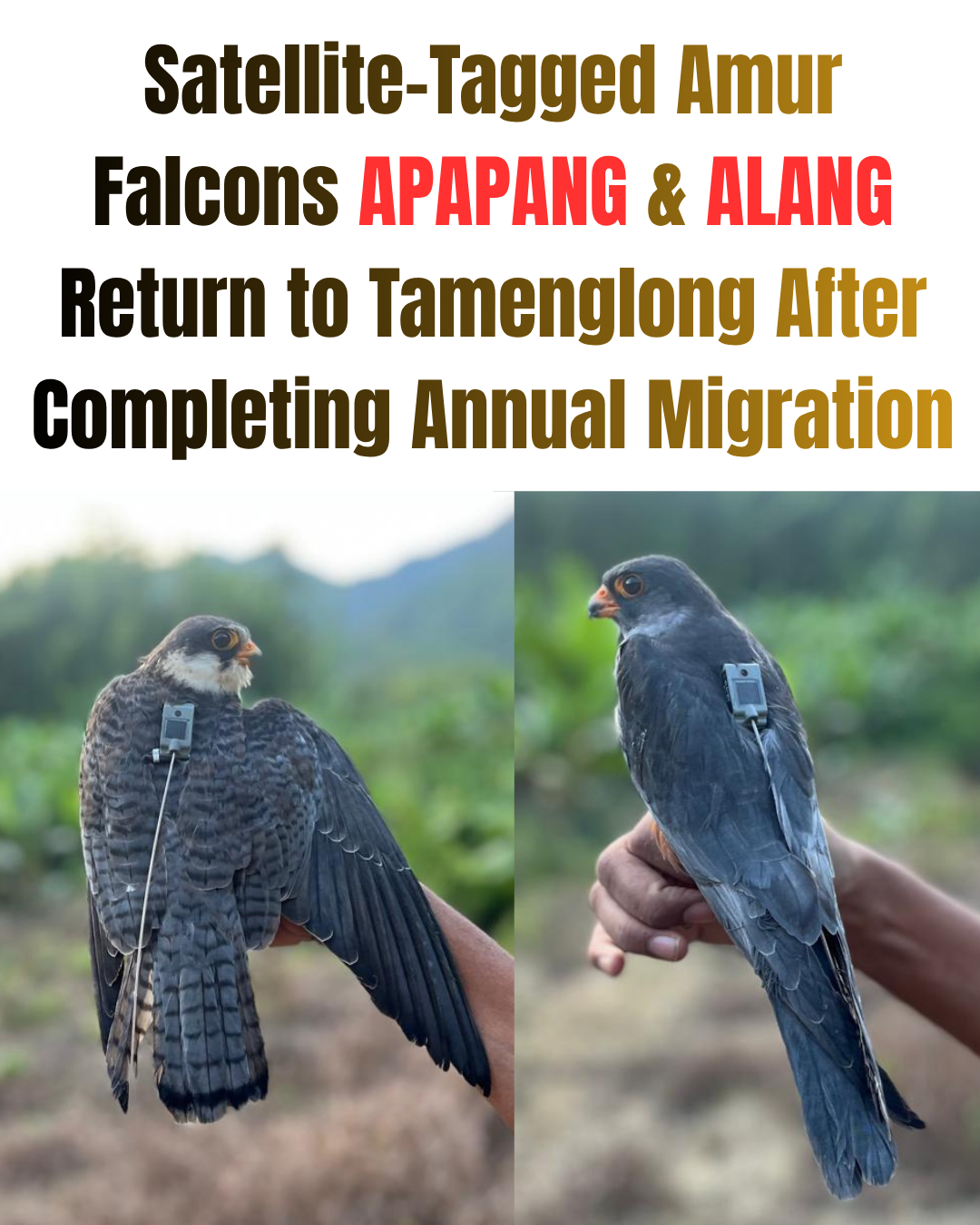
Two satellite-tagged Amur Falcons, named Apapang and Alang, returned to Tamenglong district on October 22 after completing their annual migratory journey, marking a significant milestone in wildlife conservation efforts in Manipur.
The return of the two migratory birds highlights the importance of scientific research, satellite tracking and community participation in protecting the Amur Falcon, a long-distance migratory raptor that travels between its breeding grounds in eastern Asia and non-breeding grounds in southern Africa.
According to the Tamenglong Forest Division, the successful return of Apapang and Alang provides valuable information about the birds’ migratory routes and movement patterns, strengthening ongoing efforts to conserve the species and protect its habitats.
Divisional Forest Officer (DFO), Tamenglong Forest Division, Amit Kaler, IFS, expressed happiness over the return of the birds and described it as an encouraging achievement for the conservation movement in the district.
Union Minister for Environment, Forest and Climate Change Bhupender Yadav also acknowledged the successful return of the two satellite-tagged Amur Falcons in a social media post on October 23. The birds are expected to remain in Tamenglong for two to three weeks before continuing their migration, according to the press release.
The DFO appreciated the scientific contribution of Dr Suresh Kumar, a scientist at the Wildlife Institute of India (WII), for his role in advancing research and understanding of the Amur Falcon. He also acknowledged the contributions of former officers and staff of the Tamenglong Forest Division, whose initiatives laid the foundation for the conservation programme.
The Forest Division further appreciated Rainforest Club Tamenglong, other civil society organisations, and the village authorities and residents of Chiuluan, Khangchiuluan, Guangram, Puching, Matung and Phalong, among others, for their cooperation and community-level support.
The Amur Falcon plays an important ecological role by feeding on insects, including locusts and termites, helping regulate natural pest populations and maintain ecological balance. Its migration across continents also underscores the need for international cooperation in wildlife conservation.
Emphasising the importance of protecting the species, the DFO cautioned that illegal hunting, trapping, capture, possession or trade of Amur Falcons would invite strict legal action under the applicable provisions of the Wild Life (Protection) Act, 1972, as amended.
The Tamenglong Forest Division appealed to village authorities, civil society organisations, student bodies, youth clubs, educational institutions, security agencies and the public to strengthen their commitment to protecting the migratory birds.
The return of Apapang and Alang has further highlighted Tamenglong’s growing significance in Amur Falcon conservation and the role of local communities in safeguarding the region’s rich biodiversity.