
You notice it first as a small inconvenience. The library table where you once read for hours now carries a discreet sign about sharing space and supporting the café. The park bench that faced the afternoon light has disappeared to make room for a seasonal market stall. The corner café where you could sit with one coffee through an entire conversation has rearranged its tables for faster turnover and begun charging for Wi-Fi that used to be free. None of these changes feels dramatic on its own. Taken together, they reveal something larger: the steady disappearance of places where people can spend time without being expected to spend money.
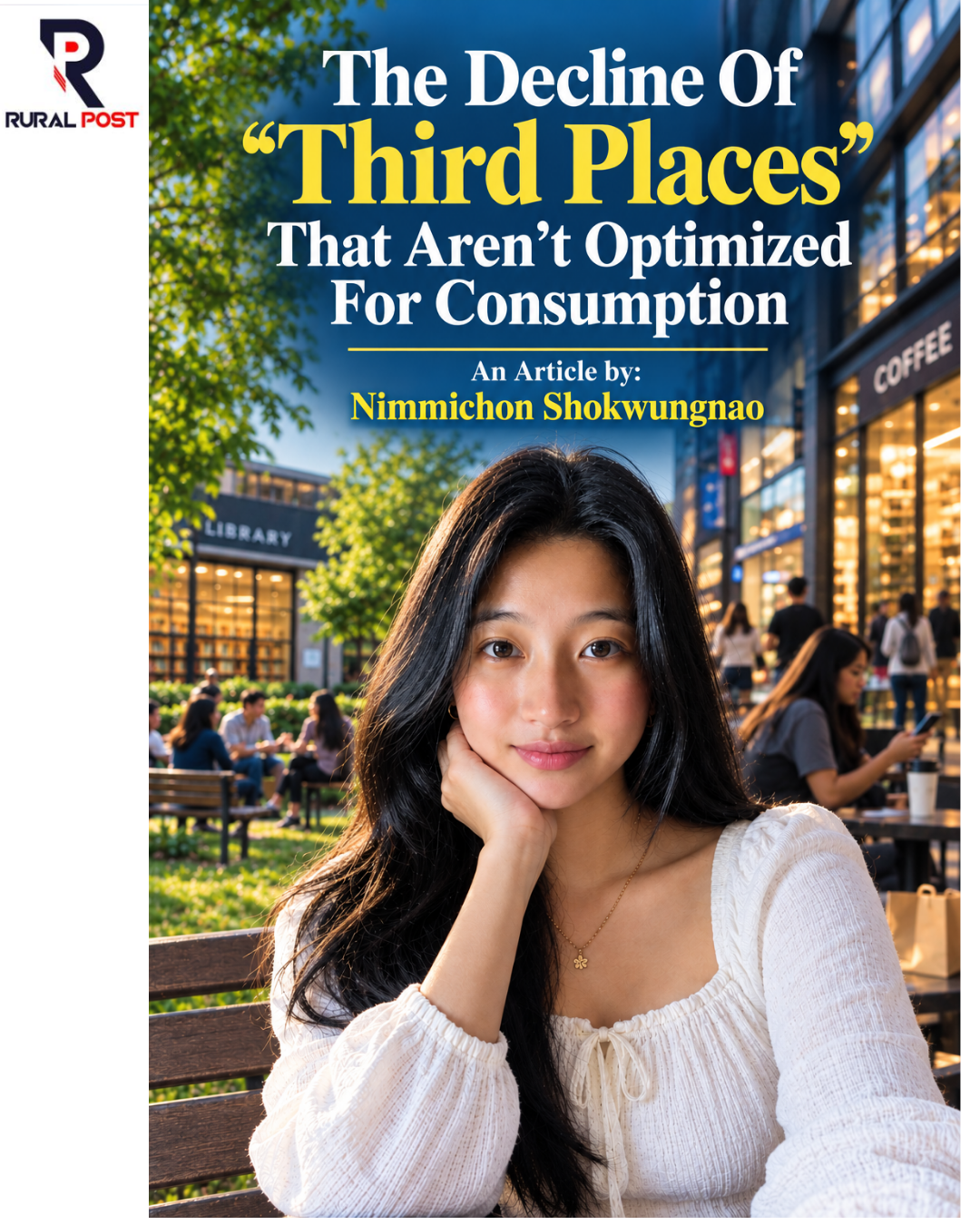
These places are often called “third places.” The first place is home. The second is work or school. A third place is somewhere outside both where people can gather informally: a library, park, café, community centre, neighbourhood shop, religious hall, public square or even a familiar bench. Its importance comes from its openness. You can meet someone there, sit alone, read, talk, wait, watch people or simply pass an hour. You do not need a formal invitation, membership or a large budget to belong there.
That simple freedom is becoming harder to find.
Look closely at many cities and the pattern becomes visible. Libraries increasingly introduce cafés, paid services or revenue generating activities into spaces that were once designed primarily for free public use. Parks fill open areas with ticketed events, food concessions and programmed activities. Cafés redesign their interiors for faster customer turnover and sometimes discourage people from occupying tables for long periods after making a purchase. Public steps, shopping-centre seating and other informal places to rest are removed, reduced or designed in ways that make lingering uncomfortable.
Each decision may have a practical explanation. Together, they create a different kind of city: one in which almost every comfortable place to sit, meet or spend time has an economic purpose.
The forces behind this change are larger than simple greed. Urban land is expensive. Commercial rents are high. Public institutions often struggle with inadequate funding.
Businesses need revenue to survive. City planners want lively streets and active public spaces. Events, cafés, markets and commercial activities can make places attractive and useful.
The problem begins when commercial value becomes the dominant measure of social value.
Commercialisation becomes deeply influential when every space is expected to earn, every activity is expected to attract spending and every moment of public life is expected to produce a return. Things that cannot be easily monetised begin to receive less attention. Conversation, reflection, community and simple human presence become difficult to defend because their value cannot be counted in money.
A space can be full of people buying things and still provide little room for people who simply want to be there. A park can host a successful event and have fewer quiet corners for someone who wants to sit alone. A library can contain a café and generate additional income while gradually losing the feeling that anyone can stay for hours without spending anything.
Third places perform a social function that commercial transactions cannot replace.
They create what sociologists often describe as weak social ties: the small, repeated encounters that make strangers familiar. You see the same person reading the newspaper every morning. You recognise the student who studies in the same corner. You exchange a few words with the shopkeeper. You see parents, elderly people, workers and young people occupying the same space. You may never become friends with any of them. Their repeated presence gives the neighbourhood familiarity and continuity.
This kind of belonging is easy to overlook because almost nothing dramatic happens.
That is precisely its value.
Third places allow people to be around others without having to perform a particular role. At home, you are a family member. At work, you are an employee, employer or professional. In a shop or restaurant, you are a customer. In a third place, you can simply be a person sitting among other people.
You can be alone without being isolated.
You can meet someone without making an appointment.
You can have a conversation without watching the clock.
You can spend an afternoon without buying anything.
These small freedoms create the ordinary social fabric of a community.
They also create conditions for thinking..
Thinking requires time, quiet, observation and curiosity. A library, park bench, reading room or ordinary café can provide that breathing space. A person sitting alone with a book may appear inactive. Inside that quiet moment, the person may be reading, reflecting, forming an opinion, questioning an idea or allowing the mind to wander.
A society needs spaces where people can exchange ideas.
This question has particular relevance to Naga society. Naga communities have strong traditions of oral knowledge, community interaction and collective discussion. Opportunities for sustained intellectual exchange can still be limited. Genuine debates about the world, the state, society and human affairs receive relatively little space in everyday public life. Conversations frequently centre on immediate personal concerns, personalities, affiliations and practical matters. People have fewer opportunities to sit together for long periods, examine ideas, challenge assumptions, listen to opposing views and think aloud about the larger forces shaping their lives.
That habit matters.
People need places where they can sit together and discuss what is happening in the world, what is happening in their state, how their society is changing and what it means to be human. Such conversations do not need an immediate practical outcome. Their value lies in the process of thinking together.
Without a culture of conversation, a society can have educated people without developing a strong culture of independent thought.
The danger of a “dumb society” lies in the gradual loss of curiosity, questioning and reflection. People can become accustomed to receiving opinions instead of examining them. Easy narratives can become more attractive than difficult questions. Constant entertainment can leave little time for contemplation. A society that stops making room for thought becomes increasingly vulnerable to shallow opinions and unquestioned assumptions.
When third places disappear, public life also becomes increasingly dependent on the ability to pay. People with money can purchase comfortable versions of social life: restaurants, private clubs, premium cafés, coworking spaces and other places designed for prolonged stays. People with less money have fewer comfortable options. Free spaces may be crowded, poorly maintained, heavily regulated or increasingly unavailable.
This changes who gets to occupy public life comfortably.
Digital life has made withdrawal from public space easier. Remote work has reduced some everyday encounters. Phones provide endless entertainment. Food, groceries and other necessities can be delivered to the door. Social interaction can happen through screens. These developments can be useful and convenient. They also reduce some of the ordinary reasons people once had to leave home and encounter other people by chance.
The result is a strange possibility: a city can remain crowded, entertained and commercially successful while becoming less socially connected and less reflective.
Yet the idea of a free, non-commercial public space has not disappeared. Maharashtra offers a useful example. The state has an established public-library system, with government libraries and recognised public libraries across the state. The Directorate of Libraries provides free reading and study facilities for students, readers and researchers, and its public-library framework provides for libraries to be available for free use by the local public during working hours.
Mumbai and Pune show how this principle survives inside major, commercially active cities. Mumbai’s State Central Library provides free services to readers, students and researchers, including dedicated study space for students preparing for competitive examinations. Pune also has government library facilities serving readers, students and researchers.
These institutions represent an important civic principle. A person can enter a shared public space to read, study, think or spend time without the primary purpose of the visit being consumption.
Their continued availability is more than a matter of convenience. It is a sign of social maturity. A mature society understands that some spaces exist because people need them. It recognises that human well-being, social connection and intellectual life carry value beyond financial returns.
There are still other places that preserve this principle. Some parks continue to provide benches, shade and open ground where people can stay without buying anything. Community centres, religious halls, mutual-aid spaces and ordinary neighbourhood establishments continue to provide places where people can gather on simple terms.
These places preserve something that economic measurements cannot easily capture.
A bench may produce no revenue and still have enormous public value. A library chair may generate no transaction and still help someone feel that they belong in the city. A person sitting quietly for an hour may contribute nothing to commercial activity while benefiting from being among other human beings. Two people talking for an afternoon may produce no measurable economic output while exchanging ideas that change how each sees the world.
The question is whether every shared space should ultimately be judged by how much money it generates.
A healthy city needs places where people can spend money. It also needs places where they can simply be present.
The availability of such places is a measure of the maturity of a society. A mature society creates room for conversation, solitude, observation, reflection and thought. It protects some spaces from the pressure to turn every moment of human presence into a transaction.
The quality of a society can also be seen in whether its people still make time to think together. Do they sit down to discuss the world? Do they debate what is happening in their state? Do they question the direction of their society? Do they have places where disagreement can happen. without immediately becoming personal? Do they encounter ideas that challenge their own?
These questions matter because a society that stops thinking together gradually loses one of its most important forms of collective intelligence.
The quality of a city is measured by more than its restaurants, shops, offices and entertainment. It is also measured by whether an elderly person can sit somewhere for an afternoon, whether a student can read without being hurried away, whether two friends can talk without ordering another round, whether someone can think without the pressure to consume, and whether a stranger can enter a public space and feel that the space belongs to them too.
The places that ask nothing of us except our presence perform a quiet public service. They create familiarity, chance encounters, reflection, conversation and a sense of shared life.
Perhaps the most important question is therefore a very simple one:
Do we still believe that people have a right to be somewhere without having to buy something?
If we do, then the last free chair is worth protecting.
Because once every chair has a price, we may discover that we have made our cities commercially successful while making them less capable of feeling like home, and less capable of giving their people the time and space to think.
Nimmichon Shokwungnao
BA VII Semester
Political Science Department
ST. Joseph College, Ukhrul