
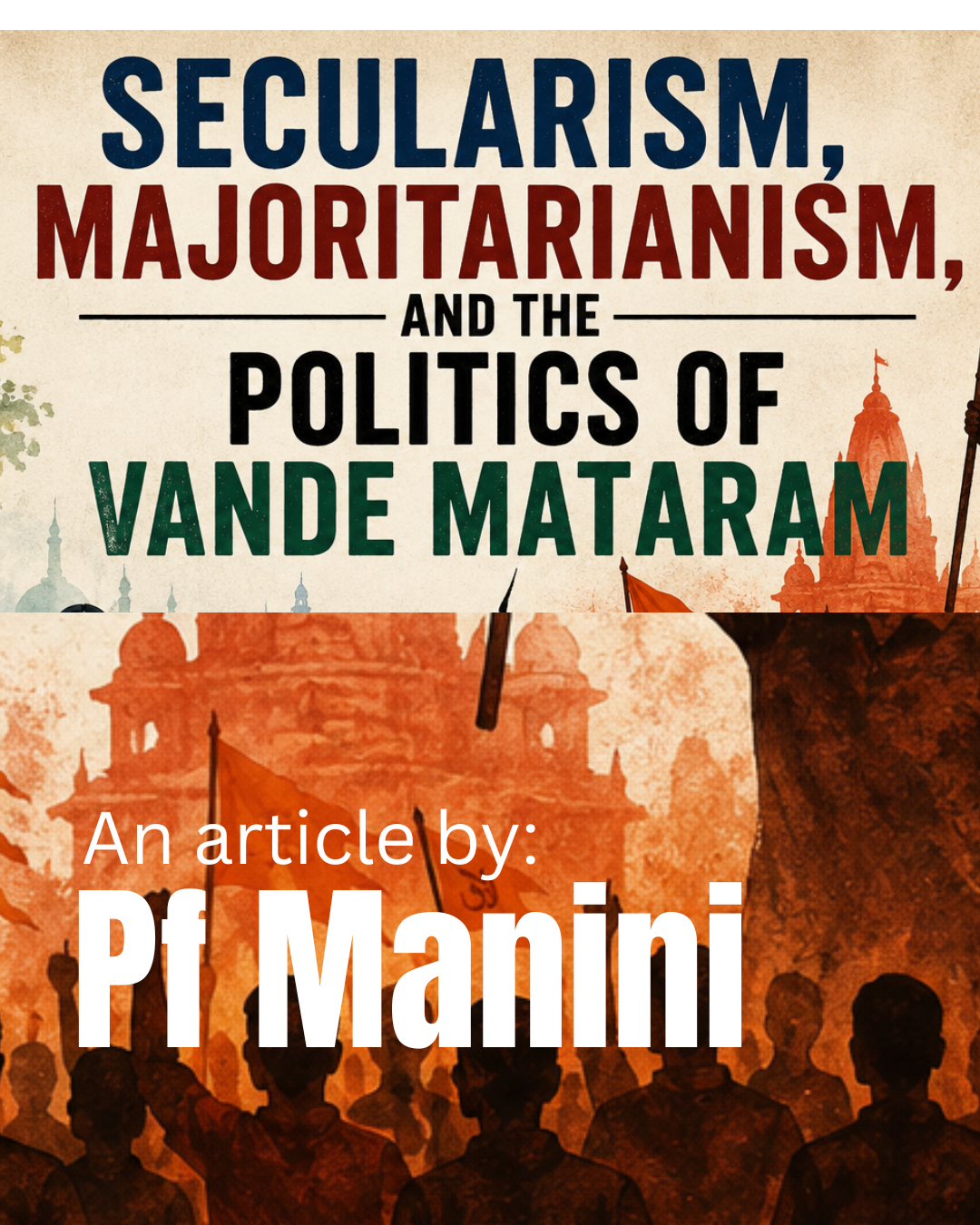
When the BJP-led NDA passed the Bill in the Lok Sabha in 2026, there was a huge outcry from across India. Yet the uproar was not positive; it was a total annihilation of the ruling government towards the secular principles envisaged in the Constitution of India. The nefarious name tag of the champion of democracy comes under the sleeve of numerous ugly bigoted laws posing a threat to the fundamental rights of Freedom of Religion guaranteed in Articles 25-28. The ruling party mandated the rendition of the inclusive six stanzas of VANDE MATARAM in official functions, deviating from the long-standing value of singing the first two stanzas. The bill elevates the status to parity with the National Anthem (Jana Gana Mana) and proposes punishment of imprisonment for a term of three years or a fine for any insult or offence.
The National Song was composed by Bankim Chandra Chattopadhyay in 1876, adopted as the National Song of India in 1950, with the first two stanzas being officially recognised. In the 1930s, debates over the song’s Hindu goddess became more pronounced. In the year 1937, the Congress Working Committee under Mahatma Gandhi and Rabindranath Tagore decided that only the first two stanzas would be utilised for national events, which were considered free of sectarian. symbolism. The idea of holding the true value of ‘National’ is to represent and respect all communities. It would be right to be called a ‘National Song’ when the very theme and imagery ignite nationalism across diverse cultural backgrounds without religious connotation. So that the song can be sung by all the communities, irrespective of the religion they follow, and diverse communities should not feel excluded or disrespected. Yet the present ruling party failed to respect the pulses of the diverse citizens. This bill has directly imposed the Hindutva majoritarian religious belief on the other groups. Magnifying colonial, dominating views of “OTHERING” in these past decades. In doing so, infringes upon the principles of secularism and federalism through the forceful imposition of majoritarian religious belief. It infringes Freedom of Expression under Article 19 (1) (a). The song is a composite historical song associated with the freedom struggle; it invites contested interpretation in a pluralistic society. It is detrimental to the idea of nationalism when the nation in the making cannot accommodate and represent an equal and respectable position for all citizens.
According to Christian, the song Vande Mataram, “I bow to thee Mother” or “Mother, I praise or worship thee”, is against their religious belief. The Bible forbids bowing down to, praying to or worshipping idols, deities or the earth. Refusing to sing is not an act of anti-nationalism; patriotism is different, worship is different a clear distinction. The Constitution granted Protection of an individual’s freedom of Conscience and Religion under Article 25 (Freedom of conscience and free profession, practice, and propagation of religion).
Secularism means being separate from religion; it entails the separation of religion from the government, social, economic, and cultural aspects of life. There is equal respect for all religions and faiths. Secularism has been an inalienable part of Indian culture, as seen in the multitude of faiths that have coexisted in this country for centuries. All religious groups in India have the same rights without any discrimination. The secular state simply means that the Parliament will not have the authority to impose a specific faith on the general populace. In a heterogeneous country like India, secularism has no alternative. Variety is a strength for India.
The song Vande Mataram is deeply woven into India’s freedom movement yet continuously debated for its religious imagery and political interpretations. The National Song should balance inclusivity with preserving national unity through the anthem. Yet the National Song seems to leave out other diverse groups, making it purely ‘Religious worship’. The question is: Can the Hindutva Majoritarian group sing a song with Christian imagery or the Muslims songs in Parliament, justifying that it has historical value at the expense of the historical past? I don’t think so; rather, there will be huge accusations of ‘religious conversion, even though the song has a historical value.
In India, Hindus are one of the majoritarian groups; in the 1931 Census, Hindus comprised 68.36 per cent, Muslims 22.16 per cent, Christians 1.80 per cent and Sikhs 1.24 per cent. And in the year 1941, Hindus were 66.2 to 73 per cent, Muslims 23.8 per cent, Christians 1.47 per cent and Sikhs 1.63 per cent. Again, in the year 1947, Hindus were 84 per cent, Muslims 9.8 to 10.5 percent and Christians Silks, Buddhists, Jains and others 5.5 per cent. In 2024, only five ministers from minority communities, out of 293 elected MPs of the BJP-led NDA government. Right now, only one minority MP in the ruling government. When we look at the population status and the MPs from past to present, it is clear to conclude that it is easy to sing Hindu goddess veneration songs because the population is dominated by Hindus and the ministers in power are dominated by Hindus.
The Right to remain silent: Bijoe Emmanuel V State of Kerala: The Supreme Court ruled that (Jehovah’s Witness) standing up respectfully without singing was sufficient, and forcing them to recite the anthem violated their freedom of expression. Here is the question: How can the other religious group stand in silence while their very faith has been compromised and disrespected? Vande Mataram personifies the motherland as a divine entity associated with Hindu deities. Forcing them to recite the lyrics directly contradicts their faith and infringes upon Article 25, the Right to Freedom of Conscience. Article 28 (3) states that no student in a state-recognised or state-aided institution can be compelled to take part in religious instruction or worship without their consent. The Preamble to the Constitution of India echoes these words: “WE, THE PEOPLE OF INDIA, having solemnly resolved to constitute India into a “SECULAR” and LIBERTY of thought, expression, belief, faith and worship. Then, what are all these rights and freedoms actually for? Any citizen criticising the BJP-led NDA over violation of constitutional rights is often labelled as “anti-national”. Now, the following questions arise,
Right to remain silent how? Can they sing Muslims songs in Parliament in the manner of their action?
What place does the state-sanctioned veneration of a single religious group have in a country that claims to be secular?
Why do they pass this type of bill when the Constitution explicitly upholds secular principles?
Could they sing a national anthem that includes lyrics venerating Allah or Christ?
Why should they be forced to stand and tolerate those lyrics that violate their religious beliefs?
How can a song venerating a specific religious goddess be called a National Song in the first place?
Why did the founding fathers allow it?
The simple answer is that they have compromised the principle of secularism. While the Bill itself has insulted others’ religious beliefs, the ruling party goes so far as to the extent of criminalising the citizen, as the lyrics itself contains: “religious bigotry”.
What kind of future are we heading towards?
The citizens should wake up from their slumber.
Here is the brief translation of the song (Shivpreet Singh)
“I salute you, O Mother When seventy million hands lift swords You are Durga, Queen of Light ou are Lakshmi, on a Lotus throne”
Pf Manini
Former President
Naga Welfare Manipur University
Canchipur, Imphal
(The views and opinions in this article are solely those of the author and do not necessarily reflect the official stance of Rural Post)