
This article is based on my personal experience and perspective. I am sharing it in the hope that it may be useful or relatable to other young people who may be experiencing similar pressures in their lives. I do not present my experience as a universal answer to stress, but rather as one personal reflection on how an activity that is often viewed negatively can sometimes provide a temporary sense of relief when approached with awareness and moderation.
Stress has become a familiar part of modern life, particularly for young people trying to find their place in an increasingly demanding world. As I have grown older, I have experienced different forms of pressure relating to my career, friendships, family, responsibilities and expectations. As I became more involved in social activities and began taking greater responsibility in my community, I also became more aware of the pressures that accompany those responsibilities. At times, the weight of these expectations can make even ordinary days feel mentally exhausting.
For me, one of the most difficult parts of dealing with stress has been the feeling that I am constantly being observed and judged. We often worry about what other people will think about our choices, our work and the direction in which our lives are moving. Human beings naturally form opinions about one another, but when we become too conscious of those opinions, they can occupy considerable space in our minds. Sometimes the pressure does not come from what people actually say, but from what we imagine they might say.
There were times when I simply wanted to get away from everything. I sometimes imagined that living in isolation would allow me to escape the pressures around me, but I eventually realised that changing my surroundings would not necessarily silence the thoughts in my mind. There were nights when I struggled to fall asleep because I continued thinking about different problems and responsibilities. I tried several ways of relaxing, including listening to music, but I often found that my mind remained restless. I needed something that could genuinely shift my attention for a while rather than simply telling myself to stop worrying.
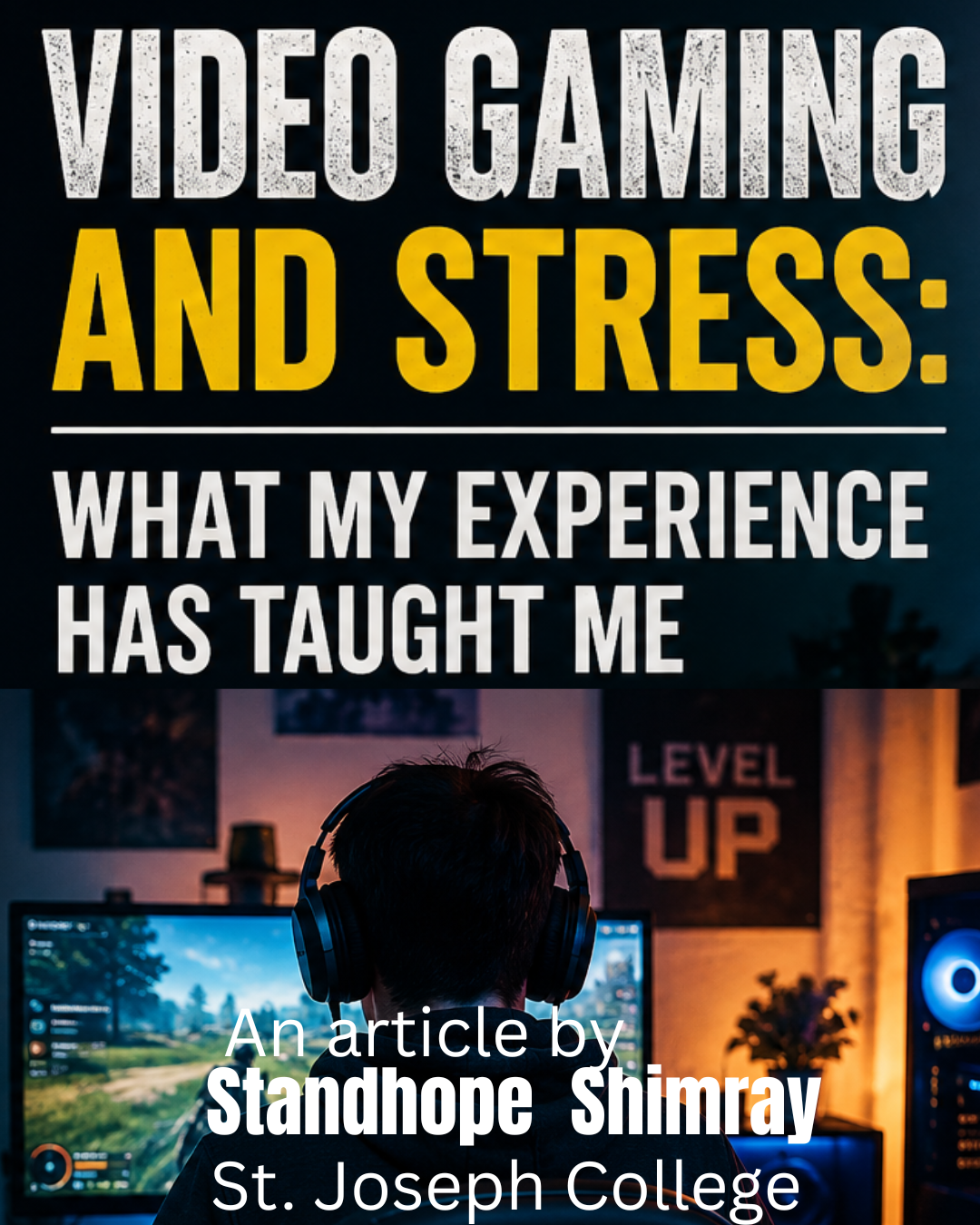
It was during this period that I discovered something that helped me: video gaming. When I started playing video games, I noticed that my attention shifted away from the things that were troubling me. For a while, I was not thinking about my responsibilities, other people’s expectations or the problems occupying my mind. I was simply concentrating on the game in front of me. That temporary change of focus gave me a sense of mental relief and allowed my mind to experience something different from the constant cycle of worrying and overthinking.
There is something strangely intimate about entering a world that exists only for you for a little while. When the outside world becomes demanding, the glow of a screen can create a private space where nobody is judging you, nobody is asking what you should become and nobody is measuring your worth. For a brief moment, you are allowed simply to exist, to choose, to win, to lose and to begin again. Perhaps that is one reason gaming can feel so comforting. It can satisfy a deeply human desire that we do not always acknowledge openly: the desire to have a space where we can temporarily belong entirely to ourselves.
I do not believe that video games solve personal problems, and I would not encourage anyone to use them as a substitute for addressing serious difficulties. They cannot remove responsibilities or change difficult circumstances. What they can sometimes provide is a temporary mental break from those pressures. For me, gaming became a way of stepping away from stress for a while, refreshing my mind and returning to everyday life with a greater sense of calm. Sometimes a short mental distance from a problem can make it easier to approach that problem again.
Perhaps this is where our conversation about gaming needs to become more honest. Are we really worried about video games, or are we sometimes uncomfortable with young people finding their own ways of coping with a world that places enormous pressure on them? Adults can spend hours watching television, scrolling through social media or discussing politics, yet when a young person spends an hour playing a video game to unwind, the activity is often immediately labelled a waste of time. Before asking young people to put down the controller, perhaps we should sometimes ask a more difficult question: What are they trying to get away from? The answer may reveal a problem that is much larger than the game itself.
This does not mean that gaming should be defended blindly. There is an important distinction between using gaming as recreation and allowing gaming to take control of one’s life. Video games can become unhealthy when they begin to interfere with studies, work, relationships, physical activity, sleep or other responsibilities. The World Health Organization recognises gaming disorder as a condition involving impaired control over gaming, increasing priority given to gaming over other activities and continued gaming despite significant negative consequences. At the same time, WHO notes that gaming disorder affects only a small proportion of people who engage in gaming.
This distinction matters because the debate around video games is often presented in extremes. Gaming is sometimes portrayed as entirely harmful, while others may treat it as an unquestionable source of benefits. My experience suggests that the reality is more complicated. The effect of gaming depends partly on how, why and how much a person plays. Research also suggests that the relationship between gaming and mental wellbeing is not simply positive or negative. A 2025 systematic review of longitudinal studies found a bidirectional relationship between problematic gaming and several aspects of psychological wellbeing, suggesting that psychological difficulties can sometimes contribute to problematic gaming while problematic gaming can also be associated with later difficulties.
This is why self-awareness matters. If gaming helps someone relax for a reasonable amount of time and does not interfere with important responsibilities, it can be a legitimate form of recreation. If a person begins using gaming to avoid every responsibility or continues playing despite serious consequences, the same activity can become harmful. The question, therefore, should not simply be whether a person plays video games, but whether that activity remains within the person’s control and whether it contributes to or interferes with the rest of their life.
I also think parents and older members of society should approach the subject with greater balance. Concerns about excessive gaming are legitimate, particularly when gaming interferes with education, sleep, physical activity or family life. But simply assuming that every young person who plays video games is wasting time may prevent a more meaningful conversation. Parents can help young people develop healthier gaming habits by setting reasonable boundaries, encouraging open communication and helping them maintain a balance between gaming and other parts of life. Guidance is often more effective than condemnation because it allows young people to understand why moderation matters.
Some games may also encourage skills such as strategic thinking, problem solving, coordination, decision making and persistence. These benefits should not be exaggerated, because they depend on the type of game, the way it is played and the individual player. Nevertheless, they demonstrate why video gaming deserves to be discussed with greater nuance than simply labelling it as either good or bad. A game is a tool of recreation, and its effect can depend greatly on the way the individual uses it.
Sometimes the activity we blame is not the real problem. If a student is exhausted because of academic pressure, worried about the future, struggling with family expectations or feeling isolated, taking away the one activity that gives that person a brief sense of relief may not address the underlying problem. It may simply remove the outlet without removing the pressure. This does not mean that every form of escape is healthy, but it does mean that we should be willing to look beneath the surface before deciding what is causing a young person’s difficulties.
There is a difference between escaping responsibility and taking a temporary break from it. A person can put down the controller and return to their studies, work, family and responsibilities, just as another person can finish a book, a football match or a film and return to everyday life. The important question is whether the activity helps a person recover or gradually becomes a way of avoiding life altogether. That distinction requires maturity, self-awareness and discipline from the individual, as well as understanding from the people around them.
For me, the most important lesson has been that people need different ways of giving their minds a break. Some people find relief through music, reading, sports, exercise, travelling or spending time with friends. Others may find it through video games. There is no single method that works equally well for everyone. What matters is finding something that provides healthy recreation without allowing it to replace the responsibilities and relationships that give our lives meaning.
My experience has taught me that video gaming can be a useful form of recreation and temporary stress relief when it is approached with self-awareness, discipline and moderation. It does not solve my problems, but it sometimes gives my mind the space to step away from them for a while. That small break can be valuable, particularly during periods when the mind feels overwhelmed and needs an opportunity to reset before facing the demands of everyday life again.
Perhaps the real lesson is not that we should play more video games. It is that we should understand ourselves better, recognise what helps us recover from everyday pressures and learn to use those things responsibly. A healthy way of coping with stress should give us the strength to return to our responsibilities, not become another responsibility that we struggle to control. Sometimes, taking a short break is not an act of weakness; it is simply a way of giving ourselves enough space to begin again.
Standhope Shimray
B.A., 7th Semester
Department of Political Science
St. Joseph College, Ukhrul, Manipur
For feedback and suggestions, please contact: standhopeshimray3@gmail.com