
I am free. I rise from the darkness of broken homes, wounded memories and dreams forced to leave.
I am Kanchanjangha. I carry the anger of the young, the silence of the displaced, the questions of a restless generation.
When morning reaches the mountains, I will still be standing, a name born from the darkness, a cry for freedom.
There are nights when sleep simply refuses to come. The room becomes too still, the mind remains. awake and the hours begin to move without meaning. One such night, before a holiday, I found myself casually browsing through the internet when I came across Kanchanjangha, the 2019 Assamese film written and directed by Zubeen Garg. I knew of the film, of course, but I had never sat down to watch it with any particular expectation. I understand Assamese very well, although I cannot speak the language fluently, and perhaps that familiarity made the decision easier. I pressed play. I did not know that the film would stay with me long after the screen went dark.
I have lived in Manipur for more than two years now and have spent around one and a half years in Ukhrul. Living here has changed the way I look at people, places and the ordinary things that surround us. I have encountered violence, met displaced people and listened to stories of lives that were suddenly interrupted. I have sat with people who lost homes, security and the simple certainty of knowing what the next morning would bring. These experiences do not always announce themselves dramatically. Sometimes they enter memory through an ordinary conversation, a face across a room or a story told in a low voice.
After what happened in Litan, I think I became more withdrawn and more introspective. The incident brought the reality of violence much closer to where I live and work, and it left me with a feeling of helplessness that I have found difficult to shake off. I had listened to people speak about suffering before, but encountering it close to home, meeting people whose lives had been suddenly disturbed and seeing the uncertainty that followed affected me in a different way. I began carrying such experiences more deeply. I listened more, spoke less and often remained silent for a long time after a conversation had ended. There are moments when one looks into the dried eyes of people who have already endured too much and wonders how much suffering a human being can carry. Perhaps that is also why, when I came across Kanchanjangha that sleepless night, the film reached something in me that was already carrying questions about violence, helplessness, young people, broken expectations and the search for a way forward.
Perhaps this is what happens when one has spent enough time listening to people. Stories do not always leave us when the conversation ends. They remain somewhere inside us. A writer carries them, sometimes consciously and sometimes without knowing it. One observes, listens, remembers, writes a few lines, erases them and begins again. There are experiences for which language always seems inadequate. One keeps searching for the right words because the lives of people we have encountered deserve more than a convenient sentence. They deserve to be remembered with honesty.
That was the state of mind in which I watched Kanchanjangha. The film tells the story of Anirban, a young man carrying ambition, frustration and the desire to build a meaningful life. His world is shaped by the aspirations of youth and by the growing realisation that institutions can become places where dreams encounter disappointment. The controversy surrounding recruitment through the Assam Public Service Commission becomes part of the world in which Anirban struggles to understand what has happened to the future he imagined for himself. His frustration accumulates. The questions become heavier. Anger begins to occupy the space where hope once lived.
As the story moved forward, I became increasingly interested in what happens inside Anirban. His transformation is not simply about anger. It is about identity. A young man begins with a name, a family, an education, a set of expectations and a picture of the future. Then circumstances begin to alter the way he sees himself. The disappointments accumulate until the old identity no longer seems sufficient. He begins to search for another name, another way of standing in the world. That is where Kanchanjangha enters.
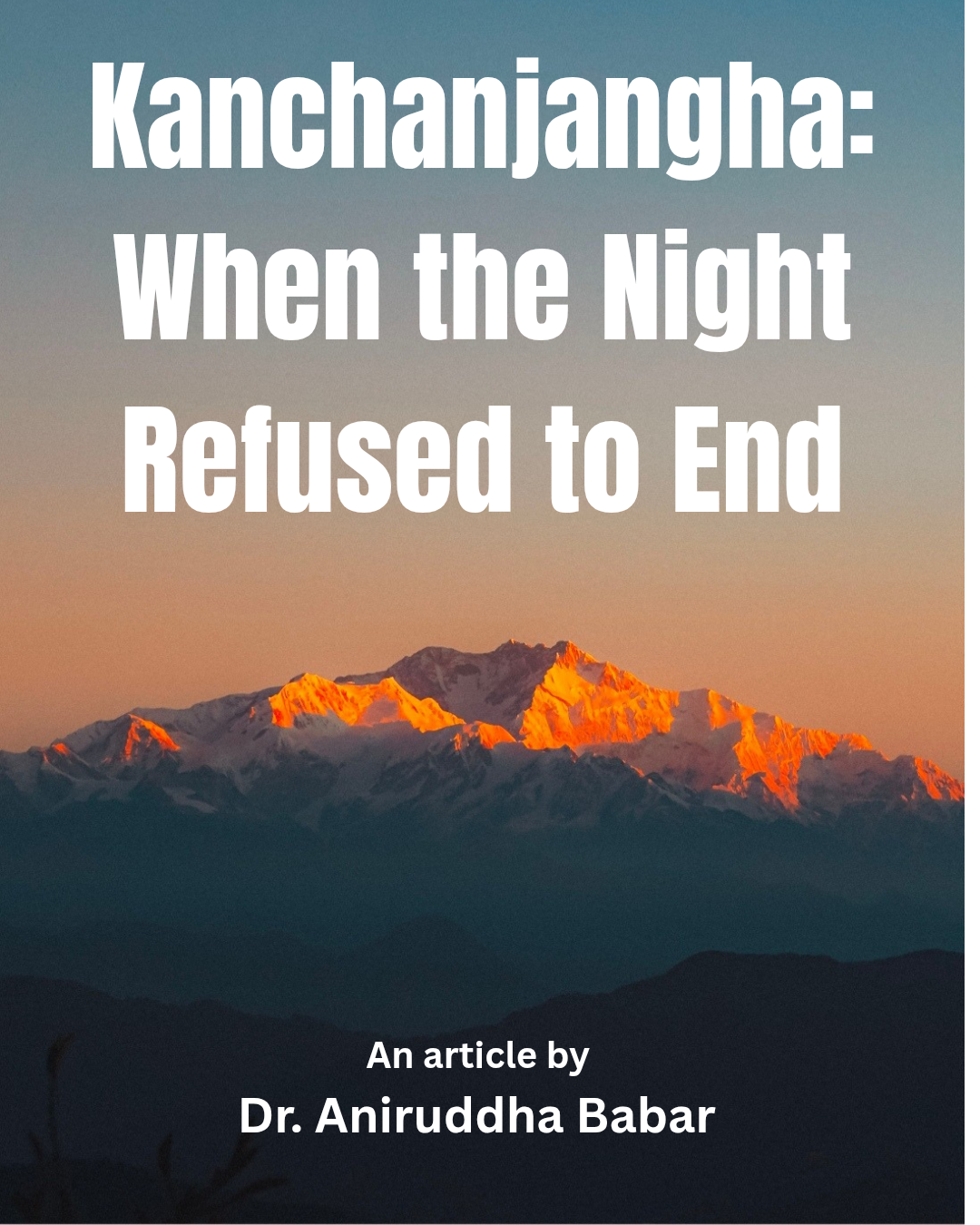
The title itself carries the image of a mountain. Kanchanjangha is associated with height, endurance, distance and permanence. A mountain stands above the landscape, immense and solitary, carrying snow, weather, darkness and light without moving from its place. In the film, the mountain becomes a powerful image for Anirban’s transformation. His journey is an ascent of another kind. He is trying to rise above everything that has defined him, wounded him and disappointed him. The mountain. becomes a name he creates for himself, a declaration of existence and a statement of freedom.
For me, watching that transformation from Ukhrul made the symbolism even more intimate. Mountains are not distant objects here. They are part of everyday life. They surround us, shape the roads we travel, influence the weather we experience and become part of the way we understand distance and belonging. A mountain can be beautiful from afar and unforgiving when one has to climb it. It can appear still while carrying the memory of storms. Perhaps that is why Kanchanjangha felt less like a distant cinematic symbol and more like something I could recognise.
As the story moved forward, another film returned to my memory: Govind Nihalani’s Aakrosh (1980). Perhaps it was because Kanchanjangha had begun stirring something deeper in me, something connected to the years I had spent in Manipur and the lives I had encountered there. I thought of Lahanya Bhikhu a deeply impoverished daily-wage tribal labourer who is falsely accused of murdering his wife the character whose silence in Aakrosh carries the weight of violence, fear and helplessness. His silence came back to me as I thought about the people whose stories I had heard, the displaced families I had encountered and the moments when I had stood before suffering without knowing what I could possibly do. There are experiences that remain with us because they resist easy explanation. They settle somewhere inside memory and return unexpectedly, sometimes through a film, sometimes through a face, sometimes through a place. That night, Aakrosh returned to me through Kanchanjangha, and Lahanya Bhikhu’s silence became part of the larger question that the film had begun to awaken in me: what happens to a human being when suffering continues for too long and the language to express it begins to disappear?
Lahanya Bhikhu’s silence has stayed with Indian cinema because it says so much through the absence of speech. His face, his fear and his inability to communicate become the language of a person crushed by circumstances. Watching Kanchanjangha, I thought about people I had met in Manipur who carried their own versions of that silence. Some stories are told in fragments. Some are carried in silence. Some remain buried beneath fear, humiliation and years of suppression. Some are never told at all. Sometimes the eyes have already dried from crying, and what remains is a stillness that speaks of suffering far beyond tears.
That memory led me to another Govind Nihalani film, Ardh Satya (1983), and to Anant Velankar, whose life becomes increasingly trapped within the institutional maze surrounding him. The words from Dilip Chitre’s poem associated with the film stayed with me: “Chakravyuh mein ghusne se pehle, kaun tha main aur kaisa tha, yeh mujhe yaad hi na rahega.” The chakravyuh, drawn from the ancient battlefield formation described in the Mahabharata, was a complex formation that was difficult to enter and even more difficult to escape. In Chitre’s poem, it becomes a metaphor for a person entering a system whose pressures, demands and compromises slowly close around him until he begins to lose sight of the person he was before he entered it. The question then becomes painfully simple: before entering that chakravyuh, who was I and what was I like? At what point did the world around me begin to change me so completely that I could no longer recognise myself?
There is something disturbing in that question. What happens when the world around us begins to change us so completely that we can no longer recognise the person we once were? What happens when individual enters a system with hopes, principles and expectations and slowly discovers that the system itself has begun shaping his identity? Anirban’s journey in Kanchanjangha brought that question back to me. His anger does not appear from nowhere. It grows from experiences that have accumulated inside him.
Then came Arjun, Rahul Rawail’s 1985 film about Arjun Malvankar, a young, educated man who finds himself unable to remain indifferent to the corruption, injustice, unemployment and humiliation surrounding him. Arjun’s anger comes from watching ordinary people live with circumstances they know are unjust, from seeing frustration become part of everyday life and from realising that an entire generation can grow up being told to adjust, compromise and keep going, even when dignity itself begins to slip away. One dialogue from the film has stayed with me: “Aap sab apni dabi hui, kuchli hui, zillat bhari zindagi ka bojh utha sakte hain, magar zulm ke khilaaf awaaz uthane ko tayaar nahi.” You can carry the burden of your suppressed, crushed and humiliating lives, but you are not prepared to raise your voice against injustice. Those words speak of a life in which suffering becomes so familiar that people begin carrying it as though it were simply their fate. Watching Kanchanjangha, I found myself thinking of Arjun Malvankar and of the anger that grows inside a young person when education gives him awareness, ambition gives him dreams and life repeatedly places obstacles in his path. Anirban carries a different story, shaped by his own experiences and disappointments, yet there is something recognisable in the restlessness of both characters, the feeling of a young man standing before a world that seems to have already decided how much space he is allowed to occupy. Their anger comes from different circumstances, but both refuse to accept humiliation as the final answer to their lives. That connection stayed with me because I have seen a similar restlessness among young people around me, young people who want education to mean something, who want work that gives them dignity, who want to remain connected to their homes and communities and who want to believe that their future can be larger than the circumstances into which they were born. Arjun brought me the anger of a young man who could no longer remain silent before injustice, and Kanchanjangha carried that anger further, towards the painful question of what happens when disappointment, humiliation and helplessness accumulate for so long that a person begins to search for an entirely new identity. In that sense, the two films met somewhere inside me, in the restless space between a young person’s dream and the world he finds waiting for him.
The restlessness of youth acquired another meaning for me because I have encountered something of it in Tangkhul society. I have seen it in the corridors of my college where i serve, in the marketplace, in conversations with young people and even among those engaged in Naga national service. I have heard it in posh restaurants, in small simple dhabas and in hair cutting salons. I have heard questions about bread, questions about work, questions about how a family will survive and questions about what tomorrow will bring. These are conversations that can begin with education. and quickly move towards employment. Employment leads to migration. Migration leads to the difficult question of whether leaving home is becoming necessary for survival.
I have watched young people trying to understand how they will build a life in a place where opportunities can appear painfully limited. Some want to leave. Some want to stay and build something here. Some are preparing for competitive examinations. Some are searching for employment. Some are trying to create small businesses. Some are simply trying to keep going. Beneath these different circumstances is a very human question: how does one make a living, support a family and live with dignity? Listening to these conversations, another set of questions begins to trouble me. Who is responsible for the future of these young people? Who will stand beside them when education does not lead to opportunity, when work becomes uncertain and when survival itself begins to consume their dreams? Who will answer when Tangkhul youth begin asking whether they still have a future here?
That was where Anirban began to feel close to home for me. His restlessness grows from expectation, education, ambition and the painful awareness that the future he has imagined may remain beyond his reach. I have seen something of that emotional tension among young Tangkhuls I have encountered in college, in the market and in ordinary conversations across Ukhrul. Some carry the desire to leave, some want to build something here, some are searching for employment, some are preparing for examinations and some are simply trying to find a way to keep going. Watching Anirban struggle with his own questions, I found myself thinking about the young people around me, about their hopes and frustrations and about the distance between having a dream and having the means to live it. That recognition made Kanchanjangha deeply personal for me.
Sometimes I wonder what happens to a human being when humiliation becomes ordinary, when fear becomes part of the daily routine and when suffering continues for so long that people begin to accept it as the natural condition of life. Perhaps that is where the deepest violence begins. A person learns to swallow anger, a family learns to live with uncertainty, a young person learns to lower his expectations and a community slowly learns to live with wounds that should have demanded an answer. The eyes become dry because tears have been exhausted. Silence becomes a habit because speaking carries a cost. Dignity becomes something people defend privately while the world outside continues as though nothing has happened. This is the violence hidden beneath ordinary life, the violence that leaves no visible wound every morning and still changes the way people think, dream, trust and hope. It can enter a young person quietly and remain there for years. It can turn disappointment into anger, anger into bitterness and bitterness into a question that refuses to disappear: how long can a human being be asked to suffer before he begins to believe that the world has forgotten his humanity?
And somewhere in that darkness stands the Constitution of India, carrying the promise that dignity, liberty, equality and justice belong to every citizen. It gives us a language through which the human being can still speak of freedom, dignity and justice even in moments when life feels overwhelming. For me, this is deeply connected to what Anirban is searching for throughout Kanchanjangha. His anger grows from a sense that something has gone wrong between aspiration and reality, between what a young person dreams of becoming and what life allows him to become. The Constitution reminds us that every generation has the right to imagine a better India and that the values of justice, liberty, equality and dignity remain essential to that imagination. It is a reminder of the India we have inherited, the India we continue to build and the responsibility each generation carries towards the next
And somewhere beneath all these questions is a belief I do not want to lose. I still believe that human beings can choose compassion over cruelty, dignity over humiliation and courage over fear. I still believe that young people can question the world they inherit while retaining their faith in the country they call home. I still believe that human values can survive difficult times and that the dream of a better India remains worth holding on to. Perhaps that is why Anirban’s journey stayed with me long after the film ended. His anger is personal, but the questions behind it are larger. They belong to every young person who has ever wondered whether the world has a place for his dreams, whether his voice will be heard and whether a life of dignity is truly within reach.
There is something deeply disturbing about the identities we inherit without ever choosing them. We are born into names, families, communities, languages, religions and histories. We learn them before we are old enough to question them. They become part of the way we see ourselves and the way others see us. In a world becoming increasingly connected, young people are also encountering identities beyond the ones they inherited. They see different possibilities of living, working, travelling and imagining themselves. They compare their lives with the lives of people they have never met. They ask questions their parents may never have asked. Anirban’s declaration, “I have no caste, I have no religion, I have no God. I am free. I am Kanchanjangha,” therefore carries a force that goes beyond provocation. It is a young man attempting to define himself through his own chosen identity. It is a cry from someone who wants to step outside the categories that have become insufficient for him. What remains powerful is the hunger behind it: the desire to become free.
Freedom is a complicated word. For one person it may mean freedom from fear. For another it may mean freedom from poverty, humiliation or discrimination. For a young person it may mean the freedom to choose a profession, leave home, remain at home, build a business, pursue an education or simply imagine a future without being told that the future is already decided. For someone who has lost a home, freedom may begin with the possibility of living without fear again. That is why the film’s title kept returning to me. Kanchanjangha is distant and immense, but it also stands firmly in its place. It does not explain itself. It simply remains. Perhaps that is what Anirban wants to become. Something that cannot easily be reduced, controlled or renamed by others. Something that carries its wounds without allowing those wounds to become the whole story.
As I watched Anirban, I also found myself thinking about the stories we sometimes hand over to young people before they have had the chance to write their own. They are taught that the past has the power to eclipse the present, that old wounds must continue to govern new lives and that the grievances of one generation must become the burden of the next. They inherit memories they never lived, anger they did not create and divisions they had no part in making. They are told who belongs to “us” and who belongs to “them”, whose suffering must be remembered and whose suffering can be forgotten. A young person can grow up looking at another human being through the shadow of a history he never experienced. The face before him disappears behind a name, a community or an inherited grievance. The person becomes “them”. Perhaps this is where anger can become dangerous, because anger born from genuine suffering can be taken, shaped and directed towards another human being who may be carrying his own wounds. I kept thinking about this as Anirban’s anger grew and his sense of identity changed. What happens when a young person begins to believe that his future must be defined by the battles of the past? What happens when the world teaches him whom to hate before it teaches him how to understand? For me, this is one of the questions that gives Kanchanjangha a significance beyond Anirban’s individual story. The film made me think about the young people I have encountered in Manipur and elsewhere, about the histories they inherit and the choices they will have to make about what they carry forward. History deserves to be remembered, wounds deserve to be acknowledged and injustice deserves to be confronted, but the future cannot belong entirely to the wounds of the past. At some point, a generation has to decide whether it will continue living inside inherited divisions or find the courage to imagine a life in which “us” and “them” no longer have the power to determine the worth of another human being.
A young person may begin by questioning the world around him and, somewhere along the way, begin questioning his own place within it. He may carry histories he never lived, divisions he never created and expectations he never chose, until the voice of the world becomes louder than his own. This is where cinema can do something rare. It can stop us for a moment and make us look again. It can take an ordinary life and reveal the wounds hidden beneath it. It can place a human face before us and refuse to let us look away too quickly. It can make silence speak, make anger understandable and remind us that behind statistics, institutions, political arguments and inherited histories are human beings who wake up every morning carrying memories, fears, hopes and questions of their own. Watching Kanchanjangha that night, I felt that Anirban was no longer simply a character whose anger I was watching on a screen. He became a young man standing inside all these questions, trying to understand what had happened to his dreams and what he was becoming in the process. Perhaps that is what the film did to me. It made me look beyond the anger and search for the human being carrying it.
When the screen finally went dark, the room became still again. The holiday was still ahead. The night had not ended. I remained awake, thinking about Anirban, Lahanya Bhikhu, Anant Velankar and Arjun Malvankar. I thought about the young people I had met in Ukhrul, about the questions I had heard in ordinary places and about people whose lives had been interrupted by violence. I thought about the faces of displaced people and those dried eyes that seemed to ask questions without speaking. I also thought about the Constitution of India and the promise that the country belongs to all its citizens. I thought about how easily words such as justice, liberty, equality and dignity can become abstract when read on a page and how profoundly human they become when one encounters someone who has lost a home, a livelihood, a sense of security or hope for tomorrow. Perhaps constitutional values matter most when they descend from the page into ordinary life and become part of how we treat one another.
That night also reminded me why I continue to write. Writing cannot repair a broken home. It cannot return a lost life. It cannot erase humiliation or bring back the years that suffering has taken away. It cannot always answer the questions people ask. Sometimes all writing can do is refuse to let a human experience disappear into silence. It can remember. It can listen. It can place a face beside an event and a human voice beside a statistic. It can say that someone suffered, someone hoped, someone waited and someone still believed. Perhaps that is the responsibility I feel most deeply as a writer: to write without forgetting the human being.
I began watching Kanchanjangha because I could not sleep, and I finished watching it carrying more questions than I had when I started. That is perhaps what a meaningful film does. It does not necessarily give us answers. Sometimes it disturbs the answers we have become comfortable with. The night that began with restlessness slowly moved towards morning. Somewhere outside, the mountains remained where they had always been. The darkness had not disappeared all at once. The first light simply began to arrive.
I thought about Kanchanjangha again. A mountain does not hurry towards the morning. It simply stands there and receives the light when it comes. Perhaps human beings are like that too. We carry our wounds, our memories, our anger and our unanswered questions. We carry the stories of those who have suffered before us. We carry the dreams of those who are still trying to find a place in the world. We climb slowly. Sometimes we lose our way. Sometimes we become angry. Sometimes we become silent. Sometimes we feel helpless because we cannot change what is happening around us. And still, we continue.
The mountain is still there, the darkness is still below and the light is still coming, and somewhere between them stands the human being, wounded, furious, uncertain, searching, remembering, climbing, still trying to believe in humanity, still trying to believe that human values can survive, still trying to believe in a better world. That sleepless night began with a film and ended with a question that has remained with me: what kind of human beings do we want to become when the morning finally arrives? Perhaps the deeper question is this: after all the violence we have witnessed, all the suffering we have endured and all the anger we have carried, do we still have enough humanity and enough courage left within us to choose, when the morning comes, to be human?
(Dr. Aniruddha Babar is a Senior Academician, Public Policy Expert & Social Development Specialist, Writer, and Researcher currently serving in the Department of Political Science, St. Joseph College, Ukhrul, Manipur. He is also the Co-Founder and Deputy Director of the Centre for North-East Development and Policy Research (CNEDPR), St. Joseph College, Manipur.)