
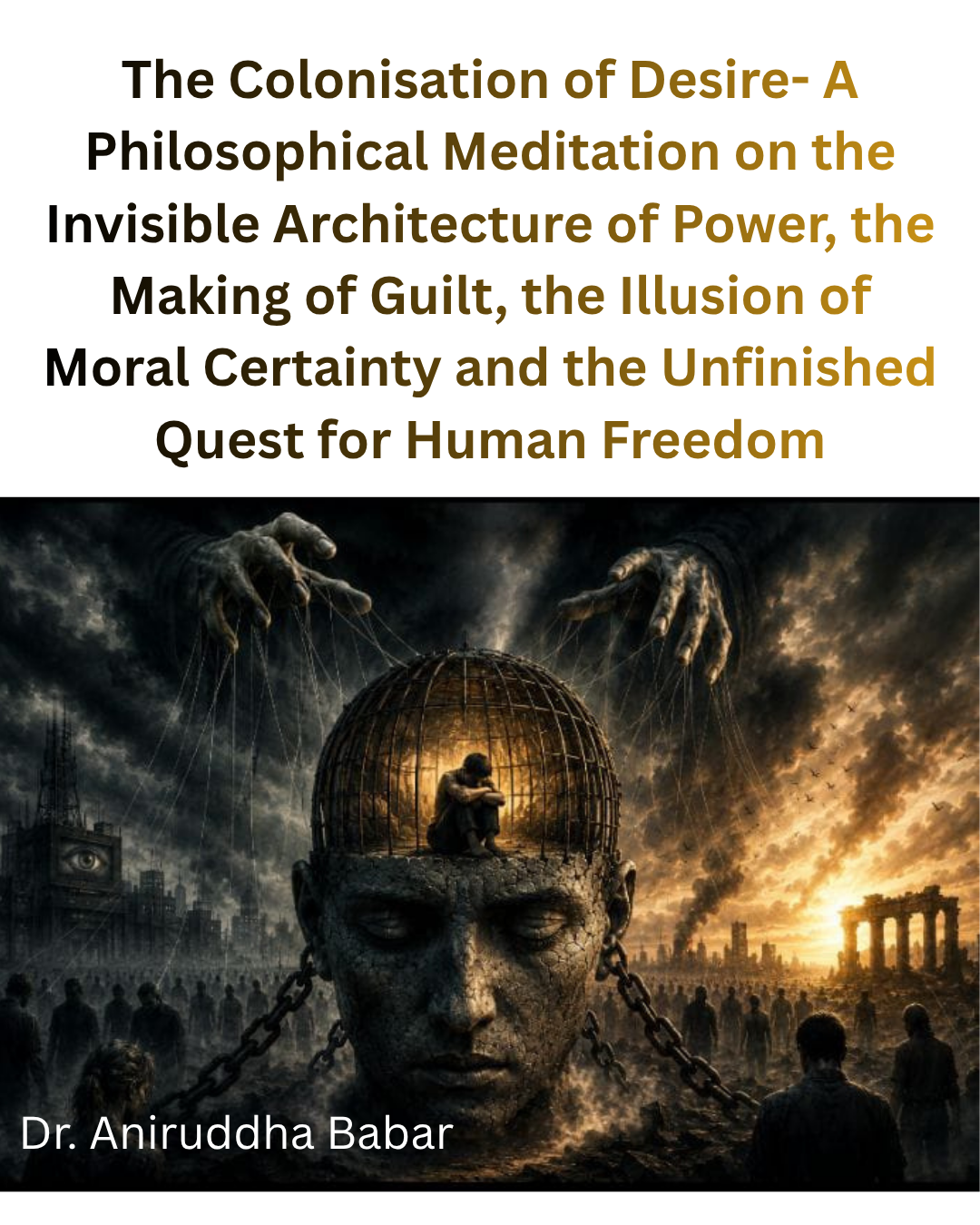
The Colonisation of Desire- A Philosophical Meditation on the Invisible Architecture of Power, the Making of Guilt, the Illusion of Moral Certainty and the Unfinished Quest for Human Freedom
Dr. Aniruddha Babar
The first government was not established in a palace. It was established in the human mind. Long before constitutions, armies or courts existed, humanity discovered a far more powerful form of authority: shape the deepest instincts of life and people will eventually shape themselves. No prison has ever been as efficient as a guilty conscience. The greatest empire is not built upon territory but upon psychology.
Among all the forces that sustain life, sexuality has perhaps been the most carefully regulated. This is remarkable because every civilisation is born through it, every family begins with it and every human being carries its imprint. Yet the very energy that creates life has repeatedly been regarded as something dangerous, impure or perpetually in need of supervision. The paradox deserves careful attention. Why has the source of life so often become the object of suspicion?
The answer may lie in the relationship between power and consciousness. A human being who is deeply at ease with life is difficult to manipulate. One who trusts direct experience asks inconvenient questions. Such a person cannot easily be governed through fear alone. By contrast, a person taught to distrust natural impulses becomes increasingly dependent upon external judgement. As confidence in one’s own awareness weakens, authority quietly acquires greater influence.
Throughout history, families, religious traditions, educational systems and states have all shaped ideas about sexuality. Some of these norms have protected people from exploitation and contributed to social stability. Others have reflected inherited anxieties more than enduring wisdom. The philosophical challenge is therefore not to reject every tradition but to distinguish between ethical responsibility and psychological conditioning.
The significance of this distinction extends far beyond questions of sexuality. It reaches the heart of politics itself. The deepest political struggle is not simply over territory, wealth or elections. It concerns the authority to define what is natural, what is moral and ultimately what it means to be human. Whoever shapes these definitions also shapes imagination, identity and behaviour. This influence is subtler than legislation because it eventually speaks through the individual’s own inner voice.
The consequences of such influence begin early in life. The child enters the world without psychological division. Curiosity is natural. Affection is spontaneous. The body is simply part of existence. Gradually the child learns that certain questions must not be asked, certain emotions must not be expressed and certain experiences must remain hidden. Shame is rarely taught through a single lesson. It grows through repeated signals, subtle silences and unquestioned expectations until it appears as though it had always belonged there.
Nature offers a revealing contrast. Rivers do not apologise for flowing. Trees do not seek permission before blossoming. Birds require no approval before singing. Human beings alone often learn to experience their own vitality through layers of judgement. Somewhere between innocence and adulthood, many cease trusting direct experience and begin trusting inherited conclusions.
When the distance between direct experience and inherited judgement widens, the individual gradually becomes divided within. That inner division marks the beginning of a deeper psychological conflict, one that extends far beyond sexuality and shapes the entire experience of being human.
When an individual becomes divided within, an extraordinary amount of energy is consumed by internal conflict. Instead of understanding desire, one struggles against it. Instead of observing emotion, one condemns it. The battlefield is no longer outside but within. Such a mind naturally seeks certainty because uncertainty has become exhausting. It seeks authority because self trust has been weakened.
This is not an argument against morality. Every society requires responsibility, mutual respect and ethical limits. The deeper question is whether morality arises from understanding or from fear. Behaviour rooted solely in fear may produce obedience, but obedience should never be mistaken for wisdom. Wisdom transforms from within. Fear merely compels outward conformity.
Suppressed energies rarely disappear. More often, they change direction. What cannot find expression through understanding may reappear as aggression, domination, obsessive ambition or the desire to control others. Human beings often imagine they have conquered desire when they have merely given it a different name.
This redirection of energy is one of the defining features of modern civilisation. Productivity, efficiency and achievement are valuable qualities, yet they cannot resolve inner conflict. When suppressed energy is redirected into endless activity, external success often conceals internal fragmentation. A person may accumulate wealth, influence and recognition while remaining inwardly divided. Achievement cannot substitute for self understanding.
Perhaps this explains why humanity repeatedly searches for fulfilment in possessions, recognition and ideology while overlooking the quality of consciousness itself. We have learned to cross oceans, explore space and transform technology, yet many people spend an entire lifetime without understanding the forces that move their own hearts. The greatest unexplored territory is not on any map. It is human consciousness.
Modern civilisation also promises liberation through consumption. It encourages the belief that fulfilment lies in acquiring more experiences, more possessions or more recognition. Yet desire pursued without awareness merely changes its object. Yesterday it sought wealth. Today it seeks status. Tomorrow it seeks influence. The movement continues because the emptiness being pursued is not external but internal.
The search for external fulfilment also reveals something deeper about the nature of power itself. Durable power rarely depends upon controlling behaviour alone. Its greatest achievement is shaping the way people perceive themselves and the world around them. Once perception has been conditioned, obedience no longer appears as obedience. It appears as common sense. Individuals begin to defend the very beliefs that limit their own freedom because those beliefs have become inseparable from their identity.
Once power succeeds in shaping perception, it no longer needs to rely primarily on force. It governs through definitions. It determines what is respectable and what is shameful, what is acceptable and what is forbidden, what deserves admiration and what deserves silence. As these definitions become deeply internalised, society no longer needs to supervise every individual. The individual becomes both the judge and the accused.
Perhaps the most remarkable achievement of civilisation is not the construction of cities but the construction of invisible boundaries within the human mind. Physical borders separate nations. Psychological borders separate individuals from their own experience. These boundaries are rarely recognised because they are inherited long before they are examined. Their familiarity makes them appear natural even when they are entirely cultural.
Yet culture is not identical with truth. Every civilisation preserves invaluable wisdom, but every civilisation also carries inherited fears. To honour a tradition is not to exempt it from examination. Genuine respect requires understanding rather than blind acceptance. A civilisation becomes stronger when it possesses the courage to question itself without losing its humanity.
Fear possesses a remarkable ability to disguise itself as virtue. It frequently speaks in the language of morality, respectability and social order. These values are indispensable to any healthy society, yet fear can quietly borrow their vocabulary and transform them into instruments of conformity. The philosophical challenge is therefore not to reject morality but to ask a deeper question: does this way of living arise from understanding or from anxiety?
There is a profound difference between discipline born of awareness and discipline born of fear. The first expands consciousness because it is freely chosen. The second contracts consciousness because it is unconsciously inherited. Outwardly they may resemble one another, yet inwardly they belong to entirely different worlds.
The recognition of this difference marks the beginning of genuine freedom. Awareness interrupts the endless cycle of escape. Instead of seeking another object of desire or another certainty to cling to, it invites individuals to observe themselves directly. Observation is among the rarest forms of courage because it offers no comforting illusion. It reveals the mind exactly as it is: ambitious and afraid, loving and possessive, compassionate and insecure, generous and self interested. To see this without condemnation is the beginning of intelligence.
What is deeply understood naturally finds its rightful place. Awareness neither worships desire nor condemns it. It illuminates it. Under that same light, love also changes. It ceases to be ownership disguised as affection. It no longer seeks security through possession or permanence through control. Freedom is not the enemy of intimacy. It is its foundation. Only those who are inwardly free can truly encounter another person without turning relationship into dependency.
True responsibility grows from such intelligence. It is not imposed by authority, purchased through reward or maintained through punishment. It arises naturally because understanding transforms the quality of action. A person who clearly sees the consequences of hatred has little desire to cultivate it. One who understands the meaning of freedom becomes reluctant to imprison another, whether through force, expectation or emotional possession.
Real freedom therefore neither rejects society nor submits to it blindly. It begins when observation becomes deeper than habit. At that moment, inherited ideas are neither accepted nor rejected automatically. They are examined with honesty. Some dissolve because they were sustained only by fear. Others remain because they are rooted in genuine wisdom.
Perhaps the most courageous act is therefore neither rebellion nor submission. It is the willingness to see without distortion. A mind capable of observing itself honestly becomes increasingly difficult to manipulate because it no longer mistakes inherited assumptions for eternal truths. Such a person neither rejects tradition merely because it is old nor worships novelty merely because it is new. Every idea must justify itself before awareness.
The greatest revolution is therefore not political but psychological. Political revolutions replace rulers. Economic revolutions redistribute resources. Technological revolutions transform the external world. Yet none of these, by themselves, resolve the ancient conflict within the human mind. If fear, greed and insecurity remain unchanged, they simply discover new languages through which to express themselves. History changes its costumes while repeating its psychology.
The future of civilisation will not be determined solely by economic strength, military power or scientific achievement. These are remarkable accomplishments, yet they cannot replace inner maturity. A nation may become prosperous while remaining psychologically anxious. It may become technologically advanced while remaining emotionally impoverished. Progress without self understanding multiplies human capacity without enlarging human wisdom.
The greatest achievement of humanity may never be the conquest of nature but the understanding of itself. We have crossed oceans, climbed mountains, explored space and transformed matter into astonishing technologies. Yet the most mysterious landscape remains the human mind. Every attempt to dominate the inner life impoverishes the outer life. Every effort to illuminate the inner life enriches the outer world.
The eternal question is therefore not whether humanity can create a perfect society. Perfection has always belonged to imagination rather than history. The deeper question is whether each generation can become a little less afraid of truth, a little less dependent upon borrowed certainty and a little more willing to encounter reality directly.
In that transformation, freedom is no longer a slogan proclaimed by ideology or a privilege granted by authority. It becomes a quality of consciousness. It is born when understanding becomes greater than fear, inquiry becomes greater than conformity and love becomes greater than possession. Then the colonisation of desire comes to an end, not because desire has disappeared, but because it is no longer governed by ignorance. Illuminated by awareness, the human being discovers the oldest and perhaps the only revolution that truly endures: the revolution of consciousness.
(Dr. Aniruddha Babar is a Senior Academician, Public Policy Expert & Social Development Specialist, Writer, and Researcher currently serving in the Department of Political Science, St. Joseph College, Ukhrul, Manipur. He is also the Co-Founder and Deputy Director of the Centre for North-East Development and Policy Research (CNEDPR), St. Joseph College, Manipur.)
(The views and opinions in this article are solely those of the author and do not necessarily reflect the official stance of Rural Post)