
“Real joy can exist only when people understand their life as service and have a definite purpose in life outside themselves and their personal happiness.”
– Leo Tolstoy
After years of teaching, reading and researching, I have often found myself reflecting on a simple question: what does a salary really tell us about the worth of a person’s professional life? It tells us something about the financial compensation received for our work, but it cannot tell the whole story of what that work means to us or to the people whose lives we encounter. As an academic at St Joseph College, Ukhrul, I have come to appreciate the experiences that give a working life its deeper meaning. The knowledge we acquire, the relationships we develop, the responsibilities we accept and the values we carry into our work all contribute to its worth. These reflections have gradually led me to consider what a salary cannot measure.
Some lessons come from books and research. Others emerge from a student’s question, a conversation with a colleague or an experience that makes us reconsider something we have long believed. A discussion in the classroom may stay with a student long after a lecture has ended. A research problem may take months to understand. We do not always recognise the value of these moments when they occur, but their influence can remain with us for years. They remind me that professional life has an intellectual and human dimension that cannot be expressed entirely in financial terms.
My own academic journey has been closely connected with our Great Naga-Lands. My interest in teaching, research and engaging with our Naga people led me to build my academic life here. My association with our Naga family now extends over more than sixteen years. During this time, I have lived in villages, interacted with different communities and listened to people speak about their lives, difficulties and hopes for the future, and i have been witnessing myself transforming, evolving in the Naga-wisdom. After spending so many years among our Naga people, no Naga village feels strange to me. Many places have become familiar, and conversations with people from different walks of life have helped me understand the region through experiences that books or YouTube videos or Television documentaries alone could never provide. These encounters have become part of my personal and academic journey, shaping the questions I ask and the way I understand the society around me.
Teaching continues to give me reasons to reflect on the value of work. Every student enters. classroom with individual experiences, abilities and ambitions. Some are confident about their future, while others are still searching for direction. A Profesor cannot always know how a particular lesson will influence a student or whether an idea discussed today will prove useful years later. Still, helping young people think clearly, ask questions and develop confidence in their own judgement is an important part of education. In Naga-Lands, education can widen opportunities for younger generations while helping them remain connected to their communities. The possibility that something discussed in a classroom might assist a student later in life gives teaching a significance that extends beyond its financial reward.
The Bible offers a reminder about the spirit in which we should approach our responsibilities: “And whatsoever ye do, do it heartily, as to the Lord, and not unto men” (Colossians 3:23, King James Version). I understand these words as invitation to work sincerely, whether our efforts receive recognition or pass unnoticed. Teaching involves more than completing a syllabus or fulfilling an institutional requirement. It requires preparation, patience, attention to students and a willingness to learn from the questions they raise. The same applies to research and other professional responsibilities. The care we bring to these tasks is part of their value, even when it remains unseen.
Research has taught me to be patient and to question my assumptions. A question that initially seems straightforward can become complicated when we examine the evidence carefully. An argument may need revision, or a piece of writing may require several attempts before it expresses an idea clearly. Much of this intellectual labour takes place without immediate recognition. My interests in political science, law, governance, public policy and development have led me towards questions that affect people’s everyday lives. I remain interested in how institutions function, how decisions shape communities and how research can contribute to discussions about education, justice and development across the Naga-Lands. The process of examining evidence, reconsidering an argument and learning something new continues to give intellectual purpose to my work.
The people with whom we work also influence how we understand our profession. At St Joseph College, I appreciate the opportunity to work with a principal and colleagues who take their responsibilities towards society seriously. Their everyday efforts have encouraged me to think about the wider role of an educational institution. A college is part of the society around it. Its contribution extends beyond lectures, examinations and administration to the ways its members respond to local concerns and engage with the needs of others. These responsibilities are shared, and their fulfilment depends on the efforts of many people working together.
Some of the experiences I value most are quite simple. A colleague may come over and ask, “Sir Ani, how are you? Are you eating properly? Is everything all right? Please let us know if you have any problem.” Sometimes a colleague calls or sends a message simply to ask how I am doing. Such gestures may take only a moment, but they can mean a great deal during a demanding period. Everyone has professional duties, family responsibilities and personal concerns, yet people still find time to check on one another. I have come to appreciate this kindness because it reminds me that our relationships with people often matter in ways that formal measures of professional success cannot capture.
Sometimes, in the middle of a busy working day, a colleague turns to me and asks, “Sir Ani, how has your day been? You have been busy since morning. Please take a little time to sit with us whenever you can. We hardly get a chance to talk these days.” We may exchange views about our work, share our thoughts or laugh about an incident from the day. Such conversations bring warmth to an otherwise demanding routine. Over the years, these ordinary interactions have become a familiar part of my experience in the Naga-Lands. They remind me that professional life is also made up of human connections, small acts of consideration and the trust that develops between people through everyday contact. These moments may never appear in a record of professional achievements, but their personal significance can endure long after a working day has ended.
My years in our Naga-Lands have also helped me appreciate the importance of cultural identity. A people’s history lives in its language, traditions, customary practices, relationship with ancestral lands and memories passed from one generation to the next. These shape how people understand themselves and what they hope to preserve for their children. I have always been moved by the way our Naga people hold on to their roots, take pride in their traditions and pass on the stories and customs of their ancestors. It has made me appreciate how deeply a people’s heritage is woven into their sense of identity and belonging. Their experiences deserve to be understood on their own terms, and their voices should have a meaningful place in discussions about their future. Our children should have access to good education and opportunities to build fulfilling lives while remaining connected to the heritage of their communities. Development should take these aspirations seriously. Understanding them requires time, listening and a willingness to learn from the people concerned.
The Bible’s words in Micah speak to the responsibilities we carry towards others: “What doth the LORD require of thee, but to do justly, and to love mercy, and to walk humbly with thy God?” (Micah 6:8, King James Version). I find these words meaningful because they remind me that our values are expressed through our conduct. In academic life, this means treating people fairly, taking their experiences seriously and recognising the limits of our own knowledge. In discussions about governance, development and human rights, it means considering how policies and institutions affect the people they are meant to serve. These responsibilities give professional work a moral dimension that cannot be determined by income, designation or position.
Working among Naga communities has also reminded me that knowledge comes from many sources. Books, reports and academic discussions are important, but are the experiences of people who live with the consequences of decisions made around them. A conversation about a village’s past or a family’s hopes for its children can reveal concerns that might otherwise be overlooked. As researchers, we need to listen carefully and avoid assuming that we understand a community simply because we have studied it. Listening often raises further questions, and that is part of what makes research worthwhile. It encourages us to recognise the limits of our understanding and remain open to learning from others.
These considerations are particularly important in discussions about governance and development. Laws, policies and institutions affect people’s lives in practical ways. Access to education, healthcare, infrastructure, public services and employment can influence the future of an entire family. Research can help us understand where systems are working and where people continue to face difficulties. In the Naga-Lands, development needs to take account of local experiences, cultural realities and the aspirations of younger generations. Statistics and official reports are useful, but they cannot tell us everything about the lives behind the figures. Listening to the people concerned is equally important. I hope my teaching, research and public engagement will continue to give me opportunities to explore these questions and contribute to a better understanding of the issues affecting the region.
From the perspective of my Christian faith, I believe God can guide us through the responsibilities we accept and the way we respond to the people around us. For me, following God’s path has much to do with carrying out everyday responsibilities honestly, listening to others and treating people with respect. It also means examining my own decisions and accepting that I may sometimes get things wrong. I occasionally ask myself whether my work reflects the values I believe in and whether I am making good use of the opportunities available to me. I do not always have clear answers, but these questions help me keep my priorities in perspective. They remind me that the meaning of a professional life depends partly on how we respond to the responsibilities entrusted to us.
The Christian thinkers whose works I have read have given me different ways of considering these questions. Augustine wrote about the restlessness that can remain even after we achieve things we once desired. Thomas Merton reflected on silence and contemplation, while C. S. Lewis explored human longing and the search for fulfilment. Dietrich Bonhoeffer wrote about responsibility and our obligations towards others. Their reflections encourage us to consider the connection between belief and everyday conduct. Faith, as I understand it, should influence how we treat people, how honestly we work and how we respond when others need us. Professional status and financial success have their place, but neither can settle every question about the kind of life we are leading or the values by which we choose to live.
Not every working day is fulfilling. There are times when teaching is rewarding and research opens up new possibilities; there are also days filled with routine tasks, administrative work and problems that take longer to resolve than expected. We learn to continue with our responsibilities, complete the work that needs to be done and remain interested in the questions that first drew us to our profession. This steady effort may not always bring immediate satisfaction, but it forms an important part of a working life. Sometimes, commitment means continuing with care even when the immediate results are difficult to see.
Ecclesiastes offers a passage that speaks directly to the relationship between labour and the enjoyment of life: “That every man should eat and drink, and enjoy the good of all his labour, it is the gift of God” (Ecclesiastes 3:13, King James Version). I read this as a reminder that work and material security have their rightful place in a good life. We need to provide for ourselves and our families, and it is reasonable to find satisfaction in the fruits of our labour. The question is whether salary, money or material pleasure becomes the only measure by which we judge our professional lives. Financial stability and opportunities for advancement matter. So do friendship, intellectual growth, family, faith and the sense that our time has been spent on something worthwhile. These aspects of life contribute to our well-being in different ways, and no single measure can adequately represent them all.
When I look back on my professional journey, I think of what teaching and research have taught me, the extraordinary people I have met and the places that have become familiar. My years in the Great Naga-Lands have been an important part of this learning. The friendships and brotherhoods I have developed, the conversations I have shared with colleagues and the experiences I have encountered in different villages have broadened my understanding. I remain grateful for what these years have taught me, both professionally and personally. As I look towards the future, I hope to continue teaching, researching and writing about questions that matter to our people, while remaining attentive to the concerns of the Great Naga-Lands and the hopes of its younger generations. There will always be more to learn, and I hope to approach that learning with an open mind.
Salary will always have a place in professional life. It provides security, recognises labour and helps us fulfil our everyday responsibilities. Yet when I think about what I will remember most from my years in academia, I think of the students I have taught, the questions I have pursued, the colleagues who have inspired me and our people who have shown me kindness. I think of the Great Naga-Lands, the villages that have become integral part of and the conversations that have stayed with me. I will remember a colleague asking whether I have eaten, an invitation to sit together during a busy day and the example of people who take their responsibilities towards society seriously. I will also remember the questions that challenged me and the experiences that encouraged me to reconsider my assumptions. These things have become part of my life in ways that a salary statement could never record. A salary can tell us what we have earned, but it cannot tell the whole story of what our work has meant, what we have learnt, whom we have come to know or how our experiences have shaped us. That is what a salary cannot measure.
I have had a habit of introspection since childhood. I often find myself thinking about the things I have seen, the people I have met and the ways in which certain experiences have changed me. My life in Ukhrul has given me much to reflect upon. Here, I have experienced at close quarters what it means to live under the shadow of uncertainty and bloodshed. It is difficult to put this experience. into words. You begin to look at ordinary life differently when you realise that the security and peace many people take for granted cannot always be assured. The uncertainty surrounding people’s lives, the suffering they endure and the fears they may never speak about have made a deep impression on me.
The great hills of Ukhrul stand tall, and so do the men and women who call this land their home. These hills and the people who live among them have become a meaningful part of my own journey. I have become a part of the great Tangkhul story, shaped by the struggles of its people, their silence, their suffering and their hopes for a better future. Behind the beauty of these hills lie human lives, memories and experiences that deserve to be understood. The people I have encountered here have given me much to think about, especially when I consider how they carry on with their lives amid uncertainty. They have families to care for, work to do and responsibilities to fulfil. It pains me to think that fear and uncertainty have become part of everyday life for some people. I cannot claim to know the full weight of what they have endured, but living here has brought me closer to their reality. and made me more conscious of the suffering that exists beyond my own experience.
Great Naga-Lands has given my personal and professional life an eternal meaning that goes beyond the salary I earn. The people I meet, the conversations we share and the realities I witness have become an important part of my life. I feel privileged to have known this land and its people and to have learnt from their lives. Their struggles, their dignity and their determination to carry their heritage forward have left a lasting impression on me. In light of the holy grace of our Father in Heaven i shall continue teaching, learning and contributing to the lives of the people among whom I work. Through education and research, I want to do my part in understanding their concerns and contributing to the well-being of the communities I serve.
I hope my experiences in Ukhrul will help me become a better human being. They have made me think more carefully about the burdens people carry and the importance of listening to their stories with patience and understanding. When I look at the hills of Ukhrul, I think of the Tangkhul people, their struggles, their suffering and their hopes for the future. I feel grateful to have become a part of
their story, even in a small way. The bond I have developed with this land and its people is something I hold close to my heart. It is among the most precious gifts of my professional journey as a Professor, something I value far more than any material reward. It is a part of my life that no salary can measure.
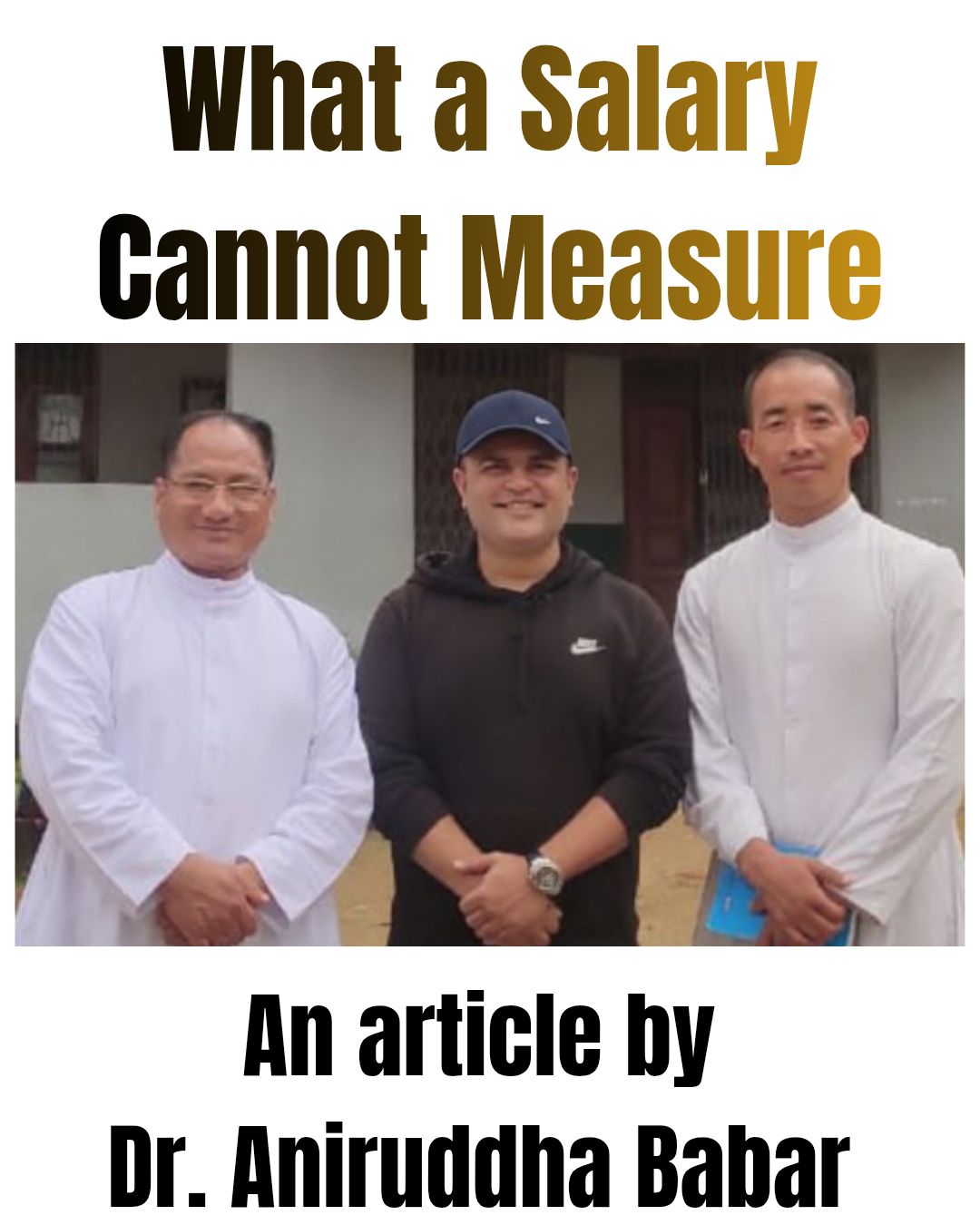
Dr. Aniruddha Babar
(Dr. Aniruddha Babar is a Senior Academician, Public Policy Expert & Social Development Specialist, Writer, and Researcher currently serving in the Department of Political Science, St. Joseph College, Ukhrul, Manipur. He is also the Co-Founder and Deputy Director of the Centre for North-East Development and Policy Research (CNEDPR), St. Joseph College, Manipur.)