
THE ARCHIVAL RECORD: KUKI WARFARE AND THE BRITISH DESCRIPTION OF “SAVAGERY”
A Reflection on Historical Records, Contemporary Atrocities and the Conscience of Humanity
By Markson V. Luikham
How and when do human beings become capable of committing heinous crimes and inflicting horrifying cruelty upon another human being? It happens when our collective conscience fails, when government authorities look away, when brutality becomes a spectacle and the world watches in silence.
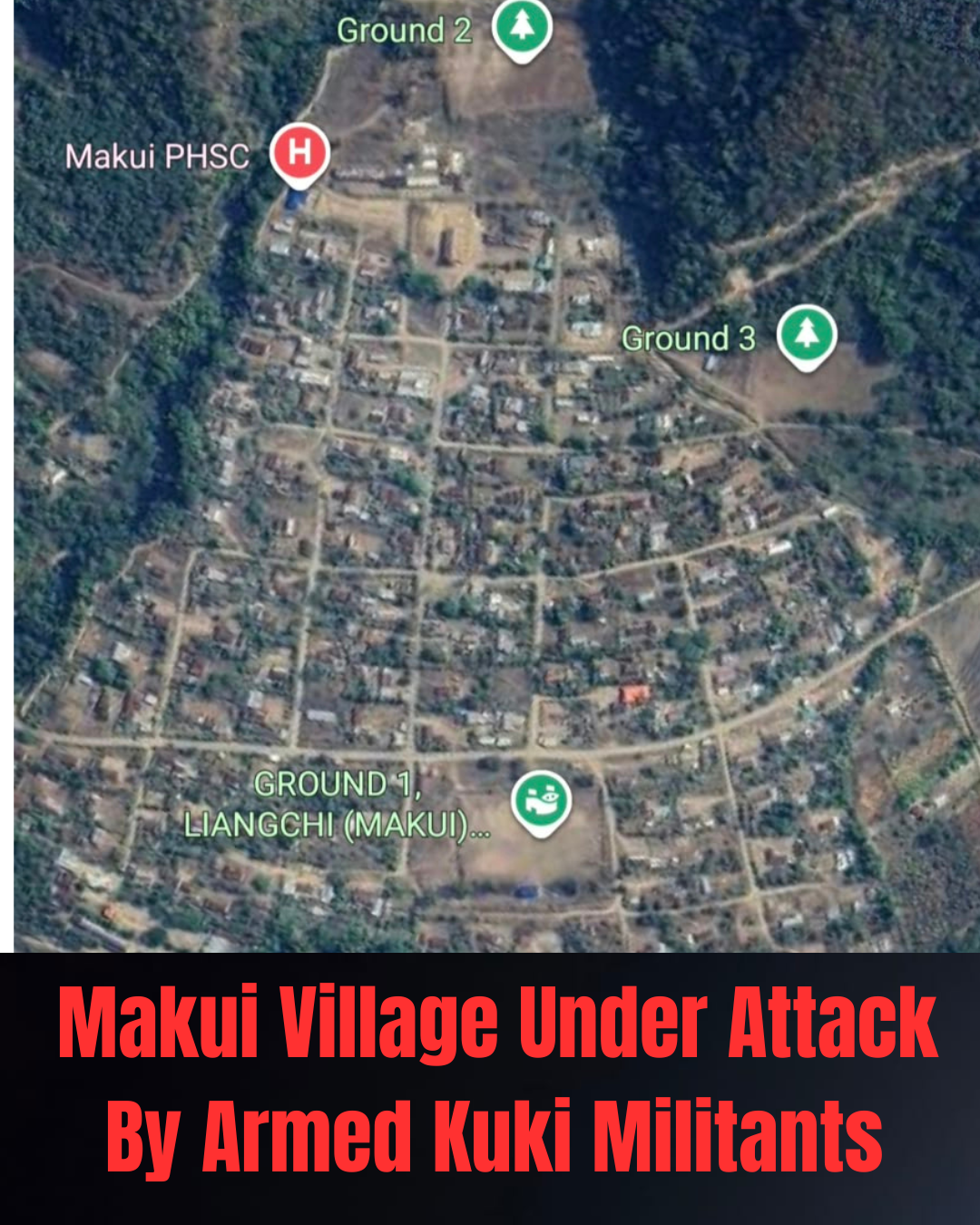
On 10 October 2026, three Naga men were killed in an attack on Makui Ashang village, a Liangmai Naga village in Manipur’s Kangpokpi district. The victims were identified as M. Daimai, R. Gangmei, and R. Ajinpou.
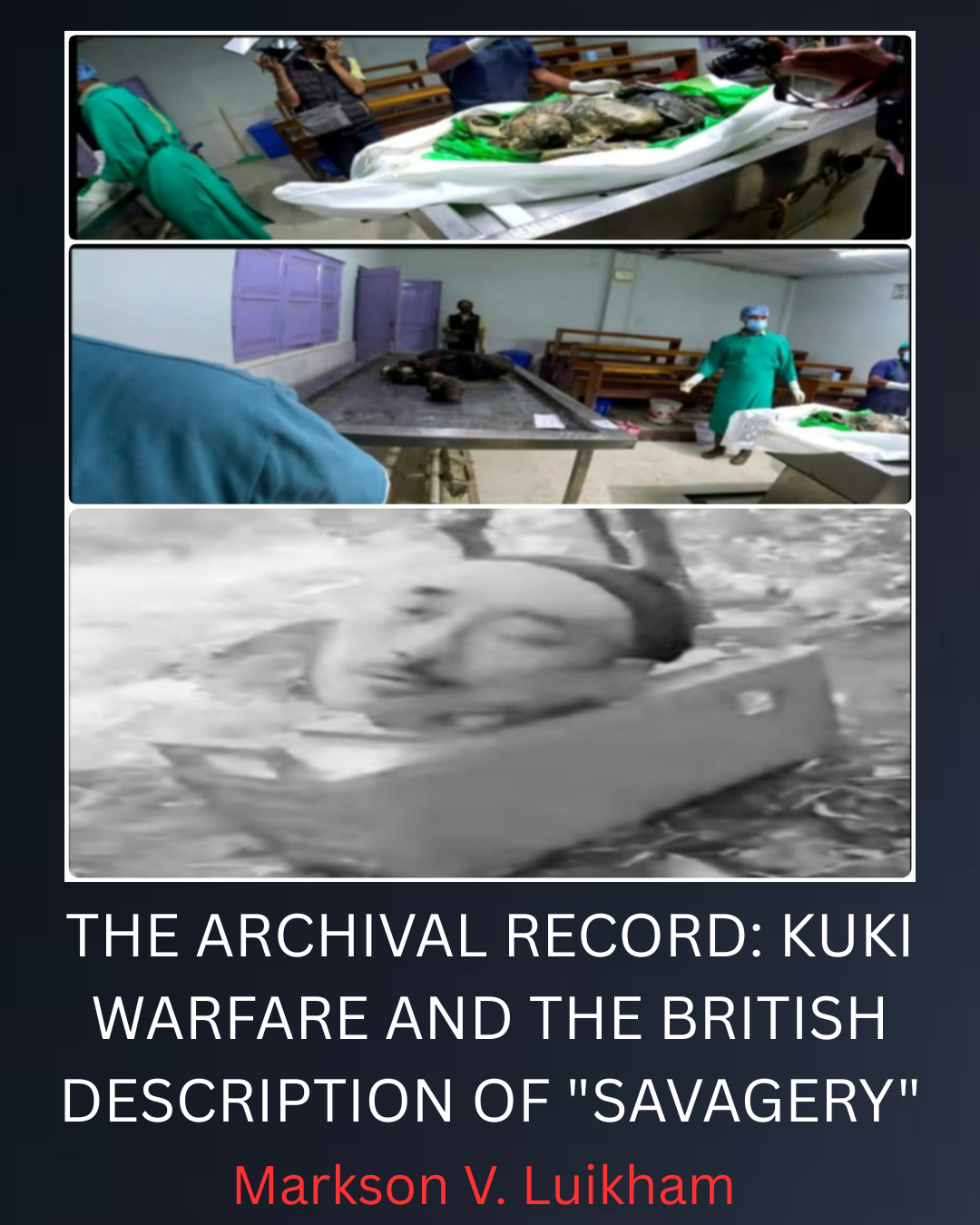
Ajinpou, a 52-year-old man, was allegedly beheaded by Kuki militants. A video circulating on social media purportedly showed armed men displaying his severed head. His family has refused to accept his headless body until the missing head is recovered, citing their traditions. His elder brother, R. Stoneson, said: “A person’s head is their identity. Without it, how can anyone identify the deceased?” The Joint Tribe Council-Manipur issued a 48-hour ultimatum demanding the return of the severed head and the arrest of the alleged perpetrators, Thangboi Kipgen, David Hangsing, and Sailen Haokip, identified as Kuki militant leaders.
Those images were watched by thousands. What did they feel? What does it say about our humanity when a severed human head can be displayed amid armed men and circulated as a spectacle? Would such cruelty seem less horrifying if the victim belonged to another community? Silence cannot restore the dead, but neither should the world become so accustomed to brutality that it stops demanding accountability.
This was not the only horror. On 13 May 2026, eighteen Naga civilians, including twelve female hostages, one of whom was an infant, and six men, were abducted at Leilon Vaiphei village in Kangpokpi district between 10:30 a.m. and 10:50 a.m. The captives were intercepted by Kuki women and men, taken to a hill, and handed over to armed Kuki militants. The six men were separated from the female hostages and taken away in a vehicle. The twelve female hostages, including the infant, were subsequently released, but the six men remained missing.
The released women described being blindfolded, having their hands tied behind their backs, and being moved through jungle and mountainous terrain. Dingamliu Abonmai said around forty people in civilian clothing had surrounded them before armed men in camouflage uniforms arrived, whom she identified as members of the Kuki National Front (KNF). Winiliu Thiumai recounted being blindfolded, forced to climb a steep hill, and taken to a gorge before being released at Molnoi village on 15 May and handed over to the police. Her husband was among the six men who remained missing.
The women were kept blindfolded through the night and threatened with death if they complained. They were not given proper food. They could hear the voices of armed women guarding them. When they asked the guards to remove their blindfolds, the guards shouted at them and threatened to shoot them.
The women also described being fed meat of unknown origin while blindfolded. Unable to see what they were eating or identify the meat’s source, they feared it might have been human flesh from the men taken away from them. A Facebook user also posted the comment, “We cook and ate it,” which circulated during the same period and intensified public concern.
On 28 June, Naga People’s Front president Awangbou Newmai reinforced the concern by referring to the women’s accounts and the condition of the recovered remains. He stated: “The women have stated they were fed meat of unknown origin during their captivity. Given how the mutilated bodies of the 6 Naga civilians were recovered, it makes the people suspect that they might have been fed even with that human flesh.” The women’s testimony, the disturbing social media comment, and the condition of the men’s remains demand a thorough investigation into what happened during their captivity and what they were made to eat.
The six missing men were identified as Rev. Dr. Manu Thiumai (45), Pastor Kenpibou Chawang (28), Phenrongwibou Thiumai (43), Dilip Thiumai (33), Ch. Phenrilung Chawang (36), and Kaliwangbou Abonmai (23). Their mortal remains were recovered on 10 June 2026 during a joint search operation involving hundreds of security personnel, sniffer dogs, and forensic experts. The bodies were decomposed, severely mutilated, and dismembered, making identification exceptionally difficult. Only one body, believed to be Dilip Thiumai’s, was relatively intact, with the hands tied behind the back. The other five were mutilated, butchered, and beheaded.
At the JNIMS mortuary, Paisho Thiumai, younger brother of Rev. Dr. Manu Thiumai, described the anguish of identifying his brother’s remains. He said he recognised him only by a blue sneaker. “My brother’s head had been severed, with only the skull remaining. Both his arms had also been chopped off from the shoulders, and his body was badly battered,” he said. Describing the condition of the other remains, he added: “We could not find single joints in some cases. In one case, the head part could not be found.” He concluded: “We are all deeply broken and angered by these inhuman acts.”
The families had waited weeks for the missing men to be found. The recovery of their mutilated remains brought devastating confirmation of their deaths and left their families confronting the horror of how they had been killed. The women’s testimony about their captivity and the unidentified meat they were fed, together with the condition of the six men’s remains, must be investigated thoroughly and impartially.
Nine Naga MLAs boycotted a Manipur Assembly session in protest. Awangbou Newmai also named the husband of Deputy Chief Minister Nemcha Kipgen as the prime accused in the killings. The allegation demands investigation and legal scrutiny.
At a press conference in Churachandpur on 25 June 2026, Kuki-Zo Council chairman Henlianthang Thanglet said: “I admit the Kuki-Zo people made a grave mistake in killing the six Naga civilians. It was done out of emotion. I strongly condemn it. I am very sorry and apologise on behalf of my people.” He described the incident as a “grave mistake” caused by emotion and apologised on behalf of his community. The following day, the Kuki-Zo Council clarified that the apology was a humanitarian gesture, not an admission of collective guilt, and stated that the perpetrators’ identities remained unknown. Both statements belong in the public record. The central question remains: who abducted and killed the six men, and who will be held accountable?
The suffering of Meitei civilians must also be remembered. On 11 November 2024, six members of a Meitei family, three women and three children, including a 10-month-old infant, were abducted from Borobekra in Jiribam district and killed. Their mutilated bodies were found floating in the Barak River.
The victims were identified as Yumrembam Rani Devi (60), Telem Thoibi Devi (31), Telem Thajamanbi Devi (8), Laishram Heithoibi Devi (25), Laishram Chingkheinganba Singh (2.5 years), and Laishram Lamnganba Singh (10 months). The National Investigation Agency filed a chargesheet against three accused: Thanglienlal Hmar alias Boya (40), Lalrosang Hmar alias Rosang (24), and Khopuimoi Hmar alias Puia (33), all allegedly affiliated with Kuki-Hmar militant groups. These are charges filed against named individuals in a court of law, not a verdict against an entire people.
NOW, LET US TURN TO THE HISTORICAL RECORD.
In his 1912 ethnographic work on Kuki clans, Lt-Colonel J. Shakespear devoted an entire chapter to “War and head-hunting.” He described a method of warfare involving raids on enemy villages, the seizure of captives, and the appropriation of property. He wrote that attackers would “raid the enemy’s villages and carry off as many captives and as much loot as possible.” The chapter also discusses ambushing, raiding, the first use of guns, and head-hunting.
Describing the massacre at Thaurang, a Sailo chief’s village, during the conflict between the Thangluah and Sailo chiefs, approximately 1833 to 1850, Shakespear recorded that attackers mingled with villagers celebrating at a great feast, waited until many were intoxicated, and then launched a surprise assault. Villagers were slaughtered, the village was burned, and captives were taken.
He also recorded that captives who fell behind were killed and that young men were sometimes taken away to be killed during victory celebrations. A captive might be reserved for a chief’s young son as a means for the boy to demonstrate bravery.
William Shaw’s Notes on the Thadou Kukis (1929), edited by J. H. Hutton, documented the ceremonial celebration of heads brought back from raids, including songs, processions, and special observances associated with beliefs about the afterlife and spiritual servitude.
Alexander Mackenzie’s History of the Relations of the Government with the Hill Tribes of the North-East Frontier of Bengal (1884) records that on 31 January 1860, a body of 400 to 500 Kukis swept down the River Fenny and entered the plains of Tipperah at Chagulneyah. They burned or plundered fifteen villages, butchered 185 British subjects, and carried off approximately 100 captives.
Major-General W. F. Nuthall, Political Agent at Manipur, reported in a letter to Lieutenant J. Butler, Deputy Commissioner of the Naga Hills, that on 3 May 1871, approximately 450 Kukis from Kooding-mang and its dependencies attacked Toofai village, west of the Barak River and east of the Mukroee River. His report recorded the deaths of ten men, ten women, and eight children, the removal of the victims’ heads, the abduction of three women and three children, and the burning of 87 houses and 100 granaries.
Sir James Johnstone, in My Experiences in Manipur and the Naga Hills (1896), described his investigation into the February 1880 attack on Chingsow, attributed to Chassad Kukis. He wrote: “The next day I investigated the case, and found that, as reported, twenty males and twenty-five females had been murdered.” Three people were taken captive, and half the village was burned. The assailants numbered about fifty, and victims were shot or cut down with daos. The attack followed a demand by Chief Tonghoo that the Chingsow Nagas submit to him and pay tribute, which they refused. The assault began at dawn, when villagers were starting their day. Johnstone also examined the remains of a mother and child.
For scholarly context, historian Jangkhomang Guite’s peer-reviewed article in Modern Asian Studies, published by Cambridge University Press, argues that colonial-era Kuki raids must be understood within frontier politics and resistance to state expansion. He writes that the Kukis “raided British territory when they discovered that an extension of the colonial boundary threatened their very existence as an independent state-evading population.” Historical context matters, but it must not become an excuse for atrocities or erase the suffering of their victims.
Contemporary reporting also documented the Kuki National Assembly’s political position toward the Naga movement. In an article titled “Conflict Resolution of Meiteis and Kuki-Zo-Chin,” published by The Morung Express on 17 August 2023, authors Felix Chahongnao, Wungpam Kasar, and Dr Nelson Vashum reported that in March 1989, the Kuki National Assembly (KNA) submitted a memorandum to Union Home Minister Buta Singh seeking the training and arming of Kuki youths and financial assistance. According to the article, the memorandum pledged to subdue the Naga Independence Movement within five years, a goal the authors contrasted with what they described as the Indian Army’s failure to achieve the same objective in forty years. The article identifies the KNA president and its secretary, the late Major Pugin Kipgen, as signatories and states that the exact date of submission was unavailable. The original memorandum has not been located in the sources consulted, so these details are attributed to the published account.
In 1992, the Kukis led by the KNA served a “Quit Naga” order in Moreh. The Indian Express reported that Kukis who had previously paid “taxes” to the IM said the order followed an incident in which two Kukis were killed near Moreh by IM militants.
In September 1992, the Kuki War Declaration Committee, led by C. Doungel and Holkhomang Haokip, declared war on the Nagas. Imphal Times reported that the declaration was made “without any provocation.” That phrase reflects the source’s characterisation of the declaration.
To Kuki readers, historians, and scholars, I invite you to examine these records and present credible counter-evidence wherever you believe the historical accounts are wrong. The actions of particular historical actors must neither be concealed nor projected indiscriminately onto an entire people. The same standard applies today: crimes must be investigated, perpetrators held accountable, and victims remembered without ethnic double standards.
The acts recorded in history cannot be erased by denial. Nor will the atrocities of our time disappear simply because the world looks away. I am documenting the record. Journalists are documenting it. Archives preserve the past, investigators gather evidence, and time carries the memory forward. What is done today will become part of tomorrow’s historical record.
History will remember not only those who committed atrocities, but also those who knew, those who had the power to speak, and those who chose to remain silent.
READ THE ARCHIVAL RECORD AND JUDGE FOR YOURSELF.
Markson V. Luikham
SOURCES AND FURTHER READING
1. The Indian Express, “Kin of beheaded Naga man refuse to accept body: ‘Against traditions'”
2. EastMojo, “Abducted Nagas were beheaded, mutilated ‘beyond recognition'”
3. Hindustan Times, “NIA files chargesheets in Manipur’s Jiribam killings”
4. The Hindu, “Kuki-Zo Council admits six Nagas were killed by Kukis,” 25 June 2026
5. The New Indian Express, “Kuki-Zo council admits community’s role in killing of six Naga hostages in Manipur,” 25 June 2026
6. India Today NE, “Manipur: Kuki-Zo Council admits killing of six Naga hostages, apologises; seeks impartial probe into all violence,” 25 June 2026
7. Northeast Today, “Manipur: Kuki-Zo Council Clarifies Chairman’s Apology Was Humanitarian, Not Admission Of Guilt,” 27 June 2026
8. J. Shakespear, 1912, digitised ethnographic work on Kuki clans
9. William Shaw, Notes on the Thadou Kukis (1929), edited by J. H. Hutton
10. Alexander Mackenzie, History of the Relations of the Government with the Hill Tribes of the North-East Frontier of Bengal (1884), digitised book
11. Historical account of the 1871 Toofai attack, published by Imphal Times
12. Sir James Johnstone, My Experiences in Manipur and the Naga Hills (1896), original book record
13. Jangkhomang Guite, “Colonialism and Its Unruly? The Colonial State and Kuki Raids in Nineteenth Century Northeast India,” Modern Asian Studies, Cambridge University Press
14. The Morung Express, “Conflict Resolution of Meiteis and Kuki-Zo-Chin,” 17 August 2023
15. The Indian Express, “In Manipur, shadow of an earlier ethnic clash”
16. Imphal Times, “Unveiling ‘Kuki Black Day’: The Truth Behind the Conflict and Propaganda”
17. The Sangai Express, “Freed women fear for the worst,” 19 May 2026
18. The Sangai Express, “‘Which woman can bear the sight of a beheaded husband?'” 13 June 2026
19. Northeast Live, “NPF Rejects Kuki Zo Council’s Apology Over Killing of 6 Nagas, Raises Suspicion Abductees Were Fed Meat of Unknown Origin,” 28 June 2026.
(The views and opinions in this article are solely those of the author and do not necessarily reflect the official stance of Rural Post)