
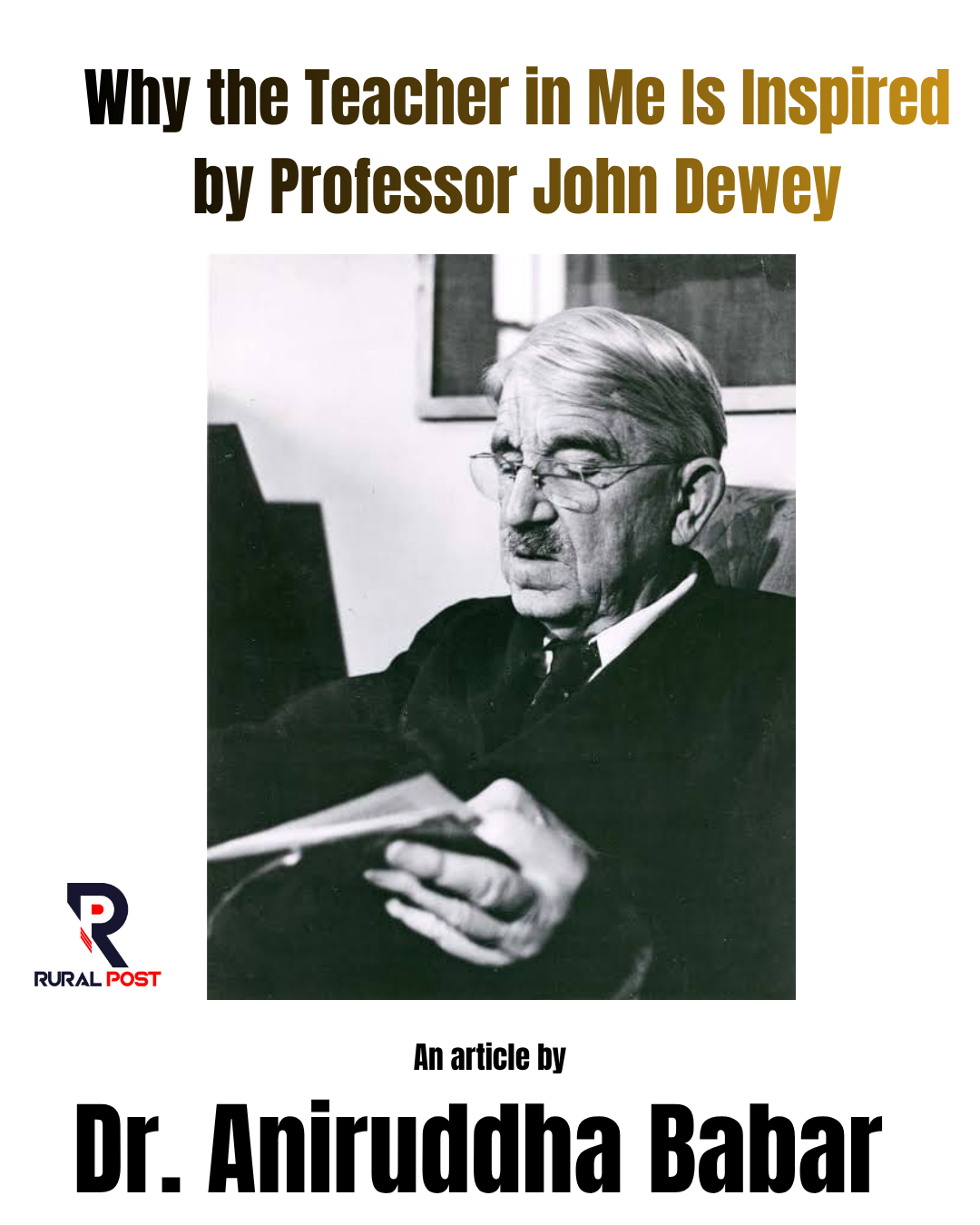
“Education, therefore, is a process of living and not a preparation for future living.”
~ John Dewey, My Pedagogic Creed (1897)
Today is Teachers’ Day, and it is a natural occasion for me to reflect on what teaching has meant to me, what I have learned from it and the ideas that have shaped the teacher in me. Teaching has led me to believe that its meaning goes far beyond mastery of a subject, preparation of lectures, examination of students and the transmission of knowledge. It concerns the formation of judgement, the development of intellectual independence and the ability of a person to approach the world with curiosity, reason and responsibility. It is within this understanding of education that I have found a strong intellectual connection with Professor John Dewey.
My connection with Dewey predates my own academic life. My father, who was a Banker by profession, was also influenced by John Dewey. I have always found this significant because his professional life was far removed from education and academic thought. Yet Dewey’s ideas made a strong impression upon him. He understood them as a way of thinking about experience, responsibility and human development. When I entered academia and began developing my own intellectual interests, I gradually recognised that some of the ideas I encountered through my studies and teaching had already been present in my home. My father’s engagement with Dewey taught me something important a great thinker belongs to the wider intellectual life of society. Ideas become meaningful when they enter everyday life and influence how people understand work, society and their obligations to others. Without my fully realising it at the time, my father’s interest in Dewey had already placed certain questions in my mind about the purpose of education and the relationship between learning and life.
Dewey remains important to me because he makes us reconsider what education is meant to do. His understanding of experience is central to this question. Human beings learn through their encounters with the world, through the consequences of what they do, through reflection and through further inquiry. Experience by itself does not necessarily educate. Its educational value develops when a person begins to understand what an experience means and what can be learned from it. This gives education a purpose beyond the accumulation of information. It makes learning a process through which experience is examined, understood and used to approach subsequent experience with greater intelligence.
This has direct relevance to the classroom. Some of the most meaningful moments of teaching have emerged from questions raised by students. A question can be incomplete, provocative or mistaken and still contain the beginning of independent thought. The responsibility of the teacher is to take the question seriously, examine its assumptions and help the student develop it into a meaningful line of inquiry. A genuine question can become the starting point of intellectual growth
The teacher therefore has a responsibility to create conditions in which students learn how to think through questions rather than simply receive answers.
This understanding has particular significance in academic life. Higher education introduces students to established bodies of knowledge, the methods through which knowledge is produced and the ways in which knowledge is revised. Academic life requires intellectual openness, careful reasoning and respect for evidence. It should develop the ability to examine an argument, understand its foundations, question its assumptions and engage with different interpretations. The purpose of teaching, in this sense, is closely connected with the development of judgement. Knowledge becomes useful when a student acquires the ability to use it intelligently.
This is where Dewey’s understanding of democracy becomes important. For Dewey, democracy was a form of associated life sustained through communication, participation and shared experience. Education had a central role because democratic life depends upon people who can communicate, inquire, deliberate and respond intelligently to common problems. This has particular relevance to India, with its enormous social, linguistic, cultural and historical diversity. Democratic life requires habits of listening, deliberation, accommodation and reasoned judgement. These habits do not develop through political institutions alone. They are also formed through education and everyday. social experience.
The progressive intellectual tradition of Maharashtra offers an important Indian context for understanding these concerns. Mahatma Jyotirao Phule placed education at the centre of social emancipation and challenged structures through which knowledge had historically been restricted. Savitribai Phule gave this principle practical expression through her pioneering work for the education of girls and those excluded from formal learning. Gopal Ganesh Agarkar placed reason, intellectual freedom, rational inquiry and social reform at the centre of his thought. Sane Guruji brought a strong concern for compassion, moral development and human dignity. Dr. B. R. Ambedkar gave education a wider constitutional and democratic significance, connecting knowledge, self-respect and intellectual awakening with social justice and equal citizenship. Their historical circumstances and intellectual positions were different, yet their work helps illuminate a question that has become important to me as a teacher: what should education enable a human being to become? The answer cannot be limited to employment or professional competence. Education must also develop the capacity to think, question, participate and act with responsibility.
This Indian context has deepened my engagement with Dewey. It has also made me more conscious that educational ideas acquire meaning within the societies in which they are practised. Dewey’s emphasis on experience, inquiry and democratic participation can be considered alongside Indian traditions of social reform, rational thought, humanism and constitutionalism. These connections became more concrete for me through teaching in Naga society. The classroom provided a place where questions about education, social change, identity, institutions and public responsibility became part of the experience of teaching itself.
Naga society is passing through a period of significant social change. Community life, customary institutions and collective responsibility continue to shape social relations and public life. At the same time, younger generations are encountering new forms of education, technology, economic opportunity and political participation. These influences are reshaping how they understand identity, authority, work, society and their place within it. The Naga student therefore enters the classroom with experiences shaped by inherited ways of life and changing social realities. Teaching in such a context requires an understanding of this social context and a willingness to engage seriously with the questions it raises.
Teaching in Naga society has strengthened my conviction that education must cultivate intellectual courage. Students need the capacity to examine their own society with honesty and seriousness. Social practices deserve examination in the light of justice, human dignity and contemporary realities. Customary knowledge deserves careful study and thoughtful engagement. Modern ideas require the same intellectual scrutiny. Education should give young Nagas the capacity to understand their history, evaluate their institutions, recognise social weaknesses and contribute to constructive change. Such education develops responsibility alongside knowledge and connects individual advancement with the welfare of society.
This is where Dewey’s understanding of experience becomes especially relevant. Students enter the classroom carrying the influence of family, community, language, region, history and personal circumstance. These experiences shape the questions they ask and the way they understand the world. A serious teacher must recognise this experience as part of the educational process. The task is to help students examine what they have inherited, understand what they are encountering and develop the capacity to make informed judgements about both. The experiences of Naga society therefore provide important material for inquiry into identity, social change, citizenship, institutions and human development. Education can help transform experience into reflection, reflection into inquiry and inquiry into judgement.
This also shapes my understanding of the purpose of education. Employment and professional competence are important dimensions of a student’s future. Education also develops the capacities required for responsible participation in society. Society requires administrators who understand consequences, researchers who respect evidence, public servants who understand responsibility and citizens who can distinguish argument from assertion. Academic life contributes to the development of these capacities through sustained intellectual engagement.
Education also has a bearing on the character and future of the nation. A nation is shaped by the quality of judgement, integrity and responsibility among its citizens as well as by its institutions and economic strength. Schools and universities therefore carry a responsibility that extends beyond individual advancement. They prepare people who will enter public institutions, professional life and communities and whose decisions will influence the direction of the nation. For a teacher, this gives education a larger sense of purpose. To teach student to think clearly, respect evidence, understand differences and act responsibly is also to contribute to the making of the nation.
For this reason, I have remained cautious about educational fashions that promise rapid change through technology, management systems or new examination structures. Technology can expand access to knowledge and create new possibilities for learning. Curriculum reform can improve relevance. Institutional reform can strengthen academic life. Their value ultimately depends upon the purposes they serve and the quality of the intellectual engagement they create. Dewey’s philosophy remains useful here because it asks us to consider what education is doing to the mind of the learner.
The teacher occupies an important position within this process. A teacher possesses knowledge, experience and institutional responsibility. These carry an obligation to guide students towards independent inquiry. The teacher must be prepared to explain how conclusions are reached, what evidence supports them and why a conclusion may need to be reconsidered when new evidence appears. This also requires intellectual humility from the teacher. A teacher cannot ask students to remain open to inquiry while treating his or her own conclusions as beyond examination.
This is why I regard the teacher as lifelong learner. Every generation of students brings new experiences and new questions. Society changes, knowledge expands and intellectual categories develop. A teacher who remains intellectually active allows these developments to enter the classroom as opportunities for inquiry. Dewey’s idea of education as growth is relevant here. Education does not end when formal schooling or university education ends. Learning continues as people encounter new situations, reconsider earlier understandings and develop new capacities through experience.
The contemporary information environment makes this responsibility even more important. Information is available in enormous quantities. Communication is immediate and opinions circulate rapidly. Students can encounter vast amounts of material within seconds. The educational challenge increasingly concerns judgement. Students need to learn how to evaluate information, establish context, recognise evidence and distinguish knowledge from assertion. The teacher’s role therefore includes developing habits of careful thought, intellectual honesty and reflection.
I have come to see teaching as the cultivation of intellectual habits that remain with a student after formal education has ended. The ability to ask a precise question, examine evidence, recognise error, listen carefully, reconsider an argument and arrive at a reasoned judgement forms the foundation of intellectual maturity. These habits also enter professional and public life. An educated mind carries its education into decisions, institutions, citizenship and relationships with others.
This is also why academic integrity matters. Honesty in scholarship, respect for evidence and willingness to acknowledge error are not merely professional requirements. They shape the habits of mind that education seeks to develop. When these habits are taken seriously, they strengthen trust in academic institutions and in the people who work within them. Institutional credibility ultimately depends upon the conduct of individuals.
The influence of a teacher is rarely captured by conventional measures of academic success. Examination marks can be recorded, degrees can be awarded and publications can be counted. The effect of a teacher on a student’s way of thinking is harder to measure. A conversation, a book, a question or a moment of encouragement may remain with a student for years. The teacher may never know where a particular lesson eventually leads. That is part of the nature of teaching.
This is ultimately why the teacher in me remains inspired by Professor John Dewey. His work has given me a way of thinking about education in which experience, inquiry, reflection and democratic participation are closely connected. His ideas have acquired an additional personal meaning because my earliest encounter with his influence came through my father, a banker whose professional life nevertheless carried an appreciation of Deweyan thought. What began for me as something I encountered within my family gradually became part of the way I understood teaching and academic life.
Perhaps this is what I have come to value most. The finest student is one who develops intellectual independence, disciplined judgement, humility and courage. Such a student carries education into the wider world and contributes to institutions, communities, public life and the nation with a sense of responsibility. If teaching helps develop such a mind, the teacher has fulfilled one of the central responsibilities of the academic profession.
On Teachers’ Day, therefore, I find myself returning to the idea that first entered my intellectual world through my father. The teacher must remain a learner. Education must remain connected to experience, inquiry and the life of society. It must also help prepare citizens capable of contributing thoughtfully to their communities and to the nation. The purpose of teaching ultimately lies in helping another human being develop the capacity to think, to question, to judge and to act with responsibility. That, for me, is why the teacher in me continues to be inspired by Professor John Dewey.
(Dr. Aniruddha Babar is a Senior Academician, Public Policy Expert & Social Development Specialist, Writer, and Researcher currently serving in the Department of Political Science, St. Joseph College, Ukhrul, Manipur. He is also the Co-Founder and Deputy Director of the Centre for North-East Development and Policy Research (CNEDPR), St. Joseph College, Manipur.)