
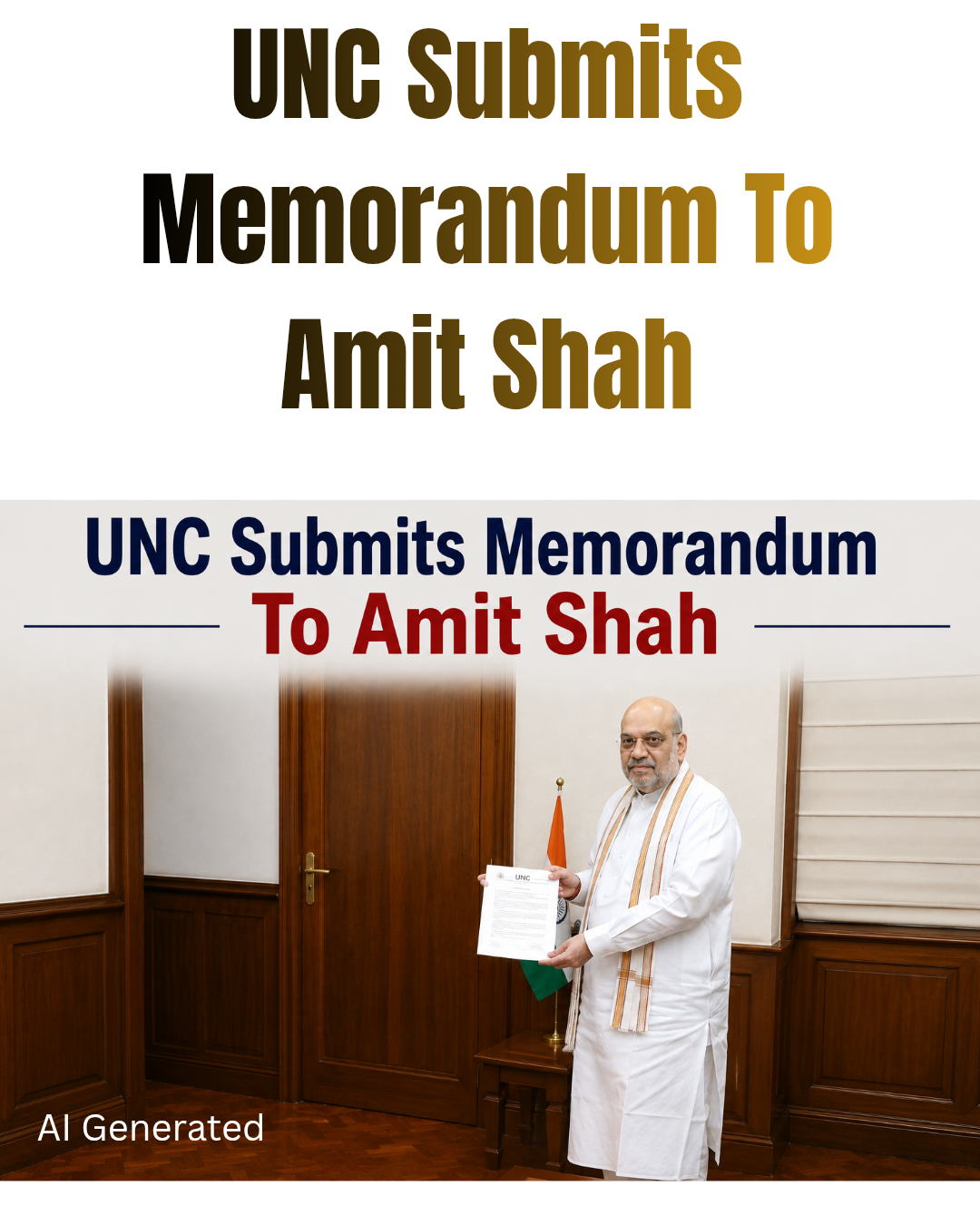
The United Naga Council (UNC) on Wednesday submitted a memorandum addressed to Amit Shah, Union Home Minister in matters related to the Strategic Security Assessment – Systemic violations of the Suspension of Operations Framework and the case for a Legitimacy-Based Frontier Security Architecture in Manipur.
The memorandum reads, “in continuation of our memorandum dated 12 June 2026, which has not yet received a substantive response, the United Naga Council (UNC) respectfully submits this updated strategic security assessment. This memorandum is intended not merely to document a further deterioration of the security situation, but to assist the Government of India in assessing a wider strategic concern. The pattern of events outlined below indicates that the present security architecture in Manipur’s Naga areas is achieving limited tactical containment without generating the political legitimacy essential for durable frontier stability. Left unaddressed, this gap is likely to increase rather than reduce long-term security risks along India’s eastern frontier.
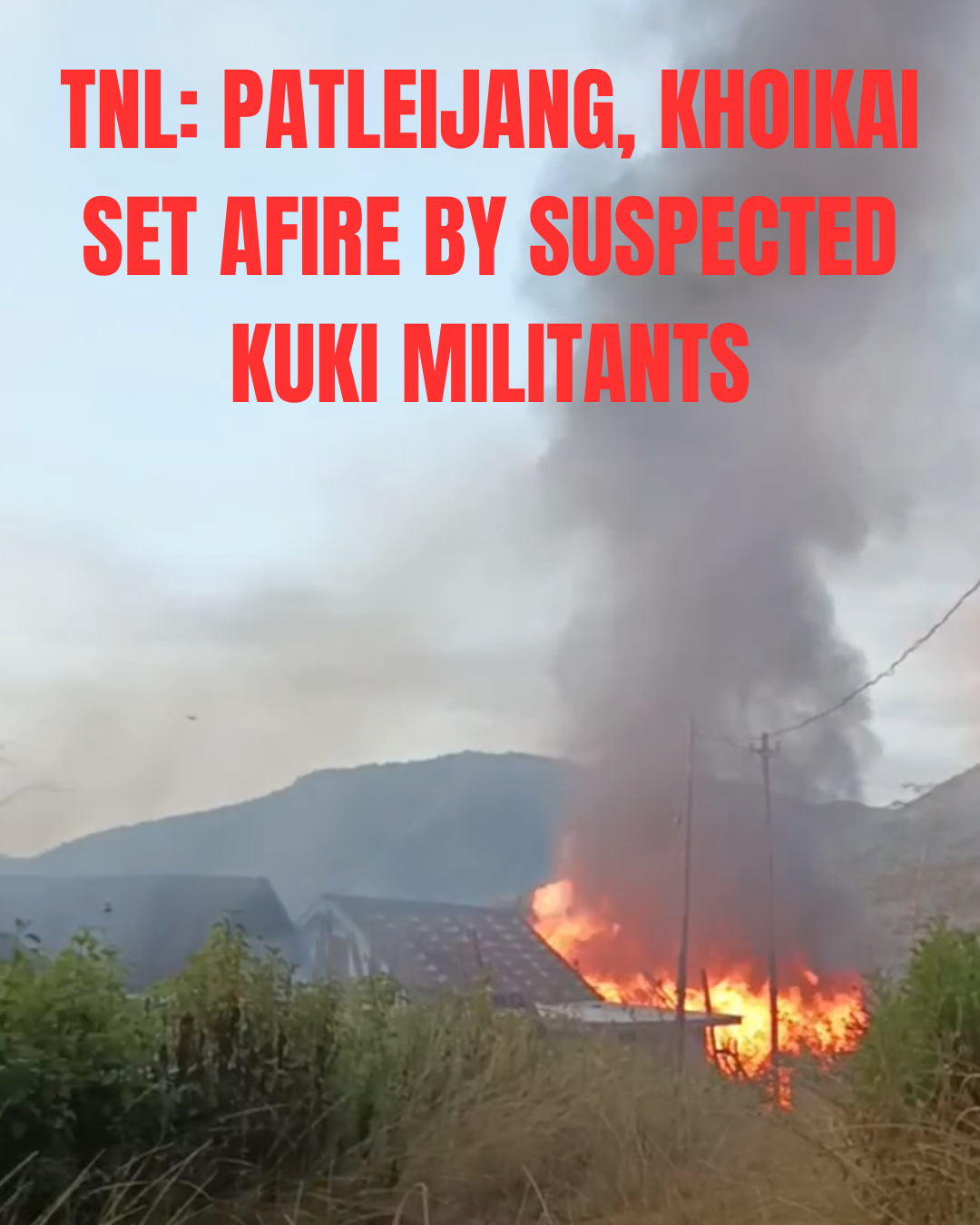
“Since January 2026, at least thirty documented incidents of arson, ambush, abduction, and armed assault have been directed against Naga villages and civilians across Kangpokpi, Ukhrul, Senapati, and Tamenglong districts, several involving cadres operating under the Suspension of Operations (SoO) framework and its cross-border extension into Myanmar. This dossier sets out the statutory and constitutional dimensions of that pattern and the federal action it requires.”
I. Cross-Border Military Incursion and the Erosion of Frontier Control
The Government of India’s constitutional mandate to secure the Indo-Myanmar border has been tested, and found wanting, at the same frontier sector twice within two months.
FOREIGN INCURSION, 7 MAY 2026: An estimated 100 heavily armed cadres of the Myanmar- based Kuki National Army-Burma (KNA-B) crossed into sovereign Indian territory at Kamjong, Ukhrul district, and, using drone-mounted munitions, rocket launchers, and 40mm breach-loading guns, systematically razed the Naga villages of Z. Choro, Namlee, Wanglee and Kaka. This was a coordinated military operation conducted by a foreign-based armed formation on Indian soil, not an isolated raid.
SECURITY APPARATUS FAILURE: The bombardment was carried out approximately 200 metres from a stationed 11 Assam Rifles company post. That an operation of this scale could be executed within visual range of a central security force post, without interdiction, points to a gap between the Union’s obligation under Article 355 to protect States against external aggression and the operational posture actually maintained on the ground
CONTINUING CROSS-BORDER COLLUSION, 1 July 2026: The pattern did not end in May. On 1 July, Kuki militants operating in coordination with the KNA B set fire to Phaimol, a Kuki village under Kamjong sub-division, what field reports indicate was a deliberate act intended to manufacture a pretext for a subsequent, pre-planned assault on two Tangkhul Naga settlements -Human Thana and Kherongram, a hamlet of Nampisha village along the Indo-Myanmar border. Twenty-five houses were destroyed. The use of a self-inflicted incident to construct a justifying narrative for cross-border aggression is not a tactic associated with spontaneous communal unrest, it is a hallmark of organised, premeditated operations, and should be assessed by the Ministry’s security planners as such.
Repelling any single incursion is a tactical achievement, preventing its recurrence at the same frontier point is a strategic one and by that measure, the current posture has not yet succeeded
II. Documented Violations of the UAPA and SoO Ground Rules.
The violence occurring within Manipur’s interior compounds this frontier breach. It is not spontaneous civil unrest, it is premeditated activity executed by groups operating under the explicit protection of the SoO agreement, and it has already met the statutory threshold for terrorism under Indian law
PREMEDITATED ABDUCTION, 13 MAY 2026: At approximately 11:30 am, at Leilon Vaiphei village, eighteen unamed Naga civilians were unlawfully abducted by a coordinated network involving village authorities and cadres of the Kulo National Front-President (KNF-P), a constituent of the United Peoples’ Front (UPF) currently operating under the SoO framework.
EXECUTION AND DISMEMBERMENT: Twelve hostages were subsequently released. The remaining six were held captive and murdered; their remains, recovered on 10 June 2026, showed signs of severe mutilation.
STATUTORY RECOGNITION: These acts are formally documented in Zero FIR No. 00(7)(5)2026 SEK-PS, transferred as FIR No. 23(5)2026-GSPM-PS, with the subsequent addition of Section 16(1)(b) of the Unlawful Activities (Prevention) Act. The investigating authority has therefore already classified these acts as terrorism in law.
The statutory threshold has already been met. What remains outstanding is not classification, but Consequence.
III. State Complicity and the Compromise of the Internal Security Apparatus
The capacity of SoO-protected cadres to execute offenses of this gravity with apparent impunity is sustained, in part, by documented failures within the state’s own security apparatus
POLICE COMPLICITY: A formal criminal complaint identifies Mr. Thanginlen Vaiphes, serving Manipur Police personnel at Leimakhong Police Station, active participant in the handover of the eighteen Naga hostages to UPF/KNF-P cadres.
INSTITUTIONAL SHIELDING: When cadres of an organisation formally party to a Union-brokered peace framework can carry out abduction and murder with the alleged assistance of serving police personnel, the resulting failure is not confined to one station or one district. It signal that the internal security apparatus responsible for enforcing SoO ground rules is, in this theatre, operationally compromised
IV. Strategic Reflections on India’s Long-Term Frontier Security
The incidents catalogued above are not merely a law-and-order concern, they bear on a strategic question that predates the current administration and will outlast it. India’s seven decade experience along its northeastern periphery offers a consistent lesson: military predominance has repeatedly proven necessary to contain immediate threats, but has just as repeatedly proven insufficient to produce lasting settlement.
The enduring security of a frontier depends not merely on the presence of the State, but on the confidence of the people who inhabit it that state authority is exercised with legitimacy, consistency, and justice. Where that confidence is established, communities become partners in securing the frontier rather than populations to be managed. This distinction is not philosophical, it has at the heart of successful frontier governance.
The most durable periods of stability along India’s northeastern frontier have emerged where the Union invested in political relationships recognised as legitimate by the indigenous communities. themselves. Article 371A, the 1997 ceasefire, and the Framework Agreement of 3 August 2015 illustrate an enduring principle of successful frontier governance. legitimacy, once earned, generates a depth of security that coercive power alone cannot sustain
This distinction between a tactical arrangement and a strategic partnership is not a semantic one. A tactical arrangement suspends hostilities, a strategic partnership transforms the relationship between the state and the community it governs. The Suspension of Operations framework, properly used, can be either.
Where it has been anchored in genuine political engagement, as with the Naga process, it has produced nearly three decades without a return to large-scale conflict. Where it functions principally as an operational ceasefire extending the legal cover of a peace process to actors who have not undertaken a corresponding political commitment – it risks becoming a shield for continued low-intensity aggression rather than a bridge to settlement. The events documented in this memorandum indicate that the SoO arrangement covering the relevant Kuki militant formations has, in practice, drifted toward the latter condition.
This matters strategically because the communities directly affected the Naga people of Manipur’s hill districts are not a peripheral constituency to be managed. They are a historically rooted indigenous population whose customary institutions have, for decades, absorbed and resolved disputes that might otherwise have escalated, the UNC’s own resolution of the majority of first-phase incidents in this conflict through Naga customary law, rather than through the formal criminal justice system, is itself evidence of an institutional capacity the state has relied upon without fully recognising. A frontier security policy that treats this capacity as incidental rather than central will find itself managing symptoms indefinitely.
None of this is an argument against firm enforcement, it is the opposite. Enforcement that fails to distinguish between actors honouring the political logic of a peace framework and actors exploiting its legal protections will, over time, degrade the credibility of the framework itself for every party to it, not only the Naga. The strategic risk before the Ministry is not confined to further violence Manipur’s hills. It is the erosion of a proposition built patiently over decades that peace frameworks in India’s northeast reward political legitimacy rather than tactical advantage. That proposition, once weakened, is not easily restored.
V. Actionable Demands
The continued extension of the SoO framework’s protections to groups documented in violation of its ground rules does not preserve peace; it defers a reckoning while eroding the framework’s credibility for every party to it, and it stands in tension with the political logic underlying the 3 August 2015 Indo-Naga Framework Agreement. On the strategic reasoning set out above, the UNC submits the following measures as steps that would restore, rather than further erode, the legitimacy on which durable frontier security depends:
1. ABROGATION OF THE SOO AGREEMENT: Immediate termination of the Suspension of Operations agreement specifically with all Kuki Militant groups.
2. TERRORIST DESIGNATION: Formal designation of the Kuki National Front-President Group (KNF-P) as a terrorist organisation, consistent with the statutory findings already recorded under the UA(P)A.
3. DEMONSTRATE A COMMITMENT TO JUSTICE: Promptly advise the Governor of Manipur to exercise his constitutional authority under Article 164(1) of the Constitution of India, under which Ministers hold office during the pleasure of the Governor, to secure the immediate removal of Mrs. Nemcha Kipgen from the Council of Ministers. In light of the complicity to the Leilon incident, her continuance in office gives rise to an apparent conflict of interest, undermines public confidence in the impartial administration of justice, and risks compromising the credibility of any investigation into the matter.
4. FEDERAL PROSECUTION: Arrest and prosecution, under the UA(P)A, of the KNF-P cadres and Leilon Vaipher village authorities identified above (Mr. Lalboi Vaiphei, Mr. Haopu Khaute, Mr. Thangkhulen Khaute), together with the complicit police personnel.
5. FRONTIER SECURITY REVIEW: An independent Ministry of Home Affairs review of the operational posture along the Kamjong sector of the Indo-Myanmar border, given the recurrence of cross-border incidents at this location in May and July 2026, to close the gap between force presence and interdiction capability identified in Section I.
6. INSTITUTIONAL ENGAGEMENT: Formal Ministry-level engagement with the United Naga Council and other Naga customary institutions on the design of a security and reconciliation framework. for Manipur’s hill districts as recognition of the institutional capacity these bodies have already demonstrated in resolving the majority of first-phase incidents through customary law, and as the operational foundation of the legitimacy-based approach set out in Section IV.
“The United Naga Council seeks, through this memorandum, not an escalation of confrontation but the restoration of a security architecture in which enforcement and legitimacy operate together. We stand ready to engage directly with the Ministry, and with any mechanism it constitutes, toward that end.
“The question before the Government is therefore not simply how to respond to the latest incidents of violence. It is whether India’s eastem frontier will continue to depend principally upon recurring crisis management or whether it will be strengthened through a durable political architecture founded upon legitimacy, constitutional engagement, accountable institutions, and trusted partnerships with historically rooted indigenous communities. The United Naga Council respectfully submits that the latter course better serves both the long-term security interests of the Republic of India and the enduring peace of the region” stated the memorandum signed by NG. Lorho, President UNC and Vareiyo Shatsang General Secretary UNC. The memorandum was submitted through the Deputy Commissioner of Senapati.