
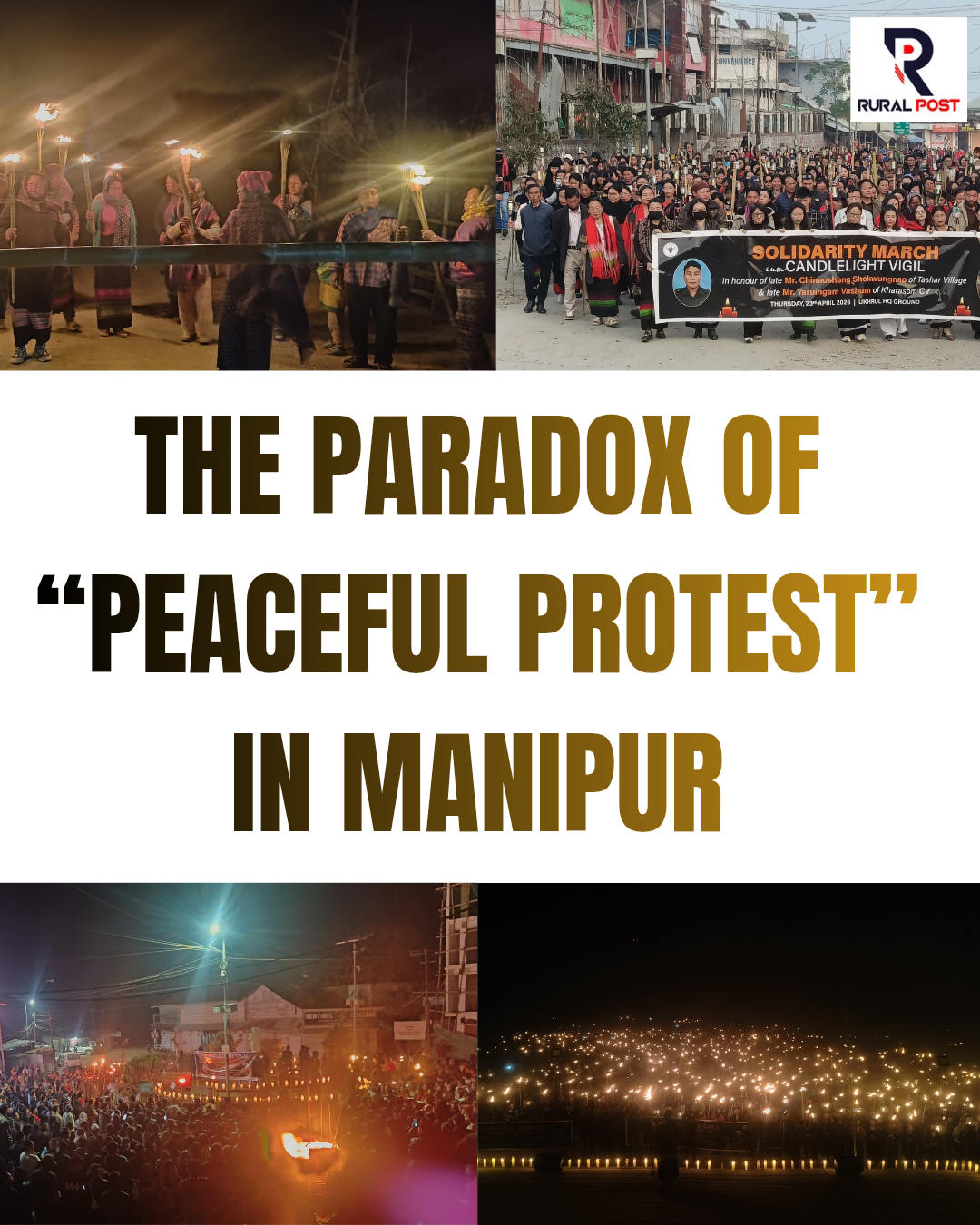
THE PARADOX OF “PEACEFUL PROTEST” IN MANIPUR
Chingya Luithui
THE PATTERN OF PROTESTS IN MANIPUR
Keen observers of ethnic conflicts and confrontations in Manipur must have seen a pattern that is as consistent as it is disturbing. Whenever a flashpoint occurs, whether from an act of the state, or individuals (these days very unfortunately but habitually given a communal tinge), or a political controversy, the affected community responds with what is commonly announced as a “peaceful protest.” Crowds are gathered, marches are organised, slogans are shouted, and placards and banners are raised. And then, with dispiriting regularity, the protest itself becomes the crisis: roads are blocked, vehicles are torched, properties are destroyed, and in cases where different communities are involved, the “others” are threatened, even killed. The very violence that is being protested against is reproduced in the act of condemning it.
This has become so normalised and run-of-the-mill that hardly anyone in Manipur seems to notice, let alone question. However, it begs the essential question of what exactly is being protested against, to whom, to what end, and for what purpose.
This pattern is not occasional or incidental but symptoms of a larger underlying disease that has infected not merely the political system in Manipur but also its social, cultural, and communal relationships. Unfortunately, the political system in Manipur has negatively influenced, shaped, and sustained these relationships; they, in turn, have fed the politics of divide. It has resulted in a perpetual cycle of violence.
SOME COMMON FEATURES
Manifestations of this cycle can be seen in the highly inflammatory and derogatory rhetoric that everyone across the board has adopted. Speeches, banners, and placards are frequently accusatory without any factual basis or evidence, and the language used in protests seems to have humiliation of the “others” as the intention. Often, acts of an individual or group are ascribed to the whole community. Bolstered by the widespread use of social media, the conflation of facts with misinformation, allegations, and assumptions does not help.
Much of the protests witnessed in Manipur over the last few years have also been characterised by their reactive nature dictated by emotions rather than objective reflection and analysis. Anger, fear, and grief are utilised by some as ingredients to incite further violence. While there certainly are genuine community-wide protests, there has been an increasing tendency where vested political actors and groups have exploited the people as instruments of forceful pressure rather than as those who are exercising their sincere democratic will. This co-option of protests is particularly visible when electoral politics is thrown into the mix.
Related to this, another common feature of protests in Manipur is the weaponisation of victimhood where genuine suffering and challenges are transformed into political capital. Every community in Manipur has been a victim in one way or another. Marginalisation, discrimination, and injustice are very real common threads that weave together the experiences of the people in the state. However, victimhood does not legitimise further injustice and denial of rights to others; the experience of being wronged (whether real or perceived) has been too frequently used not to seek justice but to justify further wrongdoing. As victims, there seem to be a rationalisation of exemption from moral principles and constraints in response to the suffering. This is problematic at so many levels; just because an individual or a community is a victim does not absolve them from being accountable as participants of violence.
MORAL BANKRUPTCY AS AN UNDERLYING FACTOR
All these are clearly indicative of a deep moral bankruptcy steeped in the “us” and “them” mentality. This is evident from the fact that justice, rights, and peace have been appropriated by each group or community not as shared values or principles but as mere words and vocabularies to further one’s own interest. In the end, protest gets reduced to a very performative display of grievances while the substance of justice, rights, and peace are intentionally ignored and quietly abandoned. As such, protests become markers for a community’s potential to harm if demands are not met instead of their ability and capacity to listen and reason. It inherently results in the dehumanisation of each other and closes the doors for much needed dialogues and discussions.
Aside from undermining the credibility of protest, these have the more far-reaching consequence of misinforming future generations of the very concept of legitimate protest. Rather than deliberate and principled engagement within themselves and others toward goals underpinned by shared principles and values, they are shown that protest is just a performance to signal affiliations to one’s own group while directing hostility toward the “others.” In the process, the very actions and injustices that are being opposed are normalised when committed by “us.”
It is important to remember that moral bankruptcy does not occur or sustain itself in a vacuum.
Moral bankruptcy needs the complicity of those who lead as well as those who follow. Political and community leaders, civil society organisations, and religious institutions all bear responsibility for the society over which they have a sphere of influence. However, everyone in Manipur seem to have taken the path of least resistance: validating the anger of their communities rather than channelling it, amplifying grievance rather than analysing it, and protecting their own position rather than taking responsibility.
While this may seem far-fetched, AFSPA and the culture of impunity it has fostered is also a significant factor. AFSPA has created an environment in which violence by state actors goes unpunished; it is hardly surprising that violence by protesters or non-state actors follow a similar logic of immunity, of moral bankruptcy. The common people have learned that violence achieve results, or at least is not punished, while those who follow the rule of law lose out.
Moral bankruptcy requires the stifling of dissent. This is where the common people can play a significant role. However, for a number of reasons there is an overwhelming defeatist approach among the people when it comes to dissent. Protest, in its barest form, is an expression of dissent against the status quo of injustice. But when the very barest form of dissent is drowned by the structure it seeks to question, what is the way forward?
SYMPTOM TO CAUSE: THE NEED TO REVISIT “PEACEFUL PROTEST”
What began as a symptom—protest as an expression of deeper social discontent—has become a source for further violent conflict in its own right. It is worth remembering that protest cultures have their own momentum, their own logic of escalation, their own capacity to shape the communities that practice them. A generation raised on performative protest, on the understanding that grievance is expressed through rage, that the enemy is always the other, that restraint is weakness and accommodation is betrayal, is a generation being prepared for perpetual conflict rather than equipped for coexistence.
Genuine protest in a democratic society must have consistency of principle: the wrong being protested must be condemned as a wrong regardless of who commits it. A community that protests violence against its own members while ignoring or condoning violence by its own members has not made a moral argument or taken a conscientious stand—it has made a communal argument and has taken a communal stand.
From the discussion above, the need for openness to dialogue is self-evident. Genuine protest innately means the willingness to engage with what it is opposing or who it is opposing. A protest movement that treats opportunities for dialogue as a means to dominate or as capitulation implies it has chosen the continuation of conflict over the achievement of a just and fair outcome.
Related to this is the recognition of restraint as strength. The most powerful protest movements in history such as Gandhi’s Satyagraha, Mandela’s Defiance Campaign, or the US Civil Rights Movement, or as a present example, the Gaza Freedom Flotilla, are precisely powerful because of their refusal to respond to violence with violence. These examples show that restraint is not weakness but, while the hardest, is also perhaps the most effective discipline a protest movement can achieve. Restraint is a moral principle that proclaims injustice or wrongs to one should not cause further injustices or wrongs to others.
All these require honesty and to hold one’s own to the same moral standards that one applies to others. Ultimately, this is a moral choice of making oneself accountable. And accountability is the beginning of any genuine protest movement that claims to be for justice, rights, and peace.
References:
Bhagat Oinam, “Patterns of Ethnic Conflict in the North-East: A Study on Manipur,” Economic and Political Weekly, Vol. 38, No. 21 (May 2003), pp. 2031–2037.
Human Rights Watch, “They are Still Here to Terrorize Us”: India’s Continued Use of the Armed Forces Special Powers Act, Report (New York: HRW, September 2008).
James M. Jasper, The Art of Moral Protest: Culture, Biography, and Creativity in Social Movements (Chicago: University of Chicago Press, 1997).
Partha Chatterjee, “Community in the East,” Economic and Political Weekly, Vol. 33, No. 6 (February 1998), pp. 277–282.
Sanjib Baruah, Durable Disorder: Understanding the Politics of Northeast India (New Delhi: Oxford University Press, 2005).
Suhas Chakma (ed.), Report on Manipur Violence 2023 (New Delhi: Asian Centre for Human Rights, 2023).
Veena Das, Life and Words: Violence and the Descent into the Ordinary (Berkeley: University of California Press, 2007).
DISCLAIMER
(The views and opinions in this article are solely those of the author and do not necessarily reflect the official stance of Rural Post)