
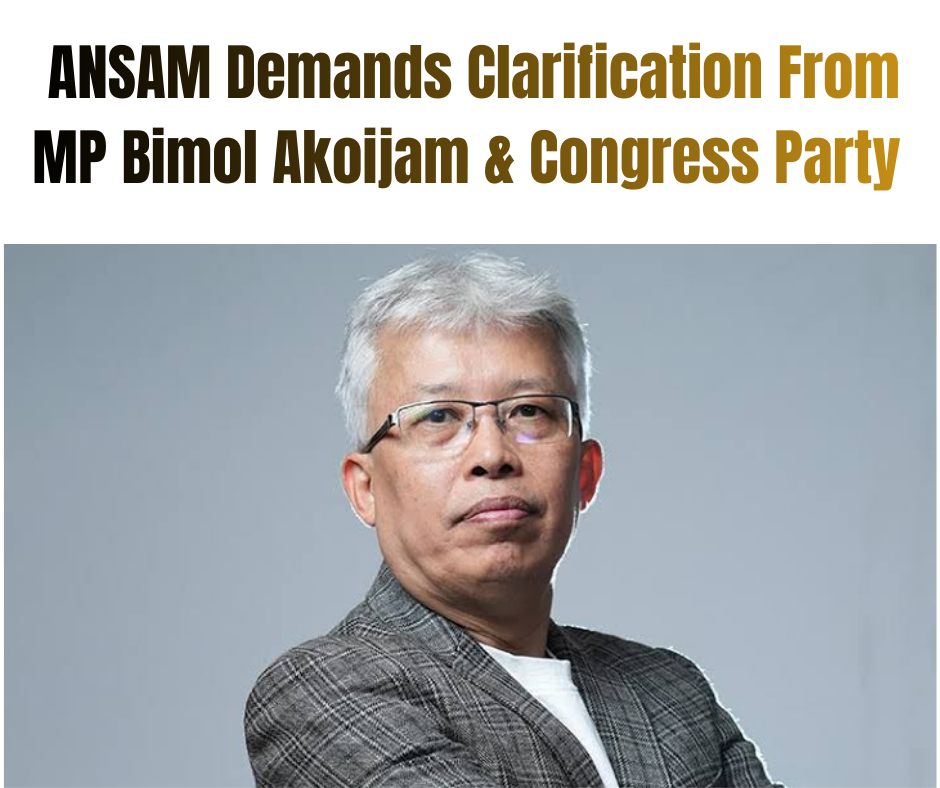
The All Naga Students’ Association Manipur (ANSAM) has demanded clarification from Hon’ble MP (Inner), Dr. Bimol Akoijam whether the statement was made in his personal capacity, or do the statements that disregard the established legal, constitutional and administrative framework governing land and resource ownership in the hill districts of Manipur reflect the official position of the Indian National Congress. ANSAM has sought public clarification from the MP.
The press release issued by Information and Publicity, All Naga Students’ Association, Manipur (ANSAM) stated that, “the All Naga Students’ Association Manipur (ANSAM) has taken serious note of the statements of Dr. Bimol Akoijam, MP, Inner Manipur Lok Sabha Constituency made in various discussions and the latest recent talk, widely circulated on social media since 14 of January 2026, in which references were made to forest land in the hill areas of Manipur, the demand for Scheduled Tribe (ST) status for the Meiteis, and criticism of the constitutional safeguards governing the hill areas under Article 371C. In light of the sensitivity of these issues and their direct implications for the tribal communities of Manipur, ANSAM is compelled to seek clarification from the honourable MP and the Indian National Congress Party on several points which undermined the constitutional and historical rights of the indigenous tribal peoples of the State.”
1. Constitutional Safeguards under Article 371C:
Article 371C of the Constitution of India was introduced during the transition to statehood for Manipur in order to provide special administrative safeguards for the hill areas. Article 371C was necessitated and enacted to safeguard the existing rights of the tribal people of Manipur, particularly over their land, resources, culture and custom. It was introduced with full awareness of the historical and continuing attempts by dominant groups to encroach upon tribal rights. That concern remains valid even today. The Article provides for the Hill Areas Committee (HAC) in the Manipur Legislative Assembly and assigns special responsibility to the Governor to ensure proper administration of the hill areas. The provision reflects a constitutional recognition of the distinct historical, social and administrative realities of the hill regions and the need to protect the interests of the tribal population.
2. Customary Land Ownership in the Hill Areas:
Tribal leaders from Manipur have at various stages since the independence of India approached various courts in the country culminating in the Supreme Court of India, whereby the highest Court of the land has time and again affirmed that there is no government khasland in the hill areas of Manipur and instead gave rulings that the land belongs to the people, as per records available since time immemorial as the indigenous owners of the land. These judgments are on record. That is why compensation in the hills is mandatorily paid directly to the indigenous tribal landowners by all user agencies including the State as well as the Union Government.
3. Land Administration in the Valley:
Following the merger of Manipur with the Union of India in 1949, land in the valley became the property of state. Hence, land administration of the valley areas has largely been governed through statutory mechanisms under the Revenue Department of the State Government. Thus, the valley areas are administered under formal land revenue laws, which are totally different from the customary land systems that prevail in the hill districts till date.
4. Respect for Settled Constitutional Arrangements:
Given these historical and constitutional realities, your statements suggesting that forest lands in the hill areas are open for claims by communities outside the traditional tribal inhabitants raise serious concerns. Such assertions and attempts to dismiss these settled legal positions and the constitutional recognition of tribal land rights in Manipur are viewed with serious concerns by ANSAM. We demand your clarification whether you are speaking in your personal capacity, or do these statements that disregard the established legal, constitutional and administrative framework governing land and resource ownership in the hill districts of Manipur reflect the official position of the Indian National Congress?
5. Historical Distinction of Hill Administration:
We wish to remind you that on the eve of statehood, Article 371C was given in lieu of a separate state to the tribals of Manipur during the Congress rule. Would you rather that we abolish Article 371C and have two states? Our earliest recorded history documented that the hill regions of Manipur have always been administered differently from the valley. Even during the colonial period, the hill areas were governed under separate administrative arrangements with a separate political agent, recognizing the distinct social and customary systems of the tribal peoples. The constitutional safeguards that exist today evolved from such historical context.
6. Representation and Institutional Safeguards:
As a parliamentarian we expect that you will work for empowering the tribals, and instead such open challenges are threatening the already discriminated and marginalised tribal population of the state with a mere 20 assembly seats in a house of 60.
7. Protection of Tribal Status and Rights:
Across the North-Eastern region of India, tribal communities have been granted special constitutional protections in recognition of their distinct identities, customary laws, and relationship with land and natural resources. These safeguards are a fundamental part of India’s constitutional commitment to protecting indigenous and tribal peoples. How can such a progressive community with a claim of 2000-5000 years of existence desire to benefit from being an ST under the Indian constitution. It is a paradox of community supremacy.
8. Need for Consistency in Political Positions:
We note that leaders of your party have supported stronger constitutional protections for tribal communities in other regions of the country. In this context, your statements questioning the existing safeguards for the tribal peoples of Manipur raise concerns regarding consistency in policy and commitment. Recently in Ladakh, the top leadership of your party, Rahul Gandhi vociferously supported for the extension of the Sixth Schedule provisions for the people there. Yet in Manipur, your statements undermine constitutional safeguards for tribals under Article 371C. This clear double standard raises serious questions about the Indian National Congress Party in general and your intent in particular.
Having special provisions by way of enacting constitutional provisions for all the tribals living across the Northeastern States is a general exercise to ensure protection of custom and culture and so also inclusive sustainable growth. This makes it ardently clear that Manipur is not an isolated “unique” case but all the tribals living in NE in general are all in the same category. Your immature statement with limited knowledge of the working and mechanism of the constitutional provisions enacted for the tribals of Manipur would therefore openly challenge the veracity of all the constitutional provisions for the remaining tribals in the entire Northeast.
All tribals in NE are given special status everywhere, even in tribal states like Mizoram, Meghalaya, Arunachal and Nagaland. You may also refer to Article 371A to understand the extent of exclusive power given to the Nagaland state before critiquing Article 371C as unique. Under the North-Eastern Areas Reorganisation Act,1971 when the Congress was in power, Manipur, like other states was given Article 371C. Does this mean your party would like to reverse the constitutional tribal status of all the 8 Northeastern states or are you aiming at only tribals of Manipur to further exploit the acute economic disparity between the hills and the valley which has left us as one of the lowest income generating tribal communities in the country?
9. Need for Responsible Public Discourse:
As a Member of Parliament and national political leader, we expect you to be more respectful of other communities in the state. At a time when Manipur continues to face deep social and political challenges, statements that appear to question established protections for tribal land and institutions risk further deepening divisions between communities and creating more insecurities for the tribals who are already facing huge development disparity in the state.
10. Demand for Public Clarification:
In light of the above concerns, ANSAM respectfully seeks a clear public clarification regarding your statements and position on:
• The constitutional safeguards provided under Article 371C
• The rights of indigenous tribal communities over land and resources in the hill areas
• The implications of extending Scheduled Tribe status to communities outside the traditional tribal group
ANSAM believes that clarity on these matters is essential in order to maintain trust, constitutional adherence, and peaceful coexistence among the peoples of Manipur. We therefore request that this clarification be issued publicly. Failing this, ANSAM will be compelled to consider your hon’ble self and the party you represent i.e. Indian National Congress as an anti-tribal entity.
Issued in the interest of protecting the constitutional rights, land, and identity of the tribal peoples of Manipur.