
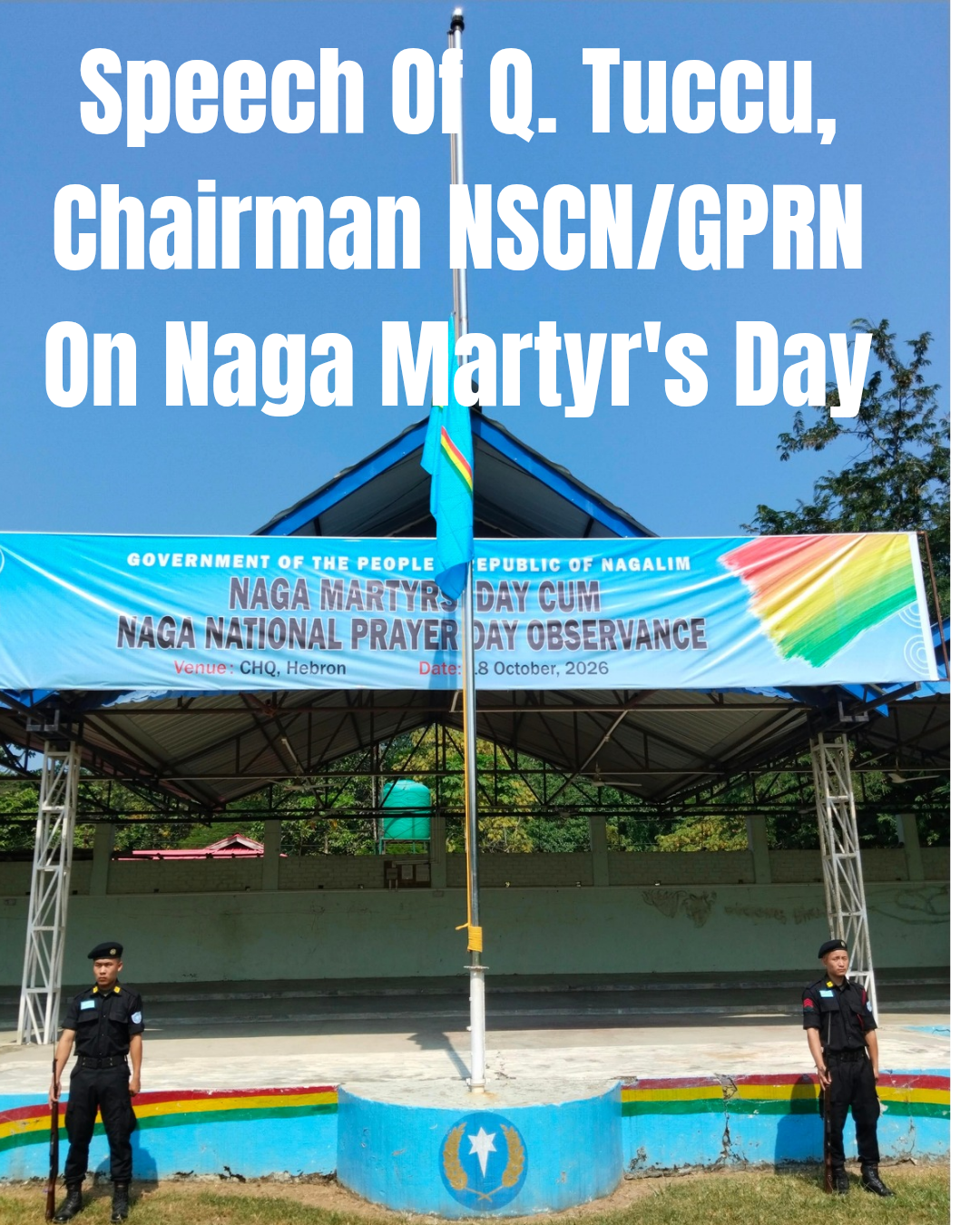
COMMEMORATION OF THE NAGA MARTYR’S DAY
18th October, 2026
CHQ, Hebron
My Dear Naga Compatriots,
I greet you all in the name of our Lord and Saviour, Jesus Christ.
Today, we assemble with solemn hearts to commemorate Naga Martyrs’ Day and to pay our highest tribute to all those brave sons and daughters of our soil who gave everything for the Naga people and for the cause of the Naga nation. Their lives were marked by courage, discipline, patriotism, and an unwavering commitment to truth and justice.
On this solemn occasion, we bow our heads before the memory of our martyrs. We remember too, their families, who endured separation, hardship, and grief. The martyrs did not bear their sacrifice alone; their parents, spouses, children, and communities also carried its burden. Your suffering is part of our national story. We owe you more than words, and we pledge to stand with you.
Our martyrs did not live for personal gain or comfort. They dedicated themselves to a larger national responsibility. They believed that a people must preserve their identity, protect their dignity, and determine their own future with courage and unity. Their sacrifice has become part of the conscience of the Naga people and an inseparable chapter in our national history.
My Dear Naga People,
Our struggle was never born of hatred or greed for power. It was born of the desire to protect our identity, our land, our culture, and our sovereign right to determine our own future.
Let me walk you through that painful memory of 18 October 1952, when Ino. Zasibito Nagi was shot dead by a sub-inspector named Dutta in the heart of Kohima town, where a silent and non-violent rally had been held against the brutal and inhumane torture of a young Sumi boy by the Assam Armed Police. This was only the beginning of the atrocities committed against the Naga people by the invading Indian armed forces.
What followed was an unrelenting reign of terror-an era of unimaginable human-rights violations inflicted by the Indian armed forces upon the innocent and unarmed Naga people.
From Khonoma to Lungkhum, a force of 1,200 soldiers swept through the land, reducing 520 homes and granaries to ash and silence. In Chingmei, the thunder of bombardment erased a living village; when the smoke had cleared, only 31 souls remained to bear witness. At Yengpang, 64 Nagas were massacred-many of them beheaded-their lives extinguished with a cruelty that defies human conscience.
Mangmetong village, in the heart of the Ao region, endured raid after raid-thirty-seven times it was violated-before 600 Indian soldiers finally consigned it to flames on 25 April 1955. In Khensa village, on 22 April 1956, police officer Phukan, leading a troop of 400 soldiers, came and executed five church leaders in public. In Chemong village, of the Tuensang region, Chonimong and Shemshemong were subjected to torture beyond description: they were nailed to a cross and then shot dead.
In 1958, more than 40,000 Naga people were held and confined in about 180 concentration camps. These camps were spread across Kiphire, Sheyetsu, Ungma, Aghunato, Luma, Suruhoto, and many other places. Between 1957 and 1960, more than 49,000 Sumi Nagas alone were killed by the Indian Army.
At Metikhru village, the Sikh Regiment massacred nine villagers by beheading them, while the rest of the villagers were tortured and their houses burned. Many fled the village, and many died of hunger, cold, and disease. The Pochury massacre is often remembered not merely as a series of killings, but as the destruction of an entire community.
The Indians used fighter jets and helicopters to bombard the Naga villages of the Tuensang region, the Yimkhiung region, the Meluri region, and many other areas of Nagalim, resulting in countless losses of precious lives, casualties, and property.
The Yimkhiung region holds a distinguished place in the history of the Naga national movement. The spirit of the Naga volunteers of Huker village found early expression in one of the first acts of armed resistance against the atrocities of Indian soldiers. On the 24th March, 1955 armed only with traditional machetes (daos) and spears, they confronted the Indian Army; four soldiers were killed. This act of self-defence became the prelude to the Longtukrü war, which tested the endurance of an entire people for nearly seven years.
Under Major General Hothrung, the Naga Army established the Home Guard Eastern Division at the Haphu camp. From this stronghold, the Naga forces stood as a symbol of organised resistance. Indian units; including the 8th Assam Rifles, the 4th and 9th Gorkha Rifles, and the Rajput Rifles, were deployed to capture it, but failed despite superior numbers and weaponry.
For nearly seven years, Indian forces bombarded the Haphu camp with long-range cannons and helicopters, seeking to break the defenders’ will. Yet the Naga Army stood firm. Amid casualties, hunger, hardship, and death, they refused to surrender their ground. The cost of this war was unbearable, in the surrounding Yimkhiung villages many naga civilians were tortured, raped and slaughtered, homes were burnt, harvests destroyed, families scattered, and many villages raided repeatedly and reduced to ashes, leaving generations to carry the memory of loss.
After the battle of Oinam, the Indians launched the infamous Operation Bluebird, during which more than 30 innocent Naga villages were subjected to unspeakable acts of violence. Twenty-seven innocent Naga civilians were slaughtered, while more than 300 endured unbearable torture and shame at the hands of the Indian armed forces. Women were raped, and pregnant women were forced to give birth under the sneering eyes of Indian soldiers. More than ten churches were desecrated and dismantled, and schools were reduced to rubble.
On 27 December 1994, the 16th Maratha Light Infantry, commanded by Major Deepak Sharma, shot dead nine innocent Nagas and burned six Nagas alive in Mokokchung. Women were raped, and hundreds were tortured and crippled.
Many brave sons and daughters joined the Naga national movement and sacrificed their lives. Many supporters of the movement were captured, tortured, and killed without mercy at the hands of the Indian and Burmese forces.
When we turn back the pages of history, we discover that the Nagas were a people of warriors-undaunted, self-reliant, and never subjugated by any adversary. Freedom was not merely an aspiration; it flowed in our blood and defined the spirit of our ancestors.
We remember with profound reverence Haipou Jadonang, the courageous leader of the Zeliangrong people, who rose against colonial British rule in pursuit of an independent Naga kingdom. Though the British silenced him on the gallows in 1931, they could never silence the ideal for which he lived and died. His martyrdom remains an enduring testament to the unyielding love of freedom that has shaped the Naga people through generations.
In those dark days, no Naga village was spared the wrath of the paramilitary forces. Determined to force the Naga people into submission to the Indian Union, the soldiers unleashed atrocities that scarred generations: women were violated and dishonoured; men, women, and children were shot, beheaded, burned alive, and buried alive.
Our beloved fathers and mothers, brothers and sisters, sons and daughters-even infants at their mothers’ breasts were subjected to torment, humiliation, and death. Some were tortured until life departed from them; others were left crippled for the remainder of their days. Many perished slowly, consumed by hunger and abandonment.
Yet, amid the ashes of burned villages and the silence of the departed, the spirit of freedom refused to die. The longing for dignity, identity, and freedom burned undiminished in every Naga heart. Such was the patriotism of the Nagas of yesterday-men and women who gave everything, even life itself, so that those who came after them might live with honour.
The harrowing stories that I have narrated are but a few among the countless painful ordeals our ancestors endured. I remind you of the Oting incident, only four and a half years ago, in which fourteen of our brothers were slaughtered like animals by Indian Army personnel from the 21 Para Special Forces.
Remember! The atrocities hasn’t stopped, our story has not ended. It will go on, and it is up to us to decide how our story will end.
The struggle of the Nagas to be free people is not a bedtime story. It is the history of a people written in blood and sealed in martyrdom for a cause.
Yes, the Naga people who fought and died for our cause are our martyrs not victims of the adversaries. To forget them would be a betrayal; to abandon the responsibility they entrusted to us would be a sin against their sacrifice. We must, therefore, carry the flame forward. The fight is not over. The work is not done yet.
My Dear Naga People,
We must understand that remembrance is not merely a ceremonial act. To remember the martyrs is to accept a responsibility they left for us. It requires us to uphold the principles for which they gave their lives-truth, justice, integrity, unity, and respect for the rights and future of our people.
We choose dialogue over violence and negotiation over bloodshed. This is not weakness. It is the maturity of a people who have paid too high a price already. We urge the Government of India to approach the table with sincerity, respect, transparency, and the political will to resolve the Indo-Naga issue; we will likewise engage with openness for an honourable resolution.
But let no one mistake our commitment to peace for weakness. Peace without freedom is only silence. Peace without justice is only a pause before another wound, and peace without principle is unsustainable. We must seek a future in which our people can live with honour, where our villages are not ruled by fear, and where our children inherit land, school, churches, and homes-not graves and memories of war.
If my life is taken, do not answer death with revenge. Do not allow my blood to become a reason for another mother to weep. Let my sacrifice strengthen your discipline, your unity, and your determination to pursue justice through courage, truth, and peaceful political action.
To our young people, I say: do not inherit hatred; inherit responsibility. Learn our history, protect our land, our language and culture, respect every tribe and community, and refuse to become instruments in the hands of those who come to destroy our land.
To our elders and church leaders, I entrust the conscience of our nation. Guide our people away from vengeance. Remind us that authority exists to serve the people, not to control them. Let no leader claim to speak for the nation while ignoring the suffering of ordinary Naga families.
To those who oppress us, I say this: you may silence a voice, but you cannot erase a people’s longing for freedom. You may imprison us, but you cannot imprison an idea whose roots lie in memory, identity, and rights. Yet we do not ask land from you. We ask for recognition, dialogue, and a solution founded on justice and truth.
Let my last message be simple:
Do not divide. Do not surrender your dignity. Do not abandon peace.
Let every sacrifice bring us closer to our destination. Let every wound teach us compassion. Let the future of the Naga people be built not only by those who carry the burden of struggle, but also by those who carry books, plant fields, teach children, heal the sick, and defend the truth.
My Dear Naga People,
At this important juncture, I appeal to all Naga leaders and national workers to rise above their differences and place the common interest of the Naga people above individual or organisational considerations. Differences may arise, but they must not destroy our unity. We may follow different paths, but our responsibility toward the cause of the people and the ultimate goal remains the same.
The blood of the martyrs calls us not to forget or desert, but to remain faithful. It calls us to reject corruption, oppression, and betrayal. It calls us to work honestly, speak responsibly, and act with a clear conscience. Their dream can be honoured only when we build a society founded on justice, equality, accountability, human dignity and freedom.
I extend my respect to every Naga who has contributed to the national movement and to the welfare of our people-whether through public service, peaceful advocacy, social work, prayer, education, or sacrifice. Every sincere contribution to the preservation the sovereign right, history and land of our people deserves recognition.
I am glad to learn that today the third Sunday of October also coincided with the Naga National Prayer Day. Nagalim is for Christ, and prayer is our Shield and our primary weapon. God has never failed the Nagas, He has sustained us thus far. Today is the appointed day for all the Nagas across Nagalim to kneel and pray to the Lord with contrite heart and ask for deliverance form all bondage.
On this Martyrs’ Day and as a day dedicated to the Lord as the Naga National Prayer Day, let all call upon the Lord with sincere heart and renew our pledge that:
We shall not forget the sacrifices of our martyrs.
We shall protect the unity and dignity of the Naga people.
We shall pursue our political aspirations through courage, commitment, determination and negotiation.
We shall remain committed to truth, justice, and peace with freedom.
We shall work for a future in which our children can live with security, dignity, and hope.
May the Almighty God comfort the bereaved families, bless our people, and guide our leaders. May He grant us the wisdom to overcome the enemies, the courage to face challenges, and the spirit to serve the Naga people faithfully.
The martyrs may no longer be among us in body, but their spirit of self-sacrifice, and ideals continue to live in the heart of the Naga people for all time.
May their memory remain eternal.
Long live the Naga people.
KUKNALIM!
Q. Tuccu
Chairman NSCN/GPRN