
Roads to the Frontier: The Governance and Human Imperative of the Ukhrul-Tusom Corridor
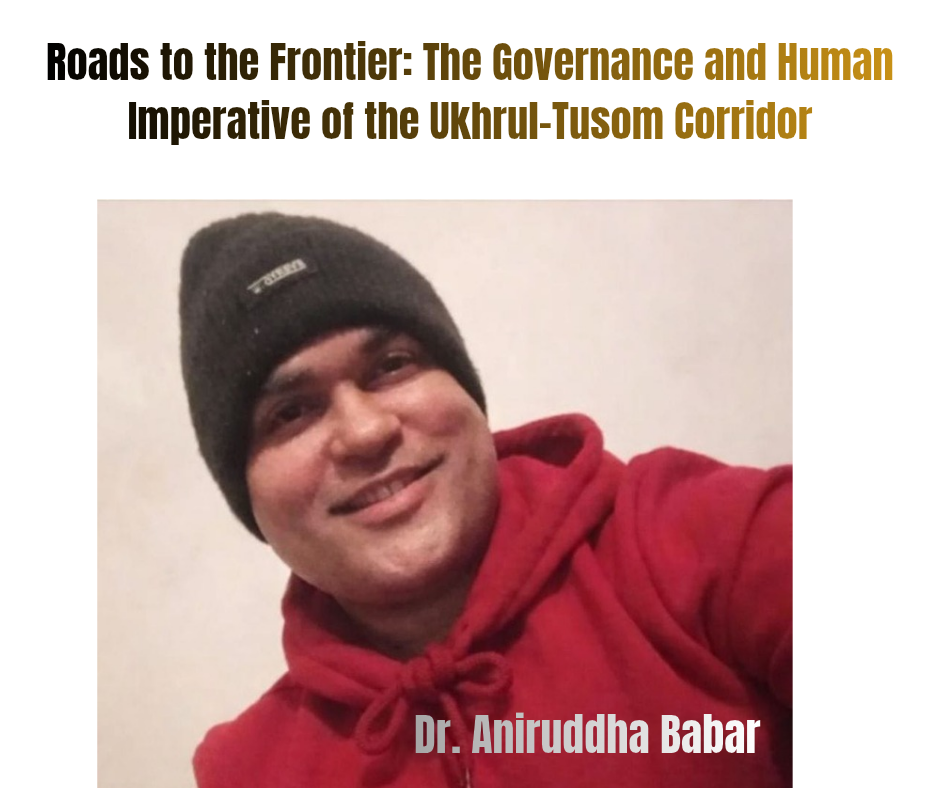
Dr. Aniruddha Babar
(Dr. Aniruddha Babar is a Senior Academician, Public Policy Expert & Social Development Specialist, Writer, and Researcher currently serving in the Department of Political Science, St. Joseph College, Ukhrul, Manipur. He is also the Co-Founder and Deputy Director of the Centre for North-East Development and Policy Research (CNEDPR), St. Joseph College, Manipur.)
A road between Ukhrul and Tusom is not merely a line drawn across the hills of Manipur; it is a lifeline that determines whether citizens living in remote frontier villages can reach hospitals, schools, markets, and the institutions of governance that sustain everyday life.
In the mountainous frontiers of North-East India, the strength of governance is often measured by the strength of the roads that connect remote communities with the institutions of the state. Roads therefore represent far more than strips of asphalt laid across rugged hills; they function as the lifelines through which development programmes, public services, and economic opportunities reach distant villages. In districts such as Ukhrul in the State of Manipur, rugged terrain, fragile geology, and intense monsoon rainfall shape the physical landscape in ways that directly influence mobility and accessibility. Reliable road connectivity determines whether citizens can reach hospitals, schools, markets, and administrative institutions that sustain everyday life. The strengthening and sustained maintenance of the Ukhrul to Tusom road corridor must therefore be understood not simply as an infrastructure project but as an essential instrument of inclusive governance and regional equity. The need to strengthen and maintain this corridor has therefore become increasingly urgent as the demands of governance, mobility, and regional development continue to grow across the hill districts of Manipur.
In frontier regions such as Ukhrul district, the road often becomes the most visible expression of the relationship between the state and the citizen. In the hill districts of Manipur, the reach of governance is frequently determined by the reach of the road, and the quality of that road defines how closely the institutions of the state remain connected to the everyday lives of citizens living in remote frontier villages.
The geographical structure of Manipur further reinforces the importance of transportation infrastructure in the hill districts. The state covers an area of about 22,327 square kilometres and displays a distinctive physiographic pattern in which the central Imphal valley occupies a relatively small portion of the territory whilst the surrounding hill districts constitute nearly ninety per cent of the total land area. Communities in these hill districts live across rugged ridges, slopes, and valleys that remain physically distant from administrative centres. Transportation networks therefore function as a critical foundation of governance, enabling public institutions and development initiatives to reach dispersed populations across mountainous terrain. Geography therefore defines governance in the hill districts.
Within this broader context of development and governance in hill regions, the construction, upgradation, and sustained maintenance of the Ukhrul to Tusom road corridor assume considerable developmental and administrative importance. The hill regions of Manipur consist of steep slopes, fragile geological formations, and dispersed rural settlements that shape the delivery of governance and public services. The scattered settlement pattern increases the dependence of rural communities on road infrastructure for mobility, communication, and institutional access. Strengthening such corridors contributes directly to narrowing the developmental distance between remote villages and the administrative institutions of the state.
A clearer understanding of the geographical setting of Ukhrul district further illustrates the infrastructural importance of this corridor. Ukhrul district occupies a significant position in the north eastern sector of Manipur and forms part of the Indo-Burma mountain system, a geologically young and structurally complex mountain belt extending across North-East India and South-East Asia. The district lies approximately between 24°29′ north latitude and 25°42′ north latitude and between 94°30′ east longitude and 94°45′ east longitude. It shares geographical boundaries with Myanmar to the east and with the state of Nagaland to the north, thereby forming part of a frontier landscape with considerable administrative and strategic relevance. Ukhrul district covers an area of approximately 4,544 square kilometres and recorded a population of about 1,83,998 according to the Census of India 2011. Population density stands at roughly forty persons per square kilometre, reflecting a settlement pattern in which villages are widely dispersed across hill ridges and valleys.
The distribution of settlements across the district further reinforces the importance of transportation infrastructure. Census records indicate that Ukhrul district contains more than two hundred inhabited villages spread across mountainous terrain. More than eighty five per cent of the population resides in rural settlements distributed across ridges and valleys. Under such settlement patterns, roads become the principal channels through which social services, economic activity, and administrative coordination reach rural populations.
The terrain of Ukhrul district is dominated by rugged hill ranges intersected by narrow valleys and seasonal streams that produce a highly dissected mountain landscape. Elevations range from roughly 913 metres above mean sea level in lower valleys to about 2,835 metres in higher ridges. Shirui Kashung peak represents the highest elevation in the district and stands as an important geographical landmark within the hill system. Ukhrul town functions as the district headquarters and lies at an elevation of approximately 1,662 metres above sea level. The town serves as the principal administrative, educational, and commercial centre for surrounding hill communities. Ukhrul town lies approximately eighty four kilometres from Imphal and is connected to the state capital through National Highway 202, an important transportation corridor linking the hill districts with the wider regional road network.
The hydrological landscape of Ukhrul district also influences infrastructure planning across the region. Several river systems originate from the slopes of the Shirui hill ranges and flow through narrow valleys across the mountainous terrain. Seasonal streams and drainage channels shape erosion patterns during the monsoon months. Understanding these natural drainage systems remains essential for designing durable transportation infrastructure in mountainous environments.
Within this mountainous geographical setting lies Tusom, a remote frontier settlement located in the northern sector of Ukhrul district within the Jessami subdivision. The road from Ukhrul town gradually winds northward across successive hill ridges and narrow valleys before reaching the frontier settlement of Tusom near the Indo-Myanmar boundary, forming one of the most remote transportation corridors in the hill districts of Manipur.
The condition and significance of the Ukhrul-Tusom road corridor also become clearer through direct field observation along the entire route. My familiarity with the Ukhrul to Tusom corridor comes from direct field experience along the entire route. I travelled this road on my Royal Enfield motorcycle on three separate occasions, covering the full stretch between Ukhrul town and the frontier settlement of Tusom. During these journeys I also visited Kalhang village , Chingai village and travelled across the villages that form the Tusom cluster, including Tusom Khullen, Tusom Christian Village, and New Tusom. The Tusom settlement cluster lies in the northern sector of Ukhrul district close to the Indo-Myanmar international boundary and is located roughly one hundred and twenty kilometres from Ukhrul town and only a few kilometres from the border near pillar number 130.
Each journey involved riding through winding hill sections, narrow ridges, and steep valleys that characterise the mountainous terrain of Ukhrul district. The district itself covers an area of approximately 4,544 square kilometres and displays a relatively low population density of about forty persons per square kilometre, reflecting the widely dispersed settlement pattern across the hill landscape. Travel along this route also revealed the environmental conditions that shape mobility in the region, including erosion, landslides, and seasonal rainfall that frequently affect transportation along hill roads. These journeys therefore provided a practical ground assessment of the physical conditions that influence connectivity across this remote frontier corridor.
Travelling across these villages offered a direct understanding of the realities faced by residents who depend on this corridor for everyday mobility. The villages in the Tusom cluster are home largely to members of the Tangkhul Naga community whose livelihoods are closely connected to agriculture and village based economic activity. According to the Census of India 2011, New Tusom village alone has a population of about 1,608 residents living in roughly 341 households, and Tusom Christian Village has a population of about 642 people. These communities rely on the same mountain road to reach Ukhrul town for healthcare services, education, markets, and administrative interaction. Personal field observation along the Ukhrul to Tusom road therefore provides a clear appreciation of the importance of reliable transportation infrastructure in ensuring that governance, development programmes, and economic opportunities remain accessible to citizens living in the frontier hills of Ukhrul district. Such ground experience reinforces the broader policy argument that strengthening this corridor remains essential for improving connectivity and advancing inclusive development across the remote hill regions of Manipur.
For the people who live in these hills, connectivity is not an abstract policy question. Families residing in frontier villages depend almost entirely on this road corridor for everyday mobility, and the quality of the road often determines how quickly they can reach healthcare, education, markets, and administrative services.
(The views and opinions in this article are solely those of the author and do not necessarily reflect the official stance of Rural Post)