
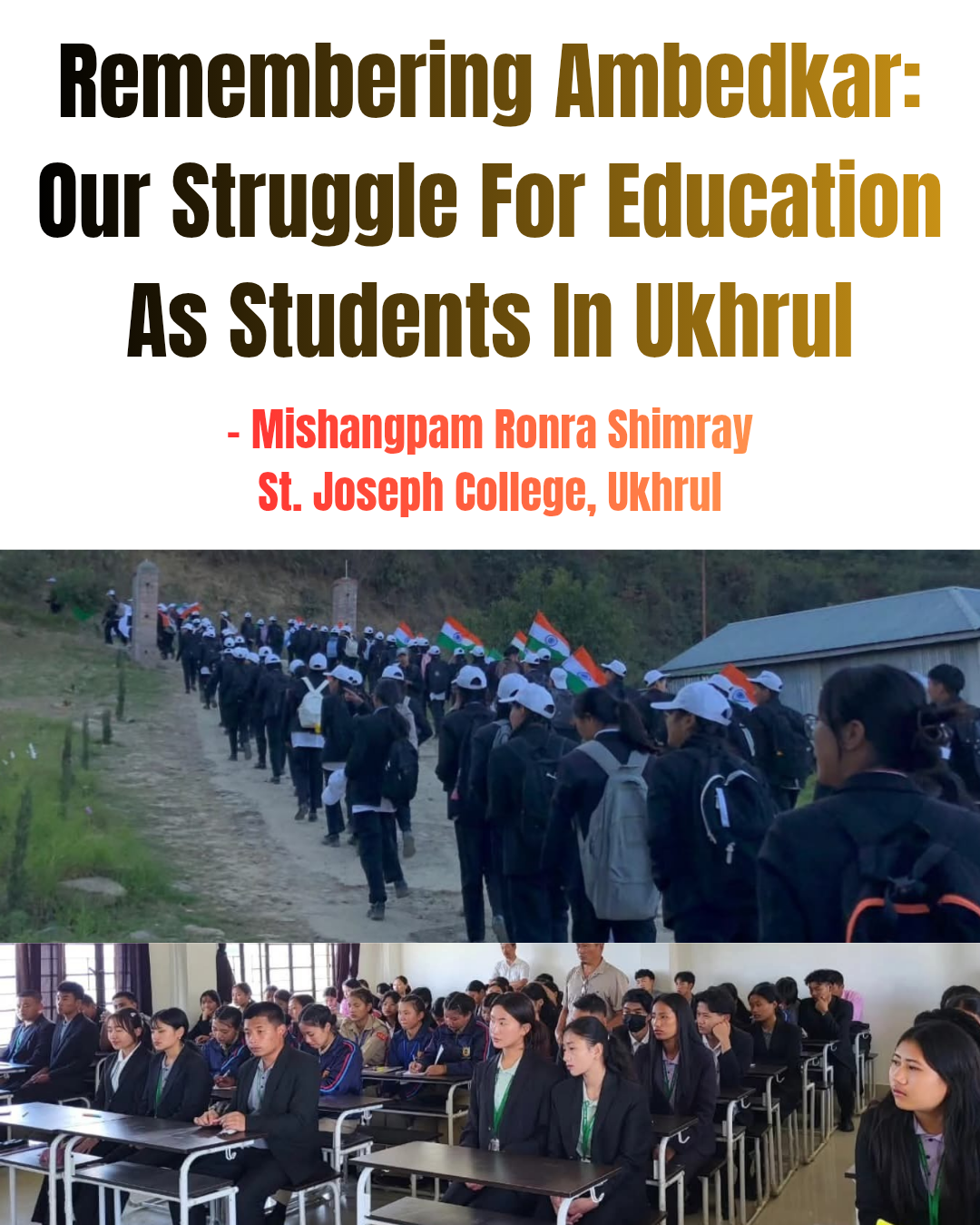
Ukhrul is a remote district, and here poverty is not something we hear about, it is something we live every day. It is in our homes, in our families, and in the way we come to college. It shows in small things that people may not notice, and it is something we feel all the time. In our college, most of the students come from families that live below the poverty line. For us, education does not feel like something normal. It feels like something we are holding on to.
Nearly 95 percent of the students come from families that live below the poverty line, and more than 85 percent of us are the first in our families to come to college. These are not just numbers. These are real lives. Every student here carries the story of a family that has never had this chance before. Every classroom feels heavy because so many hopes are sitting together.
Many of us continue our studies while dealing with problems at home. Some of us come after helping our families. Some of us sit in class but keep thinking about things happening outside. It is not easy to focus all the time. Still, we try. Many of us even go for labour work so that we can earn a little and help pay our fees and other expenses.
Many of us do not have money to buy new clothes or new shoes. We come to college in our uniform, wearing the same one again and again. We try to keep it clean as much as we can, but we know how it looks and we feel it. These small things stay in our mind the whole day. They remind us of the life we come from. Still, we sit in class and try to focus and learn, hoping that this is the only way our life can slowly change.
As students, we carry a responsibility that feels very heavy in our everyday life. We study not only for ourselves, but for our families who have very little and still believe in us. Many times, we sit in class and our mind goes back to home. We think about the struggles that are always there. Every book we open feels like we are trying to slowly change a life that has always been difficult. We often think about a different life, a life where basic things are not a problem, where buying simple clothes or shoes does not feel like a burden, and where we can live like students in cities like Mumbai, Delhi, Bangalore, Guwahati, Kohima and Dimapur. These thoughts stay with us and keep pushing us to continue and try again.
At the same time, we also feel that our education is not only for us. We feel that somehow we have to change our situation and also do something for others who will come after us. This feeling stays with us in everything we do.
Our teachers come from backgrounds like ours. They understand these struggles because they have lived through the same poverty and the same kind of life that we are still facing. This creates a connection that we do not need to explain. It is felt in the classroom and in the way they teach us. St. Joseph College, Ukhrul starts to feel like more than just a college. It feels like a place where people with the same struggles sit together, learn together, and try to move forward, even when life still feels heavy.
Our teachers also go out of their way to support us. They know what we are going through because they have gone through it themselves. They come from the same poverty and the same kind of life. When they teach, it feels like they are sharing something from their own life. There is a pain in that understanding, because they know what it feels like to sit in class with problems that no one else can see. When we look at them, it sometimes feels like we are seeing our own future.
Education here feels different. It is not just about books. It feels like effort, struggle, and hope together. It helps us slowly understand things and see a little beyond our present life. When we read about Dr. Bhimrao Ramji Ambedkar and his idea that “Freedom of mind is the real freedom,” it feels close to us. It feels like maybe thinking differently is where change starts.
When we study, we also start to understand why things are like this. We understand that not everyone gets the same opportunities. We see that students in places like ours face more difficulties. We begin to understand that our struggles are not only personal, but part of something bigger.
There are many problems around us like lack of resources, fewer opportunities, and many limitations. These things affect our daily life and our studies. Slowly we begin to understand this reality.
At this point, the life of Dr. Bhimrao Ramji Ambedkar feels very close to us. He also faced struggle and still chose education. His life shows that learning can give a person dignity.
The most important lesson we learn from him is that education can change a life, even when everything feels limited. He did not stop learning even when things were difficult. For us, this feels very real. It reminds us that even if our situation is hard, continuing to learn can slowly open a way forward.
His words “Educate, Agitate, Organize” feel meaningful to us. They remind us that learning and awareness matter.
For students like us, his life also gives a feeling that our identity matters and our voice matters.
We continue our studies with limited support and many difficulties. Still, we try to move forward.
There is a strong feeling among us that we cannot stop now. Everything around us feels heavy, like problems are always there and do not end. It feels like life keeps pushing us down again and again. Still, we do not want to disappear into it. We do not want to be finished by the life we are born into. We keep holding on, even when it feels like nothing is changing. We keep coming to class and trying to learn, because somewhere inside we feel that this is the only way to move forward. We also know that our teachers will not be with us forever, and one day we will have to stand on our own- all alone. We will not give up. We want to build a new world, a better world, an honest world, a world with human dignity and human values, with whatever we are able to learn, even if the path feels long and difficult.
On 14th April, when we remember Dr. Bhimrao Ramji Ambedkar, it feels personal. It feels like his life connects with ours in many ways. It becomes a moment where we stop and think about why we are studying and what we are trying to become. It reminds us that education is not just about passing exams, but about building a life with dignity and self respect. It gives us a small sense of strength to continue, even when things feel difficult, and to keep believing that what we are doing today will matter in the future.
In the end, our story is about poverty, struggle and effort. It is about trying to move forward even when things are difficult.
This journey feels very slow, and many times it feels like nothing is really changing. Every small effort we make feels very small in front of everything around us. Still, we keep going. We keep trying, even when it feels like life is too heavy. Somewhere inside, we believe that things cannot stay like this forever. One day, something has to change. And when that day comes, we will rise not only for ourselves, but for our families, for our community, for our country, and for all those who live a life like ours. One day, we will win. One day, we will live in a world that feels more human, where there is dignity and where life does not feel like a struggle all the time. One day, we will win.
Mishangpam Ronra Shimray
BA 2nd Semester
Department of Political Science
St. Joseph College, Ukhrul
Manipur
(The views and opinions in this article are solely those of the author and do not necessarily reflect the official stance of Rural Post)