
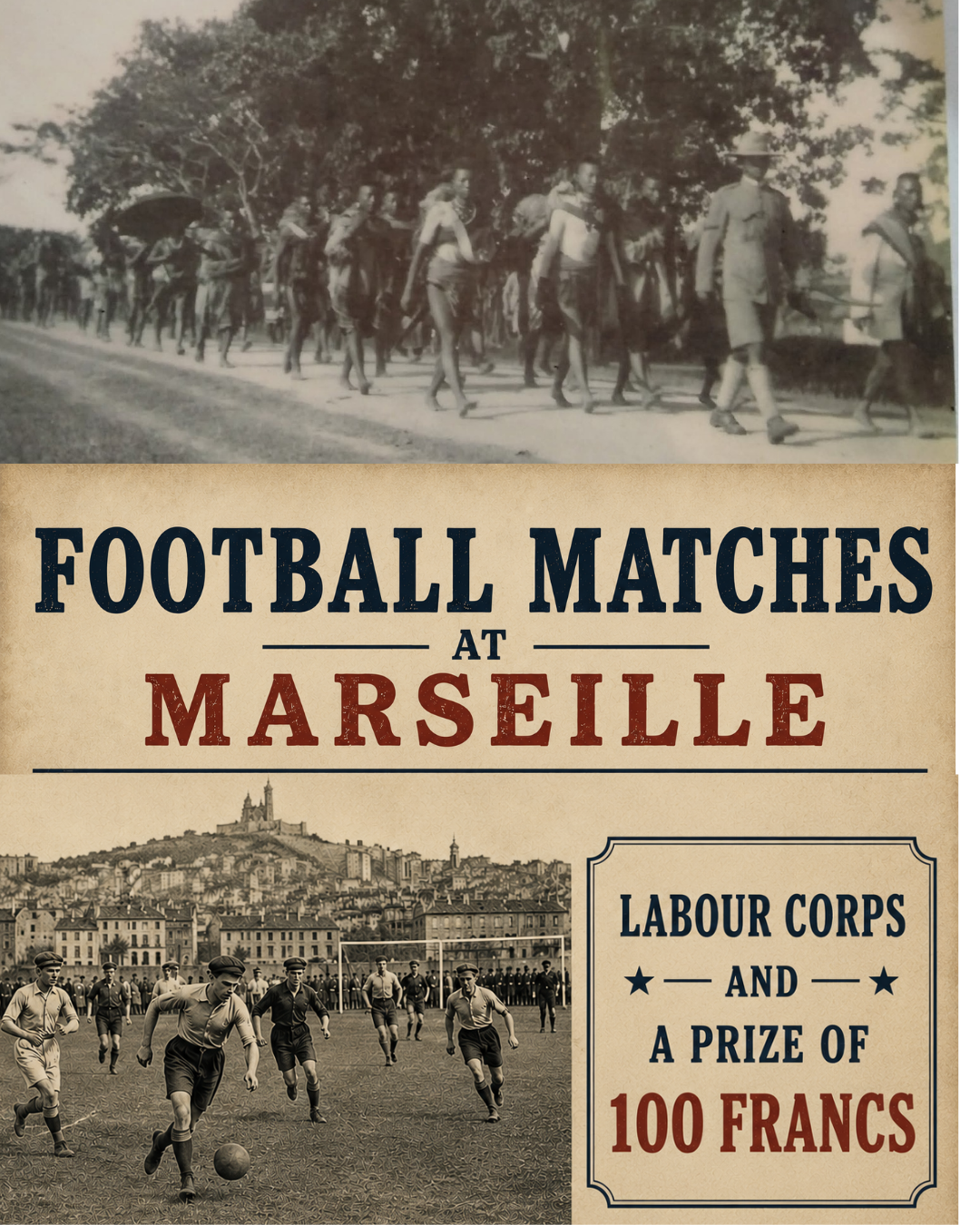
Football was introduced to the Tangkhul community by the Missionaries.
When the tide of the war changed in favour of the British by January 1918, weekends were made free. Football and clicking photos at French studios became their source of entertainment for the Labour Corps.
According to Kanrei Shaiza, they worked for 8 hours every day without respite (including Sundays). Their work consisted of picking bomb shells, digging trenches, carrying food and ammunition, and shovelling snow.
This is the story of the FOOTBALL MATCHES AT MARSEILLE as narrated by Kanrei Shaiza in one of his books. The football matches were played from January 1918 till they returned home in April, 1918.
According to S. Kanrei, the 66th Unit Football team consisted of 10 Tangkhuls and 1 Meitei. Namely:
1. A Porom Singh (A Meitei – he was educated and baptized in Ukhrul. He married a Tangkhul woman)
2. R. Ruichumhao
3. S Chara
4. R Wungzak
5. K Ngashangshi
6. Khorkham
7. Wokkha
8. Tariya
9. R Lungthuk
10. S Haitong
11. S. Kanrei
S. Kanrei narrated that “Our team would play and defeat teams from other Manipur Companies as well as three or four other company teams of Angam Hao. At every game, we would score two three goals. These made our officers so euphoric that Lieutenant Brown would sanction HUNDRED FRANCS, of which Agam Singh, the Zamindar, would give 50 francs to us. With this amount, the players would hold a tea party each time.
“We would slip and fall often since it was winter, snowfall was a regular sight. This football ground was much better than the Imphal town football ground. People would come in thousands to see these matches. It was like people from almost all the nations were there. I remember that there were English, French, Italians, Africans, Burmese, Chinese, Indians, and American spectators. These people were either soldiers or labourers. No civilians were there, as they were prohibited from entering.
“All our players were students of the Ukhrul Mission School. All of them used to regularly play football at the Ukhrul Mission Football Ground, from where they honed their skills.”
S. Kanrei, A. Porom Singh, and R. Ruichumhao – these three were very good football players with stamina and skills.
However, amongst the three, S. Kanrei was the most skilful player. He was swift and nimble footed and nobody would chase him once a sprint with the ball was made. He was a proficient striker too, as he would regularly score goals. Because of his skills and good spirit, everyone watching the game including his officers were pleased with him and showered him with praise. During winter, the frost would make the football ground slippery.
DEMAND FOR LABOUR CORPS
When the first world war (28 July 1914 to 11 November 1918) was underway, Triple Entente (Russia, France, and Britain) felt short of men’s force to clean the rubble, bomb shells and bury the deaths.
To win the war against Triple Alliance, they felt the immediate need to acquire labour corps from their colonies, India and China being the Britain’s biggest colonies. Thus, they (King George V and Parliament) “demanded” that labour corps be supplied from these countries.
The Central Indian government under British power demanded from the natives to gather labourers to work in France. This demand reached Maharaja Churachand Singh in early 1917. To have his own interest materialized (gain more power), he sent “darkas” or “order” to the hill areas to contribute labourers for the British cause. This was met with a staunch protest from the tribals (especially the Tangkhuls).
SALARY AND COMPENSATION
It took the convincing power of the Scottish Missionary, William Pettigrew to recruit the natives as “Labour Corps” with the promise that:
1. They would be exempted from house tax for life.
2. They would be exempted to perform force labour (beggar) for life
3. They would not participate as an army, but perform only manual work “off” the war zones
4. They would be paid monthly salary as:
Head Interpreter – Rupees 100
Headmen -Rupees 100
Head Clerk – Rupees 100
Head Accountant -Rupees 100
Assistant Interpreter – Rupees 75
Assistant Headmen – Rupees 75
Assistant Clerk – Rupees 50
Assistant Accountant – Rupees 50
Tapha (Mate) – Rupees 30
Labour Corps – Rupees 22
Death Compensation – Rupees 300 (and his labour charges till the day of his death)
LABOUR CORPS RECRUITMENT
Recruitment started in March 1917, where they underwent medical check-up at Imphal, Ukhrul, and Kangpokpi. 2000 were selected from Tangkhuls, Mao, and Poumai (few Christian meiteis also participated), among which there were around 1000 Tangkhul labour corps (some said 1200). The 2000 labour corps were put under the 22nd Manipur Labour Corps, with 500 people in each Unit (40th, 64th, 65th, and the 66th). While 66th and 64th Unit consisted only of Tangkhuls and the Kukis respectively, the 40th and the 65th Unit were a combination of the Mao, Poumai,Tangkhul and Kuki.
THE JOURNEY
They travelled by foot to Dimapur for 11 to 13 days, and boarded trains till Guwahati. The basket (sopkai) they carried was substituted with “army rucksack”, while their loincloths were replaced with army dress (khaki and turban). From Guwahati to Bombay, they went by train, and boarded ships from Bombay harbour till Marseille (France), crossing the Red Sea and Mediterranean Sea. Many died of sea sickness during the journey.
CENTENARY CELEBRATION
The Tangkhul Naga France Labour Corps Football Centenary Celebration was held in 2017. Bruce Bucknell, the then Deputy British High Commissioner of India during the centenary celebration of World War I Tangkhul Naga Labour Corps at TNL Ground, Ukhrul on 6 November 2018 had stated that “It is through memory that we will give honour and dignity to our ancestors and it is through memory that you will give honour and dignity to your ancestors. We are bound together by this event, the event that we know as the First World War.”
“From this part of India alone, there were 21000 who were in the Labour Corps, who supported our war at first. And of course, within that 21,000, 1200 come from this district alone. And that is why we are here today” stated Bruce Bucknell.
Hundred years have gone by – the labour corps and the football matches at Marseille are part of the history now.