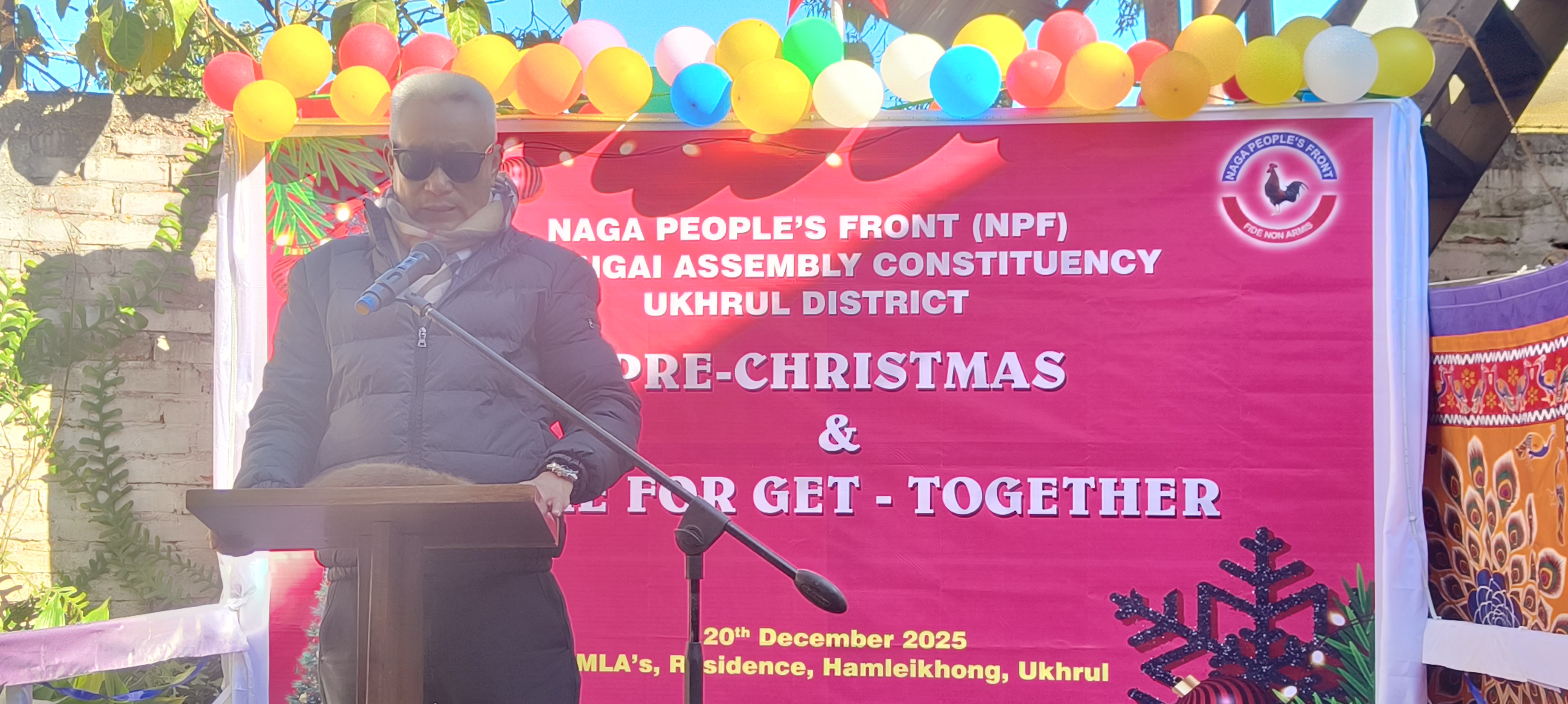

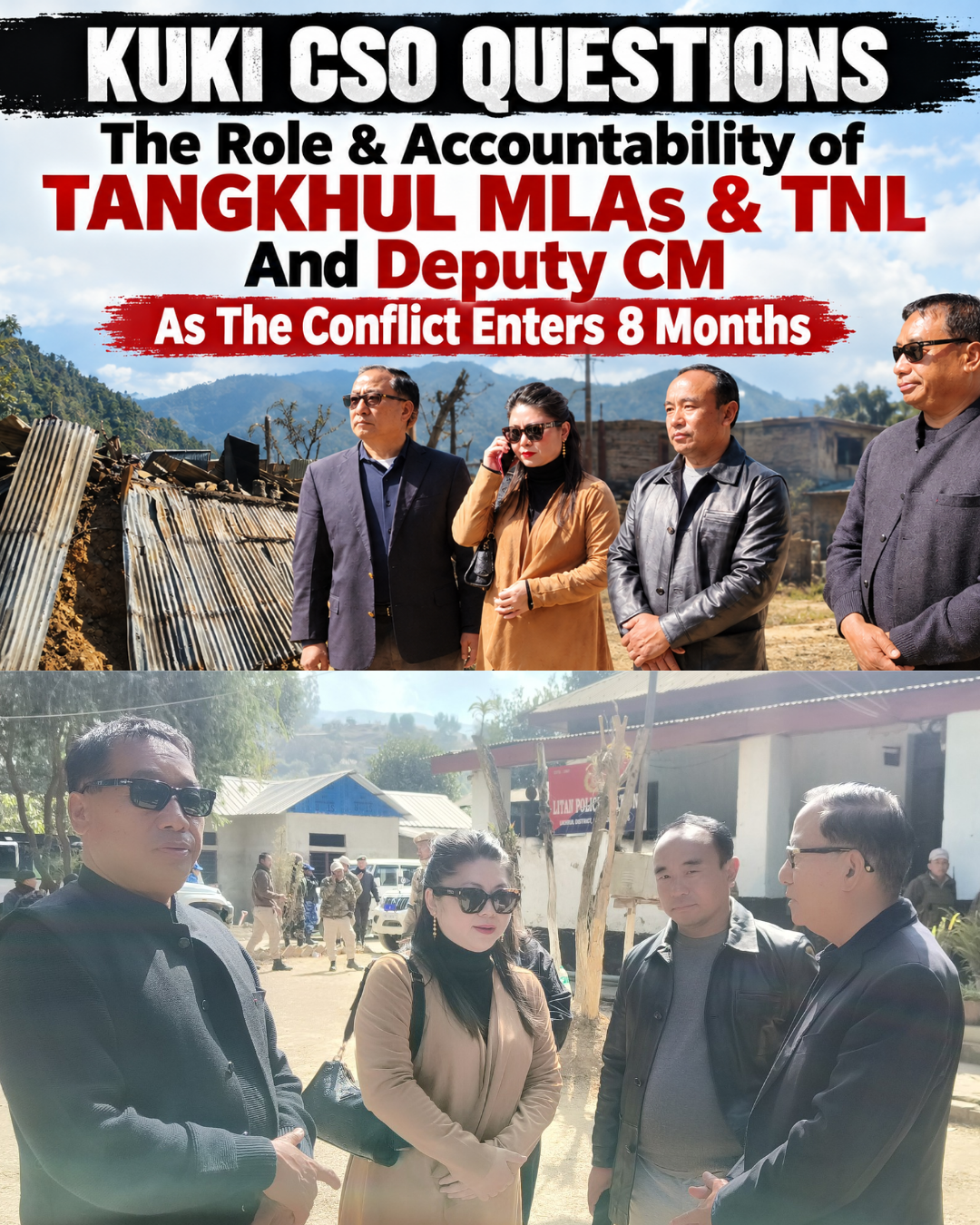
The Kuki CSO Working Committee, Ukhrul (WCKCSOs-Ukhrul) has questioned the role of Tangkhul MLAs from 43-Phungyar AC and 44-Ukhrul AC and the role of President of Tangkhul Naga Long (TNL) and Deputy Chief Minister of Manipur as the conflict marks eight month today.
The statement issued by the (WCKCSOs-Ukhrul) stated that “8 October 2026 marks eight months since the present conflict began at Litan Sareikhong on 08 February 2026.
“Eight months of displacement, burnt homes, shattered livelihoods and fear should be enough. It is time to stop recycling communal narratives and start confronting the harder questions: How did a local altercation become a prolonged conflict? Who escalated it? Who failed to stop it? And who has shown any real interest in peace?
“A drunken brawl needed a peace initiative. It got a history lesson on land and identity instead. The starting point is clear. On 07 February 2026, a drunken altercation took place between one Kuki-Zo youngster and three Tangkhul men at Litan Sareikhong. On 08 February, Kuki-Zo civil society organisations, including KSO, attempted to de-escalate the situation.
“The question is unavoidable: Who turned a local dispute into a communal confrontation?”
THE RECORD OF ESCALATION
Instead of containing a local dispute, the situation rapidly assumed a communal character. On 09 February, at the very meeting convened by Deputy Chief Minister Losii Dikho, TNL President Sword Vashum, rather than focusing on reconciliation, chose to emphasise the history of the Kuki-Zos and land ownership in Ukhrul. As Kuki-Zo houses continued to be set ablaze amid the unfolding violence, Mr. Dikho was present in person.
The subsequent conduct of Mr. Sword Vashum demands equal scrutiny. Rather than consistently pursuing reconciliation, his public statements repeatedly hardened the communal divide.
Following the TM Kasom incident on 18 April 2026, he publicly attributed the incident to the Kuki-Zos and declaring war without prior transparent investigation or conclusive evidence being placed before the public. Thereafter, Kuki-Zo villages and civilians in Ukhrul and Kamjong faced continued attacks, burning, economic targeting, hunting and killings.
THEN CAME A CHANCE TO STEP BACK
On 04 May 2026, the Nagaland Joint Christian Forum convened a peace meeting at Kohima. Yet the opportunity did not translate into the peace commitment the situation desperately required, only because Mr. Sword Vashum refused to sign.
So, who wanted this war? Who imposed it on whom? And who kept feeding it?
The answer should not come from propaganda. Let the timeline, statements and actions speak for themselves.
THE ELECTED REPRESENTATIVES: REPRESENTATIVES OF WHOM? Now consider the record of the elected representatives:
MLA Ram Muivah
– 25 February: Sinakeithel, following the 23 February forest-fire incident;
– 01-03 April: condolence mission following the 28 March Hongbei incident; and
– 30 September: launched 500 solar street lights and five ALS ambulances for Tangkhul villages and areas
MLA Leishiyo Keishing
– 09 March: K. Ashang Khullen Aze and Wanglee Namlee;
– 08-09 May: Namlee, Wanglee and Choro following the 07 May incident; and
– 25-26 September: Pilong, Aloyo, Choro and the Namlee-Wanglee area.
There is nothing wrong with serving Tangkhul constituents. That is their duty. But these MLAs were also elected by Kuki-Zo citizens.
-So, where were they when mobs from Sikibung burnt houses and fired in Litan Sareikhong causing displacement of the entire Kuki-Zo population from Litan sareikhong?
– Where were they when two abducted Kuki-Zo men were killed at Thowai Kuki?
– Where were they when Mullam Kuki was attacked and burnt?
– Where were they when Mongkot Chepu remained under continuous firing?
– Where were they when Kuki-Zo families were displaced and their villages destroyed?
These are not accusations. These are questions their constituents have every right to ask.
Their only significant visit to the Kuki-Zo community on 25 March was followed, the very next day, by their presence in Imphal meeting government authorities over the demand to withdraw the NIA case concerning the two Kuki-Zo men killed at Thowai Kuki.
AND THE DEPUTY CHIEF MINISTER?
The accountability does not end with the TNL or the MLAs. Deputy Chief Minister Losi Dikho must answer as well. He was present at Litan on 09 February, at the very meeting he had convened, while the situation was spiralling and Kuki-Zo houses were being burnt.
Yet Mr. Dikho has since made statements and taken positions that have themselves been questioned as communal and divisive. More remarkably, he later demanded accountability from his colleague, Deputy Chief Minister Nemcha Kipgen.
Before pointing fingers at others, Mr. Dikho owes the public an account of what happened at Litan, what his administration did to stop it, and what he himself did-or failed to do when the conflict was still in its infancy.
“Eight months have passed. Does the Government of Manipur and India need eight years to resolve this conflict or is it finally time to act?” stated the statement issued by the Department of Information & Media, WCKCSOs-Ukhrul.