
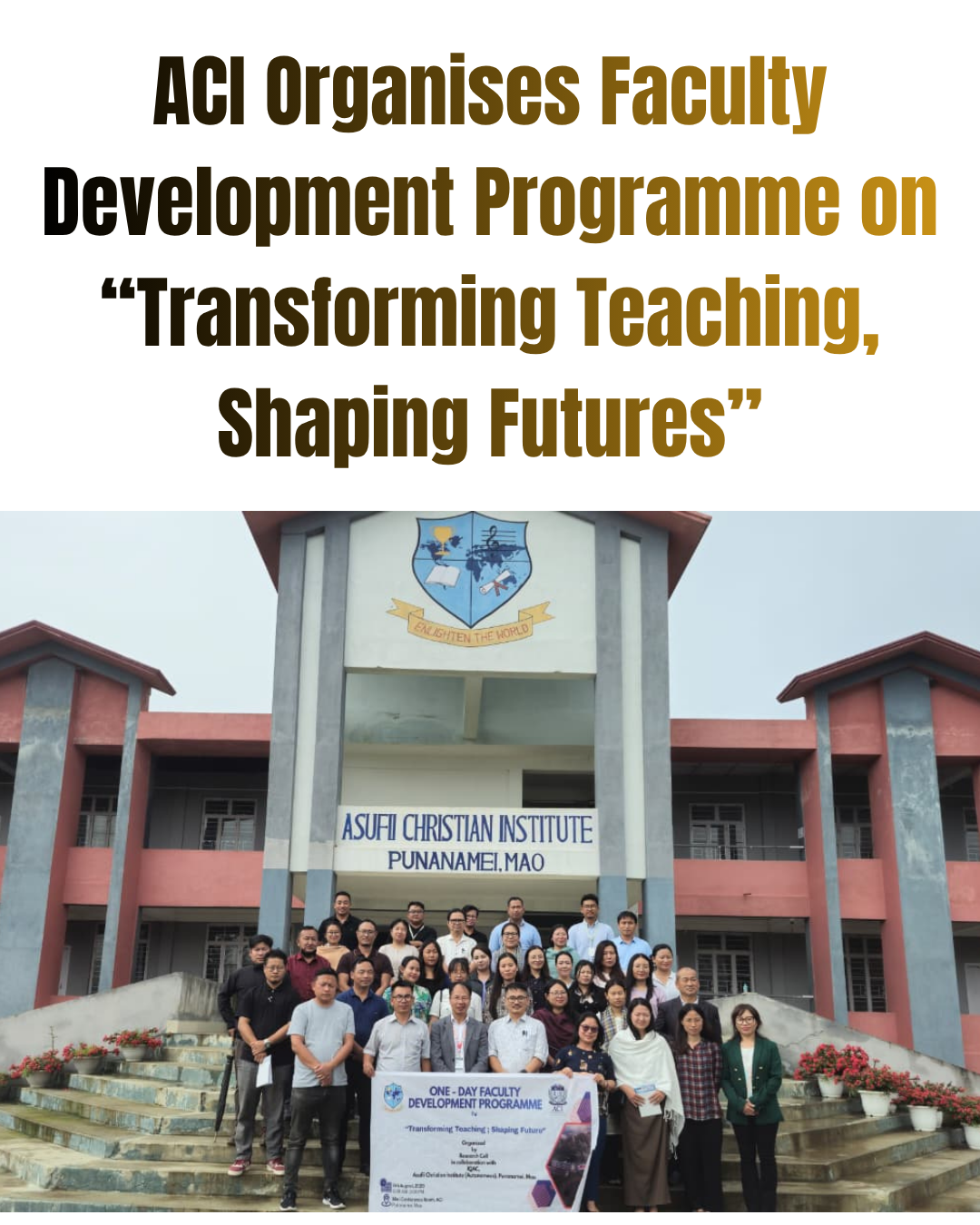
Asufii Christian Institute (Autonomous) (ACI), Punanamei, Mao, Senapati, organised a one-day Faculty Development Programme (FDP) on the theme “Transforming Teaching, Shaping Futures” on 8th August 2026. Organised by the Research Cell, ACI, in collaboration with the Internal Quality Assurance Cell (IQAC), ACI, the programme focused on strengthening contemporary teaching practices, research capacity, technological competence, emotional intelligence, environmental awareness, and institutional ethics among educators.
The FDP brought together faculty members from various colleges and senior secondary institutions, providing a valuable platform for inter-institutional interaction, professional learning, and exchange of experiences. The participation of educators from different institutions and levels of education enriched the discussions and encouraged reflection on the emerging challenges and opportunities in teaching and learning.
The programme was chaired by Hriini Gilbert Saprii, IQAC Coordinator, ACI, while the Welcome Address was delivered by K. Athishu, Vice Principal, ACI. In his address, the Vice Principal underscored the importance of continuous professional development for educators in an increasingly dynamic educational environment. The programme comprised six thematic sessions addressing key dimensions of contemporary education.
The first session, “Teaching Methods in Gen Z Generation,” was facilitated by Dr. Soreiphy Mungkung, HoD, Department of Zoology and Convenor, Research Cell, ACI. The session explored contemporary teaching strategies for engaging Gen Z learners, including learner-centred approaches, active learning techniques, and the effective use of digital tools. Particular attention was given to challenges such as short attention spans, digital distractions, and the need to create safe, supportive, and orderly learning environments.
The second session, “Beyond Curriculum: Emotional Intelligence,” was conducted by Gaikulung Gonmei, Assistant Professor, Department of English, ACI. The session highlighted the importance of emotional intelligence in holistic student development and effective teaching-learning environments. Key dimensions such as self-awareness, self-regulation, empathy, relationship management, and social skills were discussed, with emphasis on their integration into classroom practices.
The third session, “Transforming Teaching: Beyond AI and ICT,” was facilitated by Dr. Adani Azhoni, HoD, Department of Civil Engineering, NIT Imphal, Manipur. The session encouraged participants to critically examine the changing roles of teachers and learners in the age of artificial intelligence and digital technology. It emphasised the appropriate and ethical use of AI and ICT tools in alignment with learning outcomes and students’ needs. The facilitator also highlighted the continuing importance of teachers in developing students’ critical thinking, judgement, creativity, innovation, and communication skills.
The fourth session, “Environmental Consciousness for a Sustainable Future,” was conducted by Dr. Oinam U-Wang, HoD, Department of Chemistry, ACI. The session examined contemporary ecological challenges and emphasised the urgent need to develop environmental consciousness. Drawing attention to traditional cultural and religious understandings of nature alongside contemporary environmental realities, the session explored the causes of ecological degradation and highlighted major environmental initiatives and policies in India.
The fifth session, “Introduction to Research,” was delivered by Dr. Daili Neli, Principal, ACI. The session introduced participants to the fundamentals of research methodology within the broader framework of the National Education Policy (NEP) 2020. It covered the major stages of the research process, from identifying a research problem and selecting a topic to conducting research and preparing a research report. Different types and approaches to research were also discussed, encouraging participants to develop a systematic and evidence-based approach to academic inquiry.
The sixth and final session, “Institutional Ethics,” was facilitated by Kaini Lokho, Registrar, ACI. The session focused on integrity, professionalism, transparency, and ethical conduct in educational institutions. Key areas included academic management, research integrity, gender equality, teaching quality, financial transparency, and the management of conflicts of interest. The session emphasised the collective responsibility of educators and institutional stakeholders in creating an ethical, accountable, and academically sound environment.
The programme concluded with a Vote of Thanks proposed by Dr. Mhadeno Odyuo, Assistant Professor, Department of Economics, ACI, who expressed appreciation to the resource persons, participating educators, organising teams, and all contributors to the successful conduct of the programme.
The FDP highlighted the importance of continuous professional development, reflective teaching, research engagement, technological adaptation, environmental responsibility, and ethical leadership in preparing educators to meet the demands of contemporary education. The programme also opened avenues for continued inter-institutional academic engagement and collaboration.
The initiative reflects ACI’s commitment to academic excellence and professional development, while extending its academic engagement beyond the institution and contributing to the broader educational community in the region.