
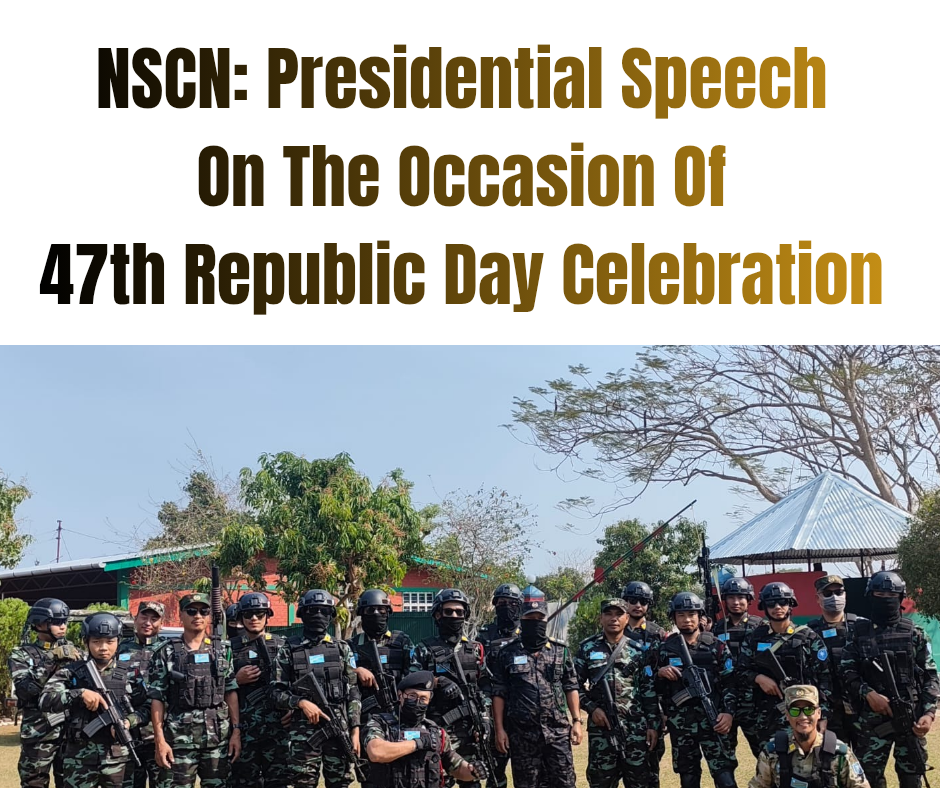
Speech of His Excellency Q.Tuccu, The President of the Government Of The People’s Republic Of Nagalim, on the occasion of the 47th Republic Day Celebration, 21st March, 2026, Chq/Hebron.
Praise the Lord! Praise the Lord! Praise the Lord!
Countrymen,
For the last 46 years we have been celebrating this day- the 21st March- to commemorate the establishment of the Government of the People’s Republic of Nagalim (GPRN). Today, we gather once more to honor this historic milestone, reflecting our spiritual duty, tireless efforts, sacrifices and political resolve. It is a divine blessing that nobody can take it away. Let us take pride, give thanks to Almighty God, and pray that truth, justice, and the fear of the Lord strengthen our government.
Countrymen,
What we are today is because of the bravery and spirit of patriotism of our martyrs. They stood their ground defending our God given rights withstanding against a powerful force. They gave their today for our tomorrow. The legacy of the martyrs is alive today as part of the Naga nation’s conscience. And the truest honour from us the living, is to live by the principles of justice and truth they championed. Let us continue to uphold the values they fought for.
Countrymen,
In the context of what we are going through I am compelled to address the subversive policies and betrayals of the government of India towards our nation. There is “blatant betrayal of truth”, “breach of trust” or “subversive character” of highest severity. Today, state-sponsored terrorism unfolds through the Indian Security Forces as “Kuki Narco-terrorist groups” targets the Naga villages in Manipur in collusion with Indian Security Forces. These surrogate Kuki militants are creating harrowing provocation leading to chaotic confrontation.
Countrymen,
Our history is alive to tell us that the Naga people’s sovereign rights were made known to the British Empire and to the present government of India in “no uncertain terms”. The Nagas strongly projected sovereign narrative based on the universal truth that sovereignty belongs to the people and no authority-however mighty- has the right to take it away.
The story of our sovereignty status as a people and as a nation began when the Naga Club submitted a memorandum to the Simon Commission on 10 January 1929, wherein it was put on record that Nagas should be left to determine their own future as an independent people. The key message was clear: “leave us alone to determine for ourselves as in ancient times”, urging the British to safeguard the rights of the Naga nation against the encroaching neighbors and ensuring that they were not placed under the “mercy of other people who could have never conquered us themselves” upon the British withdrawal from India. This petition has been recorded in history as a landmark memorandum and regarded as the cornerstone of the Naga political movement to safeguard the historical and sovereign rights of the Nagas.
Henceforth, every effort was made to ensure the British India government understood our legitimate rights as a sovereign nation. The British government responded with pretentious seriousness to respect the sovereign right of the Nagas without any meaningful follow up action as deem necessary.
In the first place, Hydari-Akbar Agreement (also known as the Nine-Point Agreement) was signed in June 1947 between the Government of British India and Naga National Council (NNC). This was intended as a transitional arrangement, guaranteeing Naga self government for ten years after India’s independence, with the option for a new agreement on our future status. However, the betrayal followed: the Government of India failed to honor its core promises, interpreting the agreement merely as “district autonomy within the Indian Constitution” rather than recognizing it as the potential steps towards Naga independence. The Naga leadership rejected this sinister design of the government of India to force the Nagas into the Indian Union.
The belligerent stance that followed against the Nagas forced the NNC leadership, under A.Z. Phizo, to approach Mahatma Gandhi- the father of Indian freedom movement from the British rule. On 19 July, 1947, NNC delegation met Mahatma Gandhi at his Bhangi Colony in New Delhi. This encounter marked a political turning point for the Naga aspirations when Mahatma Gandhi candidly affirmed: the Nagas had every right to independence if they choose not to join the Indian Union.
Ultimately, the NNC declared Naga Independence on 14th August, 1947-one day before India’s own- and cabled the United Nation and foreign embassies in New Delhi. Every care was taken that there was no violation of the international standard while declaring the Naga independence.
Another betrayal took place in the form of 16-Point Memorandum. This was signed on July 26, 1960, by a selected few Nagas who treacherously used the un-mandated nomenclature “Naga People’s Convention” (NPC) without consulting the bona fide resistant fighters spearheaded by the Naga National Council (NNC). Significantly, this was clandestinely arranged by the Intelligence Bureau (IB) headed by the then Director, BN Mullick to sideline the resolute NNC. The main objective of the memorandum was creating the state of Nagaland within India to nullify the 1951 Plebiscite for sovereignty, dividing the Naga society, and excluding much of Naga-inhabited areas.
The Naga people’s resistant movement headed by NNC argued that the 16-Point Memorandum was a betrayal for these reasons:
The Memorandum was viewed as an attempt to internalize the Naga issue by making it a domestic issue of the Indian government rather than an invasion of Naga country by India.The NPC, which negotiated the deal, was viewed as the creation of the Indian government to bypass the NNC, led by A.Z. Phizo who was abroad. The Memorandum had caused to formed the state of Nagaland, covering only a portion of the Naga-inhabited areas, ignoring the larger goal of Naga unification.
The deal created deep division within the Naga society, fostering mistrust between those who accepted statehood and those defending the full independence of their country. It was a “sellout” that ignored the immense sacrifices made for a sovereign Nagalim state.
The 16-Point Memorandum failed to establish peace in Nagaland, as fighting continued unabated. In 1964 ceasefire took place between the government of India and the Federal Government of Nagaland (FGN) to pave the way for political solution. Significantly, after six rounds of talks, failure was imminent as fundamental disagreements arises when Naga leaders stood their ground on Naga sovereignty as something non-negotiable, while the Indian government maintained that any solution must be within the framework of the Indian Constitution. This was a breach of international law as Nagaland’s sovereignty cannot be placed at the negotiating table.
On November 11, 1975, Government of India and a section of the Naga National Council (NNC) signed the so-called Shillong Accord after having created a volatile situation in Nagaland to coerce the Naga freedom fighters to agree to dictated terms and conditions to avoid inviting the worst from the Indian government. To the Nagas, this is considered as “betrayal” because it represented a capitulation to Indian sovereignty. Under the deal, it forced the surrender of arms and unconditional acceptance of the Indian Constitution without addressing the core demand for the Naga independence and self-determination, thereby, effectively abandoning the 1951 plebiscite mandate. What made the Shillong Accord as betrayal is that it was against the resolutions adopted by National Hoho on the 5th September 1974 at UNSeti.
Having realized the failure of the past in establishing peace in Nagaland, the Congress government under the prime ministership of PV Narasimha Rao approached the NSCN
Collective Leadership in 1995. Finally, ceasefire was signed between the government of India and National Socialist Council of Nagaland (NSCN) effective from 1st August, 1997 to pave the way for political dialogue for peaceful honourable and amicable solution.
After five years of tough talking, the “unique history of the Nagas and the situation” was officially recognized by the government of India on 11 July 2002 in Amsterdam (Netherlands). Following the recognition of the unique history of the Nagas, the Indo-Naga political talks gained momentum. Significantly, it took another 13 years for government of India to accept the historical reality, the truth behind the Naga history when the historic Framework Agreement was signed on 3rd August, 2015, in New Delhi at the official residence of the Prime Minister of India, Narendra Modi. It was given a high profile political signing ceremony with dignitaries from the government of India and members of National Socialist Council of Nagalim (NSCN) and civil society leaders.
The agreement was hyped as a “revolutionary breakthrough,” it was live-telecast worldwide.
Importantly,the Framework Agreement reflects the truth of Naga history as a sovereign nation.
In the subsequent years following the signing of the Framework Agreement, the changing attitude of the government of India towards the much-hyped Framework Agreement was glaringly seen as India created the treacherous situation to betray the letter and spirit of the
Framework Agreement. A dangerous, premeditated violation of trust took a predominant role in treating the Naga political issue.
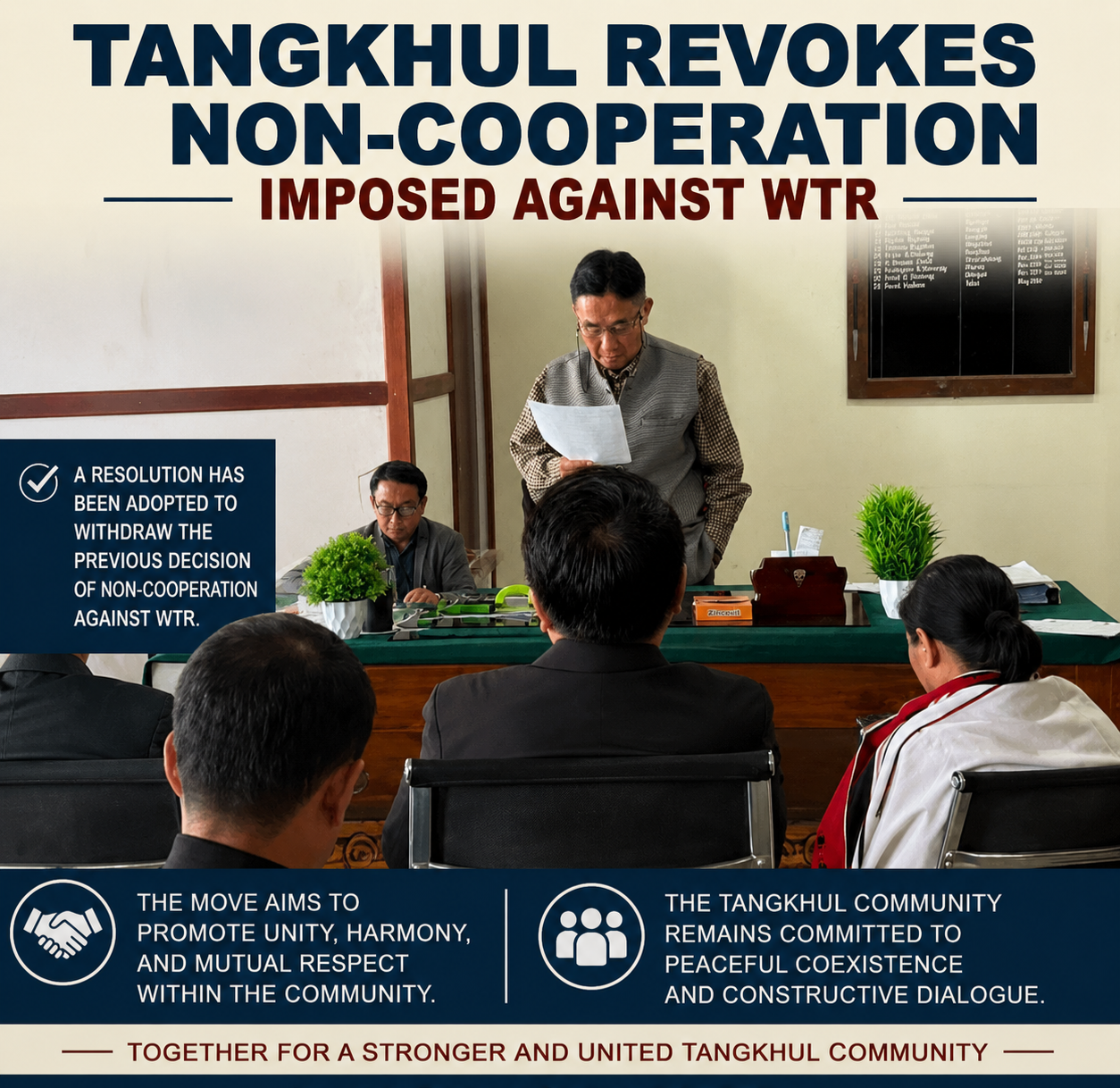
Thus, perfidious was the policy India adopted to destroy the Framework Agreement demeaning the political identity of the Nagas. It was a treacherous breach of trust all the way as India started reviving the archaic policy of the British Ruler to use the Kuki nomads by openly arming them against the NSCN. So despicable and deceitful that Indian Security Forces turned villainous against the NSCN using the Kuki militant groups as their surrogate forces. The latest incident where the Indian Security Forces, were caught working hand-in-glove with the Kuki militants as they burn down the Tangkhul houses at Litan Sareikhong. They were seen working “hand in glove” with the Kuki militants wearing face masks. This violates not only the established ceasefire ground rules but violated the International law as well. This despicable episode has to be exposed globally, including at the UN. We should spare no effort to inform the world on this treacherous character of the government of India and open defiance of what has been agreed upon.
Countrymen,
Why I am using the word “treacherous” against the government of India is for violating the spirit of political agreement, a breach of trust, hypocrisy, and the shift from legality as reflected in Framework Agreement to opportunism. The duplicitous/double-dealing as indulged by the government of India is done to deceive us by presenting a false face. We have been stabbed in the back, which is a cowardly betrayal of the Naga people’s trust.
Countrymen,
Taking into account how the Nagas have been treacherously treated by the government of India, we must redefine our courage and resilience, pledging to stand firm amid betrayal and flattery. Above all, let us believe that God works all things-including injustice- for good; vengeance is His. It is my firm believe if we maintain our trust on what God can do for us, He will certainly bring justice in His perfect timing, allowing us to move forward without having to seek retribution against those who betrayed the Nagas.
Thank you for your patience; I have spoken longer than planned.
Q. Tuccu