
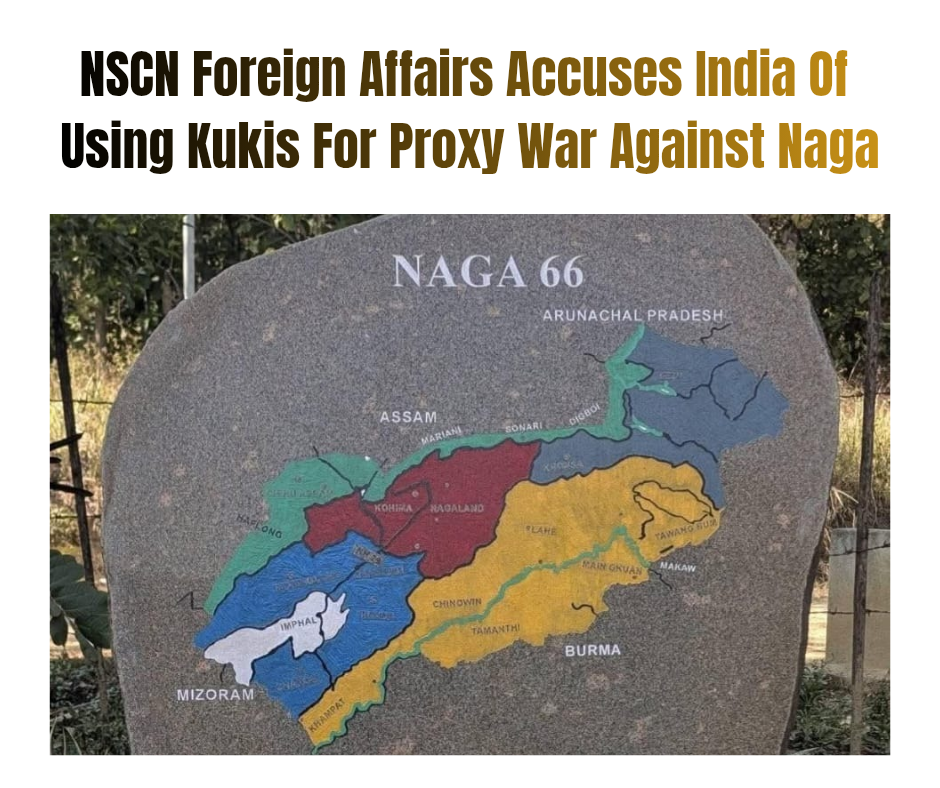
The National Socialist Council Of Nagalim, Ministry of Alee Affairs (Foreign Affairs) on Thursday issued a press statement accusing India’s hegemonic geo-political artifice to divide the Nagas by creating factions, the fragmentation of Nagalim territory, short term agreements and proxy war by using the Gol-Kuki, Suspension of Operation (SoO).
The press statement reads “the state of affairs in India, in the present state of Manipur and elsewhere in Nagaland are pure and simple another phase of the Indian-state terrorism and a manifestation of its hegemonic geo-political ambition. For this master plan the Indian state has been and is consistently and meticulously using the Kukis. The violence perpetrated by the Indian backed Kuki terrorists who are trained and armed under the Suspension of Operation (SoO) follows a pattern, whereby, Kukis are projected as the victims and “the others” labeled as the perpetrators. The politics of labeling is a potent strategy to legitimize a hidden political agenda of the enemy. Hence, the inter-community clash between the Meiteis and the Kukis, the blatant construction of the German Road / Tiger Road in the Naga areas, the burning and destruction of Naga houses in Ukhrul district, unprovoked attack on Nagas in Nagaland are pure and simple a pretext to legitimize the creation of a territorial entity called the Kuki state /Kuki homeland for the so called “victims” which is in fact a larger militaristic geo-political stratagem of the Indian state.”
To put it plainly the following are some of the compelling reasons.
India’s geo-political ambition is to become a major player in the international arena. In order to achieve this dream it must increase its influence in the Indo-Pacific “Rimland” (Nicholas John Spykman), which however by itself has no capability. Spykman postulated that, “who controls the Rimland rules Eurasia, who rules Eurasia controls the destinies of the world”. Can one conclude that India’s geo-political ambition is a conjecture. The geopolitical framework that influenced global powers cannot be easily dismissed. Hence, it can be concluded that its pivot Rim Indo-Pacific Region by enticing entities with common security interest is a geo-political paradigm that is being consciously nurtured and methodically implemented with pathological precision. India’s hegemonic geo-political aspiration has been consciously fueled by the extreme right wing Hindu nationalist / Rashtriya Swayamsevak Sangh (RSS) and its Agencies and military.
Unmistakably it is becoming very clear that the Kuki homeland/Kuki state is India’s larger Rim Indo-Pacific geo-political strategy to transform the Rim sub-himalayan region and its surrounding Rim geo-political region including the Indian ocean and Burma (present Myanmar) into its de facto military bastion and operational base reinforced by the Act-East and the
Kaladan Project connecting West Bengal, the Chin state (Myanmar), present Manipur and Mizoram in India via the Indian Ocean. The ambitious undertaking of the Indian state has, as stated, contains subtle ramifications of inviting foreign entities into these geo-political regions and who in turn can act as a bulwark against a phantom enemy, which is rooted in India’s troubled history with its neighbors. India’s geo-political strategy hinge on its power ambition and appropriating the security interest of the other entities that is distinctly an objective of strategic alliance and containment of the independence struggles and the surrounding nations.
Internally, India’s hegemonic geo-political artifice is to divide the Nagas by creating factions, the fragmentation of Nagalim territory, short term agreements and proxy war by using the Gol-Kuki, Suspension of Operation (SoO). Its policy of weaponizing the Kuki terrorists transcends its border and like a chameleon the Kuki terrorists trained and fed in the present Indian territory are exported and transformed into a pro-democracy People’s Defense Force (PDF) in Burma (present Myanmar), which literally is an extension of the Kuki homeland/Kuki state. The Kukis were imported from the Chin Hills of Burma (present Myanmar) by the British imperialist and armed with muzzle loading guns settled in Naga territory to act as a buffer against the Nagas. Kukis are aliens and refugees and they have become a willing pawn in the hands of the Indian state as the end result would benefit them at the expense of others.
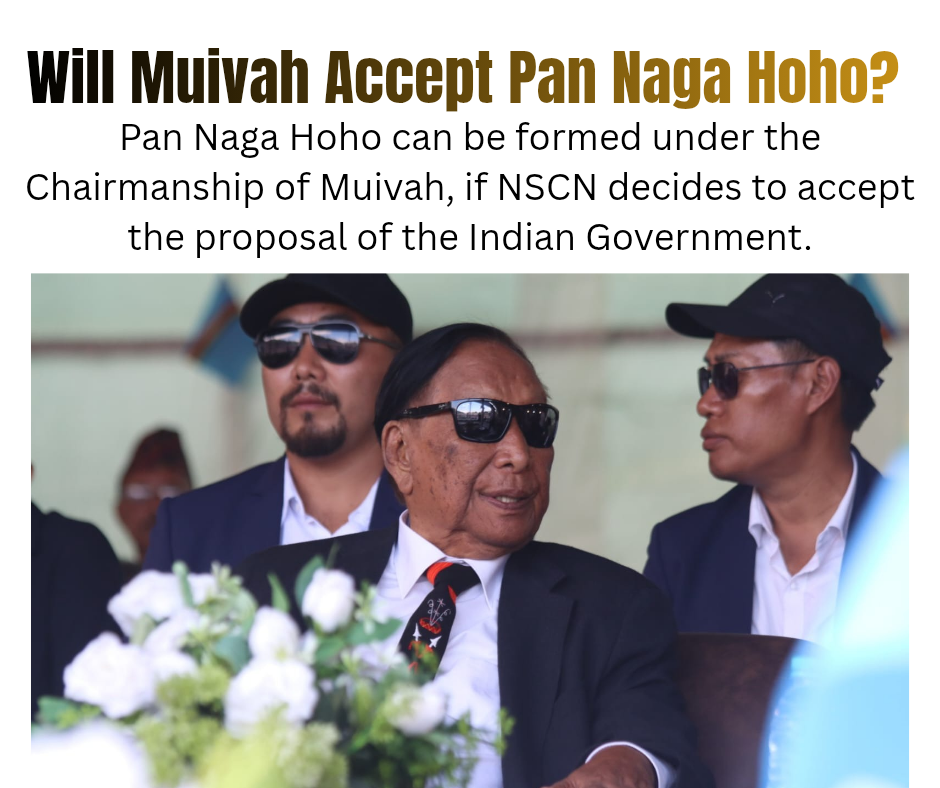
Focusing our attention on India and Nagalim during the 28 years of Indo-Naga political peace process that was initiated on August 1, 1997, the statesmanship of the India’s past and present leadership, including the Prime Minister P.V. Narasimha Rao, Deve Gowda, IK. Gujral, Atal Bihari Vajpayee, Dr. Manmohan Singh, Narendra Modi, visionary decision makers including late Rajesh Pilot etc. and Th. Muivah, the Chief Political Negotiator and General Secretary-Ato Kilonser of the NSCN/GPRN important milestone steps have been achieved with the signing of the Amsterdam Joint Communique of July 11, 2002 and the Framework Agreement of August 3, 2015.
However, the forces directing the Indian state to derail the Indo-Naga political peace process between the Gol and the NSCN by refusing to recognize Nagalim national flag and constitution is not merely indicative of its political bankruptcy but a calculated political agenda to create a new political geography wherein its power is unassailable and impede the rise of its neighbors.
During the Indo-Naga peace process the Indian state,its agencies and the extreme right wing Hindu nationalist flexing their muscles is apparent from the ceaseless militarization, mushrooming of factions in Nagalim, inter-community conflicts and others including the removal of Article 370 of the Indian constitution for Jammu and Kashmir in 2019. The tentacles of the Indian state and its agencies have also crossed the artificial international boundaries and consequently, it has organized division within the Naga organization and created factions by buying off some section of Nagas, intensified cross border terrorism by carrying out military-drone strikes, financing and giving military support to all the pro-India organizations in Burma (present Myanmar).
With the betrayal of the letter and spirit of the Framework Agreement of August 3, 2025 the current situation in Ukhrul and elsewhere in Nagalim is emerging as India’s larger hegemonic geo-political ambition and also a strategy to divert the attention of the international community from Indo-Naga political peace process between the Gol and the NSCN. India’s strategy of gaining political power globally by implementing the colonial legacy of “divide and rule” by pitting one community against the other, division of Nagalim territory, short term agreements and state terrorism, within and outside, is at best an impotent strategy and unsustainable. India’s hegemonic geo-political maneuver may seemingly be successful for a short term period but history is not static and the political geography has changed and is influenced by national aspirations. National aspirations for sovereignty cannot be suppressed by a quick fix approach through state terrorism.
It is imperative to remind the leadership in India that its ambition of becoming a major global player in the Rim Indo-Pacific region can only be achieved by being a responsible and accountable state. Will it exercise a clear political will to resolve the decades old violent Indo-Naga political conflict and stop its obsolete bully tactics. India’s Achilles heels will be on account of the extreme right wing Hindu nationalist and its extended agencies including RAW, IB, NIA, the military and others combined with the shortsightedness of India’s leadership. These integrated forces will surely lead to India’s demise.
To sum up, the challenges of resolving the decades old Indo-Naga political conflict peacefully based on the letter and spirit of the Framework Agreement of August 3, 2015 is an acid test for India and its leadership. How India and its leadership chose to conclude the 28 years Indo-Naga political peace process between the Gol and the NSCN, either peacefully or otherwise, will also impact its future and geo-political aspirations.
Nagalim is for Christ and blessed with its unique history. Hence, for Nagalim and the NSCN, Nagalim’s sovereignty, territory, national flag and national constitution are non-negotiable. The NSCN/GPRN,General Secretary-Prime Minister and the Chief Political Negotiator Th. Muivah, has made his position clear and simple that the Indo-Naga political agreement must be according to the uniqueness of Nagalim history which was officially recognized by the Framework Agreement of August 3, 2015 and Nagalim shall stand firm to the last, come what may.
If Yahweh is for us who can be against us?
KUKNALIM
Issued by:
External Publicity Wing (EPW),