
Pha̱khara̱ signifies the attainment of a womanhood and is believed to repel evil spirits while working in the fields and forest. According to our forefathers, the Kameo (spirits) of the fields and forest dare not touch a woman who has a Pha̱khara̱ on her body.
The deep blue Pha̱khara̱ lines on the body of my late grandmother hung beautifully beneath the traditional necklace, her delicate soft skin sagging… That was the first Pha̱khara̱, the mark of a Tangkhul woman, I saw as a young boy. It was beautiful and grand. I wish I had a picture of her as a young girl with the traditional tattoo, but back then we had no camera.
The Pha̱khara̱ (tattoo) has deep significance and the tattoos are not done randomly. It signifies the attainment of a womanhood and is believed to repel evil spirits while working in the fields and forest. According to our forefathers, the Kameo (spirits) of the fields and forest dare not touch a woman who has a tattoo on her body.
In the olden days, our forefather collected soot from the fire place and thorn especially from the yuzu tree and used that as an instrument to pierce on the body. Painstakingly, it was engraved on the body of a woman. According to the practice as experienced by our forefathers, the thorn from the yuzu tree is less painful and is less infectious.
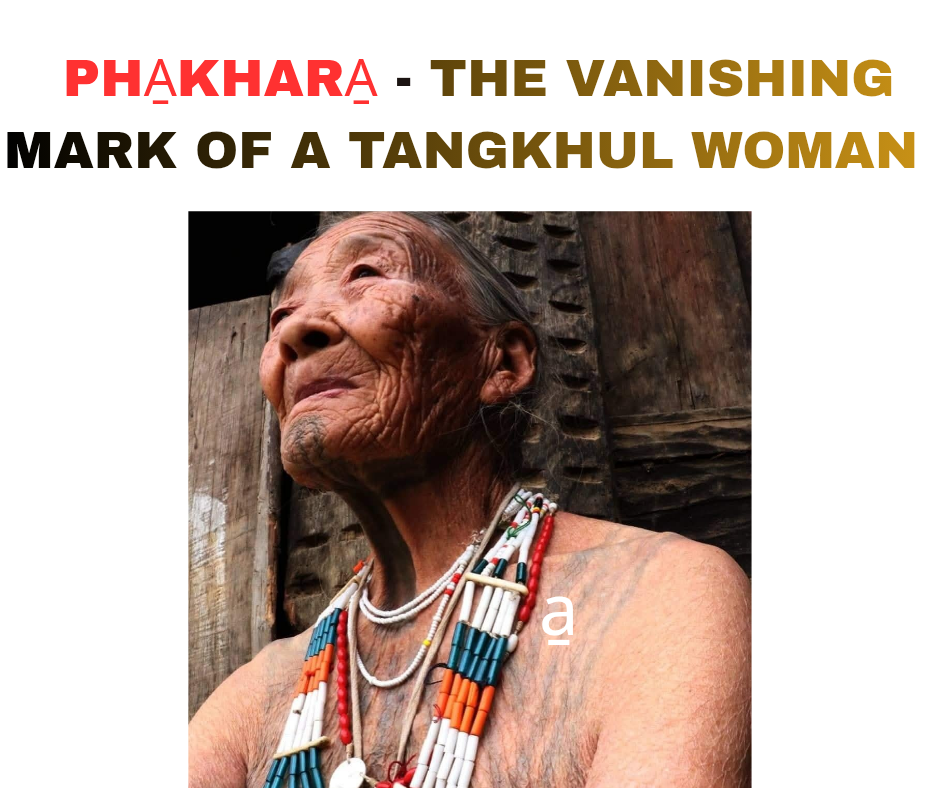
In 2018, I met Ayi (grandma) Khanaola again on the high slopes of Khamasom village, Ukhrul District, Manipur. She was in the kitchen alone sitting near the warm hearth. Her son, daughter-in-law and grandchildren had gone to the field. She posed calmly when I asked her for a photo. This time, I have a camera.
Ayi Khanaola, literally meaning the ‘last daughter’, bears the mark of her clans women. Three lines drawn from her chin extend all the way to her neck and chest. The inked lines seem to bring out her experience and endurance that only age can bring about. This unique tattoo on her body has attracted many photographers and writers from other parts of the world.
None of her descendants bear the traditional tattoo. She said that she did not mind as it was excruciatingly painful. She got tattooed after attaining the age of puberty. She narrated how painful the process was; the elders of the family held her tight while another elder pierced her body with the thorn tipped of yuzu with the soot. The soot act as a colouring agent. She narrated that the entire process was so painful that she cried so loudly and had a fever for a couple of days.
Ayi Khanaola hails from Huishu village. She was 27 years old when she got married to AS Ringshi, a hunter from Khamsom village in 1940. She narrated that a sum of Rs. 60 was paid to her parents as a bride price. Her husband died in 1980. They have nine children and 121 grandchildren and great grandchildren. Ayi Khanaola passed away on 20 December 2022 at the age of 109 years.
Probably, she is the last Tangkhul woman (whom I met and photographed) who wears the unmistakable mark of a Tangkhul woman. It will not be wrong to say that along with her several beliefs, practices and taboos of the community are fading away. Today, no Tangkhul girl wears the traditional Pha̱khara̱. However, modern tattoos which have no relation with their culture are quite common among them. Sadly, the rich and unique traditional way of life of the Tangkhul community is slowly fading out while the community is caught up in their struggle with modernism.