
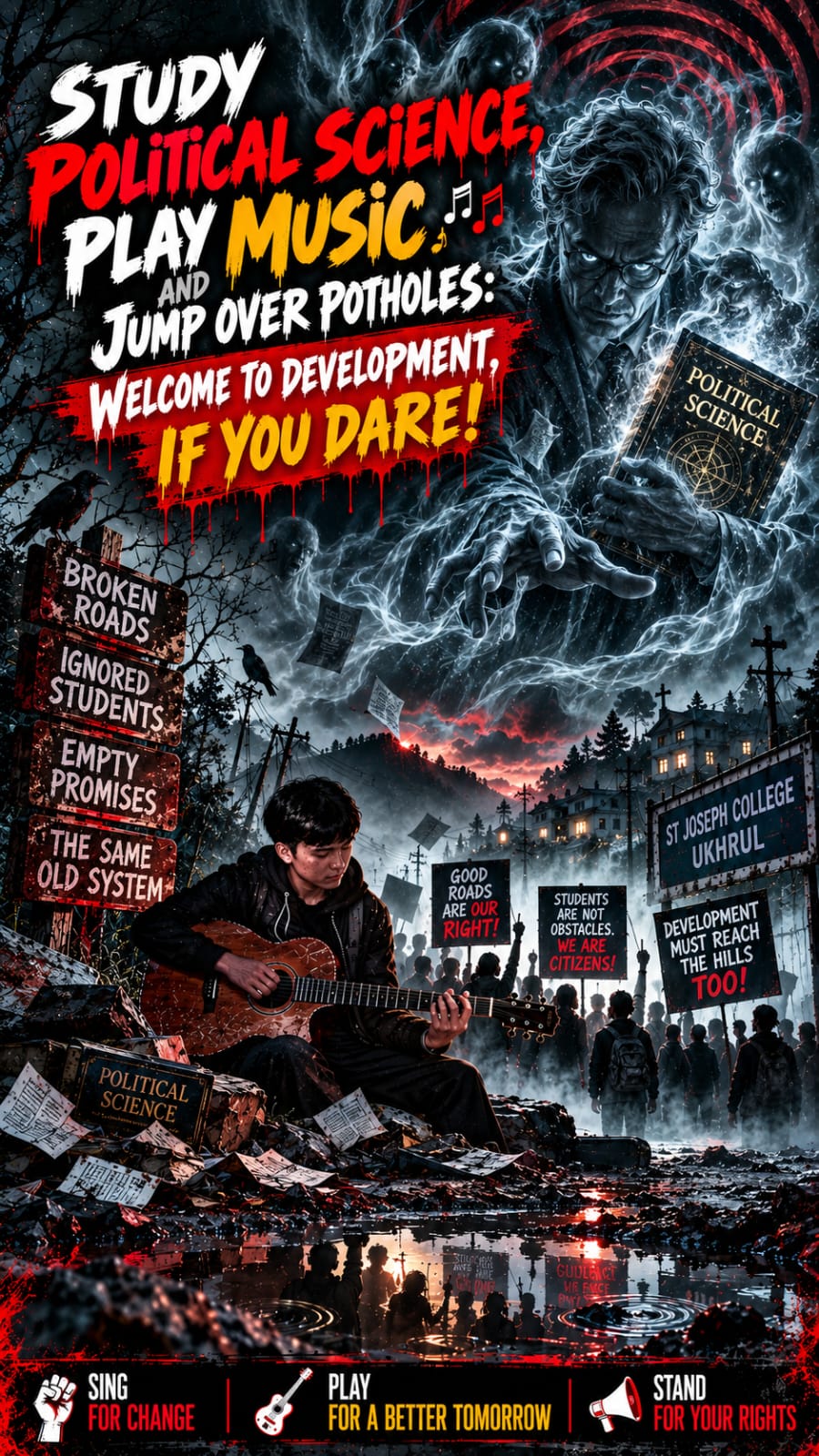
Political Science in the Classroom, Music in the Air, Potholes Everywhere: Welcome to Development, If You Dare!
(A Guitar, a Broken Road and the Power of Protest)
“Get up, stand up, stand up for your rights!” – Bob Marley and Peter Tosh, Get Up, Stand Up
Can music change the world? Bro, I don’t know about the whole world, but I am seriously considering using my guitar to deal with the potholes outside my college! Imagine being a Political Science student who spends hours studying democracy, development and good governance, only to discover that the road to the classroom has apparently skipped every lecture on development. Seriously, what is the point of discussing a developed India when reaching my own college feels like participating in an adventure reality show? I may sit at the back of the classroom, but I have eyes, ears and a guitar. If these potholes think they can survive another monsoon without becoming the subject of my next protest song, they clearly have no idea who they are dealing with!
History has shown us that songs can become powerful instruments of protest. During the American Civil Rights Movement, “We Shall Overcome” gave courage to people fighting racial discrimination. In South Africa, music became a voice of resistance against apartheid. In India, Bhupen Hazarika’s “Manuhe Manuhor Babe” reminded people of the importance of humanity and compassion. The Indian People’s Theatre Association, established in 1943, used theatre, music and cultural performances to communicate social and political messages. During the Chipko Movement, folk songs and cultural expressions helped spread the message of protecting forests. So, music is not just about romance, heartbreak and singing dramatically when someone leaves you on read. It can challenge injustice, unite people and make uncomfortable questions impossible to ignore
Here in our Northeast India, music is part of our identity, culture and everyday life. I believe young people can use that same power to talk about problems affecting our communities. We do not need a celebrity, a million rupees or a concert stage with fancy lights. Sometimes, a guitar, a mobile phone and a little rebellious energy are enough. In my case, inspiration has arrived from an unexpected place: the approach road to St Joseph’s College, Ukhrul.
Let me explain. Normally, reaching college involves travelling along a road, getting off your vehicle and walking into class. Simple, right? Not always. Our approach road has turned an ordinary college journey into an unofficial adventure sport. There are potholes, damaged stretches, mud and uneven surfaces. When it rains, the road seems to transform into a practical examination designed by someone who clearly dislikes students. We arrive hoping to learn Political Science, but first we must demonstrate our ability to navigate a landscape that looks as though it has survived an earthquake.
Honestly, we should introduce a new course called Advanced Pothole Navigation. The practical examination could be held during the monsoon. Students who reach class without falling, slipping or destroying their shoes could receive distinction. Those who arrive with clean trousers could be awarded a gold medal. Imagine me walking into class late. The lecturer asks, “Why are you late, Jeremy?” I reply, “Sir, a pothole delayed me.” The lecturer stares at me and asks, “Again?” I nod. “Yes, sir. It is still there. I think it has permanent attendance!” Some of these potholes have survived so many monsoons that they deserve official recognition for their extraordinary job security.
Naturally, I have started thinking about writing a protest song. Why should famous musicians have all the fun? If Bob Marley could sing about freedom and Peter Tosh could sing about justice, surely an insignificant skinny Political Science student with a guitar can sing about a road full of potholes! I can already imagine myself and my friends performing our very own anthem:
“We shall sing from the belly of the pothole, We shall sing while the muddy waters roll, With dirty shoes and our books held tight, We shall sing for a road that treats us right!”
‘We shall sing when the raindrops fall, We shall sing till they answer our call, From the classroom to the muddy ground, Let the guitar play and the beat resound!”
Imagine us performing this song with our guitars while trying to keep our shoes out of the mud. Someone could record the performance, upload it to social media and watch it travel beyond Ukhrul. Who knows? The song might become so popular that the potholes themselves acquire celebrity status! At least the road would finally become famous for something other than ruining our footwear. And if the authorities happen to hear our little musical protest, I hope they understand that beneath all the laughter lies a genuine request: please give us a proper road to our college.
But jokes aside, this is a real problem. A damaged approach road creates difficulties for students, teachers, staff and visitors. It wastes time and can pose safety risks. We come to college to study, prepare assignments, discuss democracy and build our futures. We should not have to calculate the safest angle for crossing a pothole before attending a lecture. I was therefore encouraged when the Department of “Social Work”, including its Head of Department, faculty members and Bachelor of Social Work students of my college, spent an entire day undertaking basic maintenance of the damaged approach road. Their initiative deserves respect because they contributed their time and effort to improve a shared space.
However, temporary maintenance cannot replace a permanent solution. Students and teachers cannot be expected to keep repairing a road indefinitely. If members of our college community can contribute their limited time and resources, why is a lasting solution so difficult? We are talking about the approach road to an educational institution, not a private highway to someone’s holiday resort. Surely, providing a safe and motorable road should be a reasonable expectation. I would love to see our respected leaders visit the college, inspect the road and experience the journey themselves. Perhaps they could even hold a press conference beside the largest pothole!
Peter Tosh’s song “Equal Rights” reminds me that fairness and justice must mean something in our everyday lives. Every student deserves a fair opportunity to learn, grow and reach the classroom safely. I am not asking for special treatment. I am asking for basic infrastructure that supports education. If the potholes ever decide to contest an election, their campaign slogan could be, “No road, no change, only potholes!” Their manifesto would promise to remain exactly where they are, rain or shine. I would campaign against them with my guitar, demanding better infrastructure and a road that does not require professional mountain biking skills.
And today, 15 October, is my birthday! So, dear friends, if anyone is wondering what to give me, please save your money on fancy gifts and expensive bouquets. I have one birthday wish: an all season motorable road to St Joseph’s College, Ukhrul. Imagine cutting a birthday cake in the morning and discovering that the road has been repaired by the afternoon. Now that would be a gift worth celebrating! I would happily exchange my cake for a properly repaired road. At least the road would benefit hundreds of people instead of disappearing into everyone’s stomach within minutes.
Mahatma Gandhi was born on 2 October 1869, and his commitment to truth, nonviolence and peaceful resistance continues to inspire people. I am certainly not comparing myself with Gandhi. He helped lead a historic struggle for India’s independence, while I am trying to get my college approach road repaired. The difference is fairly obvious! Still, I believe ordinary people can raise important questions and work peacefully towards change. My guitar is my little contribution to that tradition.
Jimmy Cliff’s song “You Can Get It If You Really Want” carries a message of determination that fits my mood perfectly. I may be a skinny fellow sitting on the last bench, but I have a guitar, a few friends and a reason to dream. Give me a beautiful melody, a professor who understands my madness and a pothole that has overstayed its welcome and I will give you a song that Ukhrul will remember! I do not need a grand stage or a thousand spotlights. Give us a chance to sing about our college, our community and the future we want to build. When the rain falls and the mud rises, let our music rise with it. Six strings can carry a thousand dreams, and one little song can put a smile on an entire hillside.
I might even release an album called Potholes and Promises, featuring tracks such as “Government Says Tomorrow”, “Mud on My Shoes”, “Brother, Where Is the Road?” and “The Pothole Waltz”. The monsoon edition could include a map showing the safest route to college, although I suspect it would need updating after every heavy rainfall. If the road is finally repaired, I promise to write a celebration song titled “The Day the Potholes Retired”. We could organise a concert, invite the authorities and celebrate the achievement. If repairing a college approach road becomes such a historic accomplishment, perhaps we should celebrate it like the launch of a spacecraft!
Bob Dylan’s Blowin’ in the Wind asks difficult questions about freedom, humanity and the problems society sometimes ignores. Its famous refrain, “The answer, my friend, is blowin’ in the wind,” makes me wonder whether the answer to our road problem has also been floating around in the wind all these years. Perhaps it is time to bring that answer down to earth, preferably with a few engineers, some machinery and a proper plan for repairing the road.
Of course, I know that music cannot repair roads by itself. We need proper planning, public resources and responsible administration. But music can make people listen. It can turn frustration into a shared message, bring communities together and encourage young people to speak about problems that matter. We can write songs about education, unemployment, corruption, environmental protection, peace and development. We do not need to wait until we become famous or powerful before raising our voices. Sometimes, a simple song recorded on a mobile phone can start a conversation that makes people pay attention.
So, can music change the world? I believe it can help change the world by giving ordinary people a voice. Here in Ukhrul, my musical movement begins with one straightforward demand: please give us a proper road to our college. I cannot carry every pothole away, especially when some look as though they have been eating government promises for breakfast, lunch and dinner. But I can give every broken stretch a song, every complaint a melody and every frustrated student a reason to sing along.
Dear authorities, please repair the road before my next album comes out. I would much rather sing about peace, love and sunshine than spend another year writing songs about mud and potholes. We are not asking for gold plated roads or a highway to the moon. We simply want a safe road that survives the monsoon and allows us to reach our classrooms without feeling like participants in an adventure reality show.
One love, one college, one proper road! Let the music play, let the students sing and let those responsible get to work. The potholes may have occupied the road for years, but they do not own our future. I may be a thin insignificant fellow, but my guitar is heavy and my determination is heavier still. The road may be broken, but our voices will not be silenced!
Jeremy Asem
First Semester BA Political Science
St Joseph’s College, Ukhrul, Manipur