
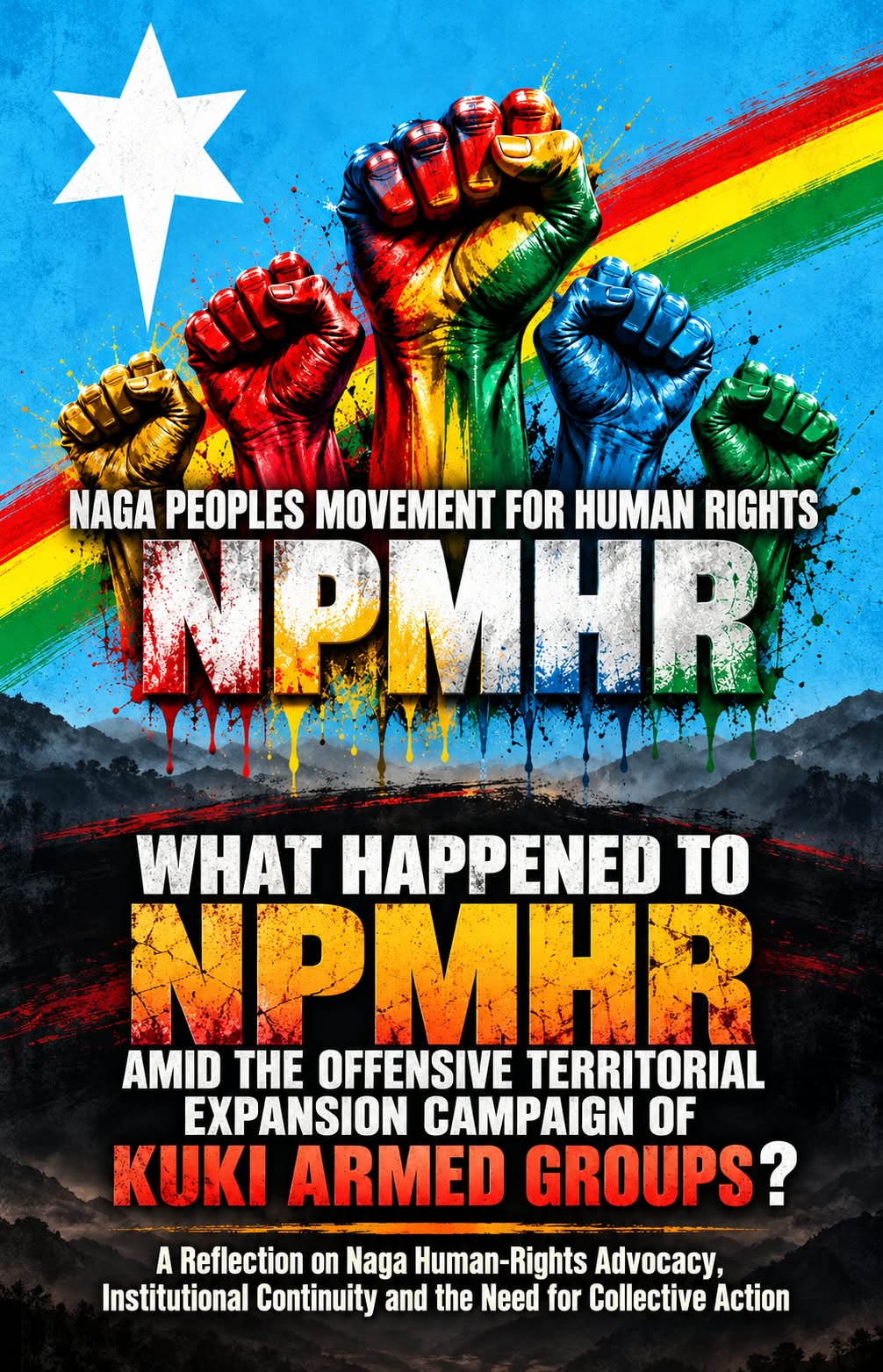
A Reflection on Naga Human-Rights Advocacy, Institutional Continuity and the Need for Collective Action
The Naga People’s Movement for Human Rights (NPMHR) occupies an important place in the history of Naga civil society. During periods when the experiences of Naga civilians affected by military operations received little attention beyond their immediate communities, NPMHR helped bring their suffering into public view. Through grassroots documentation, legal intervention, public mobilisation and engagement with national and international human-rights networks, it established a record of advocacy that remains significant today. Its work demonstrated that the experiences of villagers could be taken beyond local boundaries and placed before courts, public institutions and the wider world.
That legacy makes the present situation particularly important. Across Naga-inhabited areas of Manipur, civilians continue to face serious security threats amid a volatile confrontation involving armed groups. Naga communities have reported attacks on villages, killings, ambushes, abductions and other grave violations attributed to Kuki armed groups. Naga civil-society bodies have raised concerns about territorial encroachment, the expansion of armed influence and the growing vulnerability of settlements in exposed areas. These developments form part of what Naga communities have characterised as an offensive territorial expansion campaign by Kuki armed groups, with serious implications for civilian security and the future of Naga-inhabited territories. Throughout this campaign, Nagas have largely remained in a defensive position, seeking to protect their villages, civilians and ancestral areas against armed pressure and territorial encroachment. Investigating individual incidents and establishing responsibility remain essential to securing accountability, but these requirements do not erase the wider security concerns confronting Naga communities.
The central question is not whether NPMHR has spoken about the conflict. It publicly condemned the killing of six Naga men whose mutilated remains were recovered in June 2026. The more demanding question is whether its public interventions have been accompanied by systematic documentation, formal representations to relevant institutions, legal follow-up and sustained engagement with the wider pattern of reported violations.
A public statement records an organisation’s position, but sustained human-rights advocacy requires more. It involves preserving evidence, documenting victims’ accounts, supporting affected families, approaching competent authorities and tracking the progress of cases. NPMHR’s historical contribution deserves recognition, while its present responsibilities merit serious examination. The purpose is not to dismiss the work of its founders or those who continue its activities, but to consider how fully its accumulated experience is being applied to the challenges confronting Naga civilians today.
NPMHR’s Historical Mandate and Legal Record
NPMHR emerged during the 1970s from discussions among Naga students and activists seeking an organised movement to document and challenge human-rights violations. Its precise foundation date differs across published accounts. An NPMHR report reproduced by the International Work Group for Indigenous Affairs states that the organisation was formed on 9 September 1976. Neingulo Krome, writing in The Morung Express in September 2010, identifies 9 September 1978 as its formation date. A doctoral thesis on Naga politics traces its informal beginnings to 1977. It records the appointment of a five-member steering committee by the Naga Students’ Union, Delhi, on 9 September 1978, followed by the adoption of NPMHR’s declaration on 26 November that year. The date of 9 September 1978 is widely recognised as the organisation’s foundation date, although the earlier reference remains part of the conflicting historical record.
Sources: NPMHR’s historical report reproduced by IWGIA; Neingulo Krome, “NPMHR at the Asia Indigenous Peoples Pact,” The Morung Express, and doctoral thesis on Naga politics, University of Glasgow.
One of NPMHR’s early initiatives was Human Rights Week, held in Nagaland from 10 to 15 December 1978 to commemorate the thirtieth anniversary of the Universal Declaration of Human Rights. Despite reported government opposition and threats against organisers, NPMHR workers visited villages and held public meetings where civilians described alleged military abuses, including killings, torture, sexual violence, arbitrary detention, forced labour and the destruction of homes, granaries and crops. These activities helped bring testimony from affected communities into a wider public record.
The organisation’s engagement also extended to collective political and cultural initiatives. In 1993, it participated with other Naga organisations in Naga Week, associated with the United Nations’ International Year for the World’s Indigenous People. In January 2000, it took part in the Journey of Conscience to Delhi, bringing Naga civil-society representatives into engagement with people in India. In 2002, a Naga cultural delegation travelled to Bangkok under the slogan “Nagas Call for Peace”. NPMHR later became a participant in the Forum for Naga Reconciliation following its establishment in 2008. These initiatives reflected different dimensions of its work, from documentation and legal advocacy to public mobilisation, cultural expression and peacebuilding.
NPMHR’s historical significance is also reflected in the legal proceedings concerning the disappearance of C. Daniel, a school headmaster, and C. Paul, an assistant pastor from Huining village. The two men were reportedly taken to a military camp by personnel of the 21st Sikh Regiment on 10 March 1982 and did not return. Their disappearance became the subject of Supreme Court proceedings in Sebastian M. Hongray v. Union of India.
On 24 November 1983, the Supreme Court directed the authorities to produce the two men. On 23 April 1984, after they had not been produced, the Court ordered the payment of Rs 1 lakh each to their wives as exemplary costs. It also directed that the case papers be treated as information concerning a cognisable offence requiring investigation.
These proceedings were brought under the name of Sebastian M. Hongray and should not be misrepresented as litigation filed directly by NPMHR. They nevertheless remain an important part of the legal record concerning alleged violations against Naga civilians. See the Supreme Court judgments of 24 November 1983 and 23 April 1984.
NPMHR also pursued legal action following Operation Bluebird, launched after the attack on the Assam Rifles post at Oinam on 9 July 1987. It filed Civil Rule No. 1043 of 1987 in the Gauhati High Court, challenging the treatment of civilians during subsequent security operations. A connected application, Miscellaneous Case No. 1127 of 1987, sought an independent inquiry into allegations involving deaths, torture, rape, destruction of property and other abuses. The application and the wider proceedings must be distinguished when assessing the legal history of the case.
In a 2010 account, Neingulo Krome described the substantial documentary record assembled by NPMHR concerning Operation Bluebird, reportedly amounting to approximately 10,000 pages. The scale of this effort illustrates the importance of gathering testimony and preserving evidence even when accountability proceedings are complex and prolonged. The Gauhati High Court case material provides another reference for examining the legal history.
NPMHR was also involved in the constitutional challenge to the Armed Forces (Special Powers) Act, 1958. In Naga People’s Movement for Human Rights v. Union of India, decided on 27 November 1997, the Supreme Court upheld the Act’s constitutional validity while laying down safeguards for its implementation. The judgment did not repeal AFSPA, but it brought the relationship between extraordinary security powers and constitutional protections before the country’s highest court. The Supreme Court judgment remains a significant part of the history of human-rights advocacy in the region.
Taken together, these records establish the importance of NPMHR’s historical role in documenting civilian experiences, pursuing legal remedies and engaging institutions beyond the Naga homeland. They also provide a standard against which its contemporary work must be considered.
The Abduction and Killing of Six Naga Men
On 13 May 2026, eighteen Naga civilians were reportedly abducted from the Leilon Vaiphei area of Kangpokpi district. The female captives, including an infant, were released on 15 May, while the six men remained missing. The United Naga Council and other Naga organisations subsequently demanded information about the missing men’s. whereabouts and condition as their families continued to seek answers. The incident and the continuing search were reported by The Morung Express on 19 May 2026. The National Investigation Agency’s official case record also records the abduction of eighteen civilians at Leilon Vaiphei on 13 May.
The six men were identified as Rev. Dr. Manu Thiumai, Pastor Kenpibou Chawang, Phenrongwibou Thiumai, Dilip Thiumai, Ch. Phenrilung Chawang and Kaliwangbou Abonmai, all from Konsakhul Naga village. Their families and the wider Naga community spent weeks seeking information about their fate.
On 4 June, the Manipur High Court directed the state government to submit an action-taken report on efforts to trace the missing men. The direction came during a public-interest litigation filed by T. Mark Khapai, president of the Naga Lawyers’ Association, Manipur. At that hearing, the Deputy Solicitor General submitted, on instructions, that the NIA had not yet received official intimation of the case. This was the position recorded by the Court at that time. See the High Court order of 4 June 2026.
The subsequent record clarifies the investigation timeline. On 5 June, the Ministry of Home Affairs directed the NIA to take up the investigation. The NIA registered FIR No. RC-07/2026/NIA/IMP on 8 June. The High Court’s order of 22 June records that the agency had been entrusted with the investigation and that the government had submitted an action-taken report. The Court also referred to the NIA FIR and the need to expedite the investigation. These developments are distinct from the position reported to the Court on 4 June. See the High Court order of 22 June 2026 and the NIA’s official case listing.
On 10 June, following an extensive search involving security personnel, forensic experts and sniffer dogs, six bodies believed to be those of the missing men were recovered. Police reported that the remains were found after nearly 24 hours of search operations involving approximately 450 personnel. Relatives described the remains as dismembered and mutilated beyond recognition, and family accounts reported that the victims had been beheaded. Police also indicated that the men may have been killed elsewhere and their bodies moved to the recovery site. The recovery and the condition of the remains were reported by EastMojo on 10 June and 12 June 2026.
Allegations surrounding the abduction and killings included claims of involvement by members of the Kuki National Front-Presidential Faction (KNF-P). The circumstances of the abduction, the killings and the subsequent handling of the remains require a thorough investigation to establish individual responsibility. The recovery of the bodies made the demand for forensic examination and accountability urgent.
Reports based on accounts attributed to some of the released women also raised disturbing questions about the food served to them during captivity. The women reportedly feared that meat they could not identify might have been human flesh. This remains a reported suspicion, not an established forensic finding. It must not be presented as proof that they were served human remains. Any conclusion requires appropriate forensic evidence and a credible investigation. Their accounts were discussed by The Sangai Express on 13 June 2026 and NEWire on 13 June 2026.
A social-media screenshot also circulated while the six men remained missing. A comment appearing to refer to the missing Nagas prompted demands for digital forensic examination. Its authenticity, authorship, context and connection to the crimes must be established independently. The appropriate course is to preserve and examine the underlying digital evidence through competent investigators.
On 11 June, NPMHR publicly condemned the killings. Its statement expressed shock at the discovery of the mutilated remains, recalled its earlier appeal for restraint during the hostage crisis, referred to the release of fourteen Kuki hostages unharmed and called for justice for the six Naga men and their families. The statement was reported by The Morung Express and Ukhrul Times.
NPMHR’s condemnation must be acknowledged. It recorded the organisation’s position at a critical moment in the case. The wider question of subsequent institutional engagement, including formal representations and case follow-up, requires examination alongside the organisation’s other public activities and the limits of the available record.
The Wider Pattern of Reported Attacks
The killing of the six men occurred within a wider context of insecurity reported in Naga-inhabited areas of Manipur. Communities and civil-society organisations have raised concerns about attacks on settlements, killings of village guards and volunteers, ambushes, arson and armed activity near Naga villages. These incidents reinforce Naga concerns about territorial encroachment and the expansion of armed influence by Kuki armed groups. For Naga communities, the central issue is not merely the occurrence of isolated attacks, but the continuing threat to their settlements, civilian security and territorial integrity. Their largely defensive posture throughout this campaign must be understood in that context.
On 24 September 2026, four Tangkhul Naga civilians were reported killed in an attack at Pilong, a settlement in Kamjong district near the India-Myanmar border. The victims were identified as Phami Jajo, Vareishim Jajo, Betterson Jajo and Ningthem Kasak. The Indian Express reported that police suspected Myanmar-based Kuki National Army-Burma (KNA-B) militants. The Tangkhul Naga Long also attributed the attack to KNA-B and other armed Kuki groups, while The Times of India noted that the allegations could not be independently verified by the newspaper. These reports establish the seriousness of the allegations, while responsibility must ultimately be determined through investigation. See The Indian Express and The Times of India, 25 September 2026.
The violence reported in October intensified these concerns. On 10 October, renewed violence affected several hill districts of Manipur. Reports published the following day described at least nine deaths and approximately fourteen houses burned over a period of about twenty-four hours. Among the reported incidents were the deaths of Naga village guards and civilians, including attacks at Makui and near Ningchou, as well as an ambush near Tapon. The same reporting documented the death of a Kuki woman during a security operation and a separate allegation that a Kuki man had been shot dead by Naga rebels. Responsibility remained uncertain in some cases, making it necessary to distinguish individual incidents and verified findings from allegations about perpetrators. See The Indian Express, 11 October 2026.
On 13 October, The Indian Express reported that the family of R. Ajinpou Ringkangmai, killed during an attack at Makui, refused to accept his remains until his severed head was recovered. The family said the headless body could not be identified with certainty and that accepting it would conflict with their customary traditions. The report also described demands by a tribal council for the recovery of the missing head and the arrest of alleged perpetrators. See The Indian Express, 13 October 2026.
These incidents raise serious questions about civilian protection, the security of exposed settlements and the movement and presence of armed formations near Naga villages. The territorial concerns raised by Naga communities cannot be separated from the security conditions surrounding their settlements. The reported attacks, killings and incursions must be examined both individually and in their wider geographical and political context. Investigations must establish the facts of each incident, identify those responsible and preserve the evidence necessary for accountability.
Human-rights documentation must therefore go beyond accumulating reports of violence. It must preserve the circumstances of individual incidents, distinguish verified facts from claims, establish responsibility wherever the evidence permits and record the response of the authorities. Such work provides a reliable basis for legal action while documenting the broader pattern of insecurity confronting Naga communities.
As of 11 October 2026, the reported death toll among Naga civilians in the ongoing Naga-Kuki conflict had reached at least 34, according to cumulative figures reported by Naga organisations and local sources, together with subsequent reported killings. A consolidated official tally of Naga civilian fatalities, supported by incident-specific records and established findings on responsibility, remains unavailable.
NPMHR’s Present Public Record and Institutional Constraints
NPMHR has continued to make public interventions in recent years. It addressed the Manipur crisis in July 2023 and issued another statement in December 2023. In July 2025, it participated in the commemoration of Operation Bluebird. In October 2025, it condemned what it described as a deliberate drone attack on Khenmoi-Loiyi village in Myanmar, which reportedly killed two civilians and injured others. In June 2026, it condemned the killing of the six Naga men. On 10 October 2026, it issued a condolence message following the death of Adinno Phizo, President of the Naga National Council.
Sources: NPMHR’s July 2023 statement; its December 2023 statement; the July 2025 Operation Bluebird commemoration; the October 2025 drone-strike statement; and the October 2026 condolence message.
These activities establish that NPMHR remains publicly active. They do not, by themselves, establish the scale or effectiveness of its investigations, legal interventions, formal submissions or case follow-up. A statement, commemoration, investigative report and formal representation to an authority serve different purposes. Its present role must therefore be assessed through the available record of its activities rather than inferred from public statements alone.
There are also documented constraints on human-rights advocacy. In April 2025, NPMHR General Secretary Neingulo Krome was reportedly prevented from boarding an international flight to Kathmandu and informed that his passport had been cancelled. The Unrepresented Nations and Peoples Organization condemned the reported action and raised concerns about restrictions affecting a Naga human-rights defender. See UNPO’s statement of 16 April 2025 and The Morung Express report.
This incident concerns Krome individually and does not establish a blanket travel ban on every NPMHR member. It does, however, illustrate the obstacles that may affect international engagement by a human-rights defender. Such restrictions deserve scrutiny under applicable law, especially where they impede peaceful human-rights work.
The institutional context is equally important. The National Human Rights Commission is a statutory body established under the Protection of Human Rights Act, 1993. NPMHR is an independent civil-society organisation and does not possess the statutory powers of the NHRC or the investigative authority of the NIA. The NHRC’s official account of its mandate explains its role, while the United Nations Declaration on Human Rights Defenders recognises the role of individuals and associations in peacefully promoting and protecting human rights. The Declaration establishes an important international standard, although it is not itself a treaty.
NPMHR cannot compel witnesses, order forensic testing or prosecute suspects. It can document testimony, preserve information with appropriate consent and safeguards, support affected families, facilitate legal assistance, submit representations to competent authorities and follow the progress of cases. It can also engage national and international human-rights networks. External restrictions and resource constraints may affect its capacity, but administrative arrangements, leadership continuity, preservation of archives and public reporting also matter when assessing its institutional effectiveness.
The publicly accessible material reviewed for this article confirms NPMHR’s condemnation of the June 2026 killings but does not establish the full extent of its formal representations to national and international human-rights institutions concerning the wider pattern of reported attacks. Correspondence may remain unpublished or unindexed. NPMHR could clarify the position by identifying, where appropriate and safe, the institutions it has approached, the issues raised, the dates of its representations and any responses or follow-up. Such a record would allow a more informed assessment without exposing confidential evidence or placing victims and witnesses at risk.
The Petition and Public Mobilisation
The demand for justice for the six Naga men has also generated substantial public participation through an online petition calling for a comprehensive investigation. The petition addresses the Prime Minister’s Office, the Ministry of Home Affairs, the National Investigation Agency and the United Nations Human Rights Office. When checked on 15 October 2026, it displayed 100,339 verified signatures. See the petition on Change.org.
The signature count demonstrates substantial public participation in the demand for truth, justice and accountability. It does not, by itself, establish that every allegation has been verified, that the institutions addressed have formally taken up the matter or that a United Nations procedure has commenced. Those developments require separate confirmation. An online petition is a means of public mobilisation, not a substitute for an investigation, a formal legal filing or a confirmed institutional response.
Public mobilisation can complement established human-rights advocacy by sustaining public attention, encouraging authorities to respond and helping keep unresolved cases in view. Its value is greatest when public concern remains connected to reliable evidence, appropriate institutional engagement and documented follow-up.
From Public Condemnation to Sustained Institutional Action
NPMHR’s history provides a foundation for a stronger response to reported attacks on Naga civilians. The priority is to connect incident reporting with evidence preservation, appropriate legal action and continuing engagement with the authorities. This work requires an institutional framework that can function beyond the immediate attention. generated by a particular incident.
Each reported violation should have a clear chronology, location, available witness accounts, supporting material, details of any police complaint and the status of the investigation or legal proceedings. Sources should be identified, discrepancies recorded and allegations distinguished from verified findings. Photographs, medical records and other potentially relevant evidence should be preserved where available and handled in a manner that respects victims, protects witnesses and safeguards the integrity of possible proceedings.
Formal representations should have clearly defined objectives. A submission to a police authority may seek an investigation or particular investigative steps. A representation to a human-rights commission may raise concerns about protection, accountability or the handling of a complaint. A submission to an international mechanism must meet that mechanism’s procedures and criteria. These are distinct processes, and public statements alone should not be treated as substitutes for them.
A continuing case register would record the institution approached, submission date, reference number, requested action, response and next procedural step. Where a case is transferred to a specialised agency, the transfer and available status information should be recorded. Where an authority does not respond, qualified legal advisers can assess the available remedies. Public updates should communicate progress without compromising confidential correspondence, witness safety or the integrity of an investigation.
Collective action is essential to sustaining this work. Naga civil society includes village organisations, tribal bodies, student organisations, women’s organisations, churches, lawyers, researchers and human-rights advocates. Each can contribute different forms of knowledge and support. Local bodies can maintain contact with affected families and gather incident information; researchers can verify and organise records; lawyers can assess appropriate legal remedies; and human-rights organisations can support documentation, representations and follow-up.
Cooperation need not require every organisation to merge or agree on every political question. A standing coordination mechanism could establish shared standards for incident documentation, assign responsibilities for specific cases, maintain a common register of outstanding representations and facilitate access to qualified legal advice. It should respect the independence of participating organisations and the wishes of affected communities. Its purpose would be to ensure that important evidence and unresolved cases do not disappear when priorities change or an organisation faces. difficulties.
Institutional continuity also requires investment in people and records. NPMHR and other participating organisations should preserve their archives, document procedures, train younger members in research and legal advocacy, and plan leadership succession. Periodic reports could identify the cases documented, representations submitted, responses received and matters that remain unresolved. Where work has been constrained by limited resources, safety concerns or the absence of verifiable evidence, those limitations could be explained without exposing sensitive information.
Such arrangements would make institutional activity more transparent and help the public distinguish between a position expressed, an action taken and an outcome achieved. They would also allow Naga organisations to support one another when one body lacks resources or faces restrictions. No system can guarantee justice or prevent every external constraint, but sound documentation, cooperation and sustained follow-up would strengthen the basis on which civilian protection and accountability are pursued.
A Legacy Must Be Measured by the Work Continued
NPMHR’s contribution to Naga human-rights advocacy deserves recognition. Its history includes grassroots documentation, legal intervention, public mobilisation and engagement with institutions beyond the Naga homeland. Its condemnation of the June 2026 killings must also be acknowledged. The question is whether its present work, including formal representations and subsequent follow-up, is sufficient to address the continuing reports of attacks and grave violations against Naga civilians.
The publicly accessible record reviewed for this article does not establish the full extent of NPMHR’s formal engagement with national and international human-rights institutions concerning the wider pattern of reported attacks. That gap calls for clarification, not an assumption that no further work has been undertaken. NPMHR is best placed to explain the scope of its engagement and the progress of outstanding matters, subject to the legitimate need to protect confidential information and those at risk.
The wider responsibility belongs to Naga civil society as a whole. Families seeking answers and communities facing insecurity need evidence that is preserved, complaints that are pursued, representations that receive follow-up and organisations capable of working together without abandoning their independence. Naga communities have largely been compelled to defend their civilians, villages and territorial interests amid the continuing campaign of armed pressure and insecurity. Their concerns deserve sustained attention, systematic documentation and meaningful institutional engagement.
NPMHR helped establish a tradition of Naga human-rights advocacy through documentation, legal action and public engagement. Preserving that legacy means applying its experience to present challenges, renewing institutional capacity and ensuring that unresolved cases remain within the public and legal record. The people deserve institutions whose work continues beyond the generation that founded them, turning historical courage into sustained and verifiable action today.
Markson V. Luikham
Markson V. Luikham is an independent researcher and writer focusing on the Indo-Naga issue, Naga internal political affairs, and the history and contemporary political affairs of Northeast India.
(The views and opinions in this article are solely those of the author and do not necessarily reflect the official stance of Rural Post)