
We live in an age of glamour and luxury that creates a powerful illusion that anything imaginable is achievable. Yet beneath this glittering surface lies a deep and painful divide. On one side, powerful and manipulative personalities relentlessly pursue the top. On the other, the innocent and less fortunate are left as spectators, looking towards a distant world of power and privilege that seems beyond their reach. It is at this point that we must pause and ask ourselves a difficult question: are we truly moving towards a better society where everyone can grow together in harmony and inclusivity?
Our elders often reminded us of our exemplary forefathers who lived just and honourable lives. Their moral integrity was a treasured legacy and a foundation worthy of emulation by generations to come. For them, morality was a non negotiable measure of the quality of one’s conscience. A person’s worth was not determined merely by what he possessed but by how he lived, how he treated others and what he contributed to the community.
That rich ancestral integrity, however, seems to have been steadily eroded.
In the pursuit of power, wealth and status, we appear to have traded away a part of our integrity. We have weakened the values that once held us together. Driven increasingly by ego, we have become individualistic, viewing the world through the narrow lens of self interest and personal advancement. Our forefathers, by contrast, understood life through the community. Their identity was deeply connected to the wellbeing of those around them.
Our present social context echoes the philosophy of the Existentialist Friedrich Nietzsche, who argued that one must live by one’s own understanding to create meaning in life. If interpreted narrowly, this is a profoundly egocentric proposition, one that discards shared social values and absolves us of any responsibility to protect the weak or society. This stands in stark contrast to the teachings of all major faiths. Nowhere in Christianity or in any other religion is an individualistic motive upheld. Every religion where we anchor our faith, at its core, teaches love for one another, tolerance, and compassion.
Today, whether by coincidence, accident or conscious choice, our society seems to be moving towards a narrow form of individualism. We have become so absorbed in ourselves that the suffering of others can become invisible to us. The vulnerabilities of others can even become opportunities for personal advancement. Compassion can become conditional. Relationships can become transactional. Principles can become negotiable when power, money or status are at stake.
This is where the real danger begins.
When self interest becomes normalised, it gradually ceases to appear wrong. What was once considered shameful can become acceptable. What was once condemned can become a strategy for survival. Eventually, people may begin to admire those who succeed through manipulation while overlooking the moral cost of their success.
There is perhaps nothing more frightening than a society that becomes materially richer while becoming morally poorer. A generation may inherit better houses, better roads, better phones and greater opportunities, yet still inherit a weaker conscience. What happens when we learn to recognise success by the size of a person’s wealth but no longer recognise greatness by the depth of his character? What happens when we teach our children to compete for everything but fail to teach them to care for anyone?
At that moment, the crisis is no longer merely economic or social. It becomes a crisis of the human soul.
Perhaps our greatest tragedy is that we have begun to worship the very things our forefathers warned us could destroy us: wealth without wisdom, power without accountability and freedom without responsibility.
A society does not collapse only when its institutions fail. It begins to collapse when its people can witness injustice, walk past suffering and remain comfortable with their own silence. It collapses when conscience becomes inconvenient and integrity becomes a burden. The greatest danger is not that evil exists. It is that ordinary people gradually become comfortable with it.
This subjective and self centred mindset has created tension between individual interests and the interests of society. If such attitudes are allowed to become a normal way of life, they may eventually be passed on to future generations. Our children may inherit the material achievements of our generation while also inheriting its moral emptiness.
We must therefore begin the correction within ourselves.
We have become westernised in many ways through imitation, often without carefully examining what we are adopting and what we are losing in the process. Comfort, luxury, glamour and consumerism can easily become symbols of success and the ultimate definition of a fulfilled life. Material prosperity has its place, but when it becomes the sole measure of fulfilment, ethics and integrity gradually lose their relevance.
The problem, therefore, is not modernity itself.
Modernity can bring knowledge, opportunity, equality, scientific advancement and a better quality of life. The real danger lies in adopting the outward appearance of modernity while abandoning the moral foundations that give human life meaning. We can embrace progress without surrendering our conscience. We can become modern without becoming morally rootless.
Our traditional values should not be treated as obstacles to progress. They can provide the moral foundation upon which genuine progress is built. A society needs ambition, but it also needs restraint. It needs competition, but it also needs compassion. It needs individual freedom, but it also needs responsibility.
Perhaps what we need today is not a rejection of the West but a rejection of blind imitation. We must learn to take what enriches our lives while having the courage to question what weakens our communities. We should not measure civilisation merely by the height of our buildings, the sophistication of our lifestyles or the size of our bank accounts. The deeper measure of civilisation is how we treat those who have nothing to offer us in return.
Our forefathers may not have possessed the luxuries that define our lives today, but they understood something we seem to be forgetting: a community survives when people care for one another.
If we lose that understanding, no amount of wealth can save us from moral poverty.
Let us therefore become modern without becoming disconnected from our roots. Let us embrace progress while preserving compassion, community and responsibility. Let us teach our children that success is not simply about reaching the top but also about remembering those who remain below.
We must ask ourselves what kind of society we want to leave behind. Will our children inherit our possessions, or will they inherit the courage to stand for truth, the humility to serve others and the wisdom to understand that humanity is greater than success?
For ultimately, the strength of a society is not determined by how powerful its most powerful people become. It is revealed by how deeply its people retain their humanity.
And perhaps, in those timeless values inherited from our forefathers, lies the soul of a peace that we can still sustain together, not as isolated individuals, but as a community bound by conscience, dignity, responsibility and harmony.
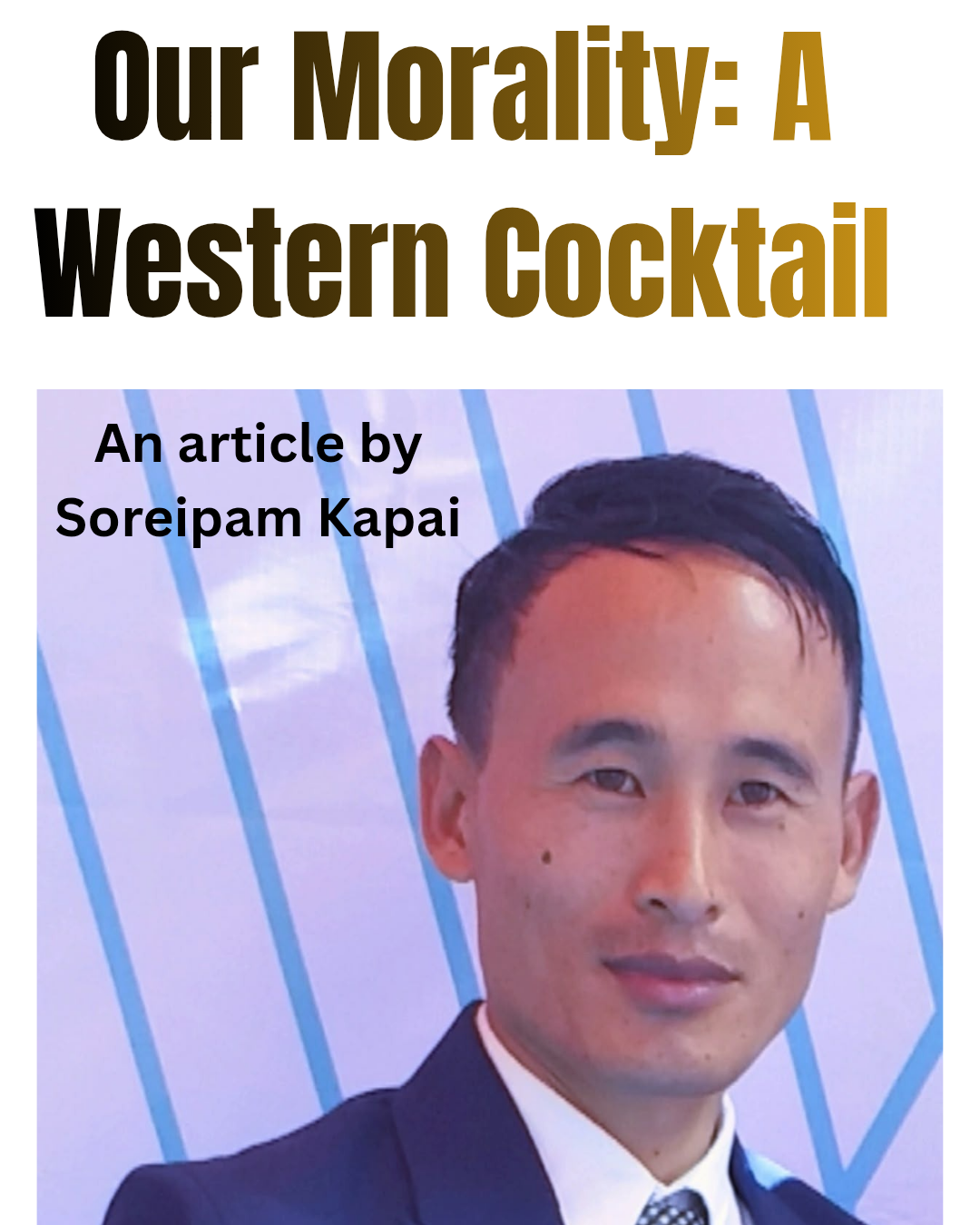
Soreipam Kapai
Assistant Professor
Department of English
St Joseph College, Ukhrul