
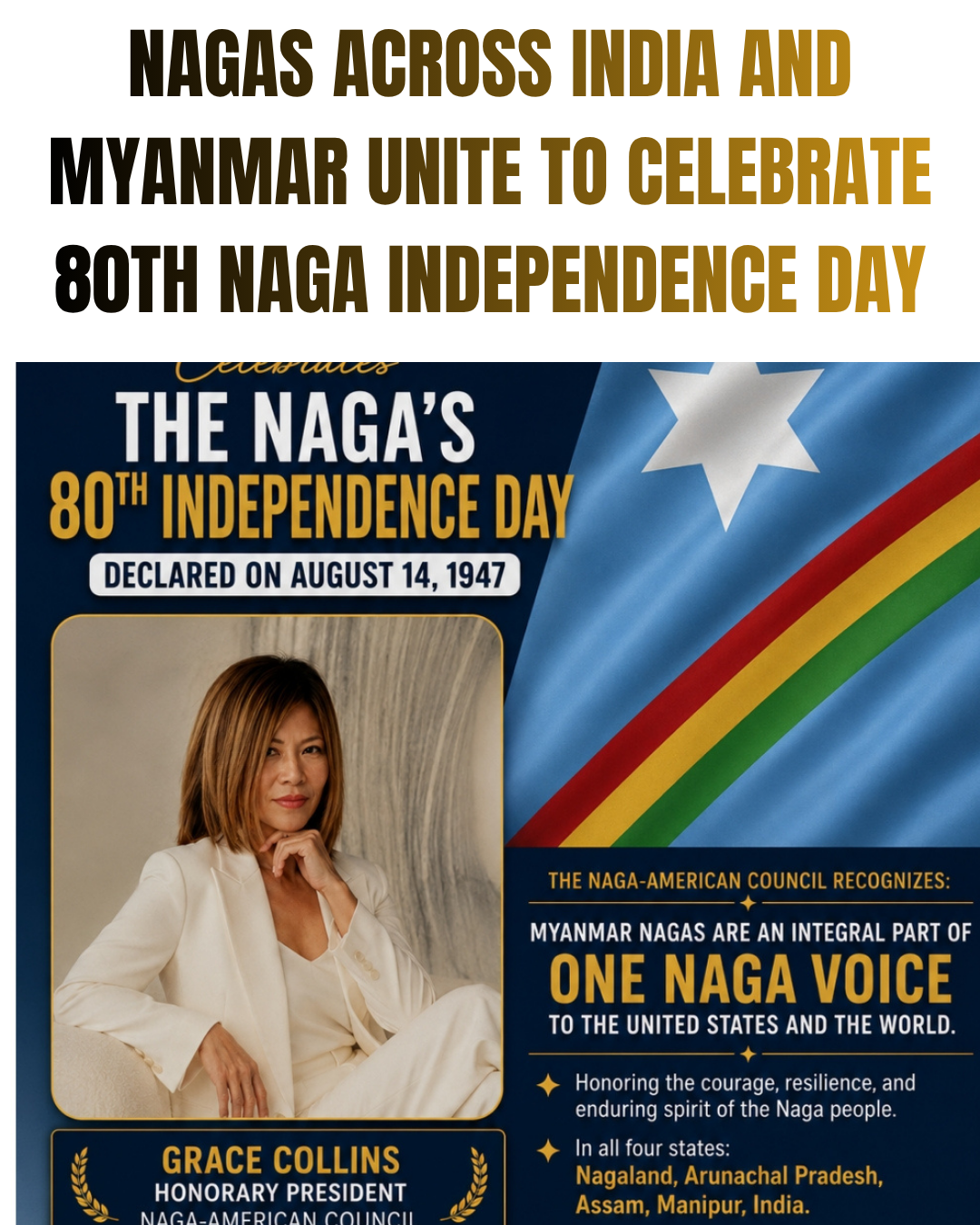
Beyond Borders and Monsoons: A Commemorative Message from the Naga-American Council.
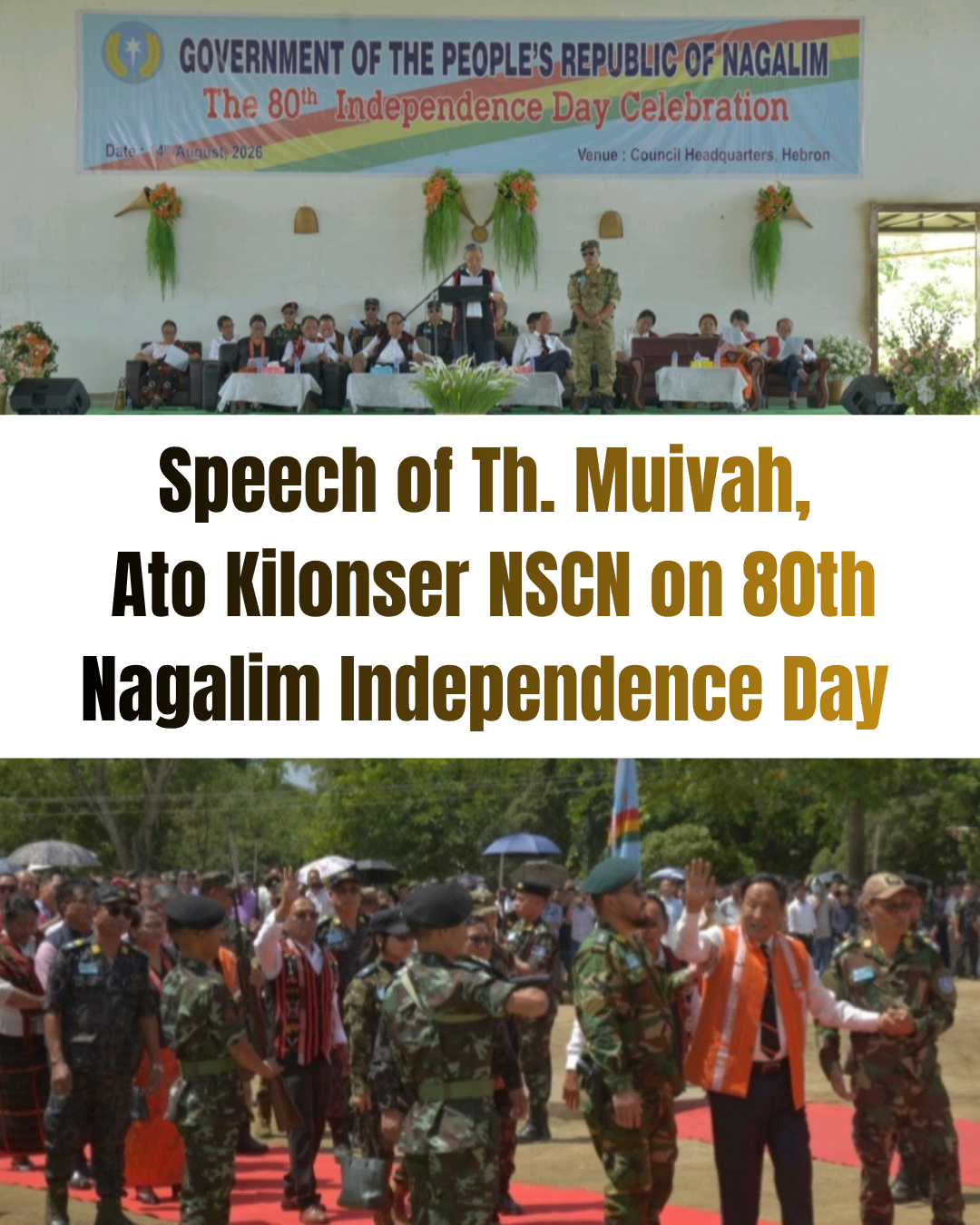
NOKLAK, NAGALAND – As Nagas across India and Myanmar commemorate the 80th Naga Independence Day on August 14, the Naga-American Council (NAC) in the United States is using this commemorative year to shed greater light on Naga communities in present-day Myanmar, particularly those living in the Naga Self-Administered Zone, and on the young leaders who will carry their communities forward.
Nagas on the Myanmar side have long observed and celebrated August 14 as well. Their commemorations, however, have received far less Indian and international media attention than celebrations among Nagas living in India. Geographic isolation, limited infrastructure and difficult access have made their observances – and their voices – less visible to the outside world.
This 80th commemorative year, NAC sought to help bring that part of the Naga story more clearly into view.
ONE NAGA PEOPLE ACROSS MODERN BOUNDARIES
At the heart of the Naga-American Council’s philosophy is the unity and inclusion of Nagas throughout their ancestral territories including those living today across Nagaland, Manipur, Assam and Arunachal Pradesh in India, as well as Naga communities in present-day Myanmar.
That cross-border reality is not simply a modern political slogan. In December 1944, British administrator J. P. Mills wrote in a tour note concerning the Burma boundary that a Patkoi boundary would “cut Naga tribes in two” and warned that such a line would hamper administration and retard progress.¹
The political record also shows that Naga leaders were articulating a distinct political position before the end of British rule. In the 1929 Memorandum to the Simon Commission, representatives of the Naga Club asked that the Naga Hills be kept outside the proposed constitutional reforms for India.² In June 1947, the Naga National Council and Assam Governor Sir Akbar Hydari concluded the Nine-Point Agreement, which recognized the right of the Nagas to develop according to their freely expressed wishes and contemplated a further agreement concerning their future after ten years.³
Historical accounts record a declaration of Naga independence on August 14, 1947, one day before India’s independence. Scholars differ on the precise institutional circumstances of that declaration, so NAC describes August 14 as the date on which Naga independence was declared rather than attributing every detail of the declaration to a single organization.⁴
Modern Myanmar law also recognizes a specifically Naga administrative area. Section 56(a) of Myanmar’s 2008 Constitution groups Leshi, Lahe and Namyun townships in Sagaing Division as the Naga Self-Administered Zone.⁵
These records do not erase the different political interpretations that have developed over time. They do, however, document that Naga identity, Naga political aspirations and the problem of boundaries dividing Naga communities have a substantial historical record.
For this year’s August 14 observance, NAC-OneNaga Voice therefore placed special emphasis on making sure Naga communities on the Myanmar side were not forgotten in the wider Naga story. Senior OneNaga Voice convenors, with the support and blessings of NAC, raised Rs. 50,000 to support the Independence Day observance at Lahe, a township in Myanmar’s Naga Self-Administered Zone. More important than the amount itself was the commitment to make a direct human connection across the border.
WHEN THE ROAD TO LAHE BECAME IMPASSABLE
The original hope was for the NAC-One Naga Voice delegation traveling from Ukhrul, Manipur, to reach. Lahe on the Myanmar side of the border. But there is no direct, reliably safe road into Lahe from the Nagaland side, and the August monsoon made already difficult mountain routes even more dangerous. Rather than abandon the mission, the two groups traveled toward one another and met at Noklak District Headquarters on the Nagaland side of India, near the Indo-Myanmar border and the remote border villages. The NAC-One Naga Voice convenors came from Ukhrul by car over rough, badly deteriorated roads. Representatives of the Naga Students’ Organization (NSO) traveled from Lahe by motorbike, because road access on the Myanmar side is especially limited.
The NSO is the apex organization for Naga students in Myanmar, a role documented in its own public statements and organizational history. According to NAC and its NSO counterparts, the organization brings together students from approximately 17 Naga tribal communities on the Myanmar side.
THREE DAYS OVER ROUGH MOUNTAIN TERRAIN
The journey from Ukhrul toward Noklak took more than three days across difficult mountain terrain. Monsoon rain had left stretches muddy, slippery and badly damaged, with erosion, loose rocks, rubble and places where portions of the road had washed away. The NSO representatives approaching from Lahe faced even more limited road access on the Myanmar side.
Two organizations. Two starting points. Two different vehicles. One meeting place.
At Noklak, the journeys finally met. NAC- One Naga Voice personally handed the Rs. 50,000 contribution to NSO representatives for the August 14 observance at Lahe. The meeting demonstrated something more powerful than a financial contribution: people separated by an international border had each endured a difficult journey simply to reach one another.
A monsoon can damage a road. A border can divide territory. Neither can erase a people.
THE JOURNEY: UKHRUL AND LAHE TO NOKLAK, THEN ON TO PESHU
NAC-One Naga Voice convenors traveled by car from Ukhrul to Noklak; NSO representatives traveled by motorbike from Lahe in Myanmar’s Naga Self-Administered Zone to the same meeting point. After the Noklak meeting, the NAC- One Naga Voice delegation continued by car to Peshu Village
THE MISSION CONTINUED TO PESHU
Noklak was not the end of the journey. The convenors had also made a commitment to Peshu Village, a remote Naga community in the Thonoknyu area of Noklak District. After the Noklak meeting, the NAC- One Naga Voice delegation continued by car to Peshu.
There, the delegation met with the local student community and extended support for the August 14 observance. The purpose was the same: to reach communities that are often geographically isolated and rarely visible beyond their own region.
PESHU VILLAGE: THE NEXT GENERATION
The visit to Peshu placed special attention on the next generation. Senior One Naga Voice members spent time with village children and students, reinforcing the message that remote communities are part of the wider Naga story and that their voices matter.
BEYOND BORDERS AND MONSOONS
The journey was difficult precisely because the communities are remote. That is also why reaching them mattered. The physical obstacles that keep these Naga communities outside ordinary media attention should not keep them outside the collective Naga story.
For NAC-One Naga Voice, this year’s mission was a concrete expression of a larger principle: Naga unity does not depend upon easy roads, convenient travel or political boundaries. It is sustained through relationships, shared identity and the willingness to keep reaching toward one another.
NAC recognizes the Nagas of Myanmar as an integral part of one Naga voice to the United States and the world.
This year, the message to Naga brothers and sisters across the Myanmar border is simple:
We know you have been celebrating. We honor those who have kept the tradition alive.We want the wider world to hear your voices. And when the Naga flag rises on August 14, we raise it together. Different Tribes Different Dialects One Naga People One People One Identity One Naga Voice
HISTORICAL SOURCES:
1. J. P. Mills, “Notes on the boundary with Burma and Tirap Frontier Tract,” Tour Notes, Assam Tribal Areas, 1943-46, 19-22 December 1944, SOAS Library collection; reproduced by the University of Cambridge Naga Database, Record R73731.
2. Naga Chub, “Memorandum of the Naga Hills, submitted to the British Statutory (Simon) Commission, 10 January 1929. The text is reproduced in published scholarship and historical collections, including Charles Chasie, The Naga Memorandum to the Simon Commission, 1929 (2017).
3. Naga-Akbar Hydari Accord (Nine-Point Agreement), Kohima, 26-28 June 1947. Text preserved by the United Nations Peacemaker archive; see also the Nehru Archive’s historical record of the Hydari Agreement.
4. For the August 14, 1947 declaration and the scholarly debate concerning its precise institutional circumstances, see Amrita Saikia, “Faith as an Instrument of Peace: Exploring the Case of Nagaland in Northeast India,” Peace Review (corrected 2026), and the 2025 Contemporary South Asia article “Destiny rest upon our shoulders: early Naga visions of their political future.”
5. Constitution of the Republic of the Union of Myanmar (2008), Section 56(a): Leshi, Lahe and Namyun townships are grouped as the Naga Self-Administered Zone.
Naga-American Council (NAC) – One Naga Voice (ONV)
In solidarity with Naga brothers and sisters commemorating the 80th Naga Independence Day on August 14, 2026. This includes Naga communities in Myanmar’s Naga Self-Administered Zone and the community of Peshu Village in Nagaland, India.