
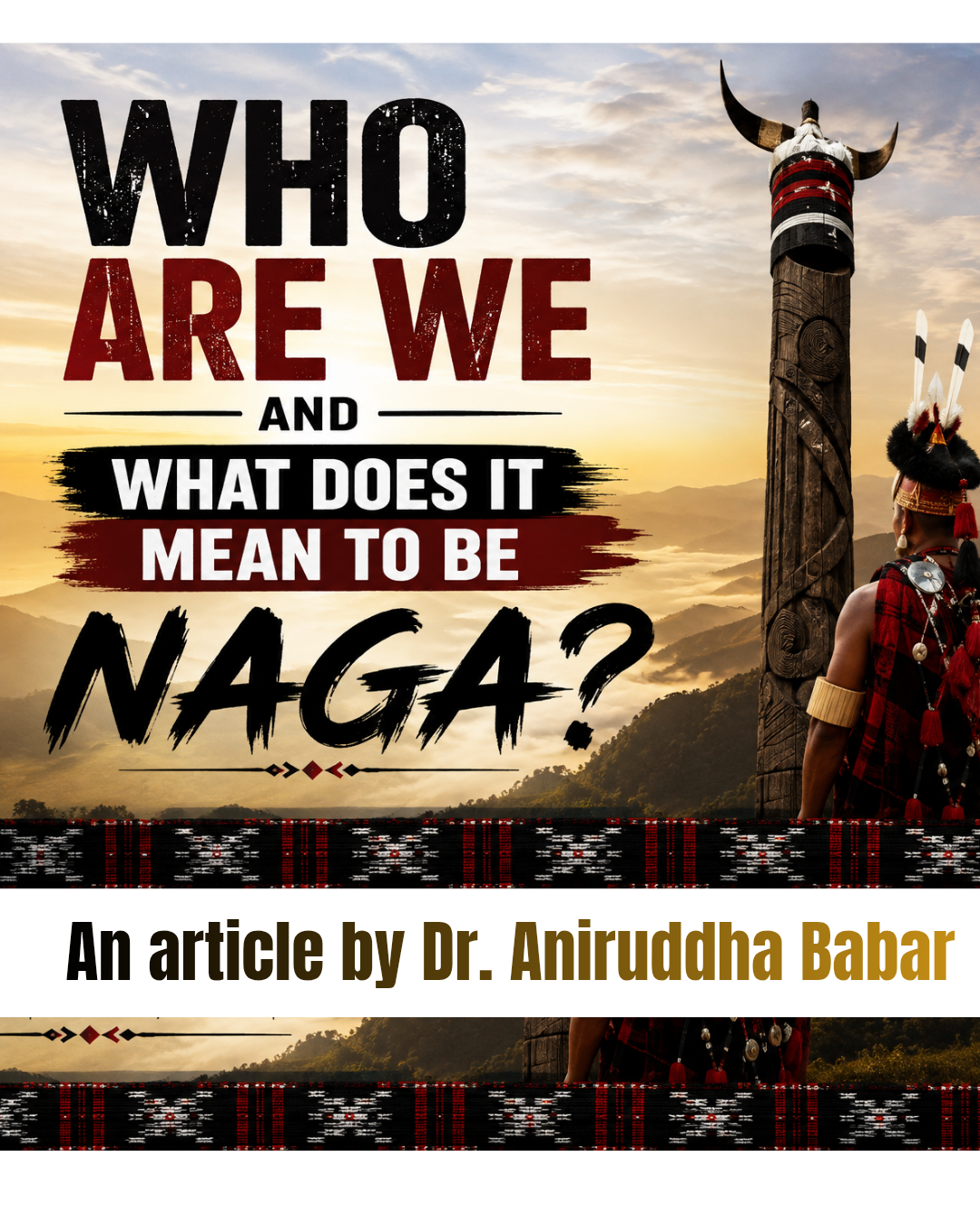
Every year on 9 August, the world turns its attention to the Indigenous peoples whose histories have endured through generations, carried in languages, songs, memories, landscapes and ways of life. For the Nagas, this day reaches somewhere deeper. It takes us back to the hills where our stories began, to villages whose names were spoken long before many of us were born, to the voices of grandparents who carried memories that no book could contain and to languages in which generations of our people first learned to call the world by its name. It reminds us that an inheritance can be carried in a word, a song, a field, a family story or the name of a distant hill. Some of these things are still with us. Some are beginning to fade. Some may disappear unless someone takes the time to listen. On this day, perhaps the most important thing we can do is pause and ask ourselves a question that reaches beyond history and into the heart of belonging: Who are we and what does it mean to be Naga?
“Writing the silences.”
– Easterine Kire
There are questions which do not arrive as questions when we are children. They come first as sounds, faces, names and places. A grandmother calls someone by an old name. A mother speaks a word that a child does not hear anywhere else. An elder points towards a distant hill and tells a story. A father remembers the name of a place where his own father once worked the land. A child listens without knowing that in those small moments a history is being handed over.
A Naga child belongs before the child understands what belonging means. It begins in the house. It begins with the voices of parents, the language spoken around the cooking fire, the names of relatives, the stories of grandparents and the particular way a mother calls her child. It begins with food placed before the family, with an old shawl folded carefully after use, with a basket brought back from the field, with a farming tool worn smooth by years of work, with photographs kept in a corner of the house. These things may appear ordinary. To the family that lives with them they carry memory.
Years later the child may begin to ask: Who were these people? Where did they come from? Why does this hill have this name? Why does my grandmother use a word that I hardly hear anywhere else? What did our people know before there were schools, roads, books and telephones? What have we received from them and what will remain when our own generation has become old?
For many Nagas belonging begins in this intimate way. It begins in the family and grows through the clan, the village and the community. It may be felt in the sound of one’s mother tongue, in a song heard at home, in the food prepared by an elder, in the shape of a field, in the name of a hill or in the memory of people whom one has never met.
A child does not need a textbook to know that a particular place is home. The child simply knows.
An old Naga woman may sit near the doorway in the late afternoon watching the light move across the hillside. She may remember people whom the younger generation has never seen. She may know why a stream carries a particular name, where an earlier settlement once stood, which family cultivated a certain field or what happened on a particular hill many years ago. Her knowledge may never have been written down.
Yet it is history.
An old man may remember the boundaries of a village or the story of a family. A farmer may know when the earth is ready for planting through signs learned over a lifetime. Someone who has spent years in the forest may recognise plants by their leaves, smell or season. A mother may know an old song because her own mother sang it to her.
Such knowledge does not usually announce itself as scholarship. It lives in ordinary people.
The Naga landscape is full of such memory. A hill is never only a hill. A field can carry the labour of generations. A forest can contain knowledge of plants, food, medicine and seasons. A stream may have a story attached to its name. A path may have been followed by generations before the arrival of modern roads.
For the Naga, land is closely bound to memory, livelihood and belonging. People have cultivated it, travelled across it, named it, remembered it and cared for it. Through such relationships the landscape becomes part of community life. The land tells a story because people have lived their lives upon it.
This is one of the deepest places where Naga Indigenous identity can be understood.
The Naga world has never been one uniform world. It is made of many communities each carrying its own history. The Government of Nagaland identifies major tribes within the state while the wider Naga world extends across present day Nagaland, Manipur, Arunachal Pradesh, Assam and Myanmar. Different official, academic and community sources use somewhat different classifications and some names refer to sub-groups or appear in different forms.
The important thing is not to count the names. It is to listen to the people behind them.
Tangkhul, Konyak, Ao, Angami, Sumi, Lotha, Chakhesang, Chang, Phom, Pochury, Rengma, Sangtam, Khiamniungan, Yimkhiung, Tikhir, Zeme, Liangmai, Rongmei, Poumai, Mao, Maram, Maring, Makury, Chirr, Monsang, Moyon, Lamkang, Anal, Chothe, Koireng, Aimol, Kharam, Thangal, Tarao, Inpui, Nocte, Wancho, Tangsa and the many other communities encountered in discussions of the wider Naga world are not merely entries in an ethnographic list. Each name leads to people, villages, languages, memories, customary practices and particular relationships with the land.
A Tangkhul village has its own memories. A Konyak village carries another. A Khiamniungan village has its own songs and histories. A Mao village, a Poumai village, a Maram village, a Rongmei village, a Liangmai village, a Zeme village, a Maring village, a Monsang village, a Lamkang village or an Anal village has its own way of remembering.
Their languages differ.
Their customs differ.
Their songs differ.
Their stories differ.
Their ways of organising village life have developed in their own circumstances. This diversity does not diminish the wider Naga identity. It gives the Naga world much of its character.
A person may first know themselves through a family then a clan, a village and a particular community. From those intimate relationships a wider Naga belonging can grow. A Tangkhul can remain deeply Tangkhul while understanding a wider Naga identity. A Konyak can carry Konyak memory into a larger Naga story. An Ao, Angami, Sumi, Lotha, Zeme, Poumai, Mao, Rongmei or any other Naga community can do the same.
There is no need for every Naga community to become culturally identical for a wider Naga belonging to have meaning. The many streams remain streams. Together they form a larger river.
In older Naga communities young people learned much of life by being among older people. In communities where the morung formed part of social organisation it provided a place where young people learned through observation, association and participation. Its exact form and role differed among communities but the principle was familiar: knowledge was not confined to a classroom. Young people learned by watching, listening, helping and taking part.
A child learned how work was done. A young person learned how people were expected to behave. Stories were heard. Skills were acquired. Responsibilities were understood. The village itself was a teacher.
Naga societies changed greatly through later historical encounters. Christianity became deeply rooted in many Naga communities and influenced worship, education, literacy, music and family life. For generations of Nagas Christian faith has been lived as part of everyday experience. It has become one of the historical layers through which many contemporary Nagas understand themselves.
Modern education opened another world. A child who once learned primarily through family and village could now sit in a classroom, learn to read and write and eventually travel far beyond the hills. Schools and colleges produced teachers, doctors, lawyers, civil servants, researchers, entrepreneurs and many other professionals. Education gave young Nagas new ways of seeing the world and new places in which to live. The Naga world became larger. The road carried people away.
A young person might leave home for school, leave again for college and later find work in Delhi, Mumbai, Bengaluru, Shillong, Guwahati, Kolkata, Yangon, Singapore, London or somewhere else entirely. The village could become a place visited during holidays. Then one day a person hears an old word in a distant place. Something happens inside. A voice from childhood has returned. It may happen through a song. It may happen through food prepared by someone from home. It may happen when an elderly relative speaks in the mother tongue. It may happen when a person sees the shape of a familiar hill after many years.
Distance can be measured in kilometres. Belonging cannot. This is why Naga languages matter so deeply. A language is not merely a means of speaking. It carries ways of addressing relatives, expressing respect, describing the land, naming plants and animals, telling jokes, remembering people and understanding relationships.
A grandmother may use a word which has no exact equivalent in the language spoken by her grandchild. She says it naturally. The child asks what it means. She explains. For a moment two generations meet inside a single word. Such moments can disappear easily.
A language can become weaker in a household without anyone deciding that it should happen. Parents become busy. Children grow up speaking another language at school. A grandparent becomes accustomed to translating. A song remains familiar as music while its words slowly become obscure.
The loss can be almost invisible. Then one day someone realises that an old word has no one left who can explain it.
Temsüla Ao captured this anxiety about the fate of inherited stories in her poem “The Old Story Teller”:
“And consign all my stories / To the script in his ancient entrails.”
The image is painful because it turns the loss of memory into something physical. A story once carried by people can disappear with the person who carries it.
Every Naga community has memories carried by people rather than books. There are stories of settlement, migration, farming, family, clan, village life, festivals, difficult years and changes witnessed during a lifetime.
An old photograph may contain six faces. Someone remembers five. Another year passes. Now only four can be named. This is how memory disappears.
Easterine Kire has described the older Naga tradition in equally direct terms: “We have unwritten history, which was passed on through oral narratives.”
For generations stories were carried through spoken memory and through settings in which people gathered to listen. Kire has described people sitting around a fireplace listening to someone who possessed the knowledge to tell the stories. The significance of that tradition lies not merely in the stories themselves but in the relationship between the storyteller, the listeners and the community.
A young Naga researcher sitting with an elder can therefore be doing something of lasting importance. A conversation can become an oral history. A song can be recorded. A village story can be written down. An old word can be documented. Knowledge of plants, forests, agriculture, customary practices and local landscapes can enter an archive without being stripped of the people who gave it meaning.
The researcher must listen carefully. The elder is not merely a source of information. The elder has lived through a world that the researcher knows only through memory.
This is where Naga scholars and research centres can make an important contribution. There are histories in villages that have never been written. There are languages that deserve serious documentation. There are customary institutions that deserve careful study. There are elders whose knowledge should be recorded while they are still here to tell it.
A kitchen can hold a history. A field can hold a history. A conversation beneath a tree can hold a history. Scholarship begins when somebody decides that such things are worth listening to. This also changes what we mean by preservation. A language is not alive because somebody has placed it in an archive. It lives when a mother speaks it to her child. A song is not alive because a recording exists. It lives when people still sing it. A custom does not survive because its name appears in a book. It survives when people understand its meaning and decide how it should live in their own time. Culture breathes through use. It changes as people change.
Naga identity can therefore grow without losing its roots. A young Naga can use a smartphone, study artificial intelligence, become a scientist, work in a multinational company or live in another country and still carry an old song in the mind. A person can speak several languages and still know the language of grandparents. A filmmaker can take an old story into a new medium. A researcher can use modern methods to study traditional knowledge.
The future does not have to be the graveyard of the past. It can become another place where the past finds life. But someone must carry it there. That responsibility belongs particularly to the young. They can ask their grandparents questions while there is still time. Who were our ancestors? Where did our family come from? Why is this place called by this name? What did people eat when you were young Which songs did you sing? What did the elders teach you? What did you learn from the forest? How did the village settle disagreements? What did people expect from a young person? What did you believe the future would look like?
Such questions can begin at a kitchen table. They can continue beside a field or while walking home. They may take an afternoon. The answers may last for generations.
There is also the experience of returning. A young Naga may leave home at seventeen and return at thirty. The road may be wider. New houses may have appeared. A shop may stand where a childhood tree once grew. The forest may have changed. Some familiar faces may have disappeared.
An elderly parent walks more slowly. A childhood friend now lives somewhere else. Children in the village speak differently. The returning person feels the change because the returning person has changed too. Then an old woman speaks a familiar word. For a moment the years fall away. The hill is still there. The family name is still known. Someone remembers the child who left. The place has changed. The person has changed. The relationship remains. This is the living character of Naga Indigenous identity. It is not a museum object. It is not a costume. It is not something that exists only on a ceremonial day. It is lived in the house, the village, the church, the field, the school, the market, the forest and the road. It is carried in language, memory, work, faith, family and relationships with land. It is also carried in ordinary things.
A woven shawl folded carefully after use. A basket brought back from the field. A farming tool worn smooth by years of work. A song known by an old woman. A photograph kept in a wooden box. A particular food prepared in a particular way. A word that a child almost forgot. These things may look small. They are not small to the people whose lives they contain.
Nor should an inheritance be mistaken for perfection. Every generation receives a world containing wisdom as well as things that may need to be questioned, changed or left behind. To honour an inheritance does not mean that everything inherited must remain untouched. It means knowing it well enough to understand what should be carried forward, what should be reinterpreted and what should perhaps be allowed to end. That is also part of belonging. A people remains alive when it can remember without becoming imprisoned by memory. To be Naga is to inherit more than a name.
It is to inherit relationships. A language comes from parents. Stories come from elders. Knowledge comes from those who have lived before us. A sense of place comes from the village and the land. Customary knowledge comes through community. Faith and education have shaped generations of Naga life. The present generation receives all these things and then has to decide what to do with them. Every generation makes that decision. A mother decides whether she will speak her language to her child. A father decides whether he will tell the old family story. A school decides which histories will be taught. A university decides which questions deserve research. A young person decides whether to sit beside an elder for another half hour. These choices are rarely dramatic. Yet they determine what survives. They also determine what kind of people we become.
The land asks something of us as well. When forests disappear, fields change and water sources are damaged, the loss is not only ecological. Knowledge connected with those places can also become harder to practise. A plant may disappear from the landscape. A path may no longer be used. A traditional practice may lose its setting.
To care for the land is therefore also to care for part of the memory carried by it.
And there is another kind of inheritance which cannot be measured in hectares or written into a document. A person can inherit a name without understanding it. A person can inherit a language without knowing where its oldest words came from.
A person can inherit a village without ever knowing the story of the people who built it. Yet the inheritance is there. It waits to be discovered.
Perhaps that is why the question “Who are we?” becomes deeper as we grow older. We are not made only by the decisions we make ourselves. We are also shaped by people we never met, by places we did not choose, by languages we inherited and by memories that reached us before we were born.
The Naga child belongs before the child understands belonging. Understanding comes slowly. Sometimes it comes only after leaving home. Sometimes it comes when an elder dies. Sometimes it comes when a language begins to disappear. Sometimes it comes when we return. One day today’s children will become the elders. Children not yet born will ask them about their grandparents. They will ask where their families came from.
They will ask what the old village looked like. They will ask what language their great grandparents spoke. They will ask what happened to the forests and fields. They will ask what it meant to be Naga when we were young. What will we be able to tell them? Perhaps an old Naga woman will one day sit beside a child and point towards a hill. She will tell the child its name. She will tell the child who lived there. She will tell the child why people remember it. The child may listen without understanding the importance of the story. Years will pass. The woman will be gone. The child will grow old.
One evening perhaps in another village or in a distant city someone will ask about that hill. For a moment the old word will seem almost lost. Then it will return. The story will return with it. The grown child will remember the voice that first gave the word meaning. Perhaps the child will tell the story to someone younger. Perhaps that younger person will carry it farther still. No monument will mark the journey. No document will announce that something has survived. There will simply be a word spoken once more. And in that word will live a grandmother, a house, a hill, a village and the memory of people who lived before either speaker was born. That is how a people travels through time. Not always through monuments. Not always through books. Sometimes through one remembered word placed gently in another person’s hands.
Perhaps this is what it means, at its deepest level, to be Naga: to receive a life that began before us, to know the people and places that gave us our belonging, to live that inheritance in our own time and to leave enough of it behind for someone we may never meet to know where they came from.
The Naga story has many voices, many languages, many villages and many memories. It is not finished. It belongs to every generation that receives it. And perhaps this is why, on a day dedicated to the world’s Indigenous peoples, we should leave one final thought with the generations who will come after us: memory is not merely something we inherit. It is something we must carry.
“Before the hills forget the names we knew,
Before the old songs fade into the rain,
Before the words our grandmothers once knew
Are lost like footsteps washed from mountain grain,
Let every child remember where they came,
The house, the field, the river and the stone,
The voice that called them softly by their name,
The distant hill that taught them they were home.
For we are more than blood that time can sever,
We are the stories handed down through years,
The songs that travelled through the changing weather,
The hands that held our childhood through their tears.
And when our own last words have left the air,
May some young Naga still remember we were there.”
Dr. Aniruddha Babar
(Dr. Aniruddha Babar is a Senior Academician, Public Policy Expert & Social Development Specialist, Writer, and Researcher currently serving in the Department of Political Science, St. Joseph College, Ukhrul, Manipur. He is also the Co-Founder and Deputy Director of the Centre for North-East Development and Policy Research (CNEDPR), St. Joseph College, Manipur.)