
𝐀 𝐂𝐑𝐈𝐓𝐈𝐂𝐀𝐋 𝐄𝐗𝐀𝐌𝐈𝐍𝐀𝐓𝐈𝐎𝐍 𝐎𝐅 𝐓𝐇𝐄 𝐅𝐑𝐀𝐌𝐄𝐖𝐎𝐑𝐊 𝐀𝐆𝐑𝐄𝐄𝐌𝐄𝐍𝐓 (𝐅𝐀-𝟐𝟎𝟏𝟓) 𝐂𝐎𝐌𝐏𝐄𝐓𝐄𝐍𝐂𝐈𝐄𝐒
Based on Competencies Disclosed in the NSCN-IM Eastern Flank Press Release (June 2026)
INTRODUCTION
The Indo-Naga political question remains one of the oldest and most enduring political questions in post-colonial South Asia. For nearly eight decades, it has passed through successive phases of political dialogue, armed conflict, ceasefire, negotiation, and constitutional engagement, reflecting both the persistence of the issue and the continuing search for an honourable and mutually acceptable political settlement. Throughout this long journey, the conflict has exacted an enormous human, social, political, and economic cost. Lives have been lost, communities have endured hardship and displacement, and successive generations have borne the burden of an unresolved political question while continuing to seek peace, justice, dignity, and an honourable settlement.
Over the decades, the search for a political settlement has been marked by several significant initiatives, including the Nine-Point (Hydari) Agreement of 1947, the Sixteen-Point Agreement of 1960, the Shillong Accord of 1975, the ceasefire agreement of 1997, the Framework Agreement of 3 August 2015 between the Government of India and the National Socialist Council of Nagalim (NSCN-IM), and the Agreed Position of 17 November 2017 between the Government of India and the Working Committee of Naga National Political Groups (WC NNPGs). Each reflected the political realities of its time and contributed, in different ways, to the evolving constitutional and political discourse surrounding the Indo-Naga question.
The journey, however, has been shaped not only by negotiations between the Government of India and Naga political organisations, but also by internal political divisions within the Naga national movement, periods of fratricidal violence, competing political and constitutional visions, and the political and territorial concerns of neighbouring states. Consequently, the Indo-Naga political question today extends beyond the relationship between the Government of India and Naga political organisations alone. It has also become a question of internal Naga reconciliation, the building of broad national consensus, and accommodation within a wider regional political landscape. These multiple dimensions have inevitably contributed to the complexity of securing a political settlement that is not only constitutionally workable, politically durable, and capable of commanding broad legitimacy across the Naga people.
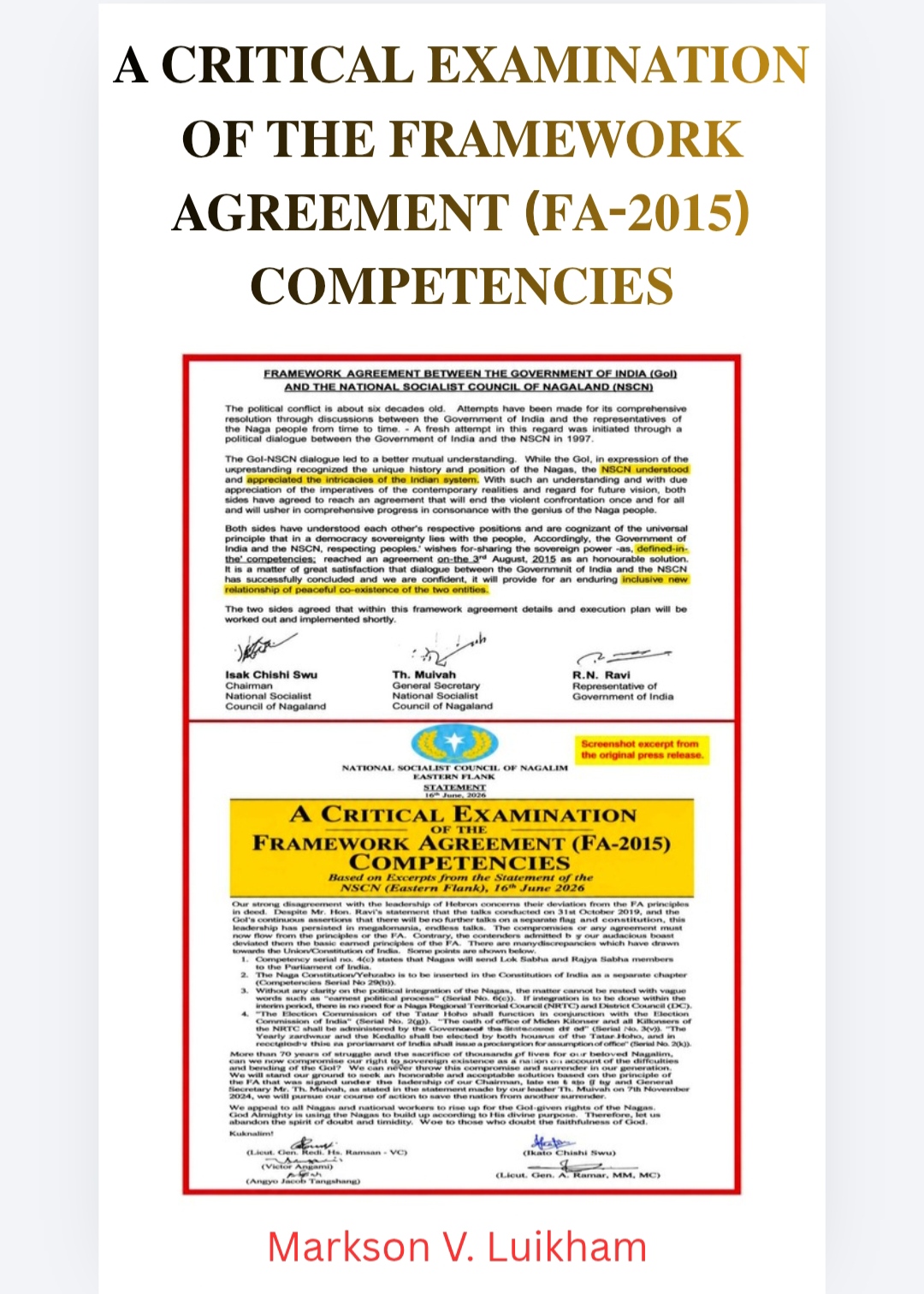
Since the signing of the Framework Agreement, public discussion has increasingly centred upon broad concepts such as the recognition of the Nagas’ unique history, shared sovereignty, integration, an inclusive settlement, and an honourable political solution. Yet despite the historic significance of the Framework Agreement, much of its substantive constitutional content has remained outside public scrutiny. This changed in June 2026, when the NSCN-IM Eastern Flank issued a press release publicly disclosing what it described as competencies under the Framework Agreement. The relevant excerpts examined in this article are reproduced in the accompanying supporting document.
The press release has generated renewed constitutional and political discussion. For ease of reference, the accompanying supporting document reproduces the widely circulated Framework Agreement of 3 August 2015 together with the relevant excerpts from the NSCN-IM Eastern Flank statement of 16 June 2026 examined in this article. The competencies themselves raise constitutional questions extending far beyond the position of any single political organisation. They invite closer examination of the constitutional architecture being contemplated, the institutional arrangements being proposed, and the political relationship envisioned between the Naga people and the Government of India.
The significance of these disclosures lies not merely in whether particular competencies are accepted or rejected by different Naga political organisations. Their greater significance lies in the opportunity they provide for informed public reflection on constitutional design, political legitimacy, institutional authority, and the future direction of the constitutional and political process initiated under the Framework Agreement. Constitutional settlements derive their durability not only from negotiated compromises but also from the confidence, understanding, and informed consent of the people whose future they seek to shape.
Constitutions do more than establish governmental institutions. They define the distribution of political authority, determine the relationship between different centres of power, and provide the legal foundations upon which future political relationships are constructed. For that reason, careful examination of constitutional arrangements is not merely an academic exercise. It is essential for understanding the long-term political consequences of any proposed settlement.
This article therefore does not seek to defend, criticise, or validate the position of any particular negotiating party. Nor does it presume to determine the correctness of competing political interpretations surrounding the Framework Agreement. Its purpose is more limited and, at the same time, more fundamental. It seeks to examine the constitutional implications of the competencies disclosed in the Eastern Flank press release, explore the institutional logic they appear to embody, and consider the broader questions they raise concerning political authority, constitutional legitimacy, and the future constitutional and political relationship between the Naga people and the Government of India under the proposed settlement.
A necessary note of caution must be stated at the outset. Because the complete text of the Framework Agreement remains unavailable for public examination, this analysis is necessarily confined to the competencies disclosed in the accompanying NSCN-IM Eastern Flank press release. It should therefore not be understood as a definitive interpretation of the Framework Agreement as a whole. Additional provisions, safeguards, guarantees, review mechanisms, or institutional arrangements not presently disclosed may substantially qualify, clarify, or alter some of the constitutional implications discussed in this article.
Equally important, constitutional debate should not be mistaken for political division. Every mature political community engages in competing interpretations of constitutional principles, institutional design, and national aspirations. Such debate is neither unusual nor undesirable. On the contrary, informed constitutional deliberation is often a sign of political vitality. The greater challenge lies not in the existence of differing perspectives, but in the ability of a people to reconcile those perspectives through dialogue and transform them into a coherent political vision capable of commanding broad national confidence.
The central question running through this discussion is therefore not whether one political organisation has advanced a stronger argument than another. Rather, it is whether the competencies disclosed in the Eastern Flank press release, considered on their own constitutional terms, point towards an arrangement of shared political authority, constitutional accommodation within the framework of the Constitution of India, or some other evolving constitutional relationship whose full contours remain to be publicly understood.
That question cannot be answered through political slogans, organisational loyalties, or historical assumptions. It can only be approached through careful examination of the disclosed competencies, the constitutional principles they appear to embody, and the institutional relationships they seek to establish.
PART I: CONSTITUTIONAL ANALYSIS OF THE DISCLOSED COMPETENCIES
(1) Competency 4(c): Naga Representation In The Indian Parliament
Nagas will send Lok Sabha and Rajya Sabha members to the Parliament of India.
At first glance, this competency appears straightforward. It proposes that Nagas will send representatives to both Houses of the Indian Parliament. Such representation would provide a formal voice in national legislation, budgetary deliberations, policy formation, and debates concerning the governance of the Indian Union.
From a practical perspective, parliamentary representation offers clear advantages. Elected representatives can advocate regional concerns, influence public policy, seek institutional protections, and participate in decisions that affect the lives of millions. Few would dispute the value of having a voice within a legislature that exercises substantial political and financial authority.
Viewed in isolation, therefore, the competency appears beneficial. The constitutional significance of the provision, however, lies not in whether representation is useful, but in what that representation signifies within the broader political settlement being negotiated.
The Naga political movement did not emerge because Nagas lacked representation in legislative institutions. Nagas already participate in electoral politics through Nagaland, Manipur, and Arunachal Pradesh and have long been represented within the parliamentary framework of India.
The historical issue has been of a different nature. From the memorandum submitted to the Simon Commission in 1929, through the declaration of Naga independence in 1947, and the plebiscite of 1951, Naga political organisations have consistently framed the issue as one concerning political status, nationhood, and the relationship between the Naga people and the Indian state.
This distinction is important because representation and sovereignty address different constitutional questions.
Representation concerns participation within a political system. Sovereignty concerns the location of ultimate political authority. A people may possess representation without exercising sovereign authority, just as a sovereign people may choose to participate in shared institutions without surrendering their political identity. The constitutional meaning of representation therefore depends upon the wider framework within which it operates.
When viewed through this lens, Competency 4(c) raises an important question. The provision situates Naga representation within the Parliament of India, an institution whose authority derives from the Constitution of India. The competency therefore appears to place Naga political participation within existing constitutional structures rather than establishing a separate legislative relationship between two coexisting political entities.
Supporters of the competency may argue that such participation reflects political maturity and realism. Parliamentary representation provides access to decision-making processes, creates opportunities to influence national policy, and ensures that Naga concerns are heard within institutions that exercise significant authority. From this perspective, participation need not be interpreted as abandonment of political identity. It may instead be understood as a practical mechanism through which Naga interests can be protected and advanced.
Critics are likely to focus on a different concern. They may argue that the central issue is not whether representation is beneficial, but whether representation adequately addresses the political aspirations that gave rise to the Indo-Naga conflict. If the core issue concerns the constitutional relationship between the Naga people and the Indian state, then parliamentary participation alone does not resolve that question. It provides a role within an existing system, but it does not by itself define the political basis upon which that role is exercised.
This explains why the competency has attracted attention beyond its immediate institutional function. The debate is not fundamentally about parliamentary seats. It is about the constitutional meaning attached to those seats within the wider settlement being proposed.
The practical significance of representation also depends upon the extent of influence it can realistically exercise. Even if future arrangements provide enhanced representation, the larger question remains whether participation in a national legislature constitutes an expression of shared political authority or participation within an authority structure whose constitutional foundations already exist independently of Naga consent.
Ultimately, Competency 4(c) highlights a distinction that runs throughout the broader debate surrounding the Framework Agreement. Representation may provide access, influence, and institutional participation. Whether it also addresses questions of political status, nationhood, and constitutional authority is a separate matter.
The competency therefore deserves careful consideration not because parliamentary representation lacks value, but because it raises a larger constitutional question: within the proposed settlement, is representation intended as an instrument of political partnership, or as participation within an already established constitutional framework?
Based on the disclosed competency, representation appears situated within the constitutional institutions of India. Whether broader provisions establish a different constitutional relationship remains unknown. The competency therefore raises legitimate questions about how political authority is ultimately structured under the proposed settlement.
(2) Competency 29(b): Naga Constitution (Yehzabo) As A Chapter In The Indian Constitution
The Naga Constitution / Yehzabo is to be inserted in the Constitution of India as a separate chapter.
Among the competencies highlighted by the Eastern Flank, this provision may be the most constitutionally significant. Unlike competencies concerning representation, elections, or administrative arrangements, Competency 29(b) addresses the question of constitutional authority itself.
The Yehzabo has long occupied a central place within Naga political thought. It has generally been understood not merely as a collection of customary practices or governance procedures, but as the constitutional expression of Naga political identity and collective self-government. In that sense, it represents far more than an institutional document. It embodies the framework through which political authority is organised and exercised.
Viewed from this perspective, the competency appears at first glance to offer a substantial achievement. The insertion of the Yehzabo into the Constitution of India would provide formal constitutional recognition to a distinctly Naga political institution. Such recognition would elevate the Yehzabo above ordinary legislation and place it within a protected constitutional framework.
Supporters of the provision may therefore argue that it secures enduring protection for Naga institutions, customary practices, and political identity while providing legal certainty and enforceable safeguards. In practical terms, constitutional recognition may offer stronger guarantees than arrangements dependent solely upon political goodwill or administrative discretion.
The deeper constitutional question, however, is not whether the Yehzabo is recognised. The deeper question is where the Yehzabo derives its authority.
This distinction lies at the heart of the Eastern Flank’s criticism.
If the Yehzabo is incorporated as a chapter within the Constitution of India, its constitutional validity would appear to arise from that larger constitutional framework. Under such an arrangement, the Yehzabo would be recognised and protected, but it would exist within a constitutional system whose foundational authority originates elsewhere.
For many observers, this may appear to be a technical distinction. Politically, however, it is a profound one.
Recognition and sovereignty are not identical concepts.
Throughout the world, indigenous peoples, autonomous regions, and minority nations enjoy constitutional recognition within larger states. Their institutions, languages, customary laws, and territorial rights may receive extensive constitutional protection. Yet constitutional protection does not necessarily imply sovereign constitutional status.
The issue therefore is not whether the Yehzabo possesses authority, but the source from which that authority is derived.
This question becomes particularly significant when viewed through the concept of constituent authority. Every constitutional system ultimately rests upon a foundational source of legitimacy from which all institutions derive their powers. Constitutions do not merely distribute authority; they establish its origin.
If the Yehzabo derives its constitutional status through incorporation into the Constitution of India, constituent authority would appear to remain with the Indian constitutional framework. The Yehzabo might exercise substantial powers and enjoy extensive protections, but those powers would operate within a constitutional structure whose foundational authority lies elsewhere.
This is why the debate extends beyond the scope of powers granted to Naga institutions. A constitutional document may possess considerable authority while still deriving its legitimacy from a larger constitutional framework. The critical issue is therefore not the extent of self-government, but the constitutional basis upon which that self-government rests.
Supporters of the competency may regard such concerns as overly theoretical. They may argue that the primary objective of any settlement is the preservation of Naga identity, institutions, customary practices, land rights, and political self-governance. If those objectives are secured through constitutional recognition, the arrangement may reasonably be viewed as a practical and honourable political settlement.
This argument carries considerable weight. Constitutional settlements are often judged not solely by abstract theories of sovereignty, but by their capacity to provide stability, protection, and durable institutional guarantees. Many successful autonomy arrangements throughout the world operate within larger constitutional frameworks while preserving substantial degrees of self-government.
Yet the distinction raised by the Eastern Flank remains important because it concerns the nature of the constitutional relationship being established. Their concern is not that recognition lacks value. Their concern is that recognition should not be confused with sovereign constitutional authority.
This is ultimately why Competency 29(b) occupies such a central place in the broader debate surrounding the Framework Agreement. It compels examination of a foundational constitutional question that underlies many of the other competencies under discussion.
Is the Yehzabo being recognised as the constitutional expression of a people exercising a distinct political authority, or is it being recognised as a protected institution operating within the constitutional sovereignty of India?
The competency does not conclusively answer that question. It does, however, indicate that the Yehzabo would be situated within the Constitution of India rather than alongside it. That distinction may ultimately prove more significant than any individual power, protection, or institutional arrangement contained within the document itself.
(3) Competency 6(c): “Earnest Political Process” For Integration
Without any clarity on the political integration of the Nagas, the matter cannot be rested with vague words such as “earnest political process.” If integration is to be done within the interim period, there is no need for a Naga Regional Territorial Council (NRTC) and District Council (DC).
Among the competencies disclosed by the Eastern Flank, this provision may be the most consequential for the future territorial aspirations of the Naga people. Unlike competencies concerning representation, constitutional recognition, or electoral administration, Competency 6(c) directly engages with the longstanding question of Naga political integration.
For many Nagas, integration has never been viewed as a secondary issue. It has been understood as the political expression of a people who share historical, cultural, and national ties but remain divided across administrative boundaries created during different historical periods. As a result, integration has occupied a central place within Naga political discourse for decades.
The competency acknowledges that the issue of integration remains unsettled. However, instead of identifying a constitutional mechanism, legal pathway, or institutional guarantee through which integration may be achieved, it refers to an “earnest political process.” At the same time, it proposes institutional arrangements such as the Naga Regional Territorial Council (NRTC) and District Councils as part of the emerging settlement.
This combination of deferred integration and immediate institution-building lies at the centre of the Eastern Flank’s criticism.
Supporters of the competency may argue that such an approach reflects political realism. Integration involves multiple states, constitutional provisions, political actors, and competing interests. Given the complexity of the issue, an immediate settlement may be neither politically feasible nor constitutionally attainable. Under such circumstances, a phased approach supported by dialogue and interim institutions may appear to be the most practical course available.
This argument deserves serious consideration. Political negotiations rarely resolve deeply contested territorial questions through a single breakthrough. Transitional institutions can provide mechanisms for coordination, representation, and confidence-building while broader political questions continue to be addressed.
Viewed from this perspective, the NRTC may be understood as an interim arrangement intended to facilitate future progress rather than replace it.
The difficulty lies not in the existence of a political process, but in the absence of clarity regarding the nature and destination of that process.
The phrase “earnest political process” expresses commitment, but it does not identify a mechanism through which integration may be achieved. It signals intention, yet it does not specify timelines, procedures, benchmarks, or constitutional obligations. As a result, the phrase provides reassurance while leaving the practical pathway undefined.
This concern forms the foundation of the Eastern Flank’s criticism.
If integration remains an agreed objective, an obvious question arises: what constitutional route exists for achieving it?
The disclosed competency does not explain whether the proposed institutions are intended to serve as transitional mechanisms leading toward integration or whether they are intended to become the principal institutional expression of Naga political aspirations within the existing territorial framework.
That distinction is important.
If the NRTC functions as a bridge toward a larger political objective, its significance lies in what it is intended to facilitate. If, however, it becomes the primary and enduring institutional arrangement, then the relationship between the council and the integration objective changes fundamentally.
Political history demonstrates that interim institutions often acquire a permanence not originally envisioned. Temporary arrangements generate administrative structures, political constituencies, and vested interests that gradually become part of the established political landscape. Over time, an institution created to manage a transition can evolve into the settlement itself.
This possibility explains why the issue extends beyond terminology.
The central question is not whether the political process is sincere. The central question is whether the process contains identifiable mechanisms capable of advancing the objective it is intended to serve.
This distinction highlights an important difference between a deferred objective and an abandoned objective.
A deferred objective remains connected to a discernible pathway through which implementation may eventually occur, even if progress is gradual. An abandoned objective may continue to be acknowledged rhetorically while lacking any realistic mechanism through which it can be achieved. The concern raised by Competency 6(c) is that the boundary between these two possibilities remains unclear.
Future assessments of this competency are likely to depend less upon the language used during negotiations than upon the outcomes produced over time. If meaningful progress toward integration remains visible, the phrase “earnest political process” may ultimately be viewed as a prudent and realistic approach to a complex constitutional challenge. If progress remains indefinite, critics may argue that the language of integration was preserved while the practical possibility of integration steadily receded.
This is why Competency 6(c) occupies such a central place in the wider debate surrounding the Framework Agreement. The competency does not merely raise questions about institutional design. It raises questions about whether the aspiration of integration is being accompanied by a credible pathway toward implementation.
The issue, therefore, is not whether integration remains desirable or widely supported. The issue is whether the disclosed competency establishes a framework capable of translating that aspiration into political reality.
(4) Competency 2(g): Election Commission Of The Tatar Hoho “In Conjunction With” The Election Commission Of India
The Election Commission of the Tatar Hoho shall function in conjunction with the Election Commission of India.
At first glance, this competency appears administrative rather than political. It concerns electoral management, institutional coordination, and the conduct of elections. Compared to questions of integration, constitutional recognition, or parliamentary representation, an election commission may appear to be a technical matter.
Yet constitutional history repeatedly demonstrates that electoral institutions often reveal important features of a political system. Elections are not merely administrative exercises. They are the means through which political legitimacy is created, expressed, and renewed. The institutions that regulate elections therefore occupy a significant place within any constitutional arrangement.
The competency proposes that the Tatar Hoho, the proposed Naga parliamentary institution, will possess its own Election Commission. This is not an insignificant provision. The existence of a distinct electoral body suggests recognition of a separate political institution with its own representative processes and internal democratic mechanisms.
Supporters of the competency may view this as an important acknowledgement of Naga political distinctiveness. A separate electoral institution implies that the Tatar Hoho is intended to function through procedures different from those governing ordinary state legislatures. In that sense, the provision may be interpreted as recognising a measure of institutional autonomy within the broader settlement.
Supporters may further argue that coordination with the Election Commission of India is neither unusual nor problematic. Electoral administration requires technical expertise, voter registration systems, dispute-resolution mechanisms, and administrative coordination across multiple jurisdictions. Cooperation between electoral institutions may therefore reflect practical necessity rather than political subordination.
This interpretation deserves serious consideration. Throughout the world, autonomous institutions frequently cooperate with larger constitutional systems without forfeiting their distinct identity or internal authority.
The constitutional significance of this competency lies not in the existence of a Naga Election Commission, but in the phrase “in conjunction with.”
The phrase appears simple. Its implications, however, depend entirely upon the nature of the relationship it establishes.
Does “in conjunction with” imply cooperation between two institutions exercising authority within their respective spheres, or does it imply a relationship in which one institution ultimately functions within a framework supervised or validated by another?
The competency itself does not provide a clear answer.
This ambiguity is important because electoral institutions do more than organise elections. They help define the process through which political authority is constituted. For that reason, the relationship between the two commissions carries significance beyond administrative coordination.
If the Election Commission of the Tatar Hoho exercises meaningful authority over electoral procedures, candidate eligibility, dispute resolution, and the certification of electoral outcomes within its sphere, then cooperation with the Election Commission of India may be largely administrative in character. Under such an arrangement, the competency could be viewed as a practical mechanism for managing overlapping jurisdictions.
If, however, the electoral legitimacy of the Tatar Hoho ultimately depends upon authority exercised elsewhere, the constitutional implications become considerably different. The distinction is subtle but important. An institution that coordinates with another body is not necessarily situated in the same constitutional position as an institution whose authority depends upon that body.
This concern appears to underlie the Eastern Flank’s criticism.
Their focus is not on election management itself. Rather, it concerns the constitutional significance of the relationship being established between the two institutions. The issue is whether the electoral foundation of the Tatar Hoho derives primarily from its own institutional authority or from a broader constitutional framework within which it operates.
This is why Competency 2(g) deserves closer attention than its administrative language might initially suggest. Beneath the discussion of electoral procedures lies a larger question concerning political legitimacy and institutional autonomy.
The competency therefore contributes to a broader theme visible across several of the disclosed provisions. It raises questions not merely about governance, but about the character of the political relationship being constructed through the proposed settlement.
The significance of Competency 2(g) ultimately lies in the fact that electoral institutions often reveal constitutional realities more clearly than symbolic declarations. The proposed Election Commission of the Tatar Hoho may represent an important recognition of Naga political distinctiveness. At the same time, the phrase “in conjunction with” invites examination of how that distinctiveness is intended to function within the wider institutional framework envisioned by the settlement.
PART II: FROM CONSTITUTIONAL QUESTIONS TO NATIONAL QUESTIONS
The Eastern Flank’s Closing Remarks: A Political Warning, Not Merely A Political Statement
The closing remarks issued by the Eastern Flank deserve careful attention because they move beyond the technical language of competencies, institutions, and constitutional arrangements. Whereas the earlier portions of the statement focus on specific provisions reportedly emerging from the negotiation process, the concluding section addresses a deeper issue: the meaning of the Naga political struggle itself.
This distinction is important.
The competencies discussed thus far concern representation, constitutional recognition, integration, and electoral administration. The Eastern Flank’s closing remarks concern something broader. They raise questions about legitimacy, historical continuity, political purpose, and the standards by which any final settlement will ultimately be judged.
For this reason, the significance of the remarks lies not primarily in whether one agrees with them. Their significance lies in what they reveal about the concerns that continue to shape Naga political discourse after decades of conflict, negotiation, and attempted reconciliation.
At its core, the Eastern Flank’s closing argument revolves around a single question:
After generations of struggle and sacrifice, what constitutes an honourable political settlement?
The statement approaches this question through the language of history rather than constitutional law. By invoking decades of political struggle and the sacrifices made by successive generations, the Eastern Flank places the present negotiations within a larger historical narrative. The implication is that any settlement must be evaluated not only by its practical benefits or institutional arrangements, but also by its relationship to the objectives that originally animated the movement.
This reflects an important tension that frequently emerges within national and political movements.
Political negotiations are often evaluated through the lens of feasibility. Negotiators must consider political realities, constitutional constraints, competing interests, and achievable outcomes. Successful settlements frequently require compromise because political conflicts are rarely resolved through complete victories by any one side.
Movements rooted in national aspirations often employ a different standard. They tend to evaluate settlements through continuity of purpose. The central question becomes whether a proposed settlement remains faithful to the principles, aspirations, and objectives for which previous generations struggled.
The Eastern Flank’s remarks reflect precisely this perspective.
Their concern is not limited to individual competencies. Rather, they are asking whether the cumulative direction of the proposed arrangements remains consistent with the political vision that many supporters believed the Framework Agreement was intended to advance.
Within this context, references to compromise, surrender, and sovereign existence should be understood as political rather than technical language. The statement is expressing concern that constitutional accommodation may gradually replace the original political objectives of the movement. Whether that concern is justified remains a matter of political debate. What is clear, however, is that the concern itself is genuine and deeply rooted in historical memory.
The references to Isak Chishi Swu and Thuingaleng Muivah serve a similar purpose. Their names are invoked not simply as historical figures, but as symbols of continuity between the principles associated with the Framework Agreement and the constitutional arrangements now being discussed. The argument being advanced is fundamentally political: that the legitimacy of any settlement should be measured against what supporters believe was recognised and promised during the negotiation process.
The broader significance of the Eastern Flank’s remarks lies in what they reveal about the nature of the current debate.
Beneath discussions concerning institutions, powers, councils, constitutions, and electoral mechanisms lies a more fundamental disagreement about how the Naga political struggle should be understood.
One perspective emphasises political realism. From this viewpoint, settlements should be judged by their ability to provide peace, stability, self-government, institutional protection, and a workable political future. The measure of success is whether the settlement improves the lives of the people while preserving their identity and collective interests.
The other perspective emphasises continuity of purpose. From this viewpoint, settlements should be judged not only by what they achieve, but by whether they remain faithful to the political aspirations that originally gave rise to the struggle. The measure of success is not merely practical benefit, but historical and political consistency.
The Eastern Flank’s statement clearly aligns with the latter perspective.
Its warning is directed not at a single competency, but at what it perceives to be a broader constitutional trajectory. The concern being expressed is that a series of individually defensible compromises may collectively produce an outcome substantially different from the vision that many supporters believed the movement was pursuing.
This concern draws much of its force from historical memory. National movements often carry enduring memories of perceived compromises, incomplete settlements, and missed opportunities. Whether such interpretations are universally accepted is less important than the influence they continue to exert on contemporary political consciousness. The Eastern Flank’s remarks derive much of their power from precisely this historical perspective.
The religious language that concludes the statement adds a further dimension. References to faith, divine purpose, and God’s faithfulness place the political struggle within a moral framework that extends beyond constitutional arrangements. Throughout Naga political history, faith has frequently served not only as a personal conviction but also as a source of collective resilience and national identity. The significance of this language therefore lies less in theology itself than in its ability to connect political aspirations with questions of moral purpose and historical destiny.
Ultimately, the Eastern Flank’s closing remarks demonstrate that the debate surrounding the Framework Agreement has moved beyond technical discussions of institutions and governance structures. Beneath the constitutional arguments lies a deeper conversation about history, legitimacy, sacrifice, identity, and the meaning of an honourable settlement after generations of struggle.
The remarks do not provide a final answer to those questions. What they do provide is a reminder that political settlements are judged not only by the institutions they create, but also by the narratives through which future generations understand them. In that sense, the Eastern Flank’s statement should be read not merely as a political position, but as a warning about how the settlement itself may eventually be interpreted within the broader history of the Naga political movement.
BEYOND THE FRAMEWORK AGREEMENT: CONSTITUTIONAL LESSONS FOR THE NAGA POLITICAL FUTURE
The preceding sections have examined four substantive competencies disclosed in the Eastern Flank press release, together with the closing observations that accompanied them. Each competency has been considered on its own constitutional terms, and each has been found to raise questions extending beyond its immediate institutional function. Representation, constitutional recognition, integration, and electoral arrangements each address distinct aspects of governance. Yet when considered collectively, they point toward a common constitutional concern: the character of the political relationship being envisioned between the Naga people and the Government of India under the proposed settlement.
The competencies have generated constitutional debate. That debate, however, has also exposed an equally important political reality. The constitutional debate surrounding the Framework Agreement has revealed that the Naga negotiating landscape presently consists of multiple negotiating platforms, constitutional interpretations, and political visions. These reflect differing understandings of the nature of the settlement being pursued and the constitutional relationship it seeks to establish. Each of these platforms advances constitutional interpretations, political positions, and institutional visions that reflect their respective understandings of the Naga political question.
Different organisations may legitimately hold different constitutional interpretations. Different organisations may also reach different conclusions regarding the Framework Agreement. Those differences are political realities. They are not necessarily signs of failure or weakness. On the contrary, diverse perspectives are a natural feature of any large and complex political movement. However, the existence of diverse perspectives does raise an important question: how are these differences to be reconciled in the pursuit of a final political settlement?
This question is not merely academic. It has direct bearing on the legitimacy and durability of any settlement that may eventually emerge.
Every agreement concluded between the Government of India and a single Naga political organisation, regardless of its constitutional sophistication or political merit, remains an agreement between India and that particular organisation. It cannot automatically become the national political settlement of the entire Naga nation unless it commands broad legitimacy across the Naga people. This is not a criticism of any particular organisation or negotiating approach. It is a statement of political reality.
Diplomatic history repeatedly demonstrates that fragmented negotiating mandates often produce fragmented political outcomes. Constitutional settlements are rarely sustained by legal drafting alone. They derive much of their durability from the confidence that negotiators genuinely speak on behalf of the political community they claim to represent. While separate negotiations may produce workable arrangements for individual organisations, they are less likely to produce settlements that are universally accepted as expressions of the collective political will of the Naga people. A settlement that commands the support of one organisation but not others may provide stability for some, but it is unlikely to provide enduring peace for all.
This observation carries particular weight when considered alongside the history of the Indo-Naga political question. The Naga movement has, over several decades, experienced periods of organisational fragmentation, the emergence of new negotiating platforms, and differing constitutional visions. These developments are manifestations of a recurring challenge: how to maintain political unity while accommodating diverse perspectives, regional interests, and competing constitutional aspirations.
The challenge is not unique to the Naga movement. National movements around the world have grappled with similar tensions. Yet the persistence of these divisions suggests that the challenge of internal reconciliation is not merely a secondary issue to be addressed after a settlement with India is concluded. It may be a prerequisite for any settlement that aspires to lasting legitimacy.
If the Nagas aspire to negotiate not merely as organisations but as a nation, the greater challenge lies not only in constitutional design but in political unity. A nation does not derive its strength solely from the justice of its historical claims. It also derives strength from its capacity to deliberate collectively, reconcile internal differences, formulate common objectives, and present a coherent negotiating position. Political maturity therefore requires not merely negotiations with New Delhi, but also sustained dialogue among Nagas themselves.
This is not to suggest that all differences must be resolved before any negotiation can proceed. Political processes rarely operate under such ideal conditions. Nor is it to suggest that individual organisations should abandon their principles or constituencies. What it does suggest is that the cultivation of a common constitutional vision – even one that accommodates differences – may be essential for any settlement to achieve the legitimacy it requires.
Whatever constitutional destination the Naga people ultimately choose, whether within the constitutional framework of India, through a distinctive federal relationship, or through any other mutually agreed political arrangement, lasting legitimacy will depend upon the extent to which that settlement reflects the informed consent of the Naga people as a whole rather than the agreement of individual organisations alone. Constitutional settlements may be signed by negotiators, but enduring political settlements are ultimately sustained by the confidence of the nation they claim to represent.
This brings us to a related question: what is the role of constitutional literacy in this process?
The competencies disclosed in the Eastern Flank press release have provided an opportunity for informed public reflection on constitutional design, institutional arrangements, and political legitimacy. They have invited the Naga public to engage with questions that are often reserved for negotiators and political leaders. Whether that engagement occurs in a manner that promotes unity or division depends largely upon how the debate is framed.
Constitutional debate should not be mistaken for political division. Every mature political community engages in competing interpretations of constitutional principles, institutional design, and national aspirations. Such debate is neither unusual nor undesirable. On the contrary, informed constitutional deliberation is often a sign of political vitality. The challenge lies not in the existence of differing perspectives, but in the ability of a people to reconcile those perspectives through dialogue and transform them into a coherent political vision capable of commanding broad national confidence.
The competencies disclosed in the Eastern Flank press release should therefore be understood not merely as provisions for constitutional analysis, but as an invitation for deeper national reflection on the political future of the Naga people. They raise questions about representation, authority, integration, and legitimacy. They also raise questions about the conditions under which any settlement can claim to speak for the Naga people as a whole.
The greatest challenge before the Naga people today may therefore not be constitutional drafting alone. It is the cultivation of sufficient national trust, political dialogue, and intellectual unity to enable future negotiations to speak, as far as possible, with one collective voice. Only then can any agreement aspire to be remembered not merely as a settlement between the Government of India and one negotiating group, but as a political settlement carrying the legitimacy of the Naga nation itself.
Ultimately, the constitutional questions examined throughout this paper cannot be resolved by legal analysis alone. They must also be answered through political wisdom, national reconciliation, and collective responsibility. Constitutions may distribute authority, but they cannot create trust where trust does not exist. Nor can agreements, however carefully negotiated, substitute for the confidence that comes from broad national participation and consent. The enduring challenge before the Naga people is therefore not simply to negotiate a constitutional settlement, but to cultivate the political maturity, constitutional literacy, and shared national vision necessary to sustain it. If that challenge can be met, any future agreement will stand not merely as a legal instrument, but as the constitutional expression of a people who have found sufficient unity to shape their future together.
Markson V. Luikham
Independent Researcher and Freelance Writer
Contact: dependent.for.all@gmail.com
DISCLAIMER FROM THE AUTHOR
This article is an independent political and constitutional analysis based on competencies disclosed by the NSCN-IM Eastern Flank in its public statement of 16 June 2026, together with information available in the public domain relating to the Indo-Naga peace process. The accompanying supporting document reproduces the widely circulated Framework Agreement of 3 August 2015 and the relevant excerpts from the NSCN-IM Eastern Flank statement examined in this article.
As the complete text of the Framework Agreement (2015) remains unavailable for public examination, this analysis is necessarily confined to the competencies and materials presently disclosed. It does not claim to provide a complete or definitive interpretation of the Framework Agreement or any eventual political settlement that may emerge from the negotiation process.
The observations presented herein distinguish between disclosed facts, reasonable constitutional inferences, and analytical interpretations. They should be understood as informed constitutional assessments rather than assertions of established fact.
The supporting document is reproduced for reference only. Its inclusion does not constitute authentication, endorsement, or verification of the contents of either document beyond their relevance as materials examined in this article.
This article neither endorses nor opposes any political organisation, negotiating party, institution, or individual. Its purpose is to examine the possible constitutional implications of the disclosed competencies and to encourage informed public discussion.
It is recognised that additional provisions, safeguards, guarantees, review mechanisms, or related agreements not presently available in the public domain may substantially affect the interpretation of the competencies discussed herein. Future disclosures may therefore confirm, modify, clarify, or contradict some of the assessments contained in this article.
Accordingly, this article should be read as a provisional constitutional analysis based on the disclosed competencies rather than as a definitive interpretation of the Framework Agreement as a whole.
(The views and opinions in this article are solely those of the author and do not necessarily reflect the official stance of Rural Post)