
The hills had vanished.
When I stepped out of my residence in Aluntang on the morning of 10 July 2026, there was nothing beyond the rain. A thick blanket of mist had erased the familiar outlines of Ukhrul, leaving only silence, water and the narrow stretch of road beneath my feet. For what I believed was the second consecutive day, there was no electricity in my locality. For most people, a prolonged power outage is an inconvenience. For me, it meant something far more consequential. My portable research. office existed inside a laptop, a mobile phone, a power bank and countless digital files. One by one, they had all surrendered to empty batteries. Research had fallen silent. Writing had stopped. Communication had ceased.
There was only one thing left to do.
Walk.
It was the peak of the monsoon. The road connecting St. Joseph College uphill towards Vino Bazaar had become almost impossible to negotiate. Only a few months earlier, I had watched trucks dumping loose mud along the stretch in what appeared to be an attempt at road improvement. The rains had quietly rewritten that intention. The loose earth had become a slippery ribbon of clay where every step demanded patience, balance and perseverance. Progress was measured not in distance. but in careful footsteps.
The climb seemed longer than usual.
Rainwater trickled down the roadside. Mist drifted lazily between the trees. Every now and then, the outline of a house emerged through the fog only to disappear again. The familiar landscape had become strangely unfamiliar.
By the time I reached Wino Bazaar, I was drenched. The mist moved slowly through the bazaar like a living presence. Buildings appeared briefly before dissolving once more into white. Then, through the fog, I noticed a modest electronics shop. Its warm light cut gently through the grey morning. It felt less like a shop than a refuge.
I stepped inside.
The door closed softly behind me.
For a brief moment, the rain became distant.
An elderly lady looked up.
“Good morning,” I said, still catching my breath after the climb.
She returned the greeting with a gentle smile.
“I hope I’m not disturbing you.”
She quietly shook her head.
“There has been no electricity in my locality for two days,” I said, placing my powerless mobile phone and power bank on the counter. “Would it be possible to charge these here for a while?”
She looked at the devices, then at me.
A faint smile appeared on her face.
“Please.”
No more words were needed.
I plugged them in.
A small charging light flickered to life.
Relief, I realised, sometimes arrives in the simplest forms.
It was around 10:40 in the morning.
Instead of sitting down, I clasped my hands behind my back and began walking slowly up and down the narrow passage inside the shop. I quietly observed the shelves lined with old radios, electrical fittings, chargers and repair tools. Outside, the rain continued its patient rhythm against the hillside while inside the silence seemed almost tangible.
I was dressed in blue jeans, a black full sleeved T shirt, a cap and a day pack slung over my shoulders, looking more like a field traveller than an academic. Reflecting upon it later, I realised that throughout more than a decade in research and academia, I had rarely looked like what popular imagination considers a professor.
Nearly an hour passed.
Outside, the rain continued without interruption. The mist drifted silently across the road, swallowing the hills beyond the shop. Inside, time seemed to move differently. The charging lights blinked quietly. Not a single customer entered.
I continued walking slowly through the narrow passage, my hands still clasped behind my back, occasionally pausing to examine an old radio, a stack of electrical components or a shelf filled with spare parts. The shop possessed a quiet dignity. Nothing demanded attention, yet everything seemed to have a story.
Then a door leading from another room opened.
An elderly gentleman stepped inside.
He looked at me with quiet curiosity. We exchanged smiles, followed by the familiar pleasantries that so often begin conversations in the hills.
“Good morning,” he said.
“Good morning,” I replied.
After a brief pause, he asked, “Who are you?”
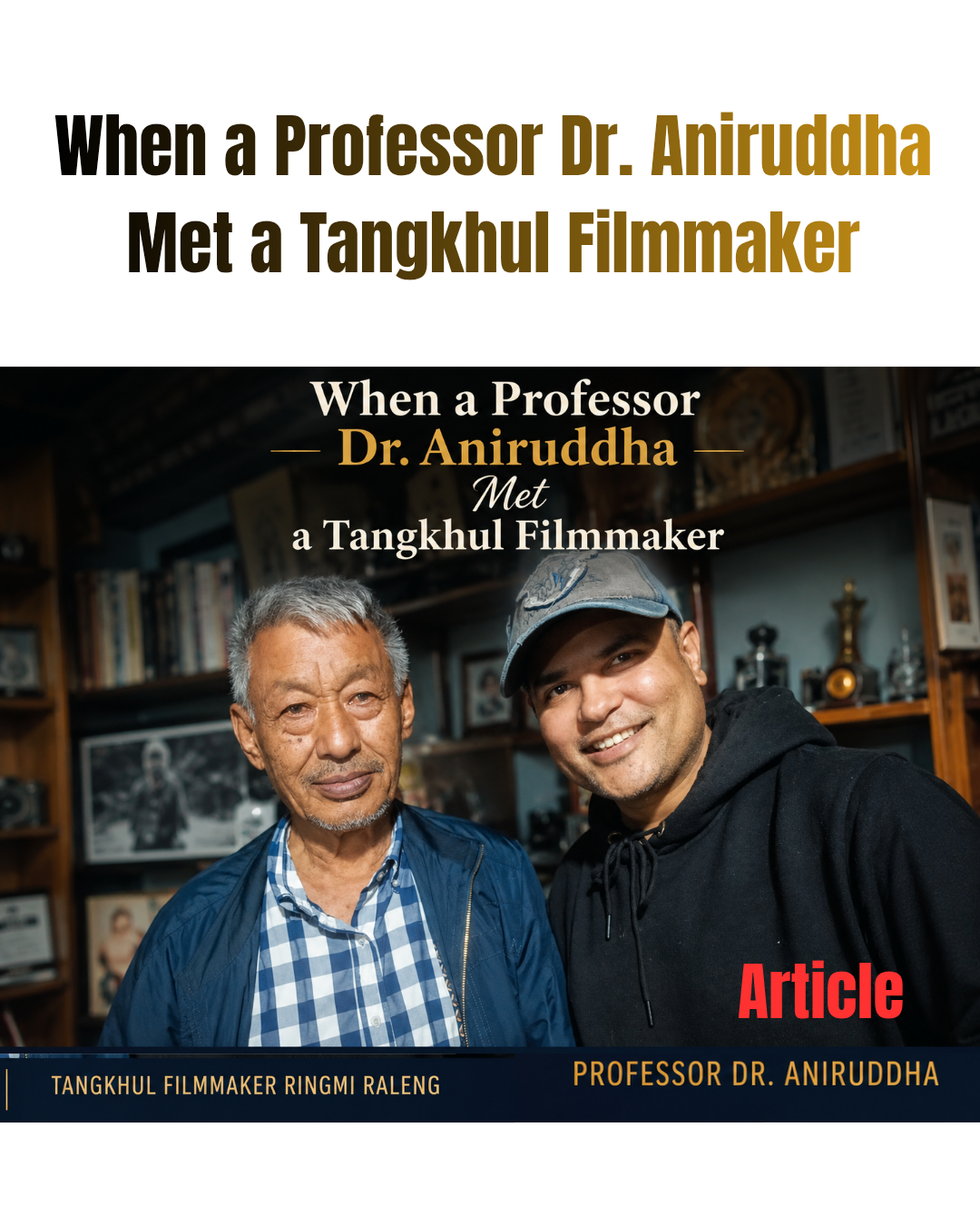
“I am Dr. Aniruddha Babar, I answered. “I teach Political Science at St. Joseph College, Ukhrul. I am also an explorer and researcher by passion.”
He listened attentively.
Perhaps my appearance had not prepared him for that introduction. I was still dressed in blue jeans, a black full sleeved T shirt, a cap and a day pack slung over my shoulders, looking more like someone returning from a long journey than a university academic.
Looking at my attire that rainy morning, few would have imagined that I had spent more than a decade studying, documenting, interpreting and theorising the Naga world. Over the years, my work had taken me deep into that world, not merely to observe it but to live with it, learn from it and understand it from within. As a political anthropologist with a background in law and governance, I had sought to understand how culture, language, customary institutions, identity, law, governance, conflict and everyday life come together to shape the political realities of Naga society. Much of what I knew had not been learned from books alone. It had emerged from countless conversations, long journeys, shared meals, village meetings, customary institutions and the generosity of people who welcomed me into their lives. Somewhere along that journey, I realised that the Naga world had quietly transformed me. Though I was born and brought up in Mumbai and did not outwardly look like a Naga, the years I had spent living, travelling, listening, learning and sharing life with Naga communities had made me Naga in spirit and in the way I understood and engaged with the world. The hills had become my classroom, the people my teachers and the field my greatest university.
Outside, the rain kept falling.
The mist drifted slowly across the road until the hills disappeared into white.
Inside, neither of us spoke for a while. Then I broke the silence.
“There has been no electricity in my locality for two days,” I said. “I walked all the way here simply to charge my equipments.
He nodded.
No surprise.
Only understanding.
His eyes briefly rested on the charging phone and power bank before returning to me.
Then, almost casually, he reached for the television remote.
With a soft click, the screen came to life.
The television screen flickered gently.
Then came the music.
Only a few notes.
Nothing more.
Yet they were enough.
I stopped walking.
There was something deeply familiar about the score. Adventure films had fascinated me since childhood and, before the title appeared on the screen, memory had already recognised what my eyes had not yet seen.
Smiling, I turned towards him.
‘That sounds like an Indiana Jones film.”
A few moments later, the screen confirmed my suspicion.
It was Indiana Jones and the Temple of Doom.
A smile crossed his face
Quite unexpectedly, he gestured towards the chair beside him.
“Come,” he said, “Watch.”
I gladly accepted.
For the next several minutes, words became unnecessary.
We watched in silence.
His eyes remained fixed on the screen, following every scene with the curiosity and quiet excitement of someone who genuinely loved cinema. Every now and then, a faint smile appeared on his face. Outside, rain continued to fall over the hills of Ukhrul. Inside, two strangers shared the same adventure.
As a political anthropologist, I have learned that the most meaningful discoveries rarely announce themselves. They seldom wait in archives, government records or official reports. More often, they emerge quietly through chance encounters and ordinary conversations with extraordinary people.
That rainy morning, I had left Aluntang in search of nothing more than electricity.
Instead, I had stumbled upon history.
On the television before us, Dr. Henry Walton “Indiana”, Jones Jr. searched for forgotten civilisations and lost treasures. Sitting quietly beside me was a man who had spent a lifetime preserving something equally precious about the stories, memories and cultural imagination of his own people.
At that moment, I knew none of it.
To me, he was simply a kind elderly gentleman who had welcomed a stranger into his shop, offered him electricity when he needed it most and unexpectedly invited him to watch a film. There was nothing about his quiet demeanour that suggested he had helped shape the cultural history of an entire people.
Only much later did I discover who he really was.
The gentle, unassuming man sitting beside me was one of the legendary architects of Tangkhul cinema. Long before indigenous filmmaking found recognition, he had dared to imagine that the Tangkhul people deserved to see their own stories, hear their own language and celebrate their own culture on the silver screen. At a time when such dreams seemed distant, he invested not only his resources but also his faith in a generation of storytellers, helping to lay the foundations of a cinematic movement that would become an enduring part of Tangkhul cultural history.
His name was Ringmi Raleng.
What followed that rainy morning was far more than a conversation.
It became a journey into the extraordinary life of a visionary whose legacy continues to illuminate the history of Tangkhul cinema.
For a few moments after the film ended, neither of us spoke. The room seemed reluctant to let go of the silence that had settled over it. Outside, the rain continued to fall over the hills. Inside, the television screen faded into darkness once again.
He switched it off and turned towards me.
“So,” he asked with an easy smile, “what brings you to Ukhrul?”
What followed was less an interview than a conversation between two people whose journeys had begun in different worlds before unexpectedly converging on a rainy morning in a small electronics shop.
I spoke briefly about my work at St. Joseph College, Ukhrul and my academic journey as a political anthropologist. I told him that for more than a decade I had devoted myself to understanding Naga society through its history, culture, language, customary institutions, governance, law, identity and everyday lived experiences. Over the years, I had come to believe that the story of the Nagas could never be fully understood through official documents alone. It lived in villages, family histories, songs, oral traditions and in the lives of ordinary men and women whose contributions often. remained unrecorded.
He listened quietly.
Then, with remarkable humility, he began speaking about himself.
There was no attempt to glorify the past, no effort to magnify his own achievements and no desire to be remembered as an extraordinary individual. He spoke instead as a son of the Tangkhul hills. whose own life had unfolded alongside the evolution of modern Tangkhul cultural expression.
As our conversation deepened, I gradually realised that I was listening not merely to the memories of one individual but to a living witness of the formative years of Tangkhul cinema. His recollections carried me back to a time when filmmaking in the Tangkhul language was little more than an ambitious dream sustained by determination, community support and a belief that the stories of the Tangkhul Nagas deserved to be told in their own language.
He spoke about an era when there were no established studios, no dedicated theatres, no institutional funding and very little technical infrastructure. Yet a handful of visionaries refused to allow those limitations to define them. They improvised, borrowed equipment, raised resources from within the community and built, almost from nothing, the foundations of an indigenous film movement. Cinema, for them, was never merely entertainment. It became a medium through which language, memory, identity and culture could be preserved and passed on to future generations.
As I listened, it became increasingly clear that the history of Tangkhul cinema was inseparable from the broader history of the Tangkhul Nagas themselves. Every early film represented more than artistic expression. It reflected a community’s determination to preserve its language, celebrate its traditions and tell its own stories in its own voice.
Only later did I fully appreciate that the quiet gentleman sitting before me had himself played a pivotal role in that remarkable journey. He was among the pioneering figures of Tangkhul cinema. Through vision, personal sacrifice and sustained commitment, he helped create opportunities for indigenous filmmaking at a time when resources were scarce and the future of Tangkhul cinema remained uncertain.
Listening to him, I realised that I was no longer hearing only the story of a filmmaker.
I was listening to the cultural history of the Tangkhul Nagas, narrated by one of the people who had helped shape it.
Outside, the mist still concealed the hills.
Inside, another landscape was beginning to emerge.
It was the story of Ringmi Raleng.
The story did not begin with a camera.
It began with an idea.
Long before Tangkhul cinema found its audience, filmmaking in the hills remained little more than a distant possibility. Resources were scarce. Equipment was difficult to obtain. Professional training was virtually absent. Yet the absence of opportunity did not diminish the desire to tell stories in the Tangkhul language.
As Ringmi Raleng spoke, I realised that he had never regarded these limitations as reasons to wait. He treated them as reasons to begin.
He understood something fundamental.
A film industry cannot exist on imagination alone.
It also needs projectors.
Cameras.
Editing equipment.
Places where people can gather to watch their own stories unfold.
While many dreamed of making films, he quietly worked to build the foundations that would make those dreams possible.
History rarely remembers such work.
It should.
He established the first video hall in Ukhrul district and became the first person to bring a video film projector to Manipur after securing a bank loan. At a time when such technology was almost beyond reach, these were not merely business decisions. They were investments in possibility. They created opportunities for filmmakers and audiences alike, extending even beyond the Tangkhul community as filmmakers from Imphal hired his projector for film screenings.
His commitment did not end there. He supported emerging filmmakers when resources were limited. He helped record Tangkhul video songs. Through RR Film Production Center, he went on to produce numerous Tangkhul films while steadily developing facilities for recording, editing and production.
Brick by brick.
Film by film.
Dream by dream.
Progress, I realised, is often built in exactly this way.
The journey demanded sacrifice. Financial uncertainty remained constant. The infrastructure was fragile. Then came another devastating blow in 2009.
In a single day, the studio, the video hall and virtually every piece of filmmaking equipment were reduced to ashes. An investment of more than Twenty lakh disappeared with the flames, while the compensation he received amounted to only Twenty Thousand. He recounted the loss without bitterness or self pity, simply as another chapter in a lifelong journey devoted to cinema. Although the fire brought his own filmmaking to an end, it could not erase the foundations he had already laid. Those foundations continue to support the enduring story of Tangkhul cinema..
Listening to him, I understood that pioneers are seldom defined by the obstacles they face. They are defined by what survives those obstacles.
From the perspective of political anthropology, cinema is far more than entertainment. Every indigenous film preserves something that might otherwise disappear. Language. Memory. Songs. Landscapes. Customary practices. Ways of seeing the world. Each frame becomes part of a people’s living archive.
By then, I no longer saw Ringmi Raleng simply as a filmmaker.
I saw a quiet builder of institutions.
A custodian of memory.
A man who understood that if a people cannot tell their own stories, someone else eventually will.
Outside, the rain still fell over the hills.
Inside, another chapter of Naga history had quietly found its way to me.
What impressed me most was not the scale of his achievements but the absence of any desire to speak about them.
He narrated each episode with remarkable simplicity, almost as though he were describing the work of someone else. There was no attempt to claim credit. No effort to present himself as extraordinary. The more he spoke, the more I understood that genuine pioneers rarely announce themselves. Their work speaks long after they have fallen silent.
Our conversation gradually moved beyond cameras, projectors and films.
We began speaking about the Tangkhul Nagas.
He spoke of a society that had preserved its identity through language, customary institutions, community life, faith and oral traditions. We reflected upon the responsibility of every generation to ensure that rapid social change did not come at the cost of cultural continuity. Modernity and tradition, we agreed, need not stand in opposition. The challenge is to ensure that one strengthens the other.
As I continued walking slowly through the shop, my eyes wandered across its shelves. They held far more than electrical equipment. Hundreds of audio cassettes of Tangkhul songs were neatly arranged alongside shelves filled with hundreds of CDs containing Tangkhul films, Manipuri movies and Hollywood classics. Every shelf seemed to preserve a different chapter of the region’s cultural journey. It was more than an electronics shop. It felt like a quiet archive where music, cinema and memory had found a home. At that moment, however, I had no idea that the quiet gentleman who owned this remarkable collection had himself played a pioneering role in shaping the history of Tangkhul cinema.
Standing there, I found myself wondering how many stories had passed through that modest shop over the years. Every cassette, every film and every weathered object seemed to possess a history of its own. Together, they formed something far greater than a private collection. They represented fragments of a people’s cultural memory, patiently preserved by someone who understood that history is not safeguarded only in museums, libraries or government archives. It also survives in ordinary places, cared for by ordinary people whose extraordinary devotion ensures that the past continues to speak to the future.
As I listened, it became increasingly clear that Tangkhul cinema had evolved into something far greater than an artistic enterprise. The release of Huinaya Phaningkakhui (“Too Late to Realise”) in 1986 marked the beginning of Tangkhul feature filmmaking, and the formation of the Tangkhul Naga Film Association in 1991 brought together filmmakers committed to promoting Tangkhul identity, history and culture through cinema. Despite limited financial resources, technical constraints and a modest audience, successive generations of filmmakers have continued to strengthen this indigenous cinematic tradition.
Many Tangkhul films preserve important aspects of language, music, oral traditions, social life, customary practices and collective memory, making them valuable cultural records. Indigenous cinema enables communities to represent their own histories, experiences and cultural imagination through their own language and perspectives. In that sense, every carefully crafted film becomes more than entertainment; it becomes part of a living archive passed from one generation to the next.
Civilisations endure because they preserve their memory. For the Tangkhul Nagas, cinema has become one of the enduring custodians of that memory. Every film preserves a fragment of the people’s language, history, customs, songs, landscapes and collective experience while also capturing the aspirations, challenges and stories of modern Tangkhul society. It records the changing rhythms of everyday life, the hopes of young people, the wisdom of elders and the resilience of communities adapting to a changing world. In doing so, it creates a visual record of a society in transition while remaining firmly rooted in its cultural identity. Together with oral traditions, family memory and community life, these moving images help ensure that the cultural inheritance of the Tangkhul Nagas remains vibrant for future generations. Young Tangkhuls will continue to see the faces of their ancestors, hear the rhythm of their language, understand the values that have shaped their community and witness the evolving story of their own generation. In this sense, cinema serves as a living archive of Tangkhul civilisation, preserving both heritage and contemporary life while inspiring generations yet to come.
When a community preserves its stories, it strengthens its identity. When every community preserves its stories, it enriches the nation. Ringmi Raleng’s lifelong commitment to Tangkhul cinema stands as a reminder that the cultural strength of India grows with every language that finds its voice, every community that safeguards its heritage and every story that is preserved for future generations. His life’s work affirms that preserving indigenous cultures is both a service to the community and a lasting contribution to the nation’s shared cultural heritage. Through his vision, perseverance and dedication, he has demonstrated that every indigenous story preserved through cinema becomes an enduring part of India’s civilisational legacy. In celebrating pioneers such as Ringmi Raleng, we also celebrate an India whose unity is strengthened by the richness of its many cultures, languages and traditions.
By the time our conversation reached this point, I realised that Ringmi Raleng’s achievements could not be measured solely by the films he produced. They were reflected equally in the confidence he inspired among younger filmmakers and in the practical foundations he helped establish for the growth of Tangkhul cinema. Today, Tangkhul cinema continues through the dedication of numerous local production houses, filmmakers, actors, technicians and audiences who remain committed to telling their own stories in their own language despite limited resources and a modest market.
Ringmi Raleng dedicated his life to the growth of Tangkhul cinema, leaving a legacy that enriches India’s indigenous cinematic heritage. Through the production of twenty one Tangkhul films, the establishment of pioneering production and exhibition facilities, and his enduring support for local filmmakers, he helped create an environment in which indigenous storytelling could flourish. His work strengthened the preservation of Tangkhul language, history and cultural memory through the powerful medium of cinema while contributing to the remarkable diversity that defines India’s cinematic tradition. His vision continues to inspire future generations to tell their own stories with confidence, creativity and cultural pride. In celebrating Ringmi Raleng, we also celebrate the enduring place of indigenous voices within the larger story of Indian cinema.
As a political anthropologist, I found this deeply significant. Anthropologists have long relied upon oral histories, participant observation and ethnographic fieldwork to understand societies. Indigenous cinema adds another dimension. It preserves not only what people say but how they speak, how they sing, how they celebrate, how they mourn, how they relate to one another and how they inhabit their landscapes. It records gestures, expressions, humour and everyday practices that rarely find a place in official archives.
As I reflected upon our long conversation, I found myself thinking about the remarkable journey of Marathi cinema, the land from which I come. From the pioneering work of Dadasaheb Phalke to generations of filmmakers who explored questions of society, culture and human values, Marathi cinema has played an enduring role in preserving the Marathi language, strengthening cultural identity and encouraging thoughtful public engagement with social issues. Its history demonstrates the remarkable ability of cinema to preserve language, inspire social awareness, encourage positive social change, strengthen cultural identity and shape the collective memory of a people. As I listened to Ringmi Raleng, I realised that Tangkhul cinema carries a similar responsibility for the Tangkhul Nagas. Every film preserves the richness of the Tangkhul language, records the changing realities of contemporary society, celebrates indigenous knowledge and safeguards the cultural inheritance of future generations. Every civilisation is remembered by the stories it chooses to preserve. The Tangkhul Nagas possess a rich cultural inheritance, and every new generation that tells its own stories adds another enduring chapter to that legacy. Through the dedication of pioneers such as Ringmi Raleng, Tangkhul cinema has become far more than a creative endeavour. It has emerged as a living cultural institution that continues to strengthen the identity, confidence and collective memory of the Tangkhul people while enriching the remarkable diversity of India’s indigenous cinematic heritage. By helping to create films in the Tangkhul language, he contributed to an enduring record of a people’s voice, imagination and worldview. Long after individual memories have faded, these films will continue to introduce future generations to the landscapes, customs, aspirations and everyday lives of the Tangkhul Nagas, reminding them not only of where they came from but also of who they are.
Ringmi Raleng may never have described his life’s work in such academic terms, nor did he need to. His work itself demonstrated the principle. Through quiet perseverance, practical vision and commitment to his community, he helped ensure that the Tangkhul Nagas would not merely be subjects of history but active custodians of their own cultural memory.
Looking around the shop, I realised that I was sitting not merely beside a filmmaker but beside one of the custodians of Tangkhul cultural memory. The shelves around us held electrical equipments, old stuffs, yet in a deeper sense the room itself seemed to hold something far more valuable, the memories of a generation that refused to allow its stories to disappear.
Outside, the rain continued to wash over the hills of Ukhrul.
Inside, I understood that the most enduring legacies are often built quietly, one story at a time.
When I finally glanced at my watch, it was almost half past five in the evening.
Nearly seven hours had passed since I had first walked into the shop to charge my mobile phone and power bank. Time had slipped away unnoticed. The conversation had quietly replaced the clock. What had begun as an ordinary search for electricity had become an unexpected journey through memory, cinema and the enduring spirit of the Tangkhul Nagas.
As the afternoon slipped by, his kind wife, whom I had by then began affectionately calling “Aunty”, emerged carrying two steaming cups of hot tea and a few bananas for us. There was nothing ceremonial about the gesture. It was a simple act of hospitality, offered with warmth and generosity. We continued our conversation over tea while the rain tapped softly outside and the mist lingered over the hills. It reminded me that the finest expressions of culture are often found not in grand ceremonies but in acts of kindness shared without expectation.
Before I prepared to leave, Ringmi Raleng spoke of one dream that still remained close to his heart. He hoped to make a grand historical film on Reverend William Pettigrew, who established his mission at Ukhrul in 1896 and went on to play a significant role in the educational, linguistic and religious history of the Tangkhul Nagas. As he spoke, I was struck by the youthful enthusiasm in his voice. Decades of pioneering work had not diminished his desire to tell one more story. For him, the film represented an opportunity to preserve an important and historically significant chapter of Tangkhul history through the language of cinema for future generations. He expressed the hope that the Government of India and the Government of Manipur would recognise the cultural and historical significance of such a project and extend the institutional support necessary to transform this long cherished vision into reality.
As our conversation drew to a close, I realised that the privilege of listening to Ringmi Raleng should not remain mine alone. Stories of such depth deserve to be heard by young minds preparing to shape the future. I therefore invited him to visit St. Joseph College, Ukhrul, and share his remarkable journey with our students. I told him that they would benefit not only from learning about the history of Tangkhul cinema but also from witnessing the life of a man whose vision, perseverance and humility had helped shape an important chapter of indigenous filmmaking. Some lessons are found in books. Others are discovered in the lives of those who dedicate themselves to a cause greater than themselves. I hoped that one day our students would have the opportunity to meet one such pioneer in person.
Before leaving, I could not resist taking home two small keepsakes from the shop. One was an old pocket knife with a large cross engraved on its handle. The other was an old rechargeable metal pocket torch, weathered by time yet still carrying the dignity of an object that had faithfully served its purpose. The shop itself was unlike any ordinary electronics store. Tucked away among its shelves were countless old and unusual objects, each seeming to carry a story of its own. Perhaps it is the antiquarian in me, or perhaps it is simply my eternal fascination with the past, but I found myself deeply drawn to these forgotten relics. Years from now, the knife and the torch may simply become old objects once again. To me, however, they will always remain reminders of the rainy day in Ukhrul when I entered a small shop searching for electricity and discovered a remarkable chapter of Tangkhul history.
My mobile phone and power bank were fully charged. The purpose for which I had entered the shop had quietly fulfilled itself long ago.
I thanked Aunty for her kindness and expressed my heartfelt gratitude to Uncle Ringmi Raleng for his generosity, his time and, above all, for sharing with me a part of his remarkable journey. He responded with the same gentle smile that had welcomed me earlier that morning. There was no expectation of recognition. Humility seemed as natural to him as storytelling.
As I stepped outside, the rain had softened into a gentle drizzle..
The evening mist drifted slowly across the hills.
I paused for a moment and looked back.
The warm light still shone through the shop window.
Inside, Ringmi Raleng had already returned to his shelves of old cassettes, films and forgotten treasures, as though our long conversation had simply become another ordinary day in a lifetime devoted to preserving extraordinary stories.
The muddy road leading back towards Aluntang looked exactly as it had that morning.
Not the hills.
Not the rain.
Not the road.
It was I who had changed.
I had left home searching for electricity.
I returned carrying something far more valuable.
Not a film.
Not a photograph.
A story.
As I walked into the evening mist, the warm light of the little shop gradually disappeared behind me.
The rain continued to fall over the hills of Ukhrul.
Some journeys end when we reach our destination.
The most memorable ones begin the moment we discover what we were never looking for.
A smile crossed my face. I drew a deep breath. A soft whistle escaped my lips and the old Hindi melody rose gently into the rain.
…Ae zindagi gale laga le…
Hum ne bhi tere har ek gham ko, gale se lagaya hai….hai na…
Ae zindagi gale laga le…
Written by
Dr. Aniruddha Babar
(Dr. Aniruddha Babar is a Senior Academician, Public Policy Expert & Social Development Specialist, Writer, and Researcher currently serving in the Department of Political Science, St. Joseph College, Ukhrul, Manipur. He is also the Co-Founder and Deputy Director of the Centre for North-East Development and Policy Research (CNEDPR), St. Joseph College, Manipur).
(The views and opinions in this article are solely those of the author and do not necessarily reflect the official stance of Rural Post)