
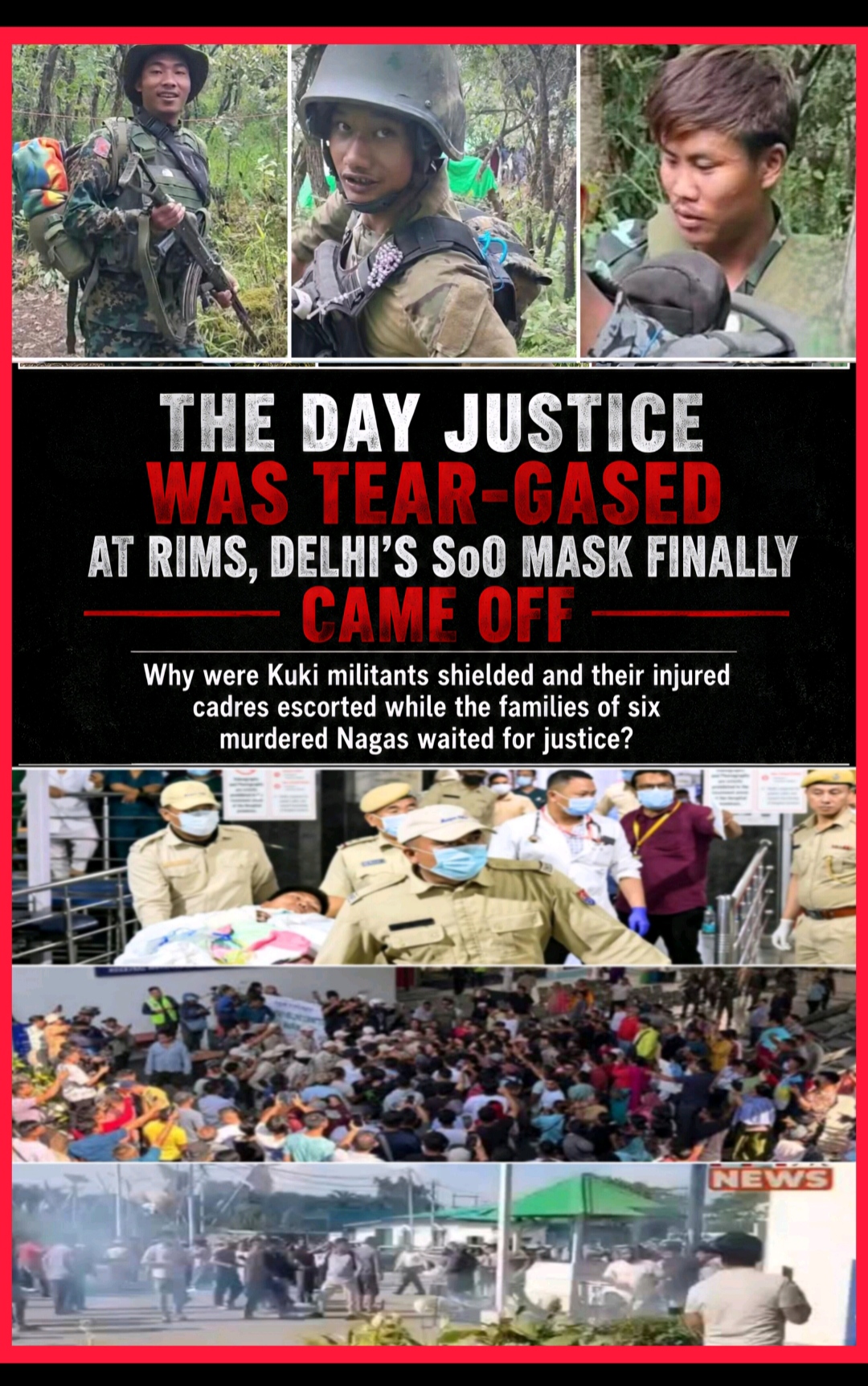
The Day Justice Was Tear -Gased at RIMS, Delhi’s SoO Mask Finally Came Off
Why were Kuki militants shielded and their injured cadres escorted while the families of six murdered Nagas waited for justice?
This dossier is written from within the Naga and Meitei experience. It documents what happened, examines what it reveals, and demands what must follow. Where sources are cited, they support the record. Where interpretations are offered, they reflect the understanding of the communities who lived through these events. This is not a neutral document. It is a truthful one.
THE PATH TO RIMS: THE CRIME, THE WAITING AND THE OUTRAGE
On the morning of June 15, 2026, three injured Kuki youths were transported under armed escort by the Assam Rifles to the Regional Institute of Medical Sciences in Imphal. To the thousands of Nagas and Meiteis who converged on the hospital gates within hours, these were not simply injured civilians. They were Genlenmang Vaiphei, Lunliandaw Vaiphei, and Paogoulal Chongloi, men widely alleged to be cadres linked to KNF-P and other Kuki militant groups.
Protesters did not arrive at RIMS because they opposed medical care. They arrived because the armed escort dramatized, in a single unbearable image, a pattern they had been living for years: the state mobilizing its resources for those it appeared to protect, while ordinary citizens waited for justice that never came.
That pattern did not begin on June 15. It had been hardening since the Kuki-Meitei conflict erupted in May 2023. It intensified in early February 2026, when violence spilled into Naga-inhabited areas and entire communities watched armed groups move with a freedom denied to unarmed civilians. By the time the three injured youths were rushed through the gates of RIMS under security escort, the question was no longer whether the state was impartial. The question was why it continued to pretend to be.
The roots of the present crisis lie in the morning of May 13, 2026. The same road witnessed two crimes on the same day. First, the killing of Christian leaders attempting to build peace. Second, the abduction of Naga civilians travelling to a wedding. Whether viewed separately or together, both incidents reinforced a growing perception that armed actors had become more powerful than civilian authority. That perception, and the state’s failure to confront it, is the subject of everything that follows.
Hours before the abduction that would tear through the Naga conscience, three Thadou Christian leaders were ambushed and killed on Tiger Road between Kotzim and Kotlen in Kangpokpi district. Rev. Dr. Vumthang Sitlhou was the President of the Thadou Baptist Association and a former General Secretary of the Manipur Baptist Convention. Rev. Kaigoulun Lhouvum served as Finance Secretary of the Thadou Baptist Association International. Pastor Paogoulen Sitlhou was their companion in faith and in death.
Survivor Hekai Simte, 56, later described how the firing continued “non-stop for at least a minute” before suddenly ceasing (The Wire, May 13, 2026). The attackers, he said, “had sophisticated weapons and that’s why they were able to shoot from a long distance” (The Wire, May 13, 2026). The firing came from the hillside, from positions of advantage, from cover. The circumstances suggested a planned and deliberate attack rather than a spontaneous confrontation.
What makes these killings politically legible is what preceded them. Sitlhou had recently led a delegation of Kuki Christian leaders to neighbouring Nagaland in an effort to broker peace between Kukis and Tangkhul Nagas in the restive Kamjong and Ukhrul districts (Vatican News, May 14, 2026; Fides News Agency, May 14, 2026). He was a bridge-builder. He was killed on a road that should have been safe. Members of the Thadou community have since stated publicly that the slain leaders had repeatedly resisted pressure to align themselves with the Kuki-Zo political construct and its Kukiland project. They had refused to submit their pulpits to the demands of armed actors. Their killing, viewed in this light, was not an isolated act of violence. It was a message directed at a community that had chosen to remain independent. It was a warning about the cost of refusing the political project that Kuki militant groups have been advancing under the protective umbrella of the Suspension of Operations agreement.
This raises the first of several hard questions this dossier places before the reader. If armed groups operating under a state-sanctioned SoO framework can kill religious leaders who refuse to submit to their political project, what does the Soo agreement actually protect? Peace, or impunity for those who enforce political conformity through violence?
Shortly after the Tiger Road ambush, armed men intercepted a wedding party travelling the same route. At around 11 am, eighteen Naga civilians were pulled from their vehicles. Twelve women. One infant. Six men, among them two pastors. They were assaulted, their phones were seized, and they were marched blindfolded into the forest (The New Indian Express, May 14, 2026; FIR, Sekmai Police Station, May 14, 2026).
Some of the abducted managed to make frantic calls describing the situation as “very hostile.” Then the calls stopped.
Upon learning of the abduction, Naga groups detained twenty-eight Kuki individuals as a security measure, holding them in a Naga hall. This was not vengeance. It was a desperate attempt to create leverage, to hold onto something that might bring their people back. The women and infant were released on May 15. At the same time, Nagas released fourteen of the detained Kukis unharmed. The remaining fourteen Kuki detainees were released on June 9 by Naga village guards, before the bodies of the six Naga men were found.
Here the dossier confronts the reader with the single most devastating moral comparison in the entire sequence of events. Naga custodians returned all twenty-eight detainees alive and unharmed. They were given blankets. Rice and dal. Tea. Someone asked if they were cold. Not a single one was harmed. Six Naga men were taken. Six were returned as mutilated corpses, beheaded, dismembered, identifiable only by a blue sneaker, a missing skull, severed limbs. Twenty-eight returned alive. Six returned dead. That is not merely an asymmetry of outcomes. It is a revelation of moral character. The Naga custodians returned their detainees with their humanity intact. The six Naga captives, by contrast, were recovered as mutilated remains.
The women and infant returned. The six men did not. For twenty-six days, mothers, wives, children, villages, and entire Naga communities, together with many Meiteis, lived suspended between hope and dread. Neighbours gathered in church halls to pray. Rumours of a possible sighting near the forest edge sent families rushing toward the tree line, only to find nothing. Every passing day sharpened the same unbearable question: were they still alive? The state, which had mobilized armed escorts for three injured Kuki youths in a matter of hours, offered no such urgency for six missing Naga men. Twenty-six days is not a procedural delay. Twenty-six days is an announcement of priorities.
On June 10, hope collapsed. After nearly 24 hours of sustained search operations involving approximately 450 personnel, the mortal remains of six persons were recovered from a jungle near Leilon Vaiphei village (Manipur Police Statement, June 10, 2026). The United Naga Council described the remains as “highly mutilated and dismembered and called the act “the most unacceptable and gross violation of human rights and an affront to human dignity” and a “sacrilegious and satanic act’ (UNC Statement, June 10, 2026). The women who were rescued later testified that they had been kept blindfolded throughout their captivity and, on one occasion, were fed a meat curry whose smell and taste they could not identify (NTIMES, June 12, 2026; The Wire, June 12, 2026). That testimony has given rise to allegations so disturbing that theydemand forensic investigation, not as speculation, but as accountability. A state serious about justice does not leave such allegations to fester in the dark.
THIS WAS NEVER ABOUT A HOSPITAL
Those testimonies. Those bodies. Those unanswered questions. They are what brought thousands to RIMS on June 15. The events at RIMS are already being described as a law-and-order problem. That interpretation misses the point entirely. People did not gather because they opposed medical treatment. People gathered because RIMS became the stage upon which a deeper contradiction was publicly and violently revealed.
For twenty-six days, families searched for six abducted Naga men. For twenty-six days, entire communities demanded answers. For twenty-six days, uncertainty hung over every church gathering, every village meeting, every prayer offered in the dark. Then came the recovery of mutilated remains. Then came testimonies from rescued women that gave rise to allegations so disturbing they demand forensic investigation. And then, before any public accounting had been provided, before any arrest had been made, before the families had been allowed even the dignity of burial, the state appeared before the public not in pursuit of justice, but in protection of those many citizens believed were connected to the very structures responsible for the violence.
People did not arrive at RIMS carrying political theories. They arrived carrying grief, anger, and questions no authority seemed willing to answer. They did not gather to oppose medical treatment. They gathered to ask why the state mobilized armed escorts and institutional protection for men they believed to be militants, while the families of six murdered Naga civilians still waited for justice and the dignity of burial.
This distinction is the ethical center of everything that follows. The outrage was never about denying emergency medical care. No civilized society should deny treatment to the injured. The issue was the unbearable context in which that treatment was provided. The same institution that received the injured Kuki youths under armed escort stood within sight of the mortuary holding the mutilated remains of six Naga men whose families were still demanding accountability. The crowd at RIMS was not opposing healing. They were opposing impunity. And impunity is not a medical condition. It is a political choice.
The response to those questions came not in explanations, arrests, or public accountability, but in batons and tear gas. That response was itself an answer. It told the crowd, and the world, that those who demand justice will be treated as a threat to order. The questions, however, remain. And they will not be dispersed by force.
THE SCENE AT RIMS: WE ARE NOT A SANCTUARY FOR MILITANT
The three injured Kuki youths were transported from the 183 Military Hospital at Leimakhong to RIMS under heavy security escort. For protesters, the optics were devastating. Here were men they believed to be militants, receiving the full protective apparatus of the state, while ordinary Naga and Meitei civilians could not travel freely through their own districts without fear of abduction or attack.
Julia Shinglai of the Foothills Naga Coordination Committee captured the sentiment precisely: “We are very disappointed with how the government is giving special treatment to the Kukis. Their sick are escorted to Imphal for treatment when our movement is limited within certain areas” (Imphal Times, June 15, 2026).
Her question exposes the structural inequality at the heart of the crisis. Why does one community receive armed escorts while another cannot move? The answer cannot be found in any legal statute. It must be sought in the political calculus that determines whose safety is prioritized and whose is not. Security personnel dispersed the crowd with tear gas shells, mock bombs, and baton charges. Hospital services were disrupted. RIMS authorities later clarified that their ‘sole responsibility is to provide medical care to all patients” (RIMS Statement, June 15, 2026). But the question was never about RIMS. It was about the armed escort that brought the patients there, and the differential treatment that escort represented.
By nightfall, an indefinite shutdown and economic blockade enforced by Kuki civil society organizations was underway across Kangpokpi district. The three injured youths were eventually shifted to Churachandpur Medical College. The protest was over. The questions were not.
THE LEILON VAIPHEI FIRING: WHOSE NARRATIVE I S BEING PROTECTED?
The June 15 firing incident is a case study in how information is weaponized in an asymmetric conflict. According to Kuki Inpi Manipur, the attack was carried out by the NSCN-IM and its ‘proxy outfit ZUF-K, and they demanded immediate arrests (KIM Statement, June 15, 2026). Yet the timing raised immediate questions. The incident occurred on the same day as the funeral of Jangngam Hangshing, a Kuki resident killed in the June 13 Lasan-Langka attack, an attack also attributed to NSCN-IM and ZUF-K. The convergence of violence and mourning on a single day suggests either acatastrophic breakdown of order or a deliberate choreography of blame.
Manipur Police reported that an encounter took place between a joint column of Assam Rifles-Army and suspected militants, during which one suspected militant was killed and an AK-47 recovered (Manipur Police Statement, June 15, 2026). Kuki MLA Letzamang Haokip immediately countered that the deceased was a civilian, claiming that “eyewitnesses have alleged that, after he was shot, his clothes were removed and his lifeless body was taken away by the joint security forces’ (The Wire, June 16, 2026).
Here the narrative fractures. The state claims one thing. Kuki political representatives claim another. Nagas, observing from the sidelines, note a third dimension: according to Naga sources, the exchange of fire was not a Kuki-Naga clash at all, but an internal confrontation between factions of the Kuki National Army, the KNA and KNA(B). If that is true, then the entire episode was not an act of Naga aggression but an intra-Kuki conflict that was immediately weaponized to blame Nagas and justify further militarization. Regardless of who initiated the violence, the immediate political consequence was the reinforcement of a narrative that justified continued protection of SoO groups while intensifying suspicion toward Naga actors. Who benefits from that narrative? And who pays the price when it is accepted without rigorous investigation?
For many Nagas, Meiteis and also many observers, the conclusion is unavoidable: the state appears to have chosen a side. The SoO agreement, in their analysis, has ceased to be a peace mechanism and has become a logistical support system for one community’s armed cadres. The RIMS escort was not an isolated lapse. It was the visible face of a deeper alignment that has been building for years.
THE PATTERN OF STATE PROTECTION: A LICENSE TO KILL
The June 15 protests did not emerge from a single incident. They were the culmination of a documented pattern that stretches back years and reveals a systematic bias in the conduct of state security forces.
Peace agreements derive legitimacy from their outcomes. When communities repeatedly associate an agreement not with security but with recurring violence, the agreement undergoes a political inversion. It ceases to be viewed as a restraint on militancy and comes to be viewed as a shield for militancy. That inversion has now occurred, and the evidence is overwhelming.
In March 2026, the Tangkhul Naga Long alleged that armed Kuki miscreants from Chassad village opened fire on civilian areas in Kamjong headquarters, near an Assam Rifles camp and a police station. The TNL statement made an even more disturbing claim: Assam Rifles personnel explicitly warned local civilians that any form of retaliation against Kuki militants would be met with violence from the security forces themselves (TNL Statement, March 2026). Think about what this means. A state security force, entrusted with protecting all citizens equally, allegedly threatened to attack one community if it defended itself against another. That is not peacekeeping. That is complicity.
On March 11, 2026, ANSAM accused the Assam Rifles of colluding with Kuki militants following the abduction of 21 Tangkhul Naga civilians from Shangkai village, an abduction that allegedly occurred “right under the nose of the Assam Rifles (ANSAM Statement, March 11, 2026). Again, the pattern repeats. Abductions happen. Security forces are present. No intervention occurs. The victims are left to wonder whether the state’s inaction is incompetence or design.
When multiple communities, across multiple incidents, reach the same conclusion independently, the burden of proof shifts. It is no longer sufficient to dismiss these allegations as isolated complaints. They form a coherent pattern, and that pattern demands an explanation. The explanation that has convinced many Naga organizations is that security forces have created a permissive environment for Kuki militant violence, an environment in which armed groups operate with the confidence that the state will not hold them accountable. If security forces threaten civilians who attempt to defend themselves, while allowing armed militants to operate freely, who exactly is the SoO agreement protecting? The answer, for those who have lived under its shadow, is not the civilians.
THE QUESTIONS NO ONE IS ANSWERING
If the Soo framework exists to reduce violence, why do allegations of abduction, killings, and armed intimidation continue to emerge from areas where SoO groups operate? If groups under SoO are expected to remain within designated camps, how do repeated allegations of armed activity continue to surface? If the agreement is succeeding, why is public confidence collapsing? If the state believes the agreement remains effective, why are both Naga and Meitei organisations increasingly calling for its termination? And perhaps most importantly: at what point does a peace mechanism cease to be judged by its intentions and begin to be judged by its outcomes?
THE CENTRAL QUESTION: WHAT IS THE SoO AGREEMENT PROTECTING?
The Suspension of Operations agreement was signed between the Union Home Ministry, the Government of Manipur, the Kuki National Organisation, and the United People’s Front. Its stated purpose was to bring armed groups into a monitored framework and reduce hostilities. But the gap between stated purpose and lived reality has become unbridgeable.
The SoO framework is not a local village arrangement. It is a political architecture designed, funded, supervised, and renewed by the Union Government through the Ministry of Home Affairs. The agreement is tripartite: the Centre, the Manipur state government, and the KNO and UPF, two umbrella groups comprising 24 separate Kuki-Zomi insurgent groups. It was first signed on August 22, 2008, between the Government of India, the Manipur government, and the umbrella Kuki organisations. The Union Home Ministry led the negotiations, with the Joint Secretary (North East), MHA, signing the agreement. The pact provides stipends of ₹6,000 per month per cadre, funded by the central government, and designates camps that are monitored through a Joint Monitoring Group. If groups operating under that framework stand accused of atrocities, responsibility cannot be confined to the hills of Manipur. The chain of accountability extends upward to the authority that created, maintained, and defended the framework itself. That is why June 15 was not merely a crisis for Manipur. It was a crisis for Delhi.
On June 14, just one day before the RIMS protest, Manipur Deputy Chief Minister Losii Dikho made a statement that should have sent shockwaves through the political establishment: those involved in the killing of six Naga civilians, he alleged, belonged to a group covered under the SoO arrangement (India Today NE, June 14, 2026). In other words, a serving Deputy Chief Minister effectively acknowledged that the very agreement designed to reduce violence was sheltering those accused of the most gruesome atrocity in recent Manipur history.
The UNC has demanded the immediate abrogation of the SoO agreement. ANSAM has called it “a licence to kill and abduct innocent civilians (ANSAM Statement, June 2026). An opinion piece in the Morung Express asked the question that now hangs over every discussion of the SoO: “How long will SoO remain a license for Kuki militants to take innocent lives?” (Morung Express, June 15, 2026).
The logic is inescapable. The state cannot offer stipends, designated camps, and political engagement to armed groups while those same groups stand accused of abduction, torture, mutilation, and beheading. It cannot maintain a framework that provides shelter to the perpetrators while the victims’ families cannot even bury their dead. As observed and evidentiary leads suggest, the SoO agreement is no longer perceived as a peace mechanism but as a system that shields those accused of violence. And the price is paid in Naga and Meitei lives.
THE KNF-P, NEMCHA KIPGEN AND THE CONFLICT OF INTEREST
No examination of state protection for Kuki militants can avoid the single most politically explosive dimension of the crisis: the position of Deputy Chief Minister Nemcha Kipgen. Her husband, Semtinthang Kipgen alias Thangboi, is the president of KNF-P, the very group that Naga organizations have directly accused of involvement in the abduction and killing of the six Naga civilians (The Assam Tribune, June 13, 2026).
This is not a matter of guilt by association. It is a matter of institutional integrity. A Deputy Chief Minister occupies a position of trust, with access to intelligence, security briefings, and policy decisions. When her spouse leads an armed group that stands accused of atrocity crimes, the conflict of interest is not a perception problem. It is a structural reality. The mere structure of the relationship, a senior minister married to the leader of an accused militant group, is itself a crisis of governance. No additional allegation is required to make this point. The relationship alone is the argument.
The UNC’s memorandum to Union Home Minister Amit Shah explicitly cited this marital relationship as raising concerns over internal security and public confidence. The memorandum was signed by UNC President Ng. Lorho and General Secretary Vareiyo Shatsang (UNC Memorandum, June 2026). The UNC also demanded the arrest of Leilon Vaiphei village chief Lalboi Vaiphei and other villagers, as well as Thanggilian Vaiphei, a serving Manipur Police personnel alleged to have been involved. These are not abstract political demands. They are specific, named allegations that demand specific, named responses.
Yet the government has taken no visible action. The Deputy Chief Minister remains in office. The militant group remains under SoO protection. The families of six murdered Naga men have still received neither justice nor the dignity of burial. This raises a hard question that no official spokesperson has yet answered. Can a government that retains a minister married to the leader of an accused militant group claim, with any credibility, to be neutral in this conflict? And if it cannot claim neutrality, what exactly is its role?
JUNE 15 WAS A MOMENT OF POLITICAL CLARITY
Every conflict contains moments when underlying tensions become visible. June 15 was one of those moments. The tear gas itself was not the story. The story was who stood together before the tear gas was fired.
Nagas and Meiteis have disagreed on many things. They do not share identical political aspirations. They do not interpret history in the same way. Yet on June 15 they stood on the same side of the barricade asking the same question: who is being protected? The significance of that question extends far beyond RIMS. Because once citizens begin asking whether institutions are protecting victims or protecting armed actors, the crisis ceases to be merely a security crisis. It becomes a crisis of legitimacy.
Governments do not survive on force alone. They survive because citizens believe institutions deserve obedience. Once large sections of society conclude that laws are being applied unequally, the crisis ceases to be about security. It becomes a crisis of legitimacy. Legality can be enforced. Legitimacy must be earned.
The RIMS protest was not an isolated eruption of anger. It was a turning point whose significance extends far beyond the hospital gates. The movement triggered by the abduction of eighteen Nagas, the twenty-six-day wait, the discovery of mutilated bodies, and the testimony of the rescued women has become something larger than a demand for justice in a single criminal case. It has become a test of whether the state is willing and able to uphold the equal protection of all citizens, or whether it has abandoned that responsibility in favour of a political calculus that privileges armed groups over unarmed communities.
When grief, outrage, and suspicion crystallize into a collective public challenge to the state’s claim of neutrality, something fundamental has shifted. The protesters who refused to disperse at RIMS were not rejecting medical care. They were rejecting the legitimacy of a system that protects the accused while ignoring the victims. When security forces responded with tear gas, they confirmed, in the most visceral way possible, that the state experiences demands for justice as threats to order. That is the hallmark of a crisis of legitimacy. June 15 will be remembered not as the day a crowd gathered, but as the day the state’s moral claim to govern was openly and collectively refused.
For the indigenous peoples of Manipur, the sight of Nagas and Meiteis standing together at RIMS was itself a historic statement. Their political interests have not always aligned. Their shared history carries the weight of complex and sometimes difficult relations. Yet on that day, a common grief and a common demand for justice brought them together. In that unity lies both a moral achievement and a fragile hope, that shared witness might become the foundation for a broader indigenous front, not merely against a common threat but for a shared future on their own land. This is not a strategic calculation. It is a moral possibility born from shared suffering.
WHY THIS MOMENT WILL ENDURE
For many Nagas, June 15 was not interpreted as an isolated event. It was understood through memories of the 1990s, through experiences of displacement, through unresolved grievances, and through a long-standing belief that Naga suffering receives less attention than the suffering of others. The Kuki-Naga conflict of the 1990s claimed hundreds of lives. Villages were burned. Homes were looted. Generations grew up in displacement. Those burned villages and the unburied dead of 2026 are chapters of the same long story, a story that has been repeatedly reopened because the structures that caused the original wound were never dismantled.
The RIMS protest therefore became not merely a reaction to a recent crime but the expression of accumulated historical memory. It was grief that had been waiting for decades to be acknowledged. It was anger that had been passed down through families. who never received justice. And it was a warning, that a people who have waited too long will eventually stop waiting, and start demanding.
The Naga people have shown restraint, dignity, and a commitment to peace that their tormentors have never reciprocated. But restraint is not infinite. If the state continues to shield militants while denying justice to victims, the crisis will deepen beyond the capacity of any authority to contain. The question is no longer whether the SoO framework can be reformed. The question is whether it can survive the collapse of public trust that its own outcomes have produced.
International law is clear. The UN Basic Principles on the Use of Force and Firearms by Law Enforcement Officials require states to protect all persons against arbitrary violence. When a state’s security forces provide safe passage to alleged perpetrators of atrocity crimes while tear-gassing those who demand accountability, those principles are not merely violated. They are inverted.
THE FAMILIES ARE WAITING. THE WORLD IS WATCHING.
The six Naga men left home expecting to return. They never did. On May 13 they were abducted. On June 10 they were returned to their families not as living sons, husbands, fathers, brothers, and pastors, but as mutilated remains. Some families identified their loved ones through a blue sneaker; others were confronted with missing skulls, severed limbs, and bodies returned in pieces. The six men were identified as Pastor Reverend Manu Thiumai, Pastor Kenpibou Chawang, Phenrongwibou Thiumai, Phenrilungbou Chawang, Dilip Thiumai, and Kaliwangbou Abonmai (FIR, Sekmai Police Station, May 14, 2026).
The UNC has declared that it will not formally receive the mortal remains until the government addresses its charter of demands. Those bodies still lie in the JNIMS mortuary, unclaimed. This is not merely a bargaining position. It is a statement that the dead will not be buried quietly while the living are denied justice. It is a refusal to accept that funerals can proceed while accountability does not.
Meanwhile, the three Kuki youths admitted to RIMS on June 15 received immediate medical care, armed escort, and state protection. They will recover. The question is whether the families of Konsakhul will ever recover, and whether Manipur will ever receive justice. That asymmetry, the rapid mobilization for the accused, the protracted silence for the victims, is the moral injury at the heart of this dossier.
THE TEST BEFORE THE STATE
The evidence and patterns documented in this dossier lead to a set of demands that are not negotiable. They are the minimum required to restore any semblance of public trust in the institutions that have failed so completely.
1. The NIA must release a full public forensic update, including the analysis of the unidentified meat served to the women, the DNA matching of remains, and the digital forensic examination of the widely circulated social media comment “we cooked and ate them already” (Facebook Screenshot, Lm Khongsai Lm Khongsai, May 16, 2026). The families deserve to know what was done to their loved ones. The public deserves to know what the state has found. Silence is not neutrality. Silence is complicity.
2. The SoO agreement must be abrogated with all Kuki militant groups involved in ethnic violence. It has become a license to kill. The state cannot continue to fund, shelter, and politically engage armed groups while their victims count the dead.
3. The Government of India must declare KNF-P a terrorist organisation and initiate criminal proceedings against its leadership, including Semtinthang Kipgen.
4. Deputy Chief Minister Nemcha Kipgen must be removed from office pending a full conflict-of-interest inquiry. Her continued presence in government is an insult to every victim of Kuki militant violence and a mockery of the principle that public office requires public trust.
5. The UNC’s four-point charter must be addressed before the bodies are received. The families have waited long enough. They deserve to bury their dead with dignity. But dignity without justice is an empty ritual. The government must deliver both.
THE FINAL QUESTION
They ask why security forces protect those accused of butchering our people. They ask why Kukis can receive treatment in Imphal while Nagas cannot move freely. They ask how a Deputy Chief Minister whose husband leads a militant group remains in office. They ask why Delhi Police permits Kuki vigils but cancels Naga ones. They ask when the NIA will release the forensic truth about the unidentified meat. These are not rhetorical questions. They are specific, answerable demands directed at specific institutions. The fact that they remain unanswered is itself the most damning evidence of all.
The people of Manipur are tired of waiting. The RIMS protest was not the beginning of this struggle, and it will not be the end. But it was a warning, a warning that a people pushed past the limits of endurance will no longer accept silence as governance, delay as justice, or tear gas as an answer.
The six men are still waiting in a mortuary. Twenty-eight detainees walked home alive. The women who survived are still waiting for forensic answers. Families are still waiting for justice. And a government that asks for patience must first explain why it moved faster for the injured than it did for the dead.
The families are waiting. The dead remain unburied. In homes across the Naga homeland, chairs sit empty, prayers remain unanswered, and grief has been forced to coexist with uncertainty. The world is watching. History is watching. The time for excuses has passed. The time for answers is now.
Markson V Luikham
Independent Researcher and Freelance Writer
Disclaimer: This dossier is an advocacy document reflecting documented events, public statements, community perspectives, allegations, and interpretations advanced by Naga organizations, representatives, survivors, and other cited sources. References to responsibility, motive, institutional conduct, political intent, or alleged criminal activity are presented as claims, allegations, opinions, perceptions, or positions attributed to the individuals and organizations identified, unless supported by publicly available official findings. The inclusion of such claims does not constitute an independent judicial finding or legal determination of guilt. This dossier is intended to contribute to public discussion, documentation, accountability, and calls for further investigation.
Sources Cited: The Wire, NDTV, India Today NE, The New Indian Express, The Daily Guardian, The Assam Tribune, Imphal Times, UNI India, Vatican News, Fides News Agency, E-pao.net, Morung Express, NTIMES, EastMojo
(The views and opinions in this article are solely those of the author and do not necessarily reflect the official stance of Rural Post)