
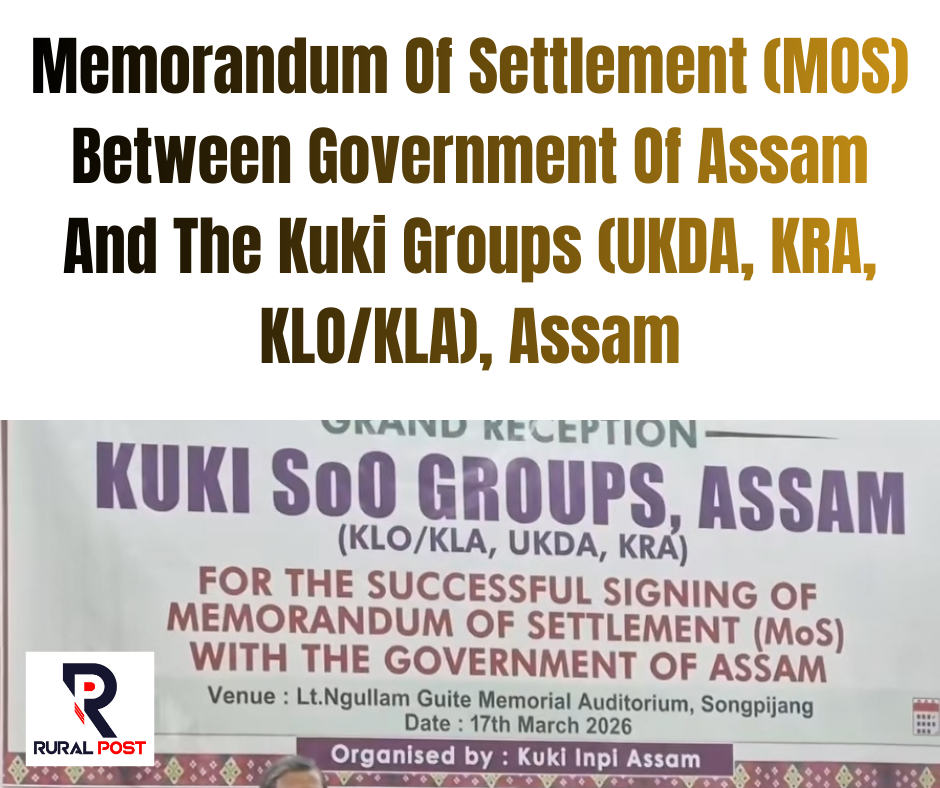
Memorandum Of Settlement (MOS) Between Government Of Assam And The Kuki Groups (UKDA, KRA, KLO/KLA), Assam
Signed On 15th March 2026 At Dispur, Guwahati
1. PREAMBLE
1.1. Kuki tribe is an important ethnic tribal community of Assam, mainly found inhabiting the districts of Karbi Anglong. Dima Hasao, Cachar, Karimganj and Hailakandi. There are more than 30 (thirty) sub-clans of Kuki tribe with a rich culture and tradition. Due to the remoteness and topography of the land inhabited by them, the community has been facing various social, economic and developmental issues for a long time. Although, the Government of India and the Government of Assam have been making concerted efforts to fulfil their aspirations, some youths of the community had formed armed outfits United Kukigam Defence Army (UKDA) in 2010, Kuki Revolutionary Army (KRA) in 2000 at Karbi-Anglong district and Kuki Liberation Organization (KLO)/ Kuki Liberation Army (KLA) in 1992/1993 in Dima Hasao district to fight against democratic Government with a view to fulfil their demands.
1.2. In a genuine effort to end the militancy, the Kuki armed groups in Assam laid down their arms in presence of the then Union Home Minister of India and the then Chief Minister of Assam in 2012. The Kuki SOO Groups of Assam consisted of Kukigam Defence Army (UKDA), Kuki Revolutionary Army (KRA) of Karbi Anglong autonomous district and Kuki Liberation Organization (KLO)/Kuki Liberation Army (KLA) of Dima Hasao, Assam. Accordingly, a Suspension of Operations (SOO) agreement was signed by the Kuki SOO groups with the State Government to resolve their long pending issues in an amicable way.
1.3. As part of this process, several rounds of tripartite talks were held between the representatives of the Government of India, Government of Assam and the Kuki SOO groups UKDA, KRA of Karbi Anglong and KLO/KLA of Dima Hasao to resolve their legitimate demands which resulted in an agreement of bringing a final solution and thus, the signing of this Memorandum of Settlement (MoS). As desired, suggested and mutually agreed upon for the purpose of preparing for the signing of the Memorandum of Settlement (MOS), all the Kuki SOO groups of Assam have come together under a single common platform named the “Kuki SOO Groups of Assam”. The signatory armed groups have agreed to abjure violence and join the peaceful democratic process as established by the Constitution of India and law of the land.
2. POLITICAL
2.1. A Kuki Welfare and Development Council (KWDC) shall be constituted by the Govt. of Assam with the objective of fulfilling the political, economic and educational aspirations; protecting, preserving and promoting social, cultural, linguistic and ethnic identities; and ensuring accelerated and focused development of the Kuki inhabited villages in Assam.
2.2. The Kuki Welfare and Development Council (KWDC) will have its headquarters in Guwahati.
2.3. An interim Council may be formed by the Government of Assam after the signing of this MoS with representation from all the Kuki SOO groups for such period, until regular elections are conducted.
2.4. The State Govt. will provide funds to the KWDC in the form of Grant-in-Aid or under any other appropriate Head of Account for developmental and welfare activities, keeping in view the population and geographical spread of the Kuki communities in the region.
2.5. The constitution and composition of the KWDC shall be as below, which may be amended as agreed upon by both parties with the following office bearers –
(a) Chairman
(b) Deputy Chairman
(c) Chief Executive Member
(d) Deputy Chief Executive Member
(e) Six Executive Members
(f) Six General Members
(g) Four Members nominated by the Govt. of Assam
2.6. Funds received from the state government and other sources shall be credited into KWDC account and disbursement will be made for the implementation of developmental and welfare schemes in the Kuki inhabited areas.
2.7. The fund will be subject to audit of the State Govt. audit authority like any other Govt Department.
3. POWER AND FUNCTIONS OF THE COUNCIL (KWDC)
3.1. The Council shall have the power to prepare its own budget annually to receive grants or funds under any other appropriate fund as decided by the State Government which shall be submitted for the approval of the State Government in the Transformation & Development (T&D) Department.
3.2. The KWDC shall receive funds from the State Government under Grant-in-Aid or any other appropriate Heads of Accounts for developmental and welfare works for Kuki inhabited villages and the members of Kuki communities across Assam.
3.3. The Council shall also have the authority to make proposals for various developmental projects under centrally sponsored schemes and central sector schemes including projects under NEC and NLCPR/ DONER for onward submission to the Central government or any other funding agencies through the state government and pursue the same. The Council shall function as an implementing agency for such projects, with due formalities and observance of existing financial rules.
3.4. The Council shall have the authority to formulate, execute and implement schemes within the funds provided under itsGrant-in-Aid.
3.5. The State Government will depute one officer with sufficient seniority as Secretary to the KWDC to co-ordinate with various departments of the state Govt as required, to manage the administration of the KWDC.
4. RELIEF AND REHABILITATION
4.1. The signatory armed group shall abjure the path of violence, surrender all types of arms/ammunition and disband their armed organisations within fifteen days of signing of the MoS and give formal press release in this regard. All camps occupied by these groups shall be vacated forthwith. Possession of any weapon after signing of the MoS shall be unlawful and it will be considered as a Criminal Act.
4.2. The armed groups have already submitted the lists of their cadres to Addl. DG, Special Branch, Assam at the time of laying down of arms. The names of such cadres shall be scrutinised and verified by the Screening Committee headed by Addl. DG, Special Branch, Assam, before their rehabilitation. Unverified cadres shall not be given any rehabilitation benefit.
4.3. The Committee headed by Addl. DG. Special Branch, Assam shall assess the rehabilitation needs of individual cadres based on age profile, educational qualification, general area of residence, etc. The Committee may also involve concerned departments of the State Govt. and successful entrepreneurs/NGOs in the process.
4.4. Necessary measures will be taken by the Govt of Assam to rehabilitate the cadres of the armed groups. Such measures shall include (i) lump sum payment of ex-gratia as per extant policy; (ii) funding economic activities through existing Govt. schemes relating to fisheries, piggery, organic farming, poultry farming, tea/rubber/indigo plantation, etc.; and (iii) trade/vocational/skill agro-based industries, development training based on locally available resources.
4.5. Efforts will be made to cover the cadres of armed groups under various on-going Govt. schemes for employment generation and other benefits as per norms and guidelines of the schemes,
4.6. Criminal cases registered against cadres of the armed groups for non-heinous offences during armed struggle will be withdrawn by Govt. of Assam as per procedure established by law. Criminal cases registered in connection with heinous offences will be reviewed on a case-to-case basis according to the existing policy on the subject.
4.7. Widow or legal heir of the expired cadre of Kuki (KRA, UKDA and KLO/KLA) from the existing list will be provided financial compensation of Rs. 2 Lakh after due verification.
5. CREATION OF NEW CONSTITUENCIES/MAC SEATS
5.1 As and when, the 125th Constitutional Amendment Bill is passed by the Parliament, in which the number of MAC/constituencies in the Sixth Schedule Autonomous Councils are proposed to be increased, the State Government shall discuss with all the stakeholders including KAAC and NCHAC, to decide on the following –
(a) Creation of at least 2 (two) MAC Seats in Karbi Anglong Autonomous Council (KAAC) exclusively for the Kuki Community.
(b) Creation of 4 new constituencies in Kuki majority areas under North Cachar Hills Autonomous Council (NCHAC)
6. COMPENSATION TO VICTIMS OF ETHNIC VIOLENCE
6.1. The Govt. of Assam, after due verification, will provide financial compensation of Rs. 1 (One) lakh to each of Next of Kin member of the Kuki community who lost their life in the ethnic violence, after due verification.
6.2. After due verification of records, the Govt. of Assam may provide financial compensation to the left-out displaced families of the Kuki communities affected during the ethnic violence 2003/2004
6.3. The Govt. of Assam will pursue with the Sixth Schedule Autonomous Councils (KAAC & NCHAC) in Hill areas, to provide land and other facilities for re-settlement of displaced families of ethnic violence of 2003/2004.
7. INFRASTRUCTURE/ DEVELOPMENTAL SCHEMES
7.1. KWDC will allocate funds, as may be deemed fit and required by KWDC, for all round development of the Kuki inhabited areas under the various schemes and also under the schemes of Govt of India and Govt of Assam.
7.2. KWDC shall endeavour to take initiatives of welfare and development schemes from the Illustrative List of schemes provided in the Annexure within the availability of its own budget.
8. Assam Police will organize pre-recruitment rallies for eligible cadres of Kuki armed groups, if any, as well as Kuki youths in Kuki inhabited areas of the State to facilitate them in the process.
9. A Joint Monitoring Committee shall be constituted with representatives of Home & Political Department, Transformation & Development Department Government of Assam, and the signatories of this MoS and few members of the civil society to monitor implementation of this Agreement.
The above Agreement is signed on in the presence of Hon’ble Minister of Assam and representatives of Home & Political Department, Govt. of Assam.
Representatives of fellowing organisations append their signature to this Agreement:
Jangngam Haokip, Chairman UKDA Assam
Jangtun Hangsing, Chairman KRA Assam
Kaiminthang Thangnew, President KLO/KLA. Assam
Janglen Kipgen, General Secretary UKDA, Assam
Lalsei Gangte, General Secretary KRA, Assam
Haolam Lunkim, General Secretary KLO/KLA, Assam
Ajay Tewari, IAS, Additional Chief Secretary, (Home & Political) Govt. of Assam
Signing of the Agreements is witnessed by Dr. Ranoj Pegu, Minister, School Education, Higher Education, Tribal Affairs (Plain) Departments, Assam
ILLUSTRATIVE LIST OF SCHEMES
Development of road connectivity and construction of all-weather, inter-connected village roads and bridges in the Kuki-inhabited areas to ensure better connectivity and development. Suggested roads are –
i. Diger Kuki Area Nivang to Purana Leikal via Monjang. Lhungjang Thingvom, Solpidong. Molkon, Khengjol. (Approx. 63 km).
ii. Borail Kuki Area Purana Leikul to NotunLeikul via Tumjang, Old Ngalsong, Gamvom, Pangmol, Molnom, Changpijang. Nomjang, Lasang (Approx. 93 km).
iii. Borail and Cachar Area – Doiheng to Songlhuh via CacharSongpijang. Twicham, Saitop, Lodi Kuki, Allephai, (Approx. 77 km), P.Leikul to Gamvom (Approx. 10 km); Ngente to Deiheng via Lodi Kuki, Saitop, Allelphai, Songlhuh, Twicham, CacharSongpijang (Approx. 83 km).
iv. Harangalan Kuki Area Songpijang to jolien via Mongon, Doniou, Lhanghol, Lower Bolsol. (Approx. 51 km).
v. Sangbar Kuki Area – Upper Bolsol to P. Taijol via Thuruk (Approx. 23 km).
vi. Borjan Kuki Area: a) Old Sehjang village to Saijang via Khonomphai, Joujang. Approx. 60 km; b)Saijang Bazar to Gosen village via Molhol village, 40 km approx. c) Saijang to Molnom via Khoken. 18 km. Approx. d) Old Sehjang to Pangmol via Thenjang, 60km.approx e) Khonomphai to Lhangkichoi via Pholjang, Chamling. 40 km. Approx. f) Saljang to Mollchang via Bungmol, Molbem, Saibol, Khengjang. 80 Imappox. g) Saljang to Laflui via Molsang. L. Gamhoi, Mongbung. 60 km. Approx. h) Saljang to Khoken via Tata Point, LK bosti. 20 km. Approx.
vii. Singhason Kuki Area a) 25 Mile Manja to Mollen via Gangjang, Kotion, Tulnomphai, Tuipajang, P. Taijol, N. Taljol, Sitpijang, Phaiphong 46 km approx. b) P. Taijol to L. Gamnom via Chonjang, Khaibung, Vongjang, Khonom 31km approx. c) Manja to Thenbung via Kholen, Mimbung, Govajang, Molcham, awllen 36 km. approx. d) Govajang to Jangnomphai via Phalphengjol. 26km.approx e) Siloni Picnic Spot Longsit to Jollen via Mongjang, Songjang, Bungjol. Songsang, 49 km. Approx. f) Mongjang to Zalenbung via Phailong, Nokjir, D. Lhangnom, Molphei, Thenbung 25 km approx. g) Siloni
Advancement of Kuki culture including establishment of cultural research centres, construction of tourist guest houses, and establishment of community halls –
i. Statues of Kuki Freedom Fighters should be installed at some prominent places of Kuki inhabited areas.
ii. Construction of Kuki Museum-cum-Library at a suitable place.
iii. The Chavang Kut Festival of the Kukis shall be recognised and declared as one of the official festivals of Assam.
iv. Establishment of Anglo Kuki War Patriots Memorial Park in a suitable place.
v. Preservation Pu Mangjahu, Freedom Fighter, Burial site at Cachar and erection of his statue at the same site.
vi. Construction of Tourist Guest House in the following locations: 1. L. Gamnom 2. Thenbung 3. Jalenbung 4. Vongjang 5. Jawllen 6. Bungjol 7. Nakejang B. Gosen 9. L. Gamhol 10. Saljang, 11. Guest House & Stone Stepping at Sielkal Peak 12. Guest House & Stone Stepping at Hempeuper Peak (Teikhangmol Highest Peak of Assam) Dima Hasao.
vii. Name of the village in details of Karbi Anglong Kuki Areas where community halls maybe constructed: 1. L. Gamnom 2. Vongjang 3. Sitpijang 4. Bungjol 5. Govajang 6. Mongjang 7. Khonomphai 8. Old Sehjang 9. Lhangkichoi 10. Joujang 11. Khoding 12. Saijang 13. New Sehjang 14. Haibung 15. Pholjang 16. Khoken 17. Mongbung 18. Molhol 19. Lailui 20. Bunglen 21. 1. Gamhoi 22. Gosen 23. Molsang 24. New Molsang 25. Changpijol 26. Boljang 27, Khengpibung 28. Nazareth 29. Pangmol 30. Lhanghol 31. C. Phailen 32. Molnom 33. Hengmol 34. Saibol 35. Lhangnom 36. Molbem 37. Kaizmai 38. Molding 39. Nomjang 40. Bangjang 41. L. K bosti 42. Chamling 43. Songgel 44. Vomli 45. Hengbung 46. Salemphai 47. Songjang 48. Molcham 49. Thenjol 50. Nakejang 51. Thenjang 52. L. Zougam 53. L. Govajang 54. Mongjang Borjan, 55. Kholen, 56. Bungjol, 57. Mimbung, 58. Tuithang, 59. Khalbung, 60. Chonjang, 61. Tuipajang, 62. Kotlen, 63. Phaijang, 64. Chalbung, 65. Maokot, 66. Leikot, 67. Phailong. 68. Thonbung. 69. Zalenbung.
V. Drinking water supply, sanitation, electrification of Kuki villages, cold storages for preservation of agricultural marketing products.
VI. Establishment of Police Stations/ Border Outposts at all feasible locations within Kuki-inhabited areas-
i. Police Out-Post to be set up at Monglang Vill. under Manja Police Station, P. Taijol Village under Manja Police Station, Saijang under Dillai Police Station and Sehjang under Bokajan Police Station.
ii. Border Outpost (B.O.P) at Chehlei& Lodi Kuki Village
VII. Financial support for income-generating schemes, including fisheries, piggery, organic farming, poultry farming, plantations and Micro, Small & Medium industries with a view to promote sustainable livelihoods and economic self-reliance of the Kukis in Kuki inhabited areas.
Picnic Spot Longnit to Leikot via Chalbung, Lhangnom, Maokot 15 km approx.
VIII. Dhanasiri Kuki area: Dhanasiri Railway station to Wakot via Thingpijang 7km approx.
IX. Diphu Kold Area a) Medical College to Lhanghot 3 km approx., b) Rongkimilumding road to DPC gaon via Thadou Veng. D. Molhoi. 3 km approx.
Medical/Health facilities such as establishment of PHCs/CHCs etc. –
i. Rural Hospital at Thingvom Village, Digger Kuki Area.
ii. Public Health Centres (PHCs) at Gamvum (P.O. Mahur), Lodi Kuki and P.Leikal, Tumjang (P.O.Mahur)
iii. Rural Hospital at P. Taijol, Singhason Kuki Area and Saljang Borjan Kuki Area.
iv. Public Health Centre (PIC) at Mongjang, Mimbung, Vongjang, MoulkhangMolsang, Molhol, Kholen, SongjangandKhonomphai.
Establishment of MOBILE HEALTH UNIT or MEDICAL MOBILE UNIT at the following villages: a) Thenbung b) Jalenbung c) Sitpijang d) Khonom e) L. Gamnom f) Phaijang, g) Govajang, h) Old Sehjang, i) Molsang j) Mongbung, k) Lailui I) Molhol m) Songphel, n) Kholen o) Bungjol.
Promotion of sports including sports training institutions, multi-facility Indoor/outdoor sports stadium, etc.
i. Establishment of Football Playground at 1. Thenhung 2. Chaibung 3. Mongjang 4. Salemphai 5. Tulnomphai 6. Khonom 7. N. Tatjol 8. Pholjang 9. Sitpijang 10. Kotlen 11. Bunglen 12. Kaimai 13. Hengmol 14. Molding 15. Lailui 16. Molkhang 17. Lhangkichoi 18. Khoding 19. Bungjol 20. Mongjang 21. Khaibung 22. Govajang 23. Chonjang 24. Hengbang 25. Gamnom 26. Songphel 27. Kholen 28. Mimbung, 29. Jangnomphai, 30. Molchain, 31. Phaljang
ii. Construction of Multi-facility Indoor/Outdoor Sports Stadia in the following Kuki inhabited areas of:
a. Dima Hasao: 1. Songpijang, 2. Lasang, 3. N. Leikul, 4. P. Leikul, 5. Thingvom, 6. Khongsai, 7. Lodi Kuki, 8. Nomjang
b. Karbi Anglong: 1. Mongjang, 2. Kholen, 3. Vongjang, 4. Salbol, 5. Molsang, 6. Sajjang, 7. Molhol, 8, Khonemphai, 9. Sehjangand 10. P.Taijol
c. Barrak Valley at 3 suitable places
d. Indoor Stadiums at Zawlien, Twipajang, Gangjang, Salemphai, Khaibung, Khonom, Moullen, Khengjang, Monghung, Molbem, Khoding, Changpijol, Thingpijang
iii. Establishment of Multipurpose Air-Conditioned Auditoriums – One at Mahur area and named after the Kuki Raja and Freedom Fighter Pu. ChengjapaoDoungelby and another one at Manja area and named after the Anglo-Kuki War Patriot Memorial.
VIII. Construction of Market Sheds at suitable places in the Kuki inhabited areas to promote trade and business and encourage tribal entrepreneurs.
i. At Dima-Hasao District –
a) P. Leikul Village
b) Changpijan Village
ii. At Karbi Anglong District –
a) P.Taijol Village
b) Saijang Village
IX. Establishment of Weaving and Craft centres at different locations to promote and encourage traditional weaving and crafts.
X. Establishment of a new Govt. Degree College, Industrial Training Institute (ITIs), Govt. Higher Secondary Schools, Govt. Upper Primary and Lower Primary Schools, Provincialisation of Schools and up gradation of eligible LP/ME schools to High School and eligible High school to Higher Secondary level in the Kuki inhabited areas.
i. Degree College at Manja, Mahur and Sangbar
ii. Establishment of ITI: a) Pangmol Villageb) Ssijang Village c) Gangjang Village
iii. Adult Education to be introduced in all the villages to eradicate illiteracy.
iv. Up gradation of Songpijang High School, Haflong and Thingvom High School to Higher Secondary School of Dima Hasao and Jonwllen ME School, Saijang, Saibol of Karbi Anglong as per NEP 2020.
v. Establishment of new Lower Primary Schools at 1. Khaibung 2. Phaijang 3. Khonom 4. Mollen 5. Govajang 6. Tuipajang 7. Thenbung 8. Salemphal 9. New Sehjang 20. Molnom 11. Lallui 12. Bunglen 13. Pholjang 14. Khengjang 15. Bungjol 16. Kholen.
I. Setting up of hostels for students in Guwahati, Silchar, Dibrugarh and other suitable locations within the state.
II. Setting up of Student Hostel cum Coaching Centres for various competitive exams at Diphu, Manja, Mahur, Sukhanjan, Halflong, Silchar, Guwahati.
III. Kuki to be included in the list of MIL subjects up to Elementary level.
IV. Establishment of Kuki Study Centres in Kuki inhabited areas.
vi. Establishment of Centre of State Universities in Kuki inhabited areas