
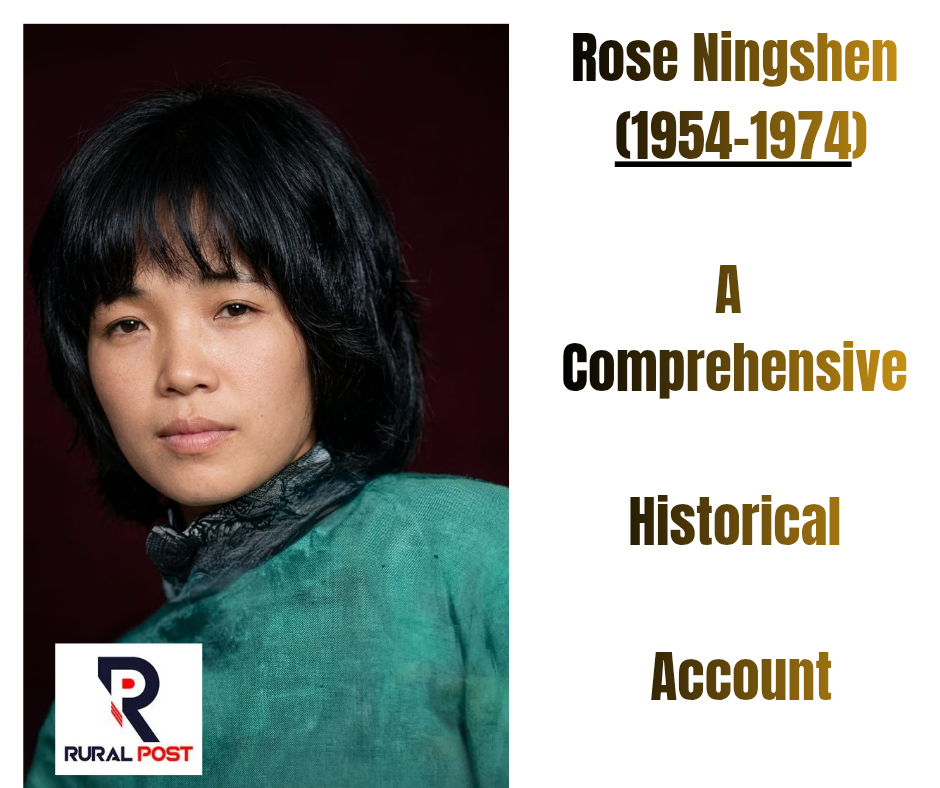
Rose Ningshen, a Tangkhul girl of Ngaprum (Kumram) village in Ukhrul district (now Kamjong District) was gang raped in the night of 4 March 1974 by the officers of 95 Border Security Force. 19 years old, Rose committed suicide on 6 March 1974.
Her sacrifice brought Tangkhul Women to come together and form the Tangkhul Shanao Long (Tangkhul Women’s League).
EARLY LIFE AND FAMILY BACKGROUND
Rose Ningshen was born on February 2, 1954, in Ngaprum (Kumram) Village, located under Phungyar Sub-division in Ukhrul District (now Kamjong District), Manipur. She was the third child of Angti Ningshen and Pinu Ningshen. According to family interviews conducted decades later, her siblings included a sister named Azingla and a brother named Angam. No public birth certificate or official record from the period has been found, and all available information about her early life comes from retrospective newspaper reports and community accounts published in later years.
THE MARCH 1974 INCIDENT
In early March 1974, the 95th Battalion of the Border Security Force conducted operations and grouping of two villages, namely Grihang and Ngaprum (now Kumram). During this operation, many women were raped and molested, while men were brutally tortured. Houses were robbed of valuable items.
According to accounts, on March 4, 1974, a young woman named Rose Ningshen was raped by officers of the 95th BSF Battalion. Some sources state she was raped by two officers identified as Captain Niki and Major Bomdi. Other sources identify the officers as Deputy Commander Pundir and Assistant Commandant Negi. Some accounts indicate she was raped repeatedly by three BSF officers.
Speaking to The Sangai Express in 2017, Rose’s younger sister Azingla provided this account: “On March 4, 1974, youth of Kumram village were practising songs for a big event which was to take place in the village in April. Suddenly, more than 500 BSF personnel led by its officers arrived in the village in search of Naga insurgents.” According to Azingla, the officers singled out four young women to assist with accommodation. Rose was among them. “The three other females were asked to fetch other bedding material while Rose was asked to stay back for other tasks. Taking advantage of the situation, Rose was raped by two BSF officers.”
Unable to bear the shame and humiliation, Rose died by suicide on March 6, 1974. Azingla recalled: “That day, my parents had gone for shrimp fishing. It was at around 9 am when we found her lifeless body hanging from the kitchen ceiling.” Rose was 19 to 20 years old at the time of her death.
AFTERMATH AND INSTITUTIONAL RESPONSE
Following her death, the family buried Rose’s body in their family garden according to customary practices. Approximately one week later, police arrived and exhumed her body to conduct a post-mortem examination. The family never received the post-mortem report.
Rose’s brother Angam Ningshen was summoned for an inquiry into his sister’s death. He was taken to BSF headquarters in Churachandpur district and Pallel in Chandel district for questioning. No charges were ever filed against the accused officers. The only financial assistance the family received was a travel allowance of Rs. 15 given to Angam for his expenses during the inquiry.
Azingla later reflected on the atmosphere of fear that prevented justice: “Villagers were scared to raise their voice against the security personnel as they would torture the villagers. While conducting an operation, they would take the villagers along.”
According to the Tangkhul Shanao Long, Rose’s case was “only one of the thousands of incidents” of abuses during the counter-insurgency.
WOMEN’S MOBILIZATION AND THE BIRTH OF TANGKHUL SHANAO LONG
Rose’s death galvanized the Tangkhul community. News of the incident spread through local publications including Lamyanba and the Pan Manipur Youth League journal.
On April 9, 1974, a public meeting was called to show solidarity with all victims of brutalities inflicted by Indian security forces. Thousands of people representing all Tangkhul villages held a peace rally and gathered at Tangkhul Long Ground in Ukhrul. A memorandum was submitted appealing to the Prime Minister for justice.
Realizing that a platform for women was needed to voice their grievances, Tangkhul women came together and formed an organization on May 8, 1974. Seven hundred and three women from 90 villages resolved to form this organization. Initially called the “East District Women Association,” it was later renamed and registered as Tangkhul Shanao Long, which means “Tangkhul Women’s League.”
Since 1975, the organization has observed March 4 as its day every year in honor of Rose Ningshen.
The Tangkhul Shanao Long was formed specifically to address the hardships and mistreatment of women by security forces. One researcher has noted that Rose’s case was “just one of the thousands of incidents” but it “became the driving force for the formation of an all Tangkhul women organisation.”
Tangkhul women have traditionally been known as “pukreila,” meaning “peacekeeper.” A pukreila is traditionally a woman who has married outside her clan or village, and such women would intervene and take the role of ambassador in settling disputes through peaceful means. This traditional role informed the character and mission of the Tangkhul Shanao Long from its founding.
THE CONTROVERSY SURROUNDING THE SUICIDE NOTE
A significant point of controversy exists regarding whether Rose left a suicide note.
THE CLAIM OF A LOVE LETTER
Some sources have claimed that Rose wrote a suicide note in the Tangkhul dialect addressed to her boyfriend. According to these accounts, the note was translated into Manipuri and published by the Pan Manipur Youth League in 1993 under the title “A Timeless Love Letter.” This Manipuri version was later translated into English by R.K. Smejita and published in a 2010 publication by the Committee for the Protection of Democratic Rights.
The English translation of this purported letter reads:
“In this world which is filled with sin, my existence is shameful and disgraceful for our family. Today is my last day and nobody can save me. When Amei returns home, tell him about the incident. Justice will never be delivered as they (officers) will get away with it. My brother, do not cry and tell the same to mother, father, brothers and sisters. We shall all meet in heaven.”
Questions About Authenticity
Serious questions have been raised about the authenticity of this letter:
First, the Tangkhul Shanao Long has stated that they do not have any such letter in their records and are not aware of its existence. This is significant because the organization was formed directly in response to Rose’s death and has been the primary guardian of her memory.
Second, the timeline raises questions. If Rose wrote a suicide note in 1974, why did it only come to light in 1993 through a Manipuri translation, and then again in 2010 through an English translation? Why were the people who bravely challenged security forces’ atrocities at the time not aware of this letter’s existence?
Third, some critics point out that the language and sentiments expressed in the letter seem sophisticated for a 19 year old village girl who was unexposed to the wider world and draconian laws like AFSPA. The letter appears to reflect experiences and awareness beyond what she would likely have possessed.
Critics argue that this highly romanticized love letter, as translated by the Pan Manipur Youth League in 1993, may be a fiction that no one has been able to prove exists. They contend that using this narrative to romanticize a very traumatic experience for Nagas into something that justifies a particular idea of common sufferance is an insult to Rose’s memory.
This is not to take away from the fact that Rose suffered and ultimately took her own life. The core facts of the incident remain undisputed: Rose was raped by BSF officers and died by suicide, and her death catalyzed the formation of the Tangkhul Shanao Long.
TANGKHUL SHANAO LONG’S GOLDEN JUBILEE (2024)
In November 2024, the Tangkhul Shanao Long celebrated its Golden Jubilee in Ukhrul under the theme “Reminiscing for the Future.” The four-day celebration from November 12 to 15, 2024, drew thousands of attendees from across the Tangkhul domain, including delegates from Tangkhul villages in Myanmar.
The event explicitly honored Rose Ningshen as the foundational figure of the movement. Tangkhul Shanao Long President Thingreiphi Lungharwoshi stated:
“This is a historic moment for me, and I extend heartfelt respect to our past leaders for their sacrifices. Today, we celebrate because of the courage of women like Rose of Kumram, Luingamla Muinao of Ngainga, and many others who endured silently yet powerfully.”
Several significant ceremonies marked the occasion. Enoli Masophi Nakhedei, Tangkhul Shanao Long’s first president, unveiled the Golden Jubilee flag. Enoli Changshila Luithui released Tangkhul Shanao Long’s historical account. Dr. Sarah Kashung unveiled the Jubilee monolith, and Pamchuila Zimik released a commemorative souvenir.
The Golden Jubilee also took on contemporary political significance. Thousands participated in a “Save the Peace” rally to demand the settlement of the Naga political issue and the repeal of the Armed Forces Special Powers Act from the Naga homeland. The gathering also voiced opposition to the proposed fencing of the India-Myanmar border, which would separate Tangkhul communities on both sides.
CULTURAL LEGACY AND COMMEMORATION
The Rose Kashan
In the aftermath of Rose’s death, Tangkhul women weavers created a traditional mekhela called the “Rose kashan” in her memory. This weave was designed specifically to dedicate the textile to her memory, marking in the Tangkhul tradition the culture of human rights abuse that had come with the conflict.
This tradition of commemorative weaving continued with other victims. In 1986, following the fatal shooting of Luingamla from Ngainga village, who was also sexually attacked by security forces, the Luingamla kashan was designed and promoted by the Tangkhul Shanao Long in the 1990s as traditional wear for Naga women. The red, white, green, and black kashan serves as a reminder of the sexual oppression faced by Naga women, with the story woven through generations.
Musical Tribute
The Imphal-based folk-rock band Imphal Talkies created a song titled “Song For A Rose” based on Rose’s story. The song was written in 2010 and recorded live in 2015. According to the band’s album notes, the song is based on the true story of Rose Ningshen.
Dramatic Works
A dramatist wrote a play titled “Chanu Rose Sadum Phakkhrabee Nupi Amagee Tentha,” which means “Rose’s Lamentation,” about her story, preserving her memory through theatrical tradition.
Memorial Stone
On March 6, 2013, the 39th anniversary of her death, villagers and the Tangkhul Shanao Long erected a memorial stone at Rose’s grave in the village cemetery to honor her memory. Azingla explained: “We wanted Rose to rest at least in a better place. So the villagers under the guidance of Tangkhul Shanao Long contributed money and set up a memorial stone on March 6, 2013 at her graveyard.”
Official Recognition
During the Tangkhul Shanao Long Golden Jubilee celebration in 2024, leaders publicly acknowledged Rose’s foundational role. MLA Ram Muivah stated that Tangkhul Shanao Long was formed through “tragic circumstances in 1974,” and that “Rose from Kumram village and Luingamla of Ngainga village sacrificed their lives due to atrocities inflicted by the Indian Army. This subsequently led to the formation of the Tangkhul Shanao Long to safeguard women’s rights and to further the collective fight for justice.”
SCHOLARLY AND HISTORICAL CONTEXT
Rose Ningshen’s case has been documented in scholarly works on Manipur history as a seminal moment in the state’s human rights history. Researchers note her case as an example of how a single atrocity could become a driving force for collective action and the formation of civil society organizations.
The case represents the intersection of gender-based violence, impunity of security forces, and indigenous women’s organized resistance, a pattern that would recur throughout Manipur’s modern history.
CONCLUSION
As of 2026, justice has never been delivered for Rose Ningshen. The accused officers faced no consequences, and her family never received compensation or the post-mortem report. Her sister Azingla has stated that the family believes “justice will never be delivered.”
While questions remain about the authenticity of the romanticized suicide note that has circulated since 1993, the core facts of Rose’s story are not in dispute: she was a 19-year-old Tangkhul woman from Ngaprum village who was gang raped by BSF officers on March 4, 1974, and died by suicide two days later. Her sacrifice brought Tangkhul women together to form the Tangkhul Shanao Long on May 8, 1974, an organization that continues to advocate for women’s rights and justice five decades later.
Her memory lives on through multiple cultural forms: woven into the Rose kashan, sung in songs, performed in plays, and etched in stone at her grave. As Tangkhul Shanao Long President Lungharwoshi affirmed at the Golden Jubilee, the celebration was possible “thanks to women like Rose of Kumram” who “endured in silence” but whose sacrifice catalyzed a movement that continues to shape Tangkhul society.
Markson V Luikham
(The views and opinions in this article are solely those of the author and do not necessarily reflect the official stance of Rural Post)