
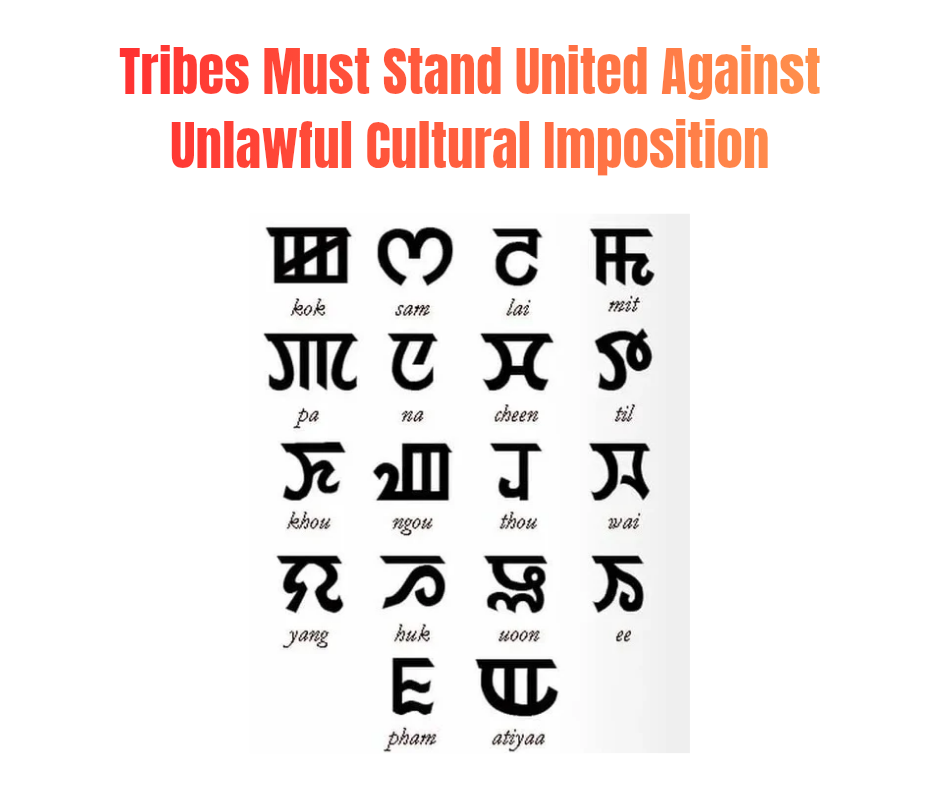
On 24 February 2026, the Meetei Erol Eyek Lionasillol Apunba Lup (MEELAL) reportedly announced that all vehicles plying in Manipur must display registration numbers in Meetei Mayek script by March 2026, failing which action would be taken by the organisation.
This announcement has no force of law. It is legally untenable and socially irresponsible. Such unilateral diktats by non-state actors have the potential to inflame tensions and disturb the fragile communal peace in Manipur. The state government must act immediately to prevent the implementation of any unlawful directive that threatens peace and public order.
Legal Position: What the Law Clearly States
Under the Motor Vehicles Act and the Central Motor Vehicles Rules, particularly Rules 50 and 51, vehicle registration numbers must be displayed in English letters (Latin script) and Arabic numerals. These provisions mandate uniformity across India and prohibit the use of non-standard fonts, regional scripts, or stylised lettering.
Further, registration plates must conform to High-Security Registration Plate (HSRP) specifications. Tampering with or altering registration plates is a punishable offence. No private organisation has the authority to mandate changes to vehicle registration formats. Any attempt to enforce such a directive would amount to encouraging the violation of central law.
The Transport Department must immediately clarify the legal position, summon the organisation responsible for the announcement, and, if necessary, initiate appropriate legal proceedings to prevent unlawful enforcement.
A Pattern of Cultural and Political Assertion
This recent development cannot be viewed in isolation. It forms part of a broader pattern of escalating assertion by sections of the Meitei community that many tribal communities perceive as hegemonic. Over the years, demands have included, expansion of recognition relating to Manipuri/Meitei language and script, the ongoing movement seeking inclusion of the Meitei community in the Scheduled Tribe (ST) list, policies and narratives that, in the perception of tribal communities, undermine constitutional protections for the Hill Areas. The demand for ST status is viewed with particular concern by tribal communities. Under the special constitutional protections applicable to Manipur, including safeguards associated with the Hill Areas under Article 371C, tribal land ownership has historically been protected. Many fear that granting ST status to Meitei community could weaken these protections and open tribal lands to demographic and economic pressures.
The Growing Sense of Alienation
For many tribal communities, including Naga and Kuki groups residing in the hill areas, repeated instances of perceived cultural imposition, political marginalisation, and threats to land security have created a profound sense of alienation. While some tribal voices have supported coexistence within Manipur through substantially empowered Autonomous District Councils or enhanced constitutional arrangements, the cumulative effect of recent developments has led many to reconsider their political future. The idea of a separate administrative arrangement, whether as a Union Territory or statehood, is increasingly being discussed as a defensive measure to safeguard identity, land, and governance rights. This growing sentiment should not be ignored. It is not born out of hostility, but out of fear of cultural erosion and political vulnerability.
The Role of the State Government
One of the most serious concerns in Manipur today is administrative inaction. When private organisations issue unlawful directives and the state fails to respond promptly, it creates a dangerous atmosphere of selective enforcement and lawlessness. The Chief Minister and the state administration have a duty to publicly clarify that vehicle registration formats are governed solely by central law, prevent any unlawful enforcement attempt by non-state actors, and take legal action where necessary to uphold the rule of law. Prompt action can prevent untoward incidents. Silence or delay, on the other hand, risks emboldening further unilateral assertions by non-state actors.
A Call for Unity and Constitutional Protection
The issue at hand is not about language or culture alone. India’s strength lies in its diversity, so is the same with Manipur. Every community has the right to preserve and promote its language and script. However, no community has the right to impose its cultural identity through coercion or threats. The tribes of Manipur must remain united in defending their constitutional safeguards, land rights, cultural autonomy, and the rule of law. At the same time, all communities must reflect on the long-term consequences of actions that deepen divides.
Peaceful Coexistence in Manipur
Peaceful coexistence in Manipur can survive only if it is based on equality, legality, and respect, but not dominance, intimidation, or unilateral declarations. A new government has been installed with two Deputy CM from the tribes. It is now their onerous responsibility, sitting alongside the Chief Minister, to assuage the fears of the tribes that the government is in total control of the situation and will not allow some private organisations to call the shots.
Ngaranmi Shimray
New Delhi
(The views and opinions in this article are solely those of the author and do not necessarily reflect the official stance of Rural Post)