
“The language is the heart of our culture; it holds our thoughts, our way of seeing the world. It’s too beautiful for English to explain.” An Anishinaabe (Potawatomi) Elder; Quoted by Robin Wall Kimmerer, Braiding Sweetgrass.
“To name the world is to change it.” Paulo Freire, Pedagogy of the Oppressed.
The history of colonial encounters around the world has shown that the physical subjugation of a people is preceded by linguistic acts—the population is defined and classified, rivers are renamed, places are redescribed; a reorganisation of what things are called, and therefore of what they are allowed to mean. Thus linguistic acts become a central mechanism of conquest.
The doctrine of terra nullius—”empty land”—to justify dispossession of indigenous peoples’ territories was a linguistic act. Because the land was not named and organised according to colonial vocabulary, it did not belong to the indigenous communities who already named, governed, and inhabited it. As such, the absence of a language, and the system of governance on which it was based, that was not recognisable to the colonial forces became the legal ground for dispossession of land.
We can see similar logic operating even in our own backward. The administrative reorganisation of indigenous peoples spaces such as the redrawing of boundaries and the naming of districts is being done through a linguistic order and logic that is alien to indigenous peoples’ conception of identity, and their relationship to their own lands and territories. In Manipur, consider the forest department’s classification of many Naga community forests as being under its ownership and control just simply because the concept of collective ownership of land, and their names, is alien to the existing legal regime. Many instances of places, rivers, and mountains known in official documents as other than their indigenous names abound. It does not stop there; even people are being sought to be recategorised.
These are not innocent bureaucratic conveniences but are acts of asserting hegemonic control and exercising new forms of subjugation. To give a territory a new name is to claim it; to classify a community under a new administrative category is to dissolve its prior spatial identity into a colonial one. It is in this context that for indigenous self-determination movements which are innately grounded upon issues of lands and territories, it is crucial to identify and understand the link between language and space.
Linguistic and cognitive sciences have established, with considerable evidence, that language does not merely label or describe a pre-existing spatial world but it also structures the way spatial relationships are perceived, categorised, and navigated. And different languages encode spatial relationships differently.
Dr. Lera Boroditsky, a cognitive scientist and influential proponent of linguistic relativity noted of Kuuk Thaayorre, a language spoken by less than 300 individuals of the Thaayore people who live on Australia’s Cape York Peninsula of Queensland, that in this language there are no words for “left” and “right,” and instead cardinal directions—north, south, east and west—are used to relate ones position or the placement of an object. So, she comments, for instance in Kuuk Thaayorre one would say, “There’s an ant on your southwest leg. Or, move your cup to the north-northeast a little bit.”
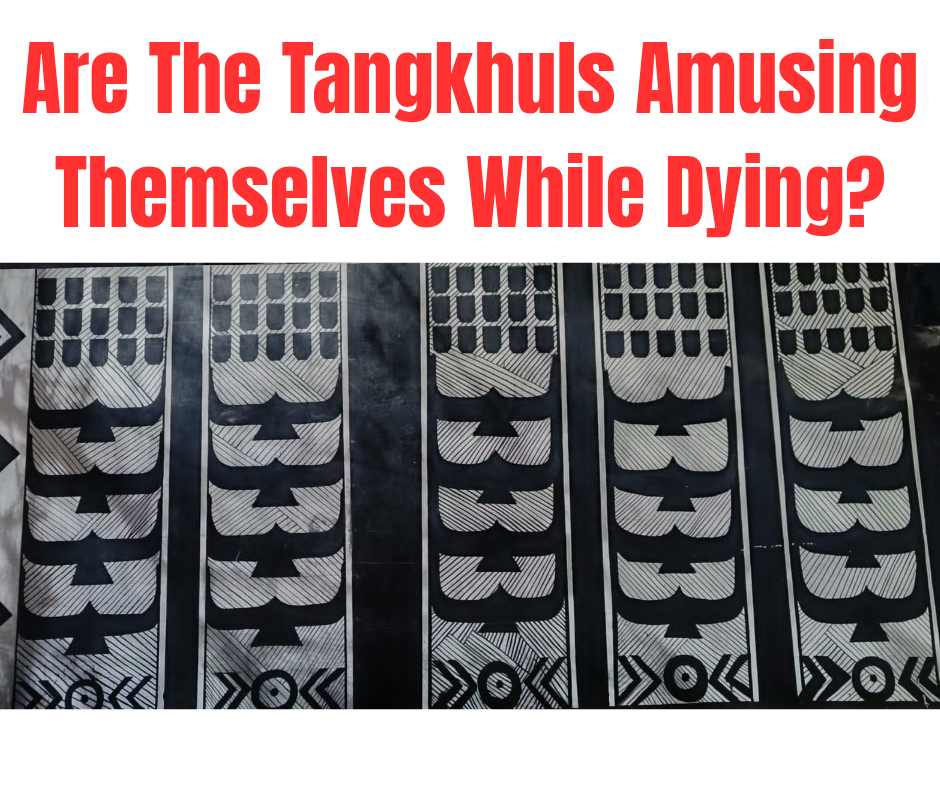
Similarly in the languages of the Tzeltal Maya, spatial relationships are encoded by reference to the slope of the land itself: uphill and downhill, rather than left and right. In the languages of many Pacific islanders, orientation is given relative to the sea, reflecting a relationship to coastal geography that is simultaneously ecological and linguistic. Among, Naga tribes as well, spatial orientation is often used. For instance, among the Tangkhul Nagas, a common way of greeting while meeting someone is, “Shangurala?” and “Tāurala?” According to the context, these can be translated as “Are you going north?” or “Are you going uphill?” and “Are you going south?” or “Are you going downhill?”.
These are not mere lexical differences. They are different ways of exhibiting how different people inhabit their world and spatial imaginations are encoded in their grammar of daily speech. As such, when languages are suppressed, it does not merely remove a communication system. It dispossess the people of their tools for navigating, understanding, and relating to a particular geography and other abstract ideas associated with it. By replacing indigenous spatial ontologies—the manners and ways in which a community understand what space is and was, who it belongs to, and how it is and was to be used—drastically deprives them of the most intimate means of belonging to their own land. To make a people unable to describe their own geography in their own terms is to make them, in a profound sense, alien in their own landscape.
This has a far-reaching impact on a people’s understanding of freedom, equality, justice, and rights. Among indigenous communities, these concepts are not abstract entitlements held by individuals independent of place. They are relations between communities and specific territories—relations of inhabitation, stewardship, spiritual connection, and governance that are inseparable from particular landscapes, rivers, forests, and ancestral sites.
Thus, the Naga peoples’ struggle for self-determination cannot and should not forget their own geographical vocabularies—names for hills, rivers, and territories that reflect the shared history of its people, their collective memory, and ancestral unity. They encode values that the modern state’s cartographical narrative can never fully comprehend or capture. It is for this reason that the administrative artificial boundaries drawn through lands and territories of the Nagas which had deeply divided the shared Naga territorial memory continue to be central to the struggle.
The relationship between language and self-determination is not merely symbolic or expressive but structural, spatial, and juridical. Language in self-determination movements is simultaneously a means of mapping territory, a technology for articulating rights, and a tool through which justice, equality, is conceived and demanded. Most importantly, language should not merely be a medium of communication but of how the community collectively remembers and understand ideas of freedom, equality, justice, rights, and their respect for, and relationship with their lands, territories, and natural resources.
Chingya Luithui
Ukhrul
(The views and opinions in this article are solely those of the author and do not necessarily reflect the official stance of Rural Post)