
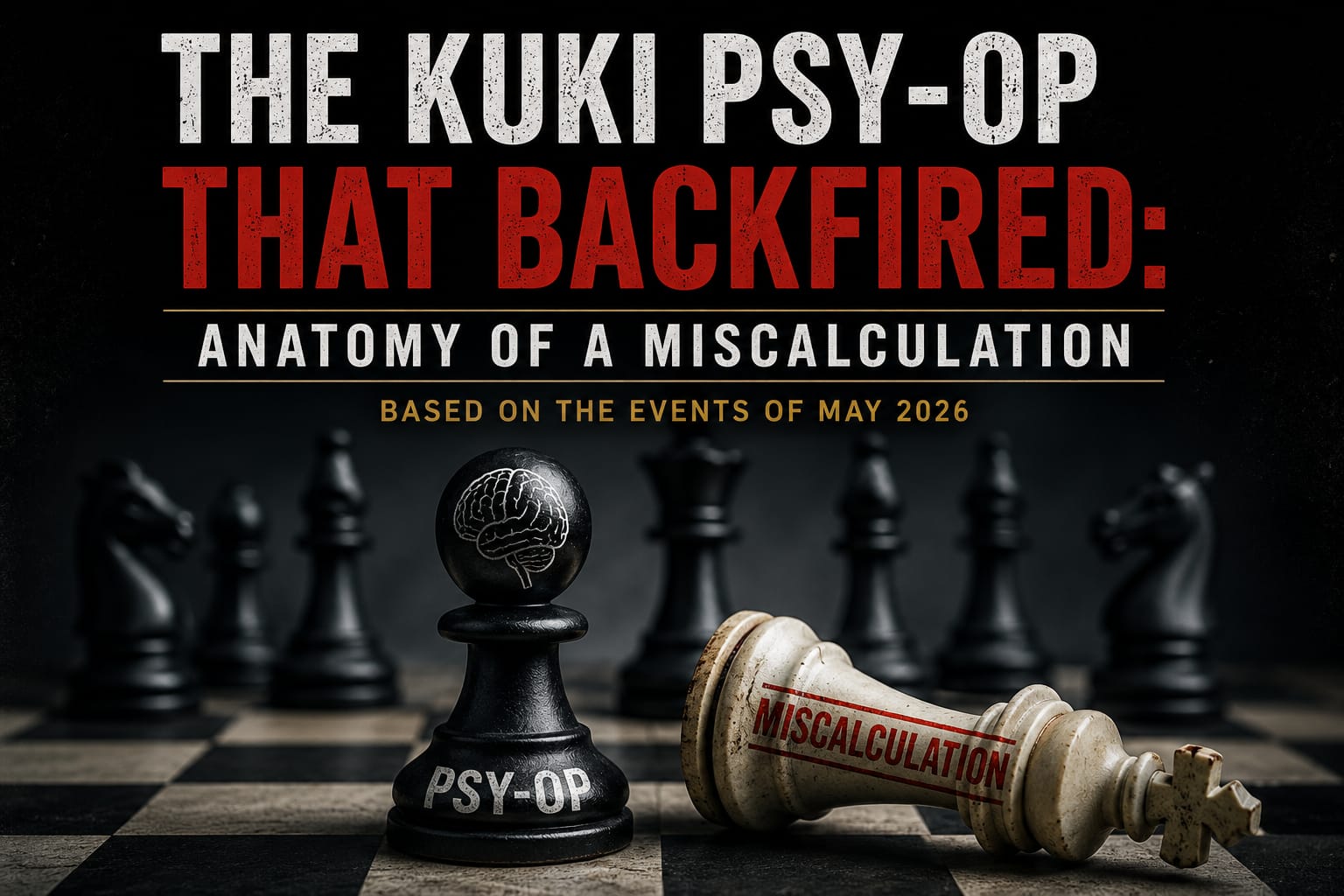
𝗧𝗵𝗲 𝗞𝘂𝗸𝗶 𝗣𝘀𝘆‑𝗢𝗽 𝗧𝗵𝗮𝘁 𝗕𝗮𝗰𝗸𝗳𝗶𝗿𝗲𝗱: 𝗔𝗻𝗮𝘁𝗼𝗺𝘆 𝗼𝗳 𝗮 𝗠𝗶𝘀𝗰𝗮𝗹𝗰𝘂𝗹𝗮𝘁𝗶𝗼𝗻
𝑨 𝑪𝒐𝒎𝒑𝒓𝒆𝒉𝒆𝒏𝒔𝒊𝒗𝒆 𝑨𝒏𝒂𝒍𝒚𝒔𝒊𝒔 𝑩𝒂𝒔𝒆𝒅 𝒐𝒏 𝒕𝒉𝒆 𝑬𝒗𝒆𝒏𝒕𝒔 𝒐𝒇 𝑴𝒂𝒚 𝟐𝟎𝟐𝟔
𝗪𝗵𝗮𝘁 𝗶𝘀 𝗮 𝗣𝘀𝘆‑𝗢𝗽?
In military doctrine, a psychological operation (PSYOP) is a planned campaign of activities designed to convey selected information and indicators to a foreign target audience, in order to influence their emotions, motives, objective reasoning, and ultimately the behaviour of governments, organisations, and individuals. It is warfare by narrative. The objective is not to win a battle. It is to win the story of the battle before the first shot is even investigated.
On 13 May 2026, between Kotzim and Kotlen villages in Kangpokpi district, the Kuki militant machinery launched a PSYOP of catastrophic proportions. It has backfired so completely that it has isolated the Kuki political project from its own Thadou constituency, exposed its propaganda apparatus, and placed the Deputy Chief Minister of Manipur at the centre of a scandal that now demands international scrutiny.
𝗧𝗵𝗲 𝗚𝗿𝗮𝗻𝗱 𝗦𝘁𝗿𝗮𝘁𝗲𝗴𝘆: 𝗪𝗵𝘆 𝗧𝗵𝗶𝘀 𝗣𝘀𝘆‑𝗢𝗽 𝗪𝗮𝘀 𝗟𝗮𝘂𝗻𝗰𝗵𝗲𝗱
The Kuki political project has long sought to reframe the conflict as a “Tangkhul‑Kuki war.” This is not accidental framing. It is a deliberate strategy with a precise objective. For decades, the NSCN‑IM has been locked in peace negotiations with the Government of India under a ceasefire that has been repeatedly extended. Kuki militants have watched these talks with frustration, because a successful Naga political settlement would bury their own territorial claims under the weight of a recognised Naga entity.
The Kuki strategy therefore has been twofold: first, to drag the NSCN‑IM, which they mistakenly characterise as a “Tangkhul‑led organisation,” directly into the conflict; and second, to paint the NSCN‑IM as a terrorist outfit that should not be negotiating with Delhi. By engineering an atrocity and pinning the blame on the NSCN‑IM, the Kuki militants aimed to force the Government of India to abrogate the ceasefire agreement and the decades‑long peace process that has defined the Indo‑Naga political dialogue. The Kuki Students’ Organisation protest at Jantar Mantar on 16 May 2026 demanded precisely this: the abrogation of the ceasefire agreement with the NSCN‑IM.
Simultaneously, the Kuki militants sought to exploit the existing divisions between the NSCN‑IM and the Zeliangrong United Front (ZUF). For years, Kuki propaganda has attempted to manufacture a “ZUF‑Kamson” faction that does not exist, repeatedly linking it to the NSCN‑IM as a “proxy force.” The ZUF itself has categorically denied the existence of any faction called “ZUF Kamson” and accused the NSCN‑IM of misusing its name. By naming both the NSCN‑IM and this phantom “ZUF‑Kamson” faction in their accusations, the Kuki operatives hoped to achieve three things simultaneously: paint the NSCN‑IM as a terrorist organisation, drive a wedge between the Tangkhul and Zeliangrong Nagas, and drag the Assam Rifles into the conflict by framing the violence as “NSCN‑IM terrorism.”
The Assam Rifles dimension is critical. The Kuki militants understood that if the NSCN‑IM could be framed for a high‑profile atrocity, the cold‑blooded murder of three Christian church leaders, the security forces would be compelled to act against the NSCN‑IM. This would rupture the fragile peace process and potentially reignite full‑scale conflict between the NSCN‑IM and the Indian state, a conflict from which the Kuki militants could extract maximum territorial advantage.
𝗧𝗵𝗲 𝗕𝗹𝘂𝗲𝗽𝗿𝗶𝗻𝘁: 𝗔𝗺𝗯𝘂𝘀𝗵, 𝗕𝗹𝗮𝗺𝗲, 𝗔𝗯𝗱𝘂𝗰𝘁, 𝗣𝗿𝗼𝘃𝗼𝗸𝗲
The plan was multi‑layered. First, ambush and kill the three Thadou Baptist leaders on a road that runs through territory firmly under Kuki militant control, where, as the United Naga Council has stated, “no infiltration of non‑Kuki armed groups is possible.” The victims were carefully chosen. Rev. Dr. Vumthang Sitlhou had publicly rejected the “Kuki‑Zo Flag” hoisting on 9 May, was a prominent voice for distinct Thadou identity, and had been leading reconciliation efforts across ethnic lines. His killing served multiple purposes: it eliminated a Thadou leader who refused to be subsumed under the Kuki political label, and it provided the perfect “Christian martyrdom” narrative to weaponize internationally.
Second, within hours of the ambush, the Kuki Inpi Manipur (KIM) issued a condemnation naming the ZUF‑Kamson group and the NSCN‑IM as perpetrators. The United Naga Council later revealed that the KIM statement carried the date “6/5/2026,” seven days before the ambush took place. No corrigendum was ever issued. This confirms, beyond reasonable doubt, that the accusation was pre‑drafted, waiting only for a body to name. It was not a response to an incident. It was a script waiting for its cue.
Third, to manufacture evidence of Naga involvement, Kuki militants abducted 18 Naga civilians from Leilon Vaiphei, a Kuki village, as they travelled to a wedding. This served a dual purpose: it provided cover for the original crime by creating chaos, and it gave Kuki propagandists a “hostage crisis” to attribute to Naga groups. The women were later released; the six men were separated and, according to intelligence reports, killed the same night. Their bodies remain missing.
Fourth, to seal the narrative, the Kuki Students’ Organisation Delhi and NCR staged a protest at Jantar Mantar on 16 May, demanding the abrogation of the NSCN‑IM ceasefire, while the global Kuki propaganda machinery flooded social media with the message that “Tangkhul‑led NSCN‑IM” had murdered Christian leaders. The Naga Students’ Union Delhi described the protest as a desperate attempt to “mask the blood‑stained hands of those Kukis implicated in the killing of Thadou Church leaders.”
𝗪𝗵𝗲𝗿𝗲 𝘁𝗵𝗲 𝗣𝘀𝘆‑𝗢𝗽 𝗕𝗮𝗰𝗸𝗳𝗶𝗿𝗲𝗱
This carefully constructed operation has collapsed under the weight of its own contradictions.
First, the Thadou community did not play its assigned role. The Thadou Inpi Manipur promptly described the slain leaders as “Thadou Martyrs” and firmly rejected attempts to label them as “Kuki.” This was not a minor rebuke. It was an act of defiance by a community that has long resisted absorption into the Kuki‑Zo political construct. The entire propaganda value of the operation depended on framing the victims as “Kuki” victims of “Naga terrorism.” When the Thadou community refused to accept that framing, the narrative collapsed at its foundation.
Second, the pre‑dated condemnation letter exposed the machinery. The revelation that KIM’s statement was dated seven days before the ambush is not a procedural error. It is forensic evidence of premeditation. It tells the world that the accusation was prepared before the crime was committed.
Third, the cross‑border dimension has backfired. On 7 May 2026, just six days before the ambush, the KNA‑B from Myanmar had already attacked Naga villages in Kamjong district, burning homes and using drones. The Kuki propaganda narrative that “Nagas are the aggressors and Kukis are the victims” was already collapsing under the weight of these cross‑border incursions. The ambush on the Thadou leaders, carried out in territory where Kuki militants maintain checkpoints and tax collection gates, only confirmed what observers already suspected.
Fourth, the confession, if verified, is a catastrophe. Intelligence reports indicate that Semtinthang Kipgen, alias Thangboi, Chairman of KNF(P) and husband of Deputy Chief Minister Nemcha Kipgen, confessed before the DGP of Assam Rifles in Shillong that the six Naga hostages were killed on the night of 13 May, driven by what he allegedly described as “out of control anger.” Whether this confession is confirmed or denied, the very fact that it has entered the intelligence stream has already inflicted irreparable damage. The Deputy Chief Minister, who had publicly condemned the ambush as a “barbaric act of violence,” now faces the unanswerable question: what did she know, and when did she know it?
Fifth, the political isolation of the Kuki project is now visible to all. As India Today NE reported on 23 May, “The Kuki political edifice is trembling under the weight of its latest miscalculations. The ambush on Thadou church leaders in Kangpokpi on May 13, 2026, followed by the taking of Naga hostages by Kuki militants, has not forged unity in adversity.” The Thadou have walked away. The Zomi have walked away. The Hmar have walked away. The Kuki‑Zo construct, held together for decades by intimidation and propaganda, is now fracturing in real time.
𝗧𝗵𝗲 𝗨𝗻𝗶𝗻𝘁𝗲𝗻𝗱𝗲𝗱 𝗖𝗼𝗻𝘀𝗲𝗾𝘂𝗲𝗻𝗰𝗲: 𝗔 𝗨𝗻𝗶𝗳𝗶𝗲𝗱 𝗡𝗮𝗴𝗮 𝗥𝗲𝘀𝗽𝗼𝗻𝘀𝗲
The operation was designed to divide the Nagas. It has done the opposite. The UNC, the ZUF, the NSCN‑IM, the Naga Students’ Union Delhi, the Naga Women’s Union, and the Tangkhul Katamnao Saklong have all responded with remarkable unity. The ZUF denied involvement within hours. The NSCN‑IM condemned the killings. The UNC demanded proof. The NSUD called out the KSO Delhi protest as a fraudulent exercise in narrative manipulation.
If the six Naga men were indeed killed on the night of 13 May, as intelligence reports suggest, the consequences will be even more devastating for the Kuki project. The Naga people have held 14 Kuki hostages throughout this crisis. Those hostages have been fed, sheltered, and treated with humanity. Their captivity was never vengeance. It was a negotiation for the safe return of six Naga men. If those men are now confirmed dead, the moral calculus shifts irreversibly. The world will ask: who killed unarmed civilians in cold blood? And the answer, increasingly, is no longer in doubt.
𝗖𝗼𝗻𝗰𝗹𝘂𝘀𝗶𝗼𝗻
The Kuki PSYOP of 13 May 2026 was a plan of breathtaking ambition: kill Christian leaders, blame the NSCN‑IM, abduct Naga civilians, manufacture a hostage crisis, provoke international outrage, and pressure the Indian state into dismantling the Naga peace process. It failed on every count. The Thadou community rejected the narrative. The pre‑dated condemnation exposed the premeditation. The cross‑border violence exposed the aggressor. The confession has implicated the highest echelons of Manipur’s political establishment. And the Naga people have responded not with division, but with unity.
What was meant to be the final blow against the Naga political movement may instead be remembered as the moment the Kuki propaganda machine finally exhausted the world’s credulity. The truth was never going to stay buried. It is now standing in plain view.
Markson V Luikham
𝑻𝒉𝒊𝒔 𝒂𝒏𝒂𝒍𝒚𝒔𝒊𝒔 𝒊𝒔 𝒃𝒂𝒔𝒆𝒅 𝒐𝒏 𝒂 𝒕𝒉𝒐𝒓𝒐𝒖𝒈𝒉 𝒂𝒏𝒅 𝒆𝒙𝒉𝒂𝒖𝒔𝒕𝒊𝒗𝒆 𝒆𝒙𝒂𝒎𝒊𝒏𝒂𝒕𝒊𝒐𝒏 𝒐𝒇 𝒂𝒍𝒍 𝒂𝒗𝒂𝒊𝒍𝒂𝒃𝒍𝒆 𝒏𝒆𝒘𝒔 𝒓𝒆𝒑𝒐𝒓𝒕𝒔, 𝒐𝒇𝒇𝒊𝒄𝒊𝒂𝒍 𝒑𝒓𝒆𝒔𝒔 𝒔𝒕𝒂𝒕𝒆𝒎𝒆𝒏𝒕𝒔 𝒊𝒔𝒔𝒖𝒆𝒅 𝒃𝒚 𝒕𝒉𝒆 𝑼𝒏𝒊𝒕𝒆𝒅 𝑵𝒂𝒈𝒂 𝑪𝒐𝒖𝒏𝒄𝒊𝒍, 𝒕𝒉𝒆 𝑻𝒉𝒂𝒅𝒐𝒖 𝑰𝒏𝒑𝒊 𝑴𝒂𝒏𝒊𝒑𝒖𝒓, 𝒕𝒉𝒆 𝒁𝒆𝒍𝒊𝒂𝒏𝒈𝒓𝒐𝒏𝒈 𝑼𝒏𝒊𝒕𝒆𝒅 𝑭𝒓𝒐𝒏𝒕, 𝒕𝒉𝒆 𝑲𝒖𝒌𝒊 𝑰𝒏𝒑𝒊 𝑴𝒂𝒏𝒊𝒑𝒖𝒓, 𝒕𝒉𝒆 𝑲𝒖𝒌𝒊 𝑺𝒕𝒖𝒅𝒆𝒏𝒕𝒔’ 𝑶𝒓𝒈𝒂𝒏𝒊𝒔𝒂𝒕𝒊𝒐𝒏, 𝒕𝒉𝒆 𝑵𝒂𝒈𝒂 𝑺𝒕𝒖𝒅𝒆𝒏𝒕𝒔’ 𝑼𝒏𝒊𝒐𝒏 𝑫𝒆𝒍𝒉𝒊, 𝒂𝒏𝒅 𝒐𝒕𝒉𝒆𝒓 𝒐𝒓𝒈𝒂𝒏𝒊𝒔𝒂𝒕𝒊𝒐𝒏𝒔 𝒄𝒊𝒕𝒆𝒅 𝒉𝒆𝒓𝒆𝒊𝒏, 𝒂𝒔 𝒘𝒆𝒍𝒍 𝒂𝒔 𝒊𝒏𝒕𝒆𝒍𝒍𝒊𝒈𝒆𝒏𝒄𝒆 𝒊𝒏𝒇𝒐𝒓𝒎𝒂𝒕𝒊𝒐𝒏 𝒕𝒉𝒂𝒕 𝒉𝒂𝒔 𝒆𝒏𝒕𝒆𝒓𝒆𝒅 𝒕𝒉𝒆 𝒑𝒖𝒃𝒍𝒊𝒄 𝒅𝒐𝒎𝒂𝒊𝒏. 𝑰𝒕 𝒅𝒐𝒆𝒔 𝒏𝒐𝒕 𝒓𝒆𝒍𝒚 𝒐𝒏 𝒄𝒐𝒏𝒋𝒆𝒄𝒕𝒖𝒓𝒆 𝒃𝒖𝒕 𝒐𝒏 𝒅𝒐𝒄𝒖𝒎𝒆𝒏𝒕𝒆𝒅 𝒇𝒂𝒄𝒕𝒔, 𝒑𝒖𝒃𝒍𝒊𝒄 𝒔𝒕𝒂𝒕𝒆𝒎𝒆𝒏𝒕𝒔, 𝒂𝒏𝒅 𝒕𝒉𝒆 𝒍𝒐𝒈𝒊𝒄𝒂𝒍 𝒊𝒏𝒇𝒆𝒓𝒆𝒏𝒄𝒆𝒔 𝒕𝒉𝒂𝒕 𝒇𝒍𝒐𝒘 𝒇𝒓𝒐𝒎 𝒕𝒉𝒆𝒎. 𝑻𝒉𝒆 𝒄𝒐𝒏𝒄𝒍𝒖𝒔𝒊𝒐𝒏𝒔 𝒅𝒓𝒂𝒘𝒏 𝒂𝒓𝒆 𝒕𝒉𝒐𝒔𝒆 𝒐𝒇 𝒕𝒉𝒆 𝒂𝒖𝒕𝒉𝒐𝒓, 𝒃𝒂𝒔𝒆𝒅 𝒐𝒏 𝒕𝒉𝒆 𝒆𝒗𝒊𝒅𝒆𝒏𝒄𝒆 𝒂𝒔 𝒊𝒕 𝒄𝒖𝒓𝒓𝒆𝒏𝒕𝒍𝒚 𝒔𝒕𝒂𝒏𝒅𝒔.