
Ukhrul-Somra Economic and Humanitarian Corridor: A People Oriented Framework for Human Development, Frontier Connectivity, and Strengthening Indo Myanmar Relations
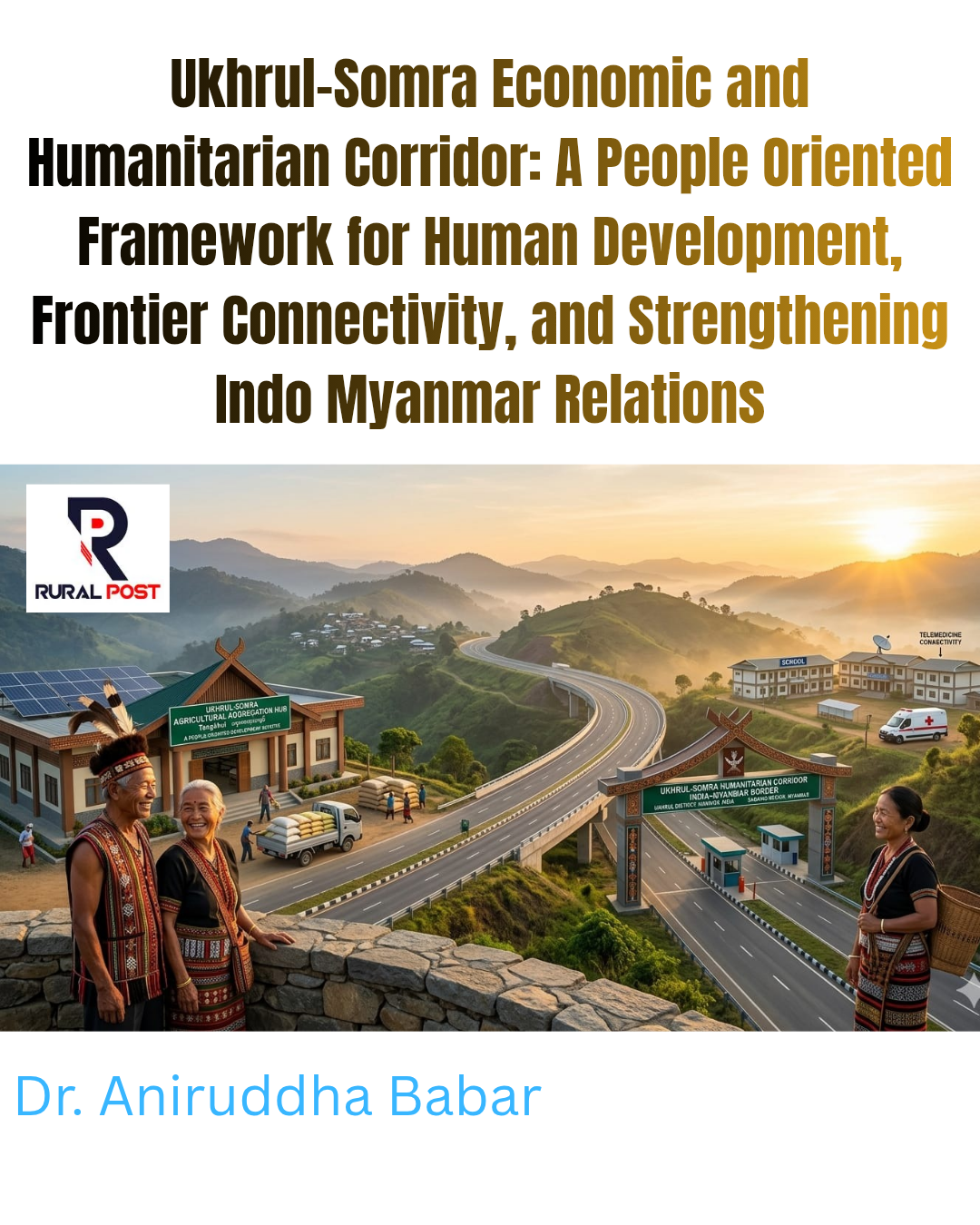
The Ukhrul-Somra Corridor is a proposed plan to better connect the border regions of India (Ukhrul) and Myanmar (Somra). It aims to improve the lives of local communities by building all-weather roads, upgrading local farming with better storage and processing, and providing shared healthcare and emergency supplies to remote villages. Built on the strong family and cultural ties already shared by people across the border, the project seeks to boost the local economy and strengthen overall Indo-Myanmar relations.
The East Shall Shine
The East does not arrive.
It has been waiting
in the folded hills between Lahe and Layshi,
where mist settles
like a language no one taught.
From Ukhrul to Somra,
the ridgelines carry quiet footsteps,
and the earth remembers
what borders could not keep.
Between India and Myanmar,
the hills keep speaking,
as they always have
in a shared breath
of kinship, passage, belonging.
India and Myanmar remain close,
like brothers across the hills,
held together by the border villages
where Naga homes face each other,
sharing fire, memory, and trust.
From Layshi to Somra,
paths remember what maps forget.
Feet have known these ways
long before lines were drawn,
long before silence was named distance.
From Noklak to Lahe,
the wind carries names without passports,
and stories move
from hearth to hearth,
unclaimed, unbroken.
From Somra to Layshi,
the journey is not forward,
it is return
to voices that recognise each other
before they speak.
From Nanyun to Homalin,
the land opens,
worn, patient, enduring.
And somewhere beyond,
where dusk gathers its last breath,
Hkamti glows
not as a signal,
not as a call,
but as something that remains
when everything else has been named.
The East shall shine
not because it was lit,
but because it never agreed
to disappear.
At the eastern edge of Ukhrul, extending toward Somra, there exists a clear and evidence-based foundation for the formulation of an economic and humanitarian corridor anchored in terrain configuration, settlement dispersion, and established patterns of cross-border interaction. The region forms part of a contiguous highland system characterised by low population density of approximately 40 persons per square kilometre, fragmented habitation across more than 200 inhabited villages, and dependence on road-based connectivity with limited redundancy. Alongside these structural features, enduring kinship linkages and customary institutional frameworks operate across the Indo–Myanmar boundary, sustaining informal flows of goods, services, and humanitarian assistance within a long-standing socio-cultural continuum. The proposed approach seeks to organise and strengthen these processes within a coordinated, people oriented framework, explicitly respecting customs and traditions, and supported by reliable transport infrastructure, aggregation and value chain nodes, and decentralised service delivery systems, thereby enabling predictable mobility, expanded livelihood opportunities, advancing human development, and improved access to healthcare and emergency response through targeted humanitarian initiatives, including supporting people of Somra, within a participatory, locally aligned, and administratively coherent framework that reflects a natural responsibility towards neighbourhood and neighbours and contributes to strengthening Indo Myanmar relations.
This proposition derives its operational validity from the physical and demographic characteristics of Ukhrul district, which spans approximately 4,544 square kilometres and occupies the north eastern extremity of Manipur with a direct international boundary with Myanmar. The terrain is defined by rugged mountainous formations ranging from approximately 900 metres to above 2,800 metres, forming part of a continuous hill system that extends into Sagaing Region. Hydrologically, the district is linked to both the Chindwin river basin and the Manipur river system, shaping natural movement alignments that remain underdeveloped in formal infrastructure terms. Within this landscape, the population remains predominantly rural and dispersed, reinforcing the necessity of decentralised planning and service delivery models.
The cross border dimension reflects a historically continuous socio-cultural landscape where communities such as the Tangkhul Nagas inhabit both sides of the boundary, maintaining shared linguistic, cultural, and customary systems. These linkages sustain regular interaction and exchange through informal systems embedded in daily life. The corridor framework builds upon these existing patterns by introducing structure, continuity, and scale to ongoing flows while remaining aligned with local institutional practices and community governance systems.
The economic structure of the Ukhrul–Somra axis remains predominantly agrarian, with a significant proportion of the workforce engaged in cultivation and allied activities. Production systems are centred on rice, maize, pulses, horticultural crops, and forest based resources, supplemented by traditional handloom practices. Output levels remain modest and spatially fragmented due to constraints in aggregation, storage, and processing infrastructure. The corridor framework introduces a distributed network of aggregation centres, cold storage facilities, grading systems, and decentralised processing units, enabling consolidation of output, improved value realisation, and integration into wider market systems.
The humanitarian dimension is closely linked to these economic and spatial conditions. Settlements in the Somra tract and adjoining frontier areas experience limited access to healthcare, education, and emergency services, resulting in reliance on informal cross-border support systems. Within this arrangement, Ukhrul functions as a proximate administrative and service centre with an existing institutional base. The corridor enables the organisation of humanitarian initiatives through mobile health units, telemedicine connectivity, and coordinated referral systems. In addition, provision may be made for periodic humanitarian outreach to ensure continuity of support, through which medical facilities, clothing, and essential commodities such as salt and other basic supplies can be systematically delivered to remote populations, thereby supporting people of Somra and surrounding areas while strengthening human development outcomes across the frontier.
Connectivity remains the central operational requirement in translating these objectives into practice. Ukhrul is connected to Imphal through approximately 84 kilometres of road, forming the primary linkage to the state system, while forward connectivity toward border areas remains limited, discontinuous, and vulnerable to seasonal disruption. The corridor therefore prioritises all weather road stabilisation, bridge infrastructure, slope protection, and lifecycle maintenance systems, supported by feeder networks linking interior settlements to the main axis. Digital connectivity complements physical infrastructure by enabling communication, coordination, and access to services across dispersed populations.
Institutional integration assumes increasing importance within a governance environment that combines formal administrative systems with customary authorities rooted in village structures. While Ukhrul functions as the district headquarters, local governance continues to operate through village level institutions, creating a layered governance framework. The corridor incorporates participatory planning, local representation, and co implementation mechanisms, which may be operationalised through a dedicated district level coordination platform or corridor facilitation mechanism to ensure convergence across departments, alignment with community institutions, and continuity in implementation, thereby strengthening legitimacy and administrative coherence.
Cross border mobility in this region follows long-standing patterns shaped by livelihood needs and kinship ties. The corridor enables the organisation of such movement through designated interaction points and locally aligned facilitation systems that enhance transparency, continuity, and ease of exchange while maintaining administrative clarity. This approach reinforces a natural responsibility towards neighbourhood and neighbours and contributes to stable and sustained interaction across the frontier, while requiring calibrated and context sensitive implementation in a geographically and administratively sensitive frontier environment.
The absence of formal trade infrastructure along the Ukhrul-Somra axis defines the corridor as a new developmental system requiring phased implementation. Initial focus on stabilising connectivity and enabling aggregation is followed by expansion into service delivery systems and structured economic linkages. Financing for such an approach can be supported through convergence of existing central and state development programmes, including border area development initiatives, infrastructure schemes, and potential external development partnerships where appropriate. Coordination between India and Myanmar supports the operationalisation of cross border components within an enabling framework, and through this enabling framework, the corridor directly supports local communities while reflecting in practice the principles of India’s Neighbourhood First policy through sustained, people centred engagement at the frontier, contributing to strengthening Indo Myanmar relations.
As these processes consolidate, Ukhrul’s role evolves through phased strengthening of logistics, healthcare, education, and administrative capacity, positioning it as a nodal centre within the corridor system. The corridor functions as a primary axis with lateral linkages extending into surrounding villages, enabling integration of dispersed populations into a structured network of economic activity and service delivery.
The Ukhrul-Somra corridor represents a geographically grounded and socially aligned framework built upon existing systems of interaction. Its implementation proceeds through sequential infrastructure development, institutional coordination, and community participation, resulting in improved connectivity, strengthened livelihoods, expanded human development outcomes, and enhanced humanitarian engagement across a historically under integrated frontier region while supporting people of Somra and contributing to long term regional stability and cooperative cross border engagement. In this broader context, it is also essential to recognise that the eastern world deserves the light of structured development, equitable access, and sustained opportunity, where regions that have remained at the margins are brought into focus through thoughtful planning and inclusive growth. This perspective has been shaped by field level understanding and shared experiences from the region, and sincere appreciation is placed on record to friends from Somra, Tusom, Poi, Challow and Kalhang whose encouragement has contributed to bringing this framework into wider public consideration. It is intended that this idea remains grounded in the aspirations of local communities, responsive to their lived realities, and aligned with the broader interest of society, where development is inclusive, participation is valued, and progress is shared across villages, regions, and generations.
Dr. Aniruddha Babar
(Dr. Aniruddha Babar is a Senior Academician, Public Policy Expert & Social Development Specialist, Writer, and Researcher currently serving in the Department of Political Science, St. Joseph College, Ukhrul, Manipur. He is also the Co-Founder and Deputy Director of the Centre for North-East Development and Policy Research (CNEDPR), St. Joseph College, Manipur.)