
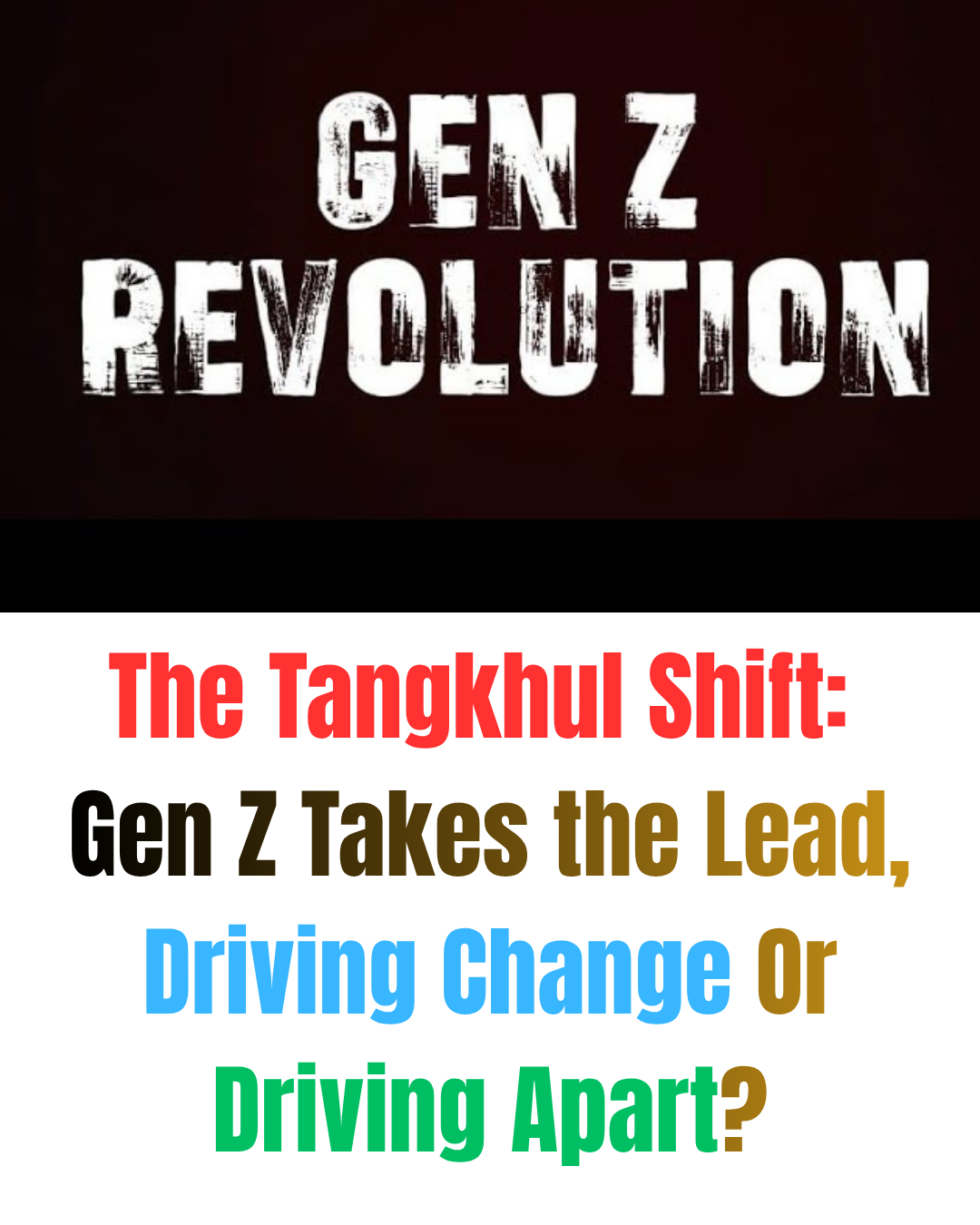
The Tangkhul society today stands at a critical inflexion point, one shaped not only by external political pressures and structural marginalisation but also by an increasingly visible internal discord between generations. This is not merely a difference in opinion; it is a widening fracture in worldview, strategy, and urgency. At the heart of this moment is a profound discord between an older generation that has long held institutional authority and a younger, Gen Z (or Generation Zoomers) cohort that is impatient, vocal, educated, socially conscious, dynamic, and determined to redefine the contours of leadership, accountability, and progress. This “Tangkhul Shift” is not merely a generational transition or disagreement; it is a structural reckoning.
It is a structural failure of dialogue, accountability, and vision. The narrative of generational tension is not new. However, what distinguishes the present moment is the intensity of disengagement and mutual mistrust. The older generation, shaped by years of lived experience, conflict, and gradual institutional building, often perceives youth as impulsive, inexperienced, and overly idealistic. Conversely, Gen Z views the elders as rigid, unaccountable, and disconnected from contemporary realities. This mutual skepticism has resulted in a communication breakdown, where dialogue is replaced by dismissal and engagement by defensiveness.
A vital issue lies in the older generation’s reluctance to cede intellectual and moral space. Authority, once earned through sacrifice and struggle, has calcified into entitlement. Leadership positions across civil society organisations (CSOs), political institutions, religious bodies, and women’s groups are often held by individuals who operate within entrenched frameworks. These frameworks, while historically significant, are increasingly inadequate for addressing the complex, rapidly evolving challenges the community faces today.
Instead of fostering inclusivity, many leaders resort to gatekeeping. Youth voices are acknowledged in rhetoric but sidelined in practice. Consultation processes are either symbolic or absent. Decisions are made within closed circles, and dissent is interpreted as disrespect. This culture of dismissal not only alienates Gen Z but also deprives the community of fresh perspectives and innovative solutions.
Accountability is another area where the older generation must introspect. Leadership without accountability breeds stagnation. When decisions fail to yield results, there is little willingness to accept responsibility or to course-correct. Instead, narratives are often reframed to preserve legacy rather than to confront shortcomings. The older generation’s greatest failure is not conservatism; it is unaccountability masked as wisdom.
However, the burden of transformation does not rest solely on the older generation. Gen Z, for all its energy and awareness, must also confront its own limitations. There is a tendency among young activists to prioritise visibility over substance, to focus on headline management rather than on sustained, ground-level engagement. Social media has become both a tool and a trap: while it amplifies voices, it also incentivises performative activism. Outrage cycles replace strategic thinking, and symbolic gestures overshadow concrete action.
Pragmatism is essential. Change is rarely instantaneous, and systemic transformation requires patience, negotiation, and compromise. Gen Z must move beyond critique and engage with the complexities of governance, policy-making, and community dynamics. This means investing time in understanding institutional processes, building alliances, and developing actionable frameworks. It also means recognising that not all resistance is regressive; some of it stems from legitimate concerns about stability and continuity.
Moreover, Gen Z must avoid the pitfall of moral absolutism. While ethical clarity is important, an uncompromising stance can hinder dialogue and alienate potential allies. The goal should not be to replace one form of rigidity with another but to cultivate a culture of mutual respect and collaborative problem-solving. This requires humility, the willingness to listen, to learn, and to adapt.
The role of CSOs is particularly critical in bridging this divide. As intermediaries for the community, they are uniquely positioned to facilitate dialogue and to mediate conflict. However, many CSOs have themselves become part of the problem. Leadership is often centralised, renewal mechanisms are weak, and youth representation is minimal. To remain relevant, CSOs must undergo internal reform. This includes democratising leadership structures, ensuring transparency in decision-making, and actively mentoring young leaders.
Elected representatives, too, must rise to the occasion. Political leadership cannot afford to be reactive or transactional. It must be visionary, inclusive, and accountable. This means engaging with youth not just during election cycles but also as continuous stakeholders in governance. Policy-making should be informed by diverse perspectives, and mechanisms for feedback and evaluation must be strengthened.
Religious and women leaders, often seen as moral anchors within the Tangkhul community, have a responsibility to promote dialogue and reconciliation. Their influence extends beyond formal structures, shaping values, attitudes, and social norms. By advocating for inclusivity and by modelling respectful engagement, they can play a transformative role in bridging generational divides.
At its core, the Tangkhul shift is not about replacing one generation with another. It is about redefining leadership, reimagining community, and realigning priorities. It is about moving from hierarchy to collaboration, from opacity to transparency, and from exclusion to inclusion. This requires a fundamental shift in mindset, one that recognises the value of diversity, the necessity of dialogue, and the urgency of change.
The stakes are high in the Tangkhul world. Political uncertainty, economic challenges, and social fragmentation pose significant risks. In such a context, disunity is a luxury the community cannot afford. The inability to converge on ideas and to present a unified front weakens collective bargaining power and undermines resilience. It also creates space for external forces to exploit internal divisions.
To move forward, both generations must engage in honest self-reflection. The older generation must ask: Are we creating space for the future, or are we clinging to the past? Are we listening, or merely hearing? Are we leading, or are we controlling? Gen Z, in turn, must ask: Are we building or merely criticising? Are we engaging, or are we performing? Are we prepared to shoulder responsibility, or are we content with visibility?
The answers to these questions will determine the trajectory of the Tangkhul community. Change is inevitable, but its direction is not. It can be chaotic and divisive, or it can be structured and inclusive. The difference lies in the willingness to engage, to move beyond ego, beyond fear, and beyond inertia.
Ultimately, the Tangkhul shift must be a collective endeavour. It must draw on the wisdom of experience and the dynamism of Gen Z. It must be grounded in accountability and guided by dialogue. Only then can the community navigate this critical juncture with clarity, cohesion, and purpose.
The time for passive coexistence has passed. What is needed now is active collaboration, which must be bold, honest, and sustained. The future will not wait for consensus to emerge organically. It must be built deliberately, through effort, empathy, and engagement. “The Tangkhul Shift” is often described as a generational takeover. But the reality is more sobering: it is a moment of fracture disguised as transformation.
Gen Z is indeed taking the lead, but without alignment, leadership becomes fragmented. The older generation still holds influence, but without reform, influence becomes irrelevance. The question, then, is not whether Gen Z will lead or whether the elders will adapt. The question is whether the Tangkhul community can learn to work together and lead.
Until that happens, the “shift” will remain incomplete, an unfinished transition, caught between potential and paralysis.
Pamreihor Khashimwo
(The views and opinions in this article are solely those of the author and do not necessarily reflect the official stance of Rural Post)