
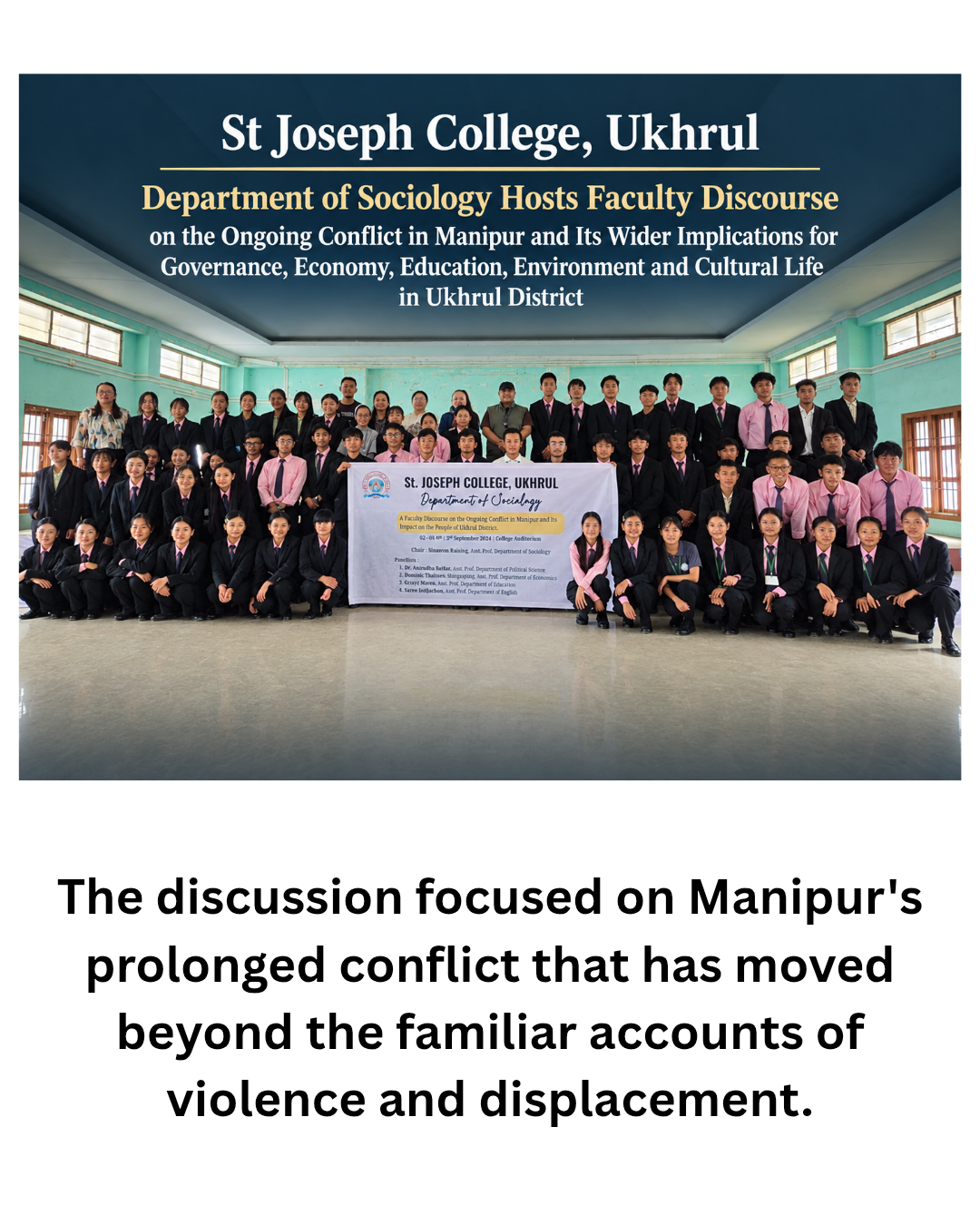
St. Joseph College, Ukhrul, Department of Sociology organised a faculty discourse titled “A Faculty Discourse on the Ongoing Conflict in Manipur and its Impact on the People of Ukhrul District”. Faculty members from several departments presented their perspectives, while students from the Departments of Political Science, Sociology, Economics, English and Social Work participated in the programme.
The discussion focused on Manipur’s prolonged conflict that has moved beyond the familiar accounts of violence and displacement. It also discourse and examines the less visible ways years of instability that have altered everyday life across the district. The conversation ranged from students struggling to maintain their education and households facing higher costs when roads are disrupted to farmers unable to cultivate their fields, communities dealing with weakened connectivity and public institutions trying to maintain essential services.
Faculty members from different academic disciplines examined these consequences through the lenses of governance, the economy, education, environment, agriculture and culture, while students reflected on how the conflict has shaped the communities around them. The discussion also drew attention to areas of Ukhrul that have remained peaceful, raising questions about whether development, connectivity and public services can continue to advance in places where ordinary life has remained relatively stable despite the wider uncertainty in Manipur.
Sinawon Raising, Assistant Professor in the Department of Sociology, chaired the programme, while Yurkhanthing Shangchiri, Assistant Professor and Head of the Department of Sociology and one of the principal figures behind the initiative, delivered the welcome address.
The discussion had a distinctly local focus. Rather than treating the conflict only as a question of violence and displacement, the presentations followed its effects into roads, markets, classrooms, agricultural fields and public institutions. The range of subjects also brought together concerns that are often discussed separately in public debate.
The first presentation examined the relationship between citizens and public institutions when conflict disrupts normal governance.
Dr. Aniruddha Babar, Assistant Professor of Political Science, presented “Governance in Conflict-Affected Manipur: Public Policy, State Capacity and Continuity of Essential Services.”
Dr. Aniruddha Babar examined the pressures placed on the relationship between citizens and government when conflict disrupts normal governance. He stressed the importance of proactive and measured confidence-building measures, responsive public policy, institutional engagement and continuity of essential services.
“In times of conflict, the strength of government is measured not only by its authority, but by its ability to remain present, responsive and worthy of the confidence of its citizens,” Aniruddha said.
He drew attention to areas of Ukhrul that have remained comparatively peaceful and raised the possibility of using such areas for continued development.
“There are areas in Ukhrul that have remained completely peaceful, such as the Ukhrul-Tusom stretch in the northern part of the district. Why should civil society and the government not identify such pockets of peace and begin developing them?” Aniruddha asked.
He also questioned the condition of the Ukhrul-Tusom road. “There is no reason why the Ukhrul-Tusom road should remain in such poor condition when it is an important route connecting towards Somra and further towards Layshi in Myanmar,” he said.
Aniruddha said developing peaceful areas could help sustain local development and improve connectivity during the continuing conflict.
The economic consequences of disruption were examined next by Dominic Thuisem Shingnaisui, Assistant Professor of Economics, in his presentation “Conflict and Economy.” Shingnaisui examined the burden borne by ordinary households when blockades and interruptions to transportation affect the movement of essential commodities.
The discussion considered the experience of Tangkhul communities, including the disruptions of 2023, when highway blockades affected the movement of commodities and placed additional pressure on households. It also examined the economic burden experienced by communities. affected by disruptions to transport and supply routes.
Shingnaisui questioned whether democratic protests could be carried out through methods that do not place additional burdens on ordinary people. “There could be better ways of lodging democratic protests than blocking roads and highways. We suffer because of conflict, but at the same time we also suffer because of blockades that become our own response to the conflict,” he said.
He said the economic effects of a blockade can continue after the road reopens. “When a blockade disrupts the movement of essential goods, the cost is ultimately carried by ordinary households. The burden does not end when the road reopens; its effects can remain in prices, livelihoods and household purchasing power,” Shingnaisui said. He also linked conflict recovery to sustainable development and continued government responsibility.
“Conflict recovery must ultimately translate into sustainable development. Instability cannot become a permanent justification for the machinery of the government to defer development and the delivery of essential services,” Shingnaisui stated.
The economic presentation placed household experience at the centre of the discussion, showing how interruptions to transport can become questions of prices, purchasing power and livelihoods for families far from the immediate sites of violence.
The educational consequences were examined by Gracy Haorei, Assistant Professor of Education, in her presentation “Educational Access and Learning Conditions in Ukhrul District, Manipur.” Haorei described conflict as a major distraction for students. Prolonged instability, she said, can draw young people into the wider conflict environment and divert attention from their primary responsibility of pursuing education..
She also highlighted the psychological pressures created by prolonged uncertainty. Students can live with a continuing sense of insecurity, affecting concentration and the ability to maintain a stable academic routine. The disruption has also affected teachers and schools. Teachers have had to leave schools because of conflict, further affecting the continuity of teaching and learning, she said.
The effects of the 2023 violence continue to be felt in the educational sphere, including instability surrounding university examination schedules. Such disruptions create uncertainty for students attempting to plan and complete their academic programmes.
Her presentation focused on student security, teacher availability, educational access and continuity of learning during periods of instability.
The discussion then turned to displacement and its consequences for land, environment and culture. Sareo Leiyachon, Assistant Professor of English, presented “Environment and Culture During Conflict.”
She drew attention to people displaced from their homes and agricultural lands and examined the consequences for fields that are no longer cultivated or maintained by the communities that previously depended on them. Prolonged absence can affect agricultural production, land use and the condition of agricultural areas. Displacement can also alter people’s relationship with the landscapes in which they have lived and worked. Leiyachon examined the cultural significance of homes, agricultural fields and familiar landscapes. Separation from these places can affect community life and cultural practices.
Across the four presentations, the focus repeatedly returns to the ordinary systems that keep a community functioning: roads that carry essential goods, classrooms that absorb displaced students, fields that sustain households and public institutions expected to continue providing services. The discussion thus placed the everyday consequences of conflict alongside its more visible effects.
Shangchiri said the faculty discourse reflected the college’s commitment to serving society through academic engagement. “This faculty discourse is our service to society. We believe academic institutions have a responsibility to engage with the issues and realities affecting the communities they serve. Through academic discussion, knowledge sharing and reflection, we can contribute to a better understanding of the challenges facing our society,” Shangchiri said. She said the faculty discourse created a space where different academic disciplines could come together, examine the consequences of conflict and encourage students and faculty members to engage with issues affecting everyday life.
“Academic institutions and society are inseparable. At St. Joseph College, we are deeply concerned about the issues affecting our society and we believe that education must remain connected to the realities and aspirations of the communities we serve. I think that is the larger purpose of an educational institution. It is not only government institutions and elected representatives that have a responsibility towards society. Academic institutions also have a responsibility to listen, to engage, to question and to contribute. Our classrooms should not be isolated from the realities outside them; they should become spaces where young people learn to understand society, think critically about its challenges and contribute meaningfully to its future,” Shangchiri said.
Lieutenant Chonchui Magdalene CS, Associate NCC Officer (ANO) of St Joseph College, Ukhrul, described the discourse as an enriching experience for students and teachers and an important platform for intellectual exchange. “Today’s event was indeed a great leap forward for us, especially for the students and teachers, and for society in general,” she said.
She said discussions involving academics from different schools of thought enabled participants to engage with diverse perspectives and gain a clearer understanding of issues affecting society. “Such intellectual brainstorming and exchange of ideas are truly the need of the hour,” she said. She added that it was enriching to see professors from different intellectual backgrounds come together to share relevant ideas, facts and knowledge. She said the programme showed how education can strengthen social awareness and encourage positive change when knowledge remains connected to the realities of the community. “When students are given opportunities to listen, question and think deeply about the society around them, they develop a stronger sense of responsibility, empathy and commitment to the future of their communities and the nation at large,” she said.
For Milan Kuwar, a seventh semester BA Political Science student who participated in the faculty discourse, the discussion expanded his understanding of the consequences of conflict beyond its immediate human cost. “Today’s faculty discussion really enhanced my knowledge. When I think about conflict, I usually think about the loss of human lives and the burning of houses. But today I came to understand how badly conflict affects the economy and the education system,” he said. Kuwar said the discussion also helped him understand how displacement caused by conflict can place pressure on educational institutions and affect students who may not themselves have been directly exposed to violence. “Some schools have more students in a classroom than they should have. These classrooms are filled with students who have come from conflict affected areas. This overcrowding can have a huge impact on the lives and education of students who are not themselves victims of the conflict,” he said. Kuwar said the discussion helped him understand how conflict affects the economy, education and the everyday functioning of communities.
Standhope Shimray, a seventh semester BA Political Science student, said the programme gave him a meaningful understanding of the ongoing conflict and its impact on the people of Ukhrul. “Today’s programme gave me a very meaningful and multidimensional understanding of the ongoing conflict and its impact on the people of Ukhrul. The discussion on its political, economic, educational and environmental dimensions highlighted how conflict affects the broader social fabric and development of the community, including economic insecurity and stagnation,” Shimray said.
He said the discussion on blockades along the national highway and their economic and developmental consequences gave him a deeper understanding of the problems faced by the community. “Through this programme, I came to realise that as students should raise our voices and concerns regarding the neglect of educational infrastructure and developmental programmes in our society,” he said. Shimray described the programme as insightful and thought-provoking and said it had strengthened his understanding of the challenges facing the people of Ukhrul and the need for sustainable, inclusive and peaceful solutions.
Nimmichon Shokwungnao, a seventh semester BA Political Science student of St. Joseph College, said the faculty discussion gave her a broader understanding of how the ongoing conflict has affected Ukhrul and Manipur. She said the four panellists brought different perspectives on governance, the economy, education, the environment and culture. She said the discussion helped her understand how economic disruption, including bandhs and blockades, can contribute to stagnation and discourage investment in conflict affected areas.
She also highlighted the connection between agriculture and Tangkhul cultural life. When farmers are unable to cultivate their fields, she said, the impact extends beyond livelihoods to the working culture and traditions of the community. She said the discussion also drew attention to the difficulties faced by displaced students and the pressure placed on schools by the movement of students from conflict affected areas.
On governance, she said the continuation of conflict should not prevent the government and concerned authorities from providing basic services and pursuing development, particularly in areas where people continue to live peacefully. “As students, we expect many more programmes like this, where we can learn from different perspectives and better understand the issues affecting our society,” she said. “Overall, it was such a privilege to attend the programme and enlighten about the ongoing conflicts in Manipur and despite of those conflicts, we still have the hopes and prospects that developmental progress should be taken up by the concern authorities, as the world is progressing and so should we, without moving backwards, but taking positive steps despite the many obstacles and hurdles that we are facing in our state, Manipur,” stated Nimmichon.
In her concluding remarks, chair Sinawon Raising, Assistant Professor, Department of Sociology, said the faculty discourse had provided an opportunity to examine the ongoing conflict from different academic perspectives and understand its effects on people and institutions in Ukhrul.
“As an academic institution, we have a responsibility to discuss the issues affecting our society. Today’s presentations have helped us look at the conflict from different perspectives and understand its effects on governance, the economy, education, environment and culture. Such discussions should continue, and students should be encouraged to engage with the issues affecting their communities,” Raising said.
She thanked the presenters, faculty members and students for their participation and said the discussion could encourage further academic engagement with the challenges facing Ukhrul and Manipur.
For St. Joseph College, the subject carries direct local relevance. Located in Ukhrul, the college provided a forum for faculty and students to examine issues affecting the district and the wider situation in Manipur.
Students from the Departments of Political Science, Sociology, Economics, English and Social Work participated in the programme, bringing questions and observations from their respective fields of study.
The faculty discourse brought the consequences of conflict into the ordinary spaces of life: roads and markets, classrooms and examination halls, households and agricultural fields, as well as the institutions responsible for delivering public services.
The programme ended with an emphasis on continued academic engagement with the concerns of the communities the college serves and on creating spaces where students and faculty can examine the challenges facing Ukhrul and Manipur through sustained discussion and reflection.