
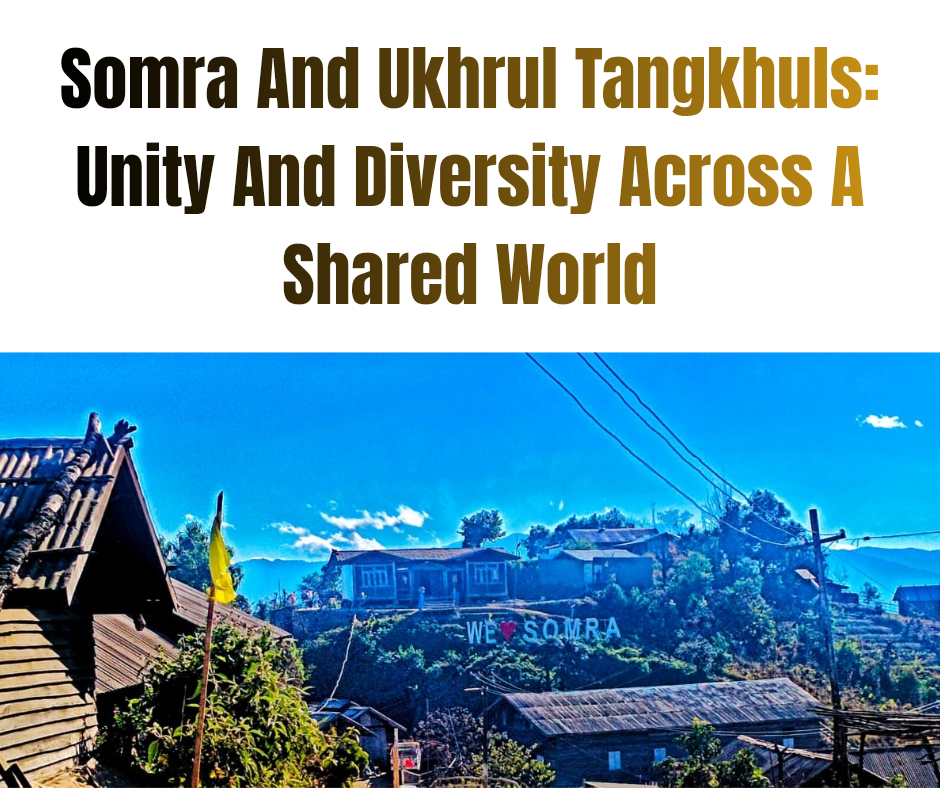
The Somra Tangkhuls form part of a wider transboundary Tangkhul world spread across the Indo-Myanmar frontier. They are found in significant numbers in the Somra tract of northwestern Myanmar, particularly in areas such as Leshi and Homalin in the Sagaing Region’s Naga Self-Administered Zone, while remaining closely linked through history, culture, and shared memory to the Tangkhuls of Ukhrul and Kamjong districts in Manipur, India, with Kamjong having emerged as a separate district in recent years. This landscape reflects a long-standing pattern of settlement and interaction that existed well before present political boundaries, allowing Somra and Ukhrul to be seen as interconnected parts of a larger Tangkhul world shaped over time. Within linguistic scholarship, what is often referred to as the Tangkhulic group is treated as a distinct and internally diverse branch within the Tibeto-Burman language family, with ongoing discussions regarding its wider affiliations.
Seen in this way, the relationship between Somra and Ukhrul Tangkhuls unfolds as a layered and evolving connection. The term “Tangkhul” reflects a rich range of closely related speech forms that have developed across villages and regions over generations. The historical organisation of Tangkhul society around village communities contributed to locally grounded patterns of interaction, allowing distinct features of pronunciation, vocabulary, and expression to gradually emerge across space while remaining rooted in a common linguistic heritage. These variations reflect the natural development of a living language tradition shaped by geography, time, and community life.
At this point, it is useful to situate this understanding in terms of my own engagement. Ever since I joined my institution, I have spent much of my time trying to better understand Tangkhul lands, language, culture, and society, and this engagement builds upon an earlier phase of learning during my years as a PhD scholar (specialised in Law & Governance) nearly a decade ago, when I came into close contact with Tangkhul society and received guidance and support from senior Tangkhul friends and elders. Their patience and generosity shaped both my research and my broader understanding in lasting ways, and this learning has continued to deepen through everyday interactions with colleagues, students, their families, and through the continued guidance of respected Tangkhul elders, leaders, and intellectuals who have shared their knowledge with openness.
Such long-term engagement allows one to move beyond surface familiarity and begin recognising deeper linguistic continuities within the Tangkhul world. The speech forms associated with Somra, often referred to as Burmese Tangkhul, can be approached as one expression of this wider linguistic heritage shaped in remote hill settlements. These forms include multiple local varieties that reflect the diversity found across the Tangkhul world, and they remain connected through shared structural features and historical depth. Degrees of mutual understanding may vary across different varieties depending on proximity and familiarity, while shared elements continue to reflect a common origin. In this sense, Somra and Ukhrul forms appear as related expressions shaped through their respective environments while remaining anchored within a shared linguistic tradition.
Comparisons of vocabulary across different Tangkhul varieties show varying degrees of similarity, and these variations reflect the particular varieties being compared as well as the methods used in such comparisons. Closely related varieties often show high levels of similarity, while others display more distinct features, together illustrating the wide spectrum of expression within the Tangkhul linguistic landscape. This range of variation forms part of a clustered continuum that has developed over time across interconnected yet locally grounded communities.
Comparative linguistic work points toward a shared ancestral stage often referred to as Proto-Tangkhulic, visible in sound patterns and word formation that continue to link present-day varieties. This shared foundation supports an understanding of unity at a deeper level, expressed through multiple evolving forms across regions.
Beyond language, the connection between Somra and Ukhrul Tangkhuls is strongly reflected in common cultural and social structures. Clan systems, customary practices, and community institutions display clear continuities, while traditions preserved through oral narratives continue to sustain collective memory and identity. These shared elements provide a foundation through which belonging is experienced across regions.
Identity within the Tangkhul world is sustained through a combination of language, kinship, cultural practice, and shared history, with each of these elements contributing to a broader sense of connection. Communities continue to identify as Tangkhul across varying linguistic expressions, reflecting the strength of these deeper ties.
Historical processes have shaped the present patterns of variation and connection across the region. Earlier patterns of settlement formed a continuous highland space within which communities interacted across what are now formal boundaries, and subsequent administrative developments introduced new frameworks of governance and interaction, contributing to distinct developmental paths in areas such as education, religious life, and institutional structures.
In Ukhrul, missionary engagement contributed to the development of a written form of the language and the wider use of a particular dialect as a common medium, supporting literacy and communication across communities. In the Somra region, these processes developed gradually, allowing local varieties to continue evolving in close connection with community life while remaining part of the broader linguistic tradition.
Shared systems of village governance, customary law, communal landholding, and agricultural practices such as shifting cultivation continue to form the foundation of social life across both regions. These enduring structures sustain a sense of connection that extends across linguistic variation and geographical distance.
Beyond these shared structures, connections between Somra and Ukhrul Tangkhuls continue through lived and everyday interactions shaped by kinship, movement across regions, and shared social practices. These connections exist within a linguistic landscape that forms a broad continuum, where speech varieties often differ from village to village in pronunciation, vocabulary, and expression, reflecting the depth and spread of Tangkhulic languages across the region. Family ties extend across regions, with relationships sustained through visits, exchanges, and participation in social and cultural occasions within community life. These interactions form an ongoing pattern of connection carried forward across generations, where familiarity and trust grow through repeated contact and shared experience. Such connections are also sustained through oral traditions, including stories, songs, and community narratives, through which knowledge, history, and customary practices are transmitted across generations. Collective participation in rituals, ceremonies, and everyday social life further reinforces these patterns of connection. In this way, a sense of connection is sustained through lived experience, collective memory, and continued engagement in everyday life. These processes support the transmission of values, customs, and social understanding across generations, even as some speech varieties remain lightly documented or gradually shift in use. Such patterns reflect a broader linguistic and cultural continuum that extends across regions, allowing the Tangkhul world to remain socially cohesive in ways that are deeply sustained over time.
Many smaller village-level speech forms remain only lightly documented, reflecting a broader linguistic reality in which Tangkhul speech varies significantly from village to village, often forming distinct local varieties. Nearly every Tangkhul village is associated with its own speech form, with differences in pronunciation, vocabulary, and structure, and in many cases these varieties are not fully mutually intelligible across wider geographical distances. Estimates suggest that there are more than two hundred Tangkhul villages across the region, each contributing to this highly localised linguistic diversity. Within the wider Tangkhulic grouping, several related languages and varieties continue to receive limited scholarly attention, indicating the extent to which documentation remains incomplete. These conditions are shaped by changing social and educational contexts, including the growing use of standardised Tangkhul based on the Ukhrul (Hunphun) variety, alongside English and other regional languages in education and communication. As a result, some village-level speech forms remain under-documented and may gradually shift in patterns of use across generations. In this context, sustained efforts in linguistic documentation, community-based recording, and research assume particular importance in preserving this complex linguistic landscape, ensuring that both widely used and lesser-known varieties continue to be recognised, understood, and transmitted to future generations.
This discussion also offers a broader way of looking at the region. It suggests that identity in the hills is shaped through multiple layers of language, culture, kinship, and shared memory, which do not always align in simple or uniform ways. This is often misunderstood in simplified readings of the region that attempt to fit complex societies into neat and uniform categories. The relationship between Somra and Ukhrul Tangkhuls reflects this pattern, where variations in speech and local expression exist alongside a continuing sense of shared belonging. Differences that are visible at one level often exist together with deeper forms of connection that continue to hold communities together across space and time. Recognising this allows for a more grounded understanding of how societies in this region have evolved through continuity, adaptation, and lived experience.
The Tangkhul world, like the wider Naga society, carries within it a depth of knowledge, values, and lived wisdom that holds much to offer not only to modern India but also to the wider world. In these traditions lies a deep understanding of community, balance, and human dignity, reminding us that knowledge, when rooted in lived experience and shared with humility, has the power to illuminate and elevate the human spirit.
The strength of Tangkhul society has long rested in its ability to sustain diversity within a shared framework of belonging, a feature deeply embedded in its village-based social organisation and clan structure. Each village has historically functioned as a largely self-governing unit, guided by a headman and council, with clans forming the foundation of social, political, and economic life, shaping relationships, responsibilities, and collective decision-making. These institutions are supported by a rich body of customary law and orally transmitted norms, within which elders play a central role in guiding community life, preserving knowledge, and ensuring continuity across generations. Cultural practices, including agricultural festivals, rituals, and communal gatherings, remain closely tied to seasonal cycles and collective participation, reinforcing shared values and social cohesion across villages. Across the wider Tangkhul world, which extends beyond present political boundaries, communities continue to recognise themselves as part of a broader collective identity, sustained through kinship ties, shared memory, and ongoing interaction. This continuity reflects a form of socio-cultural resilience shaped over generations, allowing Tangkhul identity to remain rooted, adaptive, and interconnected within changing historical and social contexts.
Seen within this broader context, the relationship between Somra and Ukhrul Tangkhuls can be more clearly understood as part of an interconnected and evolving whole.
It emerges as a layered and evolving expression of unity enriched by diversity, grounded in a shared historical and cultural foundation that continues to sustain a sense of belonging across regions. This relationship exists within the broader Tangkhulic linguistic grouping of the Sino-Tibetan family, encompassing several related languages and varieties spoken across Manipur and the Naga Self-Administered Zone of Myanmar. Within this grouping, linguistic variation forms a broad continuum, where speech forms differ from village to village in pronunciation, vocabulary, and structure, and may not always be fully mutually intelligible across wider geographical distances. These patterns of variation reflect long-standing settlement in village-based communities, where language, culture, and social organisation evolved in locally grounded ways while remaining connected through kinship networks and shared memory. Across this landscape, continuity is sustained through common institutions, oral traditions, and collective practices that reinforce a shared identity extending beyond present political boundaries. Linguistic expressions reflect the depth and breadth of a living tradition that has developed across time and space. This allows the relationship between Somra and Ukhrul Tangkhuls to continue evolving while retaining a deep and ever strengthening sense of shared belonging.
Dr. Aniruddha Babar
(Dr. Aniruddha Babar is a Senior Academician, Public Policy Expert & Social Development Specialist, Writer, and Researcher currently serving in the Department of Political Science, St. Joseph College, Ukhrul, Manipur. He is also the Co-Founder and Deputy Director of the Centre for North-East Development and Policy Research (CNEDPR), St. Joseph College, Ukhrul, Manipur.)