
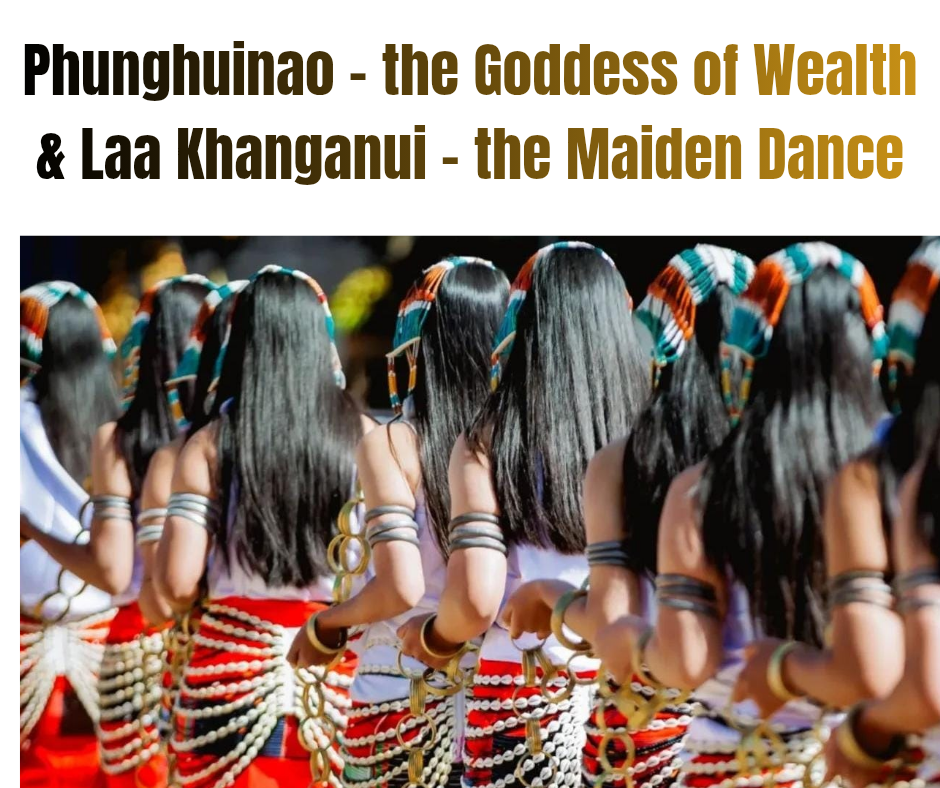
Before we go deeper, let us understand the difference between ‘Laa Kasā‘ and ‘Laa Khanganui.’ Laa kasā can be participated by everyone. Whereas Laa Khanganui can only be performed by maidens. Here maidens denote unmarried women.
From the story told to us, our ancestors learned the dance from the Phunghuinao. The story goes that the Phunghuinaos would gather on one big open space called ‘Phunghui Lui’ and there, they would laa nganui. The Phunghui Kumyao are identified as females and were considered as the Goddess of Wealth. Their performance could only be seen by those whom they wanted to show.
Laa Khanganui has also been interpreted as a virgin dance. But it would be more appropriate to refer to it as ‘Maiden Dance‘. The participants were unmarried girls and they were chaperoned by elderly women. But, the elders cannot sing, dance or participate in the Laa Khanganui. Unmarried maidens would generally denote virgins and the only guarantee that the participants were virgins would be the participants themselves and the spectators, especially, the women. The women could make out whether any of the participants was virgin or not from their physique, especially from ‘Sungthei‘ and ‘Rangthei‘. The maidens performed the dance, wearing only Kongsang and short kashan.
It was during this time, people could see the physical qualities of the maidens. There was also a fear of being cursed or harmed by Ameowa if she lied about her virginity. Let us keep in context that during our forefathers’ time (and to some extent even today), their beliefs had a lot to do with ‘Shārra‘ (taboo). It will be very difficult to know whether they all are virgins or not, we can only trust them. Since only virgins could participate, this was an easy way to identify and group them into categories such as ‘khangkaser‘ and other negative qualities that are generally used to describe a person.
‘Laa Khanganui’ was usually performed in the old villages of Tangkhul Naga and may not have been performed in the new settlements. It is usually performed during the seed sowing festival called Luira Phanit to invoke the Creator’s blessings upon the seeds that are to be sown and the crops to be as good as their body.
There was, however, no disciplinary actions against anyone who failed to participate in it. In fact, this practice reassures youth to maintain high moral principles of not losing virginity before marriage.