
Why Nagas Need a Homeland-Wide Compact to Defend Ancestral Land and Recognise Every Defender
Markson V. Luikham
For the Nagas, land is inheritance, identity, livelihood and belonging. It carries the memory of ancestors who established settlements, cleared forests, cultivated fields, marked boundaries and passed their holdings to succeeding generations. A family’s ancestral field, a clan’s traditional land and a village’s recognised territory may be governed by different customary rights, but together they form the foundation of Naga life.
The Tangkhul landholding system illustrates the complexity of these rights. U. A. Shimray’s study of the Tangkhul Naga examines landholding, agriculture, forests and communal resources, distinguishing family or individual holdings, clan land and village community land. These categories coexist within village territory, but their associated rights are not identical. Ancestral homesteads, terrace paddy fields, jhum cultivation areas, woodland and common resources may fall within the same customary boundary without being governed by one uniform form of ownership. Communal authority must not be confused with personal ownership by a village chief, just as a village boundary must not be taken to mean that every holding within it belongs collectively to the village.
Shimreipam R. S.’s research on contemporary Tangkhul society examines how these customary arrangements interact with markets, state institutions and wider social change.
Village boundaries have traditionally been preserved through local histories, customary recognition, the knowledge of elders and, in some places, physical markers associated with ridges, streams, hills, forests and stones. Every village should document its recognised boundaries, clan holdings, communal resources, inherited family property and unresolved claims. Oral testimony and customary decisions should be preserved alongside available maps and land documents. Such documentation would strengthen the protection of ancestral rights and help succeeding generations understand the territory and customary responsibilities entrusted to them.
Yet documentation alone cannot protect a village from violence. The historical record shows what happens when Naga communities face armed attacks without an effective system of collective protection.
During the colonial period, Naga villages were repeatedly attacked, their people killed or carried into captivity, their settlements destroyed. Dr. Tuisem Ngakang records that Chingsow, a Tangkhul village, was attacked in 1880, resulting in the deaths of 45 people, including 20 men and 25 women. Advocate Sira Kharay discusses the same attack and the demand that the village submit to the authority of the Chussad chief, Tonghoo, and pay tribute. The villagers’ refusal was followed by violence. The attack on Swemi, also known as Chingjaroi, is another grave episode. Ngakang reports that 286 people were killed, including 187 women and children. Kharay discusses the same historical episode and presents a different casualty figure, drawing on a village account. Both accounts. convey the scale of the violence and the vulnerability of communities exposed to armed raids.
The attacks during the Kuki Rebellion of 1917 to 1919 continued this pattern. The account of the Ngahui, also known as Awangkasom, village massacre published by Ukhrul Times documents how few survivors escaped. Such episodes form part of the historical experience through which Naga communities have understood the relationship between village security, territorial continuity and collective survival.
The pattern did not end with the colonial period. The Naga-Kuki conflict that erupted in 1992 produced displacement and territorial changes whose consequences remain unresolved.
Moreh provides one of the starkest examples of how displacement can separate a people from their ancestral land without necessarily extinguishing their customary and legal claims. Naga families were forced to flee during the 1992 Naga-Kuki conflict after their homes and properties were destroyed, and the question of their return remains unresolved. The historical background of the area also deserves attention. Captain R. Boileau Pemberton’s Report on the Eastern Frontier of British India (1835) documents indigenous communities, including the Anals, in the southeastern Manipur frontier, while E. W. Dun’s Gazetteer of Manipur (1886) provides an important historical reference to Sibong, also known as Sitpong, near Moreh. The Hill Tribal Council of Moreh has further stated that the town, originally known as Mollenphai or Mollen, was established with the consent of the chief of Sibong-Sutpong and remained under that village’s chieftainship. These historical references provide an important context for examining the older settlements and customary land relationships of the region. Against this background, the year 1974, cited by the Moreh Naga Village Authority in its account of Naga settlement, should not be treated as the starting point of Naga ancestral presence throughout the wider Moreh area. The authority’s chairman, Marashang Hashuwoshi, stated in August 2026 that 73 Naga villages had been present there, with a total population of 539. He also stated that displaced families retain their homestead pattas and that official landowner details remain available in the government’s Settlement Office. These records are particularly significant because they may help establish the claims of displaced families and support efforts towards their resettlement. Moreh demonstrates a fundamental problem in the protection of ancestral land: families may retain documentary evidence of ownership while losing the practical ability to return, reside and exercise their rights. A title in a government record cannot, by itself, restore a village, rebuild a home or secure access to ancestral property.
The displacement from Moreh was not confined to individual houses. A petition submitted to the Manipur Human Rights Commission records the allegation that many Naga villagers who fled Moreh to save their lives could not return to their respective villages and that abandoned Naga villages were taken over by Kukis. The 1992 quit notice and the resulting flight of Naga residents therefore remain central to understanding why the question of territorial protection cannot be separated from the question of displacement. A village may be abandoned under violent pressure, its people scattered across districts and its fields left uncultivated, while the land continues to be claimed by the families who were forced to leave. When resettlement remains unresolved for decades, the loss is not merely residential. It affects livelihoods, inheritance, village institutions and the transmission of customary rights to succeeding generations.
The experience of Chandel provides another concrete example. Lamkang scholar Shelmi Sankhil writes that several Lamkang villages in Chandel were displaced during the 1992 conflict. When villagers leave ancestral settlements, families lose access to cultivation areas, homes and community institutions. The longer they remain away, the more difficult it can become to maintain regular occupation, preserve boundaries and protect customary rights against competing territorial claims. The experience of the Lamkang villages shows why assistance between Naga communities must not be treated as a temporary expression of solidarity. It must be connected to the long-term restoration and protection of the rights and livelihoods of affected communities.
The former Sadar Hills area, now associated with Kangpokpi district, raises the same problem at a wider territorial and demographic level. Naga writer Nimi Kamei discussed the historical claims of Naga communities, including the Maram, Thangal and Zeliangrong, to parts of the area. Kamei identified Saikul as a locality that had been predominantly Thangal Naga before 1992 but was subsequently dominated by the Kuki community, while many of the original landholders continued to retain claims to their land. The article also presented village figures for the former Sadar Hills subdivisions between 1971 and 2001. In Sadar Hills East, the figures cited show an increase from 59 Kuki villages in 1971 to 171 in 2001, while Naga villages increased from 114 to 124. In Sadar Hills West, Kuki villages increased from 13 to 69, while Naga villages increased from 34 to 49. In Saitu-Gamphazol, the cited figures show an increase from 29 Kuki villages to 115, while Naga villages increased from 41 to 61. These figures illustrate the scale of the changes that Naga writers have raised in debates over settlement, land and administration in the area.
The history of Kangpokpi and the former Sadar Hills cannot be understood simply by looking at the present distribution of settlements. The crucial questions concern how land was first occupied, which communities exercised customary authority, how settlement was permitted and what happened to those rights when population patterns changed. A change in demographic predominance does not, by itself, settle questions of ownership. Yet demographic change can influence administration, public representation and the practical ability of an original landholding community to protect its interests. Where village boundaries and customary rights are not adequately documented and defended, a community may find that the land it inherited from its ancestors has become the centre of an increasingly difficult political contest.
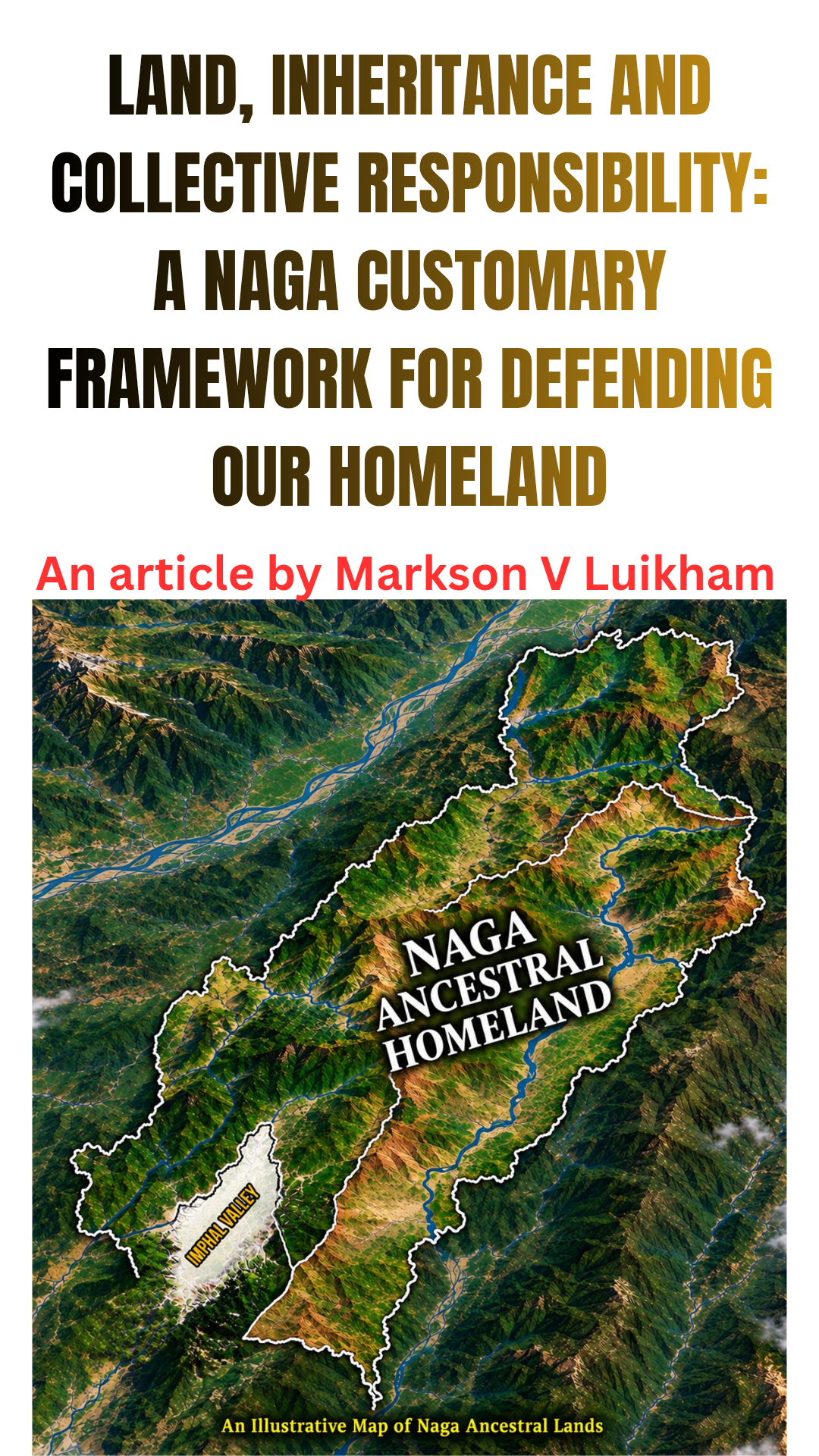
The threat is not confined to any single district. It is unfolding across the Naga homeland. In Ukhrul district, villages such as Sinakeithei, Ringui, Sharkaphung and Litan face continuing pressure. Thoyee and surrounding areas remain vulnerable. In Kamjong district, communities including Choro, Namlee, Wanglee, Konkan and Thana are exposed to the same offensive. The pressure extends to Kangpokpi, Senapati, Chandel and Tamenglong. The United Naga Council, the Naga Students’ Federation and other Naga civil society organisations have consistently described these developments not as isolated incidents but as part of a coordinated territorial expansion aimed at altering the demographic and administrative character of Naga ancestral areas. The pattern of simultaneous pressure across multiple districts supports this assessment.
In his first-person account published in The Sangai Express on 2 October 2026, Shanluiso Angkang describes insecurity, reported incidents affecting villagers’ access to their farms and wider difficulties facing the community. The account brings the land question into ordinary life: the ability to reach fields, cultivate crops and sustain households is inseparable from the ability to remain on ancestral territory. When farmers cannot safely reach their fields, families lose crops and income, and the village’s economic life suffers. Similar pressures are reported in Ringui, Sharkaphung, Litan, Thoyee, Choro, Namlee, Wanglee, Konkan, Thana and Naga communities across Kangpokpi, Senapati, Chandel and Tamenglong. The names differ, but the underlying threat is the same. Protecting ancestral land means protecting the ability of its people to live there, cultivate it and sustain their community.
These experiences raise a question that cannot be answered by declarations of unity alone. When one Naga community is threatened, who is responsible for helping to protect it, and what obligations should the receiving community owe to those who come to its assistance?
Naga customary relationships offer a principle that can answer this question. Historically, relationships between villages and clans could involve mutual assistance, reciprocal labour, shared responsibilities and the recognition of service. In particular circumstances, assistance could be acknowledged through a tangible grant or an enduring right over land. Where such a grant was recognised by the relevant customary authority, it could pass through successive generations.
My own family’s history preserves an example. According to our family tradition, our maternal family owned land in another village, said to have been granted in recognition of assistance rendered during a war to that village by our great grandfather. The grandchildren continue to cultivate farms there, and the holding has passed from one generation to the next. This is a specific family history, not a claim that every Naga village followed an identical rule. It illustrates how assistance could create an enduring relationship with land that continued beyond the generation in which the help was given. The precise terms of the grant, the authority that approved it and the rights inherited must be understood according to the relevant customary practice. Family histories, oral testimony and village records therefore preserve not only ownership claims but also the obligations through which relationships between communities have endured.
If one village calls upon another for assistance, the relationship should not end when the immediate danger passes. The receiving community should acknowledge the contribution of those who came to its aid. The form of recognition may depend on the circumstances, but the underlying obligation is reciprocal: a community that receives substantial assistance must also accept responsibility towards those who provide it.
I would therefore like to place an idea before Naga village authorities, customary councils, clan representatives and civil society organisations for serious consideration: whether a formal Naga-wide compact for mutual assistance and recognition of sacrifice could strengthen our collective responsibility towards the homeland. Rather than imposing a uniform system on communities with different customary traditions, such a compact could provide a common understanding of reciprocal obligations while allowing each participating community to retain its land rights, customary authority and decision-making autonomy. Its geographical scope could encompass Naga communities across Nagaland State, Arunachal Pradesh, Assam, Manipur and the Naga areas of Myanmar, bringing the principle of mutual assistance beyond the boundaries of individual villages, districts and states. Under such an arrangement, any Naga who travels from another part of the homeland to assist a threatened community could be considered for recognition on the basis of verified service, regardless of their place of origin. Whether assisting Konkan Thana, Skipe, Choro or Namlee in Kamjong, or a Naga community in Kangpokpi, Senapati, Chandel or Tamenglong, a defender’s contribution would be assessed on its merits. This principle could apply equally to organised assistance from villages and to individuals who respond independently, without making eligibility dependent on formal dispatch by their home village or a prior agreement between the communities concerned.
Such a compact could draw upon the principle of reciprocal obligation found in Naga customary relationships. Participating communities could discuss and agree in advance on appropriate forms of recognition, including land grants where customary practice and applicable law permit them. Land-based recognition could be reserved primarily for substantial sacrifice, particularly where a defender loses their life or suffers serious injury or permanent disability while providing verified assistance. A community receiving such assistance could establish in advance the obligations it would fulfil towards the defender or, in the event of death, the family or designated lawful beneficiaries. Other verified contributions, including civilian protection, evacuation, rescue, medical assistance, relief and the restoration of safe access to homes and agricultural land, could be recognised through appropriate financial or material support. The purpose would be to establish a clear and mutually accepted understanding of responsibility, rather than leave recognition to the discretion of individual leaders after the service has been rendered.
Land allocation could be one possible form of recognition where appropriate. Communities considering participation could identify eligible communal land in advance and clarify the nature of the tenure, the beneficiaries, inheritance conditions and procedures for resolving disputes. Existing family and clan holdings would need to remain protected, and no community should be expected to fulfil an obligation by granting land belonging to another household or land subject to a genuine dispute. Where a land grant is unavailable or unsuitable, participating communities could consider establishing a jointly funded Naga-wide reserve to provide alternative compensation and support. Such a fund could assist injured defenders, the dependants of those killed and households facing medical expenses, crop losses, emergency needs or legal costs. These arrangements would allow communities to recognise substantial sacrifice without making their obligations dependent on the availability of suitable land.
For such an arrangement to work, participating communities could also consider common procedures for requesting assistance, documenting contributions, verifying claims, determining eligibility and resolving disputes. A joint body representing the participating communities might help administer the framework through transparent procedures, with decisions recorded to preserve continuity when village leadership changes. It could be constituted through the existing customary institutions of participating communities, drawing upon their recognised procedures for consultation and decision-making. Families affected by a defender’s death, injury or sacrifice, including women and dependants, would need a meaningful voice in decisions concerning compensation, land use and inheritance. The aim would not be to replace customary institutions with a new central authority, but to explore how their existing authority could support a wider framework of cooperation and reciprocal responsibility.
The significance of such a compact would extend beyond compensation. Its greatest contribution could be the confidence it builds between Naga communities: the assurance that a village facing a threat would not be left to bear the burden alone, and that those who came to its assistance would not be forgotten once the immediate danger had passed. If communities could agree on common principles of assistance and recognition in advance, they might be better prepared to overcome geographical divisions, coordinate support and respond collectively when ancestral land and civilian life are threatened. Such an understanding could strengthen the morale of those who volunteer to help, deepen trust between communities and give practical meaning to Naga unity. It could also reduce uncertainty and disagreements over responsibility at moments when cooperation is most needed. A shared commitment of this kind would not remove every political, customary or practical difficulty, but it could provide a foundation upon which communities might work towards more effective and sustained protection of the homeland.
I do not raise this idea lightly. It comes from a place of concern for our people and from a sense of belonging to a homeland that we have seen diminish. When a village loses its land, we all lose a part of who we are as Nagas. The displaced families of Moreh, the Lamkang villages of Chandel, the Thangal villages of Saikul, and the threatened communities of Sinakeithei, Ringui, Sharkaphung, Litan, Thoyee, Choro, Namlee, Wanglee, Konkan and Thana, alongside Naga communities across Kangpokpi, Senapati, Chandel and Tamenglong, are not distant from us. They are our relatives, our neighbours and our fellow Nagas. Their loss is our loss, and their survival is our survival. Their circumstances call for more than expressions of sympathy. They call for serious reflection on how our customary institutions, civil society organisations and communities can translate solidarity into lasting mutual responsibility.
If the Naga homeland is a common inheritance, its protection must also be understood as a common responsibility. Whether a homeland-wide compact can be developed, and what form it should take, must be decided collectively by Naga communities and their customary institutions. Yet one principle deserves serious consideration: no Naga community should face the loss of its ancestral land in isolation, and no meaningful sacrifice made in support of another Naga community should be forgotten. By exploring a framework that recognises service, shares responsibility and strengthens confidence across the homeland, Nagas could give practical meaning to unity and build a stronger foundation for the collective protection of our people and ancestral lands. The reciprocal obligation understood by my great grandfather’s generation when they came to the aid of another village may offer a customary precedent for the common future we must now consider.
Sources:
U. A. Shimray, “Land Use System in Manipur Hills: A Case Study of the Tangkhul Naga,” in Walter Fernandes and Sanjoy Barbora (eds.), Land, People and Politics: Contest over Tribal Land in Northeast India.
Shimreipam R. S., The Interplay of Tradition and Modernity: An Ethnographic Study of Contemporary Tangkhul Naga Society, Department of Sociology, Jamia Millia Islamia, research abstract, 2023.
Dr. Tuisem Ngakang, “Naga-Kuki Conflict: The Search for Definitions,” NagaJournal.
Advocate Sira Kharay, “Naga-Kuki Conflict: A Case of Kuki Aggression,” E-Pao.
Khathing Ronrei, “Ngahui (Awangkasom) Village Massacre in 1918: Less than a Dozen Survived,” Ukhrul Times.
Nimi Kamei, “Sadar Hills District and Its Impact,” The Morung Express, 12 August 2011.
Shelmi Sankhil, “Why Kukis Cannot Claim Chandel As Part of ‘Kukiland’: The Lamkang Example,” Ukhrul Times, 29 July 2023.
The Sangai Express, “Targeting of Nagas, Meiteis, Paites, Tamils at Moreh Spelt Out in Petition: Excesses of Kuki Militants Since 90s Laid Before MHRC,” 12 September 2023.
The Sangai Express, “Nagas Pitch for Resettlement at Moreh,” 27 August 2026.
Shanluiso Angkang, “When Basic Human Needs Become a Struggle for Sinakeithei Village, The Sangai Express, 2 October 2026.
(The views and opinions in this article are solely those of the author and do not necessarily reflect the official stance of Rural Post)