
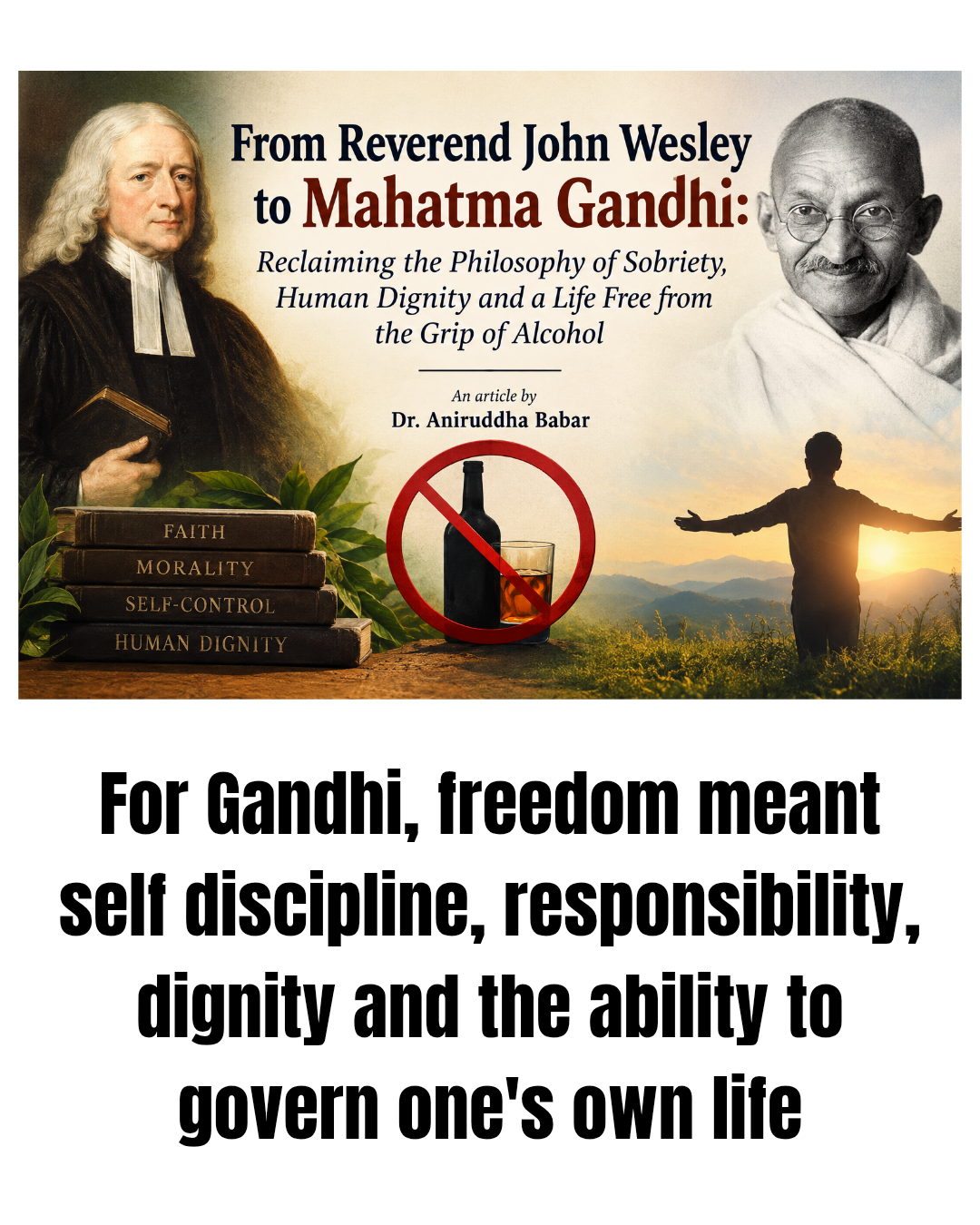
On 2 October, India remembers Mahatma Gandhi, a man who understood freedom as something that had to be lived in everyday life. For Gandhi, freedom meant self discipline, responsibility, dignity and the ability to govern one’s own life. His views on alcohol were closely connected to this understanding of freedom. He saw drinking as a serious social problem that could damage health, drain household incomes, disturb family life and cause immense suffering to women and children.
Gandhi’s opposition to alcohol also gives us an opportunity to remember an earlier reformer who took the problem of drunkenness seriously. Rev. John Wesley, the founder of the Methodist movement, placed self control and disciplined living at the heart of his moral philosophy. His own writings reveal a sustained concern about drunkenness, the harmful use of spirituous liquor and the moral consequences of profiting from substances that could damage another person’s health and life. Wesley recognised limited medicinal uses of alcohol and made distinctions concerning different forms of alcoholic drink. His central concern was the destructive use of alcohol and the loss of self control that could follow from drunkenness.
My own engagement with Wesley’s philosophy began much earlier. I first encountered John Wesley when I was in Class 11 during my junior college years. What initially appeared to be an encounter with a historical religious reformer gradually became an engagement with a much larger philosophy of self discipline, social responsibility and human dignity. His reflections on drunkenness and the responsible use of money stayed with me and years later they continue to offer a striking way of thinking about the social consequences of alcohol.
One of Wesley’s most direct writings on the subject was “A Word to a Drunkard” (https://archive.org/details/bim_eighteenth-century_a-word-to-a-drunkard_wesley-john_1748/page/n1/mode/2up), a powerful appeal against the destructive consequences of drunkenness. Written in November 1745 and published in Bristol in 1748, the tract reflected Wesley’s deep concern with self control, moral responsibility and the damage caused by excessive drinking. Wesley’s concern extended to what alcohol could do to a person’s judgement, character, health, relationships and responsibilities. His language belonged to the religious world of eighteenth century Britain. The central question remains: how much control should a human being have over his or her own appetites?
His sermon “The Use of Money” (https://wesley.nnu.edu/john-wesley/the-sermons-of-john-wesley-1872-edition/sermon-50-the-use-of-money/) took the question further. Wesley believed that earning money carried moral responsibilities. He urged people to “Gain all you can, without hurting either yourself or your neighbour, in soul or body.” He specifically questioned the morality of profiting from spirituous liquor when its sale could damage another person’s health. He went so far as to describe those who sold spirituous liquor freely in the ordinary course of trade as “poisoners general”. For Wesley, the pursuit of money carried responsibilities towards human life.
Wesley’s argument also carried a deeper economic and moral message. He believed that money was a responsibility and that prosperity acquired through the suffering of others raised serious questions of Christian prudence. In discussing the proper use of money he wrote, “You see the nature and extent of truly Christian prudence.” For Wesley, prudence meant thinking carefully about how money was earned, spent and used for the welfare of others. His criticism of the liquor trade belonged to a larger philosophy of responsible economic life.
More than a century later Gandhi confronted the same social question in India. His opposition to alcohol became part of his larger programme of social reform. He believed prohibition could protect families, improve the lives of poor households and reduce social suffering. Gandhi’s words on the subject were remarkably direct. In “Young India” on 25 June 1931 he wrote that if he were appointed “dictator for one hour” over India his first action would be to close all liquor shops without compensation.
Gandhi’s concern about alcohol also had a personal and economic dimension. In The Story of “My Experiments with Truth”, recalling his experiences in England, he described the money spent on wine at formal dinners and wrote: “I wondered how people had the heart to throw away so much money on drink.” The observation reflects Gandhi’s early awareness of the economic cost of drinking. His later opposition to alcohol became part of a wider concern with household welfare, poverty, social reform and human dignity.
For Gandhi the alcohol question was deeply connected with the condition of women. Women played a visible role in liquor shop picketing during the freedom movement. Gandhi encouraged women to participate in this work and recognised the courage required to challenge the liquor trade. Women across different parts of India organised meetings, picketed liquor shops and in some cases faced arrest and imprisonment.
This part of the freedom struggle deserves greater attention today. Women were active participants in challenging the social damage caused by alcohol. Their experience came from homes and communities where they saw the consequences directly. They saw money disappear into drinking. They saw family responsibilities neglected. They saw children affected by instability. They knew the fear and insecurity that could accompany a husband’s drinking.
That experience gives the alcohol debate a deeply human dimension. A woman may never drink alcohol herself and still carry a heavy burden because of someone else’s drinking. Household income can disappear gradually. Food and education can receive less attention. Medical expenses can become harder to meet. Children can lose opportunities. A woman can find herself carrying additional responsibilities inside a household affected by addiction.
Literature has captured this reality with particular force. Maxim Gorky, the Russian writer and powerful chronicler of poverty, working class suffering and social injustice, gave a powerful human voice to the struggles of ordinary people. His 1906 novel “Mother”, one of his most influential works, portrays the awakening of political consciousness among workers through the life of Pelageya Nilovna, a working class mother whose life has been marked by her husband’s alcoholism and violence. Remembering the misery caused by her husband’s drinking, Pelageya pleads with her son: “But don’t you drink. Your father drank for both of you.” She asks her son to have pity on his mother and to spare her the suffering she endured through his father’s drinking. Her plea captures the anguish of a woman who has already paid a heavy price for another person’s addiction. Her voice gives an intimate human dimension to the suffering that statistics can only describe.
Dostoevsky also explored the destructive consequences of alcohol through Semyon Zakharovich Marmeladov in “Crime and Punishment”. A poor former civil servant whose alcoholism has devastated his family, Marmeladov speaks with painful self awareness about the misery associated with drinking. In one of the novel’s most revealing observations he says: “Poverty is not a vice, that’s a true saying. Yet I know too that drunkenness is not a virtue, and that that’s even truer.” Through Marmeladov, Dostoevsky connects drunkenness with poverty, humiliation and family suffering. His story, like Gorky’s portrayal of Pelageya Nilovna, reminds us that the consequences of drinking rarely remain confined to the person holding the glass.
In some families the consequences can become even more serious. Harmful drinking is associated with violence against women. Alcohol can contribute to circumstances surrounding violence alongside gender inequality, controlling behaviour, economic dependence, social norms and relationship dynamics. Responsibility for violence always remains with the person who commits it. Research using data from India’s 2015-16 National Family Health Survey found that women whose husbands were sometimes or often drunk had significantly higher odds of experiencing physical, emotional and sexual violence than women whose husbands were never drunk.
Modern public health research shows why the concerns expressed by Wesley and Gandhi still deserve serious attention. The World Health Organization estimates that alcohol was responsible for approximately 2.6 million deaths worldwide in 2019. Around 400 million people aged 15 years and older were estimated to be living with alcohol use disorders including about 209 million people living with alcohol dependence. Alcohol is a psychoactive and toxic substance capable of causing dependence. It is associated with numerous diseases, injuries and health conditions including liver disease, cardiovascular disease, injuries, mental health conditions and several forms of cancer. Alcohol is an established carcinogen and increases the risk of cancers of the breast, liver, head and neck, oesophagus and colorectum. In 2019 approximately 4,01,000 cancer deaths were attributed to alcohol consumption worldwide.
These numbers can feel distant until they are brought back to ordinary regular life. Alcohol deserves a degree of caution that modern society often fails to give it. Behind the bottle is a substance that can alter judgement, damage the body and create dependence. An occasional drink can become a habit. A habit can become dependence. Gradually decisions about money, relationships, work and daily life can begin to revolve around drinking. That is one of the most serious dangers of addiction: the gradual loss of control. A person may begin by believing that alcohol is something he or she controls. Over time alcohol can become something around which life is organised. That possibility alone deserves serious thought before drinking becomes a regular part of life.
The harm can also reach people who have never taken a drink. WHO estimated that 2,98,000 deaths from alcohol related road crashes occurred in 2019 with approximately 1,56,000 of those deaths resulting from someone else’s drinking. Alcohol related harm therefore reaches families, pedestrians, drivers, workplaces and communities. The gender dimension deserves particular attention. In 2019 alcohol was associated with approximately 2 million deaths among men and 6,00,000 among women worldwide. WHO estimated that alcohol accounted for 6.7 per cent of all deaths among men and 2.4 per cent among women.
Women can experience alcohol related harm through family finances, caregiving responsibilities, relationship instability and exposure to violence. Their experiences deserve a central place in discussions about alcohol policy and public health. Indian research has also found a significant association between husbands’ drinking and women’s experience of intimate partner violence. Such findings should lead to serious public discussion. Alcohol cannot become an excuse for violence. Women experiencing violence need protection, justice and support. Communities need effective prevention programmes. Governments need accessible services for survivors. People experiencing alcohol dependence need appropriate treatment.
The financial cost of alcohol deserves equal attention. For a family living on a limited income every rupee has a purpose. It can buy food, pay school fees, purchase medicines or contribute towards rent, transport, clothing and savings. Repeated spending on alcohol can slowly remove money from these essential areas and the financial damage can accumulate over years. Gandhi understood this connection between drinking and household poverty. His writings on prohibition repeatedly reflected his concern for workers, poor families and the welfare of ordinary people. He saw alcohol expenditure as a serious burden upon households already struggling to improve their circumstances.
Women often carry much of the responsibility for managing household needs. They think about children’s education, food, healthcare and everyday expenses. When alcohol consumes a significant part of household income those responsibilities become harder to manage. This is why women’s dignity must remain at the heart of the alcohol debate. A woman deserves to feel safe in her own home. She deserves economic security. She deserves freedom from intimidation and violence. She deserves a voice in decisions about household finances. She deserves support when addiction affects her family.
The women who participated in India’s anti liquor campaigns understood these realities from experience. They stood before liquor shops and challenged a social practice that they believed was destroying families. Their courage deserves to be remembered as part of India’s wider history of women’s participation in social reform. Their story also offers a powerful way of thinking about sobriety. Sobriety can mean clarity of mind, self respect, discipline and being present for one’s family. It can mean having greater control over one’s money, decisions and future.
This idea was central to Wesley’s moral philosophy. He believed that character was shaped through everyday choices and habits. His opposition to drunkenness formed part of a wider belief in disciplined living and personal responsibility. Gandhi arrived at a related idea through his philosophy of swaraj. Political freedom in his understanding was closely connected with self government. A society could sustain meaningful freedom through individuals capable of governing themselves.
This is also where the question of masculinity enters the discussion. Alcohol is often presented as a symbol of male friendship, celebration, adulthood or social status. Many young men encounter pressure to drink as part of social life. A healthier idea of masculinity can place responsibility, emotional maturity, financial discipline, respect for women and self control at its centre. A man’s strength can be seen in the security he provides to his family, in his ability to control his anger and impulses, in the respect he shows towards his partner and in the way he protects his children’s future. Sobriety can be part of that strength.
Women need access to protection, healthcare, counselling, rehabilitation, economic opportunities and legal remedies when addiction affects their families. Children growing up in households affected by alcohol also need support. People struggling with alcohol dependence deserve compassion and effective treatment. Addiction can require medical, psychological and social support. WHO identifies screening, brief intervention and treatment as important components of responses to hazardous alcohol use and alcohol use disorders.
Public policy also has an important role. WHO’s alcohol policy framework includes measures concerning availability, affordability, marketing, drink driving, screening and treatment. Governments can use evidence based approaches to reduce harmful consumption and protect public health. Prohibition is one approach within this larger policy debate. Its results depend on enforcement, local conditions, illicit markets, treatment services, public acceptance and the wider policy environment. Any serious discussion of alcohol policy therefore needs to consider prevention, treatment, women’s safety, community welfare and economic realities.
Gandhi’s importance lies in the fact that he saw alcohol as a social issue affecting an entire community. His concern extended to the drinker, the worker, the woman, the child and the family. His campaign for prohibition formed part of his broader vision of social welfare. Wesley also understood that drinking could carry consequences for the wider community. His writings connected alcohol with character, health, economic responsibility and the welfare of others. “A Word to a Drunkard” remains one of his clearest appeals against drunkenness.
Modern public health evidence gives new meaning to concerns expressed centuries ago. Alcohol contributes to millions of deaths. It contributes to cancer and other diseases. It contributes to injuries and road deaths. It can create dependence. Its consequences can enter homes and affect people who never chose to drink. There is also a question of human potential. Addiction can consume years of a person’s life. It can consume money that a family desperately needs. It can damage relationships, interrupt education, destroy opportunities and affect children long after the drinking began.
Sobriety offers another possibility. It offers clarity, self respect and discipline. It offers greater control over one’s choices. It can protect relationships, health and financial security. It can help a person remain present for family, work and community. An anti liquor philosophy for the twenty first century should therefore be grounded in evidence and human dignity. It should encourage prevention and responsible public policy, make treatment accessible, protect women and children, challenge the glamour surrounding intoxication, encourage men to understand self control as a form of strength and treat people struggling with addiction with humanity.
The connection between Wesley and Gandhi gives this philosophy a remarkable historical depth. Wesley approached the question through Christian temperance, personal discipline and social responsibility. Gandhi approached it through India’s social conditions, women’s participation, prohibition and the philosophy of swaraj. Modern public health research provides scientific evidence about many of the harms that concerned both men. The women who stood outside liquor shops during India’s freedom struggle deserve special remembrance. They entered public spaces, challenged the liquor trade and accepted personal risks. Their participation showed that the alcohol question was also a question of family welfare and women’s dignity.
Their example remains relevant. Women should have a central voice in conversations about alcohol availability, household welfare, violence, treatment and public health. Their experiences reveal consequences that statistics alone cannot fully describe. Gandhi Jayanti offers an appropriate moment for such reflection. The alcohol question belongs to public health, economics, family welfare, women’s rights and questions of masculinity and self discipline. Above all it belongs to the larger question of human freedom.
John Wesley’s philosophy of temperance and Gandhi’s campaign against alcohol meet around a simple idea: human dignity grows when people have greater control over their appetites and when society protects families from the consequences of destructive drinking. For women this principle carries a powerful meaning. Their safety matters. Their economic security matters. Their freedom matters. Their voices matter. Their right to live without alcohol related violence and deprivation matters.
As we all know and agree, the story of alcohol is ultimately a story about choices and consequences. A bottle may belong to one person yet its consequences can enter an entire household. A drinking habit may begin with an individual decision yet dependence can affect relationships, income, health and the future of children. On Gandhi Jayanti, remembering Rev. John Wesley alongside Mahatma Gandhi gives us an opportunity to think again about what sobriety can mean. It can mean self mastery. It can mean responsibility. It can mean dignity. It can mean freedom.
During India’s freedom movement, women in different parts of the country participated in anti liquor campaigns, organising meetings and picketing liquor shops because they had witnessed the damage caused by drinking within their homes and communities. They saw household income being spent on alcohol, family responsibilities being neglected and women and children facing insecurity and suffering. Their courage made the alcohol question a matter of family welfare, women’s dignity and social reform. Rev. John Wesley and Mahatma Gandhi, separated by time and circumstance, placed self discipline, responsibility and human welfare at the centre of their thinking about alcohol. Their ideas invite us to see sobriety as a question of human dignity and social responsibility. A life free from alcohol dependence can protect health, preserve family relationships, strengthen economic security and give people greater control over their choices. The philosophy worth reclaiming is simple: sobriety can be a form of self mastery, responsibility can be a form of strength and protecting families from the harms of alcohol can be an expression of human dignity. For women, it means the right to live with safety, security and freedom; for families, the possibility of a healthier future; and for society, a commitment to placing human wellbeing at the centre of the struggle against addiction.
Happy Gandhi Jayanti !
(Dr. Aniruddha Babar is a Senior Academician, Public Policy Expert & Social Development Specialist, Writer, and Researcher currently serving in the Department of Political Science, St. Joseph College, Ukhrul, Manipur. He is also the Co-Founder and Deputy Director of the Centre for North-East Development and Policy Research (CNEDPR), St. Joseph College, Manipur.)