
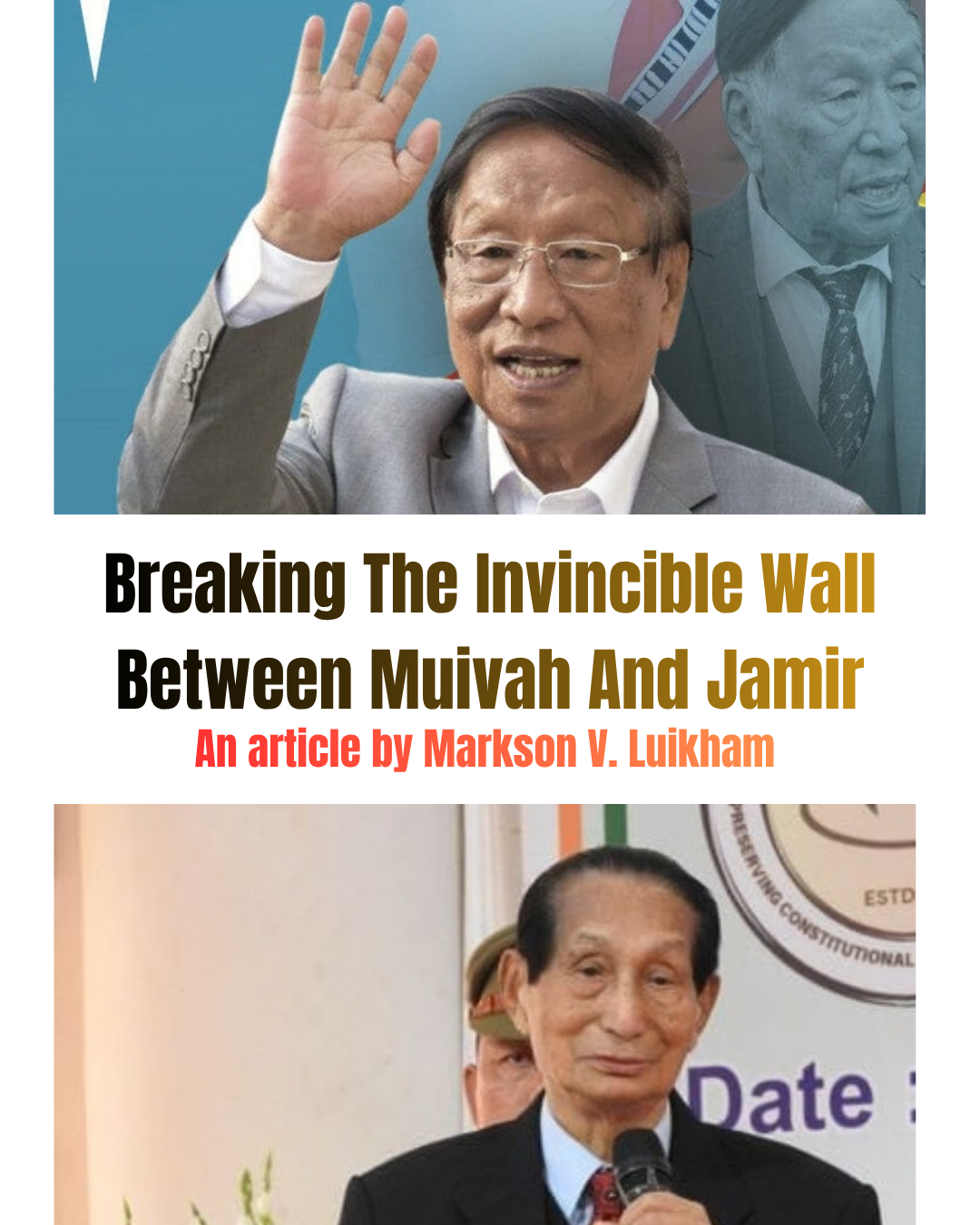
Breaking The Invincible Wall Between Muivah And Jamir
The greatest weapon for destroying your enemies or rivals is to befriend them.
Markson V. Luikham
In an anecdote later attributed to Abraham Lincoln, when criticised for speaking kindly of the South during the Civil War, Lincoln was often quoted as saying, “Madam, do I not destroy my enemies when I make them my friends?” He was not being sentimental. He was being strategic. He understood that a vanquished enemy who becomes a friend is an enemy destroyed forever, while a vanquished enemy who remains an enemy is a wound that festers and returns.
Philosophically, that sounds like a paradox. Politically, it is a chess move of the highest order. Religiously, it echoes the commandment to turn the other cheek. But humanly and practically, between Thuingaleng Muivah and Dr. S.C. Jamir, it sounds like a cruel joke. It sounds absurd. It sounds impossible. Because their history is not written in ink; it is carved into flesh with bullets and betrayals.
Let us be brutally honest about who these two men are, and about the power dynamics that place them on opposite sides of this wall, and why neither can simply be dismissed or underestimated.
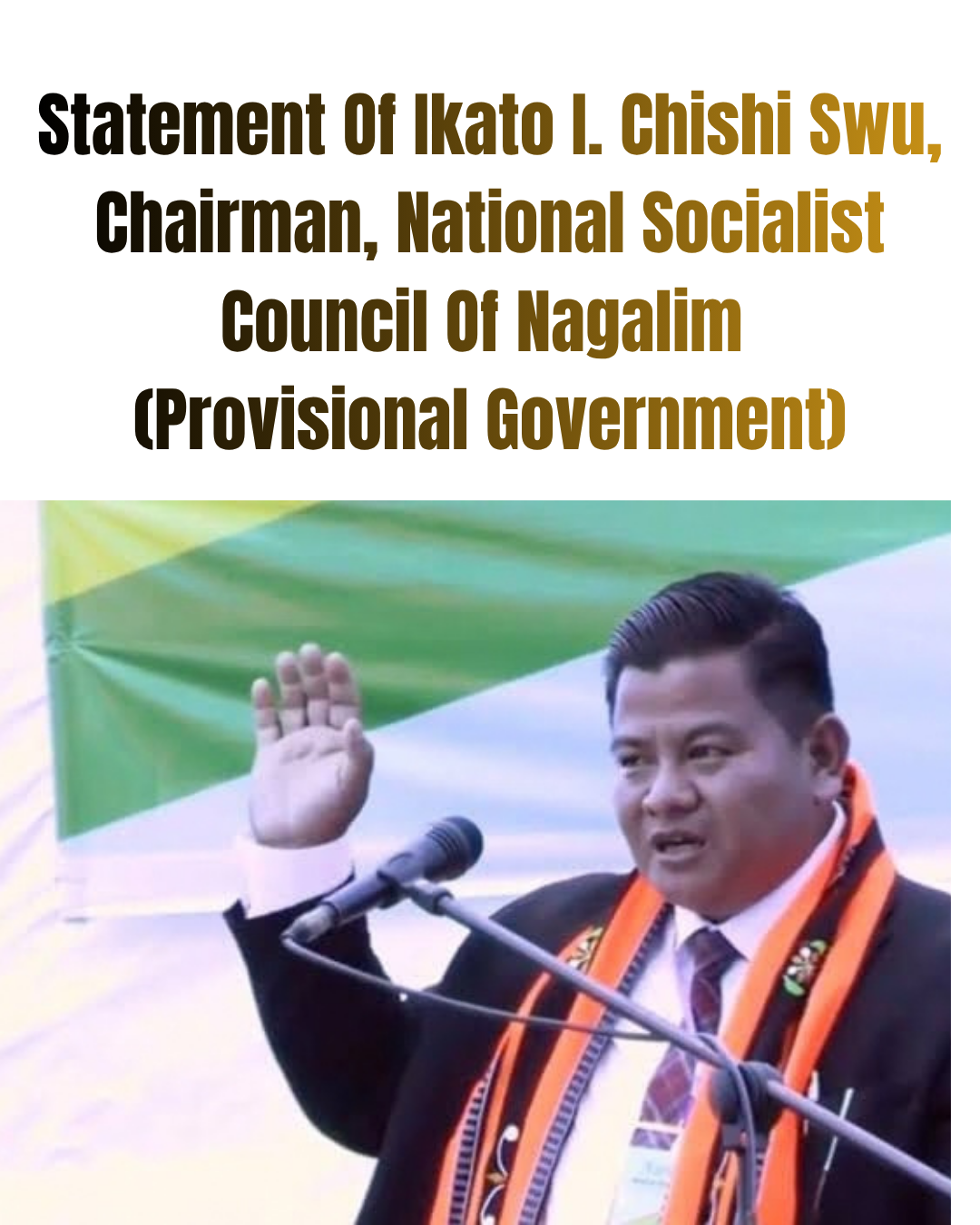
Th. Muivah commands the NSCN-IM, a movement with a pan-Naga political constituency extending across Naga-inhabited areas of Manipur, Nagaland, Arunachal Pradesh, Assam and Myanmar. His political vision is rooted in Nagalim, sovereignty and the political unity of the Naga people across the artificial boundaries imposed upon them. He and his comrade, the late Isak Chishi Swu, signed the 2015 Framework Agreement on behalf of the NSCN-IM after decades of armed conflict and political negotiations. The Government of India confirmed that Swu and Muivah were the NSCN signatories to the August 3, 2015 agreement.
The NSCN-IM’s position has been that the Framework Agreement recognises the unique history and position of the Nagas and provides the basis for a new political relationship between the Nagas and India. To Muivah, therefore, the issue is not simply about obtaining greater administrative powers or development packages from New Delhi. It is about the political identity of the Naga people and the nature of the relationship between the Nagas and India. He has repeatedly spoken of coexistence between the two entities and of sharing sovereign powers.
In his August 14, 2026 Independence Day address, read out by Deputy Ato Kilonser V.S. Atem, Muivah again declared that Naga sovereignty, the national flag and the national constitution were non-negotiable and that the final agreement must conform to the letter and spirit of the Framework Agreement. He declared, “On grounds of political expediency to please India, we shall not compromise our national sovereignty, flag, and constitution.” His political path is therefore directed toward an honourable settlement that preserves the national identity and political aspirations of the Nagas across the boundaries that currently divide them.
This is not a new position. In 2019, Muivah declared, “Come what may, we will stand for our rights till the end….our last word is we will never surrender on these two issues.” The two issues were the Naga national flag and constitution. In a later interview, when asked directly whether the Nagas would ever become part of the Indian Union, Muivah answered, “We will never be part of India.” When pressed further about whether the Nagas would surrender their rights, he gave perhaps one of the clearest expressions of his position: “We cannot. Whether it is here on Earth or there in heaven, we will not surrender. Ours is ours, yours is yours.” He then returned to the principle of peaceful coexistence between two entities. That quotation captures the political conviction behind Muivah’s position. It is not a negotiating slogan that can simply be traded away when the political atmosphere changes. His political narrative is built around the belief that the Naga political identity existed before the present constitutional arrangement and must not be surrendered merely for political expediency.
Dr. S.C. Jamir stands on a completely different historical foundation. A former five-time Chief Minister, a former Governor, an MP and the sole living signatory to the 1960 16-Point Agreement, he represents the constitutional history of Nagaland as an existing State within the Indian Union. His political life is deeply intertwined with the constitutional formation and development of Nagaland. His political authority comes from constitutional office, elections, statehood, parliamentary representation, his five terms as Chief Minister, his governorships and his role in the political process that produced Nagaland. His position is therefore rooted principally in Nagaland’s statehood and constitutional politics, while also operating within the larger constitutional and institutional structure of India.
These two men did not arrive at their present positions through the same historical road. To understand the disagreement between them, we have to understand that road and, above all, the political documents and settlements that shaped it. The 1960 16-Point Agreement was a foundational moment in the constitutional history of Nagaland. It provided that the Naga Hills-Tuensang Area would form a State within the Indian Union and that the State would be known as Nagaland. On December 1, 1963, Nagaland was formally inaugurated as a State.
Statehood, however, did not end the Naga political struggle. The political conflict continued, and the 1964 ceasefire eventually collapsed. The Shillong Accord of 1975 also failed to bring the armed conflict to a final conclusion and was followed by another major division in the Naga underground movement. The 1997 ceasefire opened another long period of negotiations, and in 2001 the ceasefire was extended beyond Nagaland. Yet the political question remained unresolved. The 2015 Framework Agreement created another major political opening, followed by the 2017 Agreed Position as the basis for a parallel process involving the NNPGs. For Muivah and the NSCN-IM, the Framework Agreement represented a political breakthrough based on the unique history and position of the Nagas and the foundation for a new political relationship.
The significance of this chronology is that the Naga political question has repeatedly survived agreements and ceasefires that were expected to bring it toward a conclusion. Statehood did not end it. The Shillong Accord did not end it. The ceasefires did not end it. The 2015 Framework Agreement created another major political opening, but it did not yet produce the final political conclusion that the Naga people continue to await. The 2017 Agreed Position created a parallel process, yet the larger political question also remains unresolved. That history helps explain why Muivah and Jamir now stand so far apart. They are not simply arguing over one policy or one document. They are working from two different political memories of the same historical journey.
Jamir’s political interpretation moves in the opposite direction. He has argued that the political process must move from an endless sovereignty struggle toward implementation of what he considers politically possible under the existing constitutional order. He has said that those who fought for an independent Naga nation made sacrifices that should be respected, but that Nagas should take what is possible under present political circumstances and be proud of what can be achieved. He has also argued that the solution must be inclusive and involve all Naga political groups rather than proceed through a piecemeal approach.
For Jamir, Nagaland itself represents a constitutional accommodation achieved through political agreement and given special constitutional protection under Article 371A. Не has argued that the essence of the 16-Point Agreement survived through constitutional protections and competencies. From that perspective, he has questioned why political discourse should continue around a separate flag and constitution when, in his formulation, those are attributes of a sovereign independent country.
Jamir’s position became particularly explicit in his later interventions. In April 2024, he urged Nagas to accept the existing Framework Agreement of 2015 and the Agreed Position of 2017 and called on the Nagaland Legislative Assembly to endorse them unanimously. His words were blunt: “In the name of sovereignty we have killed ourselves. Sovereignty was killed by us, not by others.” In November 2024, after meeting Union Home Minister Amit Shah, Jamir stated that there could be only “One Prime Minister, One Flag, One Constitution” in India and said that a separate Naga flag and constitution were not possible. In his argument, flag and constitution are attributes of sovereignty and cannot be separated from an independent sovereign State. If something is not possible, there is no point wasting decades insisting upon it. One should accept what is possible and ignore what is not.
Jamir has repeatedly criticised the effects of competing underground authorities and prolonged political uncertainty. In 2025, he described Nagaland as overwhelmed by factionalism, tribalism, sectarianism and egotism and said that many underground leaders had become detached from contemporary political realities. He argued that the two agreements were made on the basis of contemporary realities and that sovereignty and integration were not contained in either. After more than two decades of discussion, he argued that the signatories should honour what they had signed rather than continually reopen the same questions.
In 2026, he again complained about multiple authorities, extortion and threats and questioned how constitutional government could function when extra-constitutional authorities operated alongside it. In March 2026, he argued that the Government of India had already made its position clear. The negotiations had already debated sovereignty, constitutional arrangements, the flag and other core issues. The focus, in his view, should now be on implementing what had formally been agreed.
On September 19, 2026, Jamir went further in his statement, “Unveiling Bare Facts of Naga Political Struggle.” He argued that the Naga political struggle originated and matured in Nagaland. He pointed to the 1929 memorandum to the Simon Commission, the formation of the NNC at Wokha and the 1951 plebiscite under A.Z. Phizo as milestones carried out by the people of Nagaland. He argued that no other Naga tribes outside Nagaland participated in the original movement in the same manner and described the struggle as having been “born and fully matured in soil of Nagaland” before being “hijacked by alien elements.” From that position, he argued that the mandate and advocacy for Nagaland’s political future should be left to the people of Nagaland. He also contrasted the NNPGs’ publication of the Agreed Position with the NSCN-IM’s keeping of its competencies as a secret document.
He directly confronted the wider pan-Naga claim by asking whether Nagas from southern areas stood with the people of Nagaland during the greatest periods of violence and argued that the historical record should speak for itself regarding who originally carried the struggle. He criticised the NPF for returning to what he described as a “very old tune along with the secessionist groups and argued that it was not the time to revive issues he regarded as archaic or redundant. He appealed to “our brothers who are from other states” to understand the political realities of Nagaland and concluded that once a solution is made, other matters would find their place.
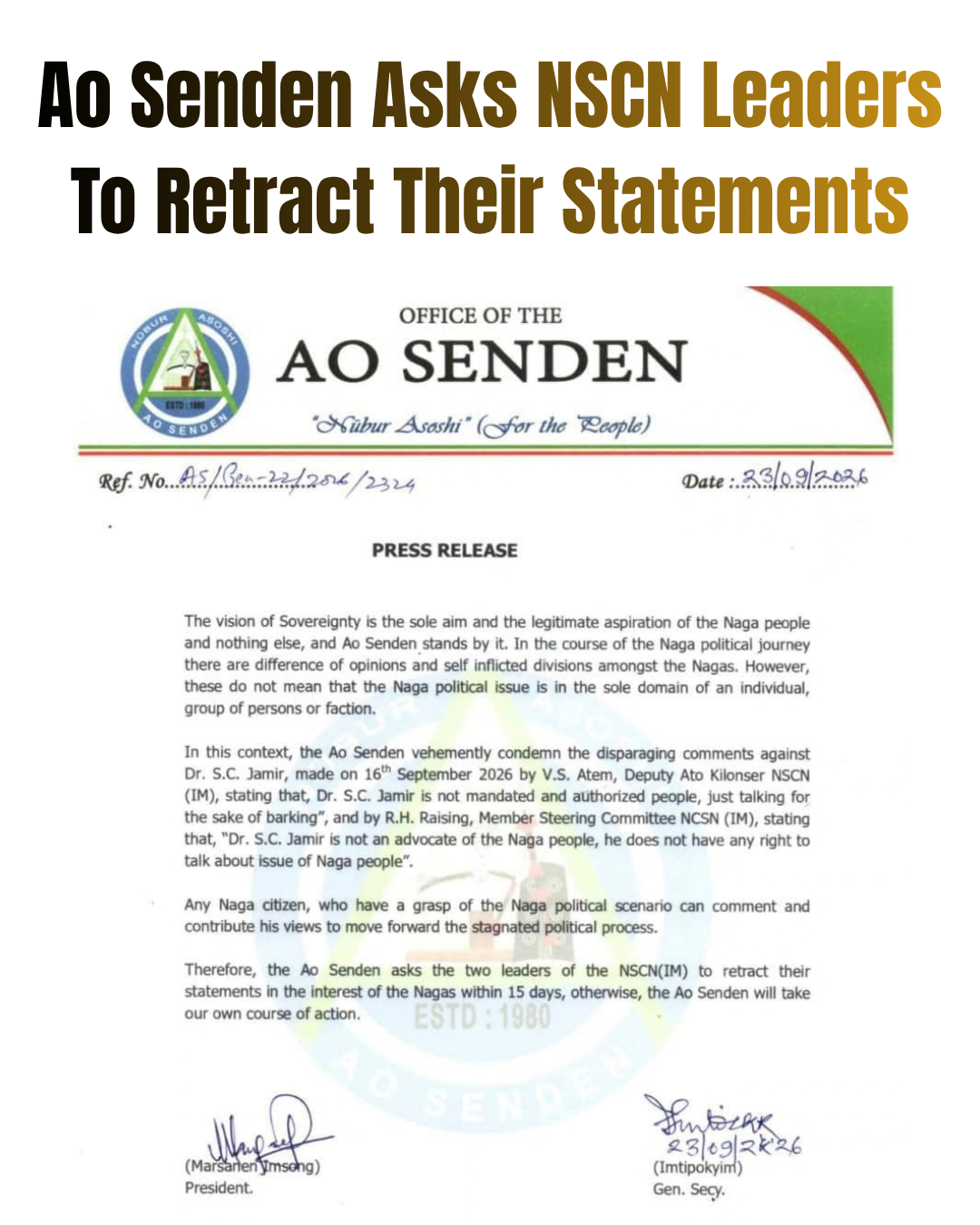
This is where the disagreement between the two political visions becomes personal. The NSCN-IM has publicly described Jamir as an “Indian agent” and “traitor” and accused him of betraying or obstructing the Naga cause. Jamir has responded from the constitutional foundation on which his political position rests. He has questioned the NSCN-IM’s interpretation of the political agreements, criticised its insistence on issues he regards as incompatible with the Indian constitutional structure and argued that the people of Nagaland cannot continue suffering because political parties refuse to implement what has already been agreed.
And the history is not merely made of arguments. Jamir survived repeated attacks on his life during his political career. On November 19, 1992, he was shot at Nagaland House in New Delhi and was taken to AIIMS after the attack. Five empty shells were recovered, and the incident was described as the third attempt on his life within a year. But who actually ordered or carried out those attempts? That remains unknown. In a political game where nobody sees everything happening behind the scenes, it would be wrong to attribute those attacks to the NSCN-IM, the Naga underground or any other political organisation without evidence. Only God knows who actually did it.
But the blood cannot be understood only through Jamir’s wounds. The larger Naga conflict left behind generations of deaths, displacement, fear, militarisation, underground violence, political repression and historical trauma. Different sides carry different memories of who suffered, who resisted, who betrayed, who sacrificed and who was responsible. People are not defending an abstract theory. They are defending memories of their dead.
Yet beneath the blood, the political arguments and the competing histories lies another question that neither side can escape: who speaks for whom?
Jamir’s political authority comes from constitutional office, elections, statehood, parliamentary representation and his role in the political process that produced Nagaland. Muivah’s claimed mandate comes from a national movement that rejects the confinement of the Naga political question to Nagaland and asserts that the political identity of the Naga people extends across present administrative boundaries. Therefore, when one side asks, “Who gave you the mandate?”, the question cuts both ways. Who authorised the NSCN-IM to determine the political future of every Naga? But equally, who authorised the State of Nagaland or the Government of India to determine the political aspirations of Nagas living outside Nagaland?
Jamir’s September 2026 position has brought this question sharply back into the public debate by arguing that the issue of mandate and advocacy should be left to the people of Nagaland, while Muivah’s political position rests on the opposite proposition that the Naga political question cannot be confined to the boundaries of one State.
The geographical question makes the mandate problem even harder. The Naga political question has never been confined entirely to present-day Nagaland. Naga communities. live across Manipur, Arunachal Pradesh, Assam and Myanmar. For Muivah and the NSCN-IM, the political future of the Nagas therefore cannot be reduced to one State. For Jamir, the political reality of Nagaland as an existing constitutional State cannot simply be ignored.
The territorial question then brings in political actors who are not controlled by either Muivah or Jamir. Manipur, Assam and Arunachal Pradesh are part of the Indian Union, and political constituencies in those states have opposed territorial changes associated with wider Naga integration. Any territorial settlement would therefore have to engage the constitutional and political interests of the affected states.
Jamir has argued that autonomy for Naga areas in Manipur and Arunachal Pradesh could instead be approached through the Sixth Schedule and that relevant competencies could be incorporated into India’s constitutional framework through Parliament. In that understanding, the Naga political problem can be addressed through maximum political accommodation within the Indian Constitution rather than through denial of the constitutional structure itself.
But the territorial question cannot be separated from the people who live in those territories. The NSCN-IM’s demand for integration has historically encountered opposition not only from the Government of India but also from political constituencies and populations in affected states that do not want their territories altered. These populations may not necessarily support Jamir personally. But their opposition to territorial alteration places them at odds with the territorial dimension of Muivah’s wider political project.
This is why neither man’s political reality can simply be wished away, and neither man can settle the Naga political question alone. There are the NSCN-IM, the NNPGs and other Naga political groups. There are political parties, tribal bodies, churches, civil society organisations, youth organisations and ordinary citizens across Nagaland and Naga-inhabited areas outside the State. There are also the communities and governments of the neighbouring states whose territories and political interests would be directly affected by any territorial settlement.
Even if Muivah and Jamir reconciled tomorrow, the political field would remain larger than both of them. Their reconciliation could open a political door, but it could not carry the entire Naga people through that door. The different constituencies would still have to enter the process themselves.
That is why reconciliation and agreement must be separated.
A handshake is not a settlement.
Muivah and Jamir could reconcile as human beings without suddenly agreeing on sovereignty, territory, the Constitution of India, the Naga flag, the Naga constitution, the Framework Agreement, the Agreed Position or the ultimate political structure of the Naga people. They could recognise each other’s history without surrendering their own understanding of history. They could agree that the Naga people have suffered enough without immediately agreeing on what sovereignty should mean or what constitutional arrangement should ultimately emerge.
There can be reconciliation without surrender, recognition without ideological agreement and accommodation without either side declaring that its entire history was wrong. But there cannot be a durable political settlement unless the competing political realities are eventually brought into one political process where they can be negotiated honestly. Otherwise, reconciliation itself becomes another demand for victory.
The purpose of reconciliation would not be to make Muivah become Jamir or Jamir become Muivah. It would be to create the political space in which they can disagree without treating disagreement as a reason to destroy each other. The objective would not be instant unanimity. It would be coexistence, accommodation and a willingness to negotiate the future rather than remain permanently imprisoned by the past.
Imagine, therefore, that these two leaders actually meet, sitting across from each other, not surrounded by followers, not speaking through press statements, not speaking through political organisations and not speaking through decades of accusations. Imagine two old men simply looking at each other. Two Naga brothers. Two men who have spent most of their lives standing on opposite sides of the same historical wound.
Perhaps they begin by saying everything they have already said publicly. Perhaps Jamir defends the 1960 Agreement. Perhaps Muivah defends the Framework Agreement. Perhaps they argue about sovereignty, the flag, territory and the mandate. Perhaps they accuse each other of having misunderstood history. And then, perhaps, after all of that, one of them asks a different question: “What have our people gained from our inability to resolve this?”
That is where reconciliation could become meaningful. It would require more than an emotional photograph. It would require political architecture. The two men would first have to recognise that neither political constituency can simply be eliminated. Personal attacks would have to give way to direct political dialogue. The different Naga political groups, political leadership, tribal institutions, churches, civil society and representatives of Naga-inhabited areas outside Nagaland would have to be brought into a wider process. Areas of common ground would have to be identified before the hardest questions were confronted. Above all, compromise would have to stop being treated automatically as betrayal. Only then could reconciliation move from symbolism to politics.
There is already something haunting in the fact that these two leaders may have spent most of their lives standing on opposite sides of this divide without ever having the opportunity to know each other simply as two human beings. As Jamir himself recounted, when the two met in Delhi, Muivah told him, “Jamir, so we may not meet again.” Jamir replied, “No need, because I told you everything during the discussions.” And everybody laughed.
It was a strange moment between two men standing on opposite sides of the greatest political divide among the Nagas. They were political enemies before they were personal enemies. Their images of each other were formed over decades through organisations, movements, political statements, accusations and historical memories. They became symbols to their respective constituencies long before they had the opportunity to know one another as two ordinary human beings.
The shockwave of such a reconciliation would extend far beyond the two men. Nagas across the artificial boundaries could suddenly begin looking in the same direction. Entrenched rivals, civil society leaders, underground factions, political parties, churches and ordinary Nagas standing on different sides of the divide could suddenly find themselves facing a completely different political situation.
Because when influential leaders move, people move. People can fight one another. because of leaders. People can also unite because of leaders. That is the power of leadership, both in the worldly sense and in the biblical sense.
But the real power of such a reconciliation would not be that every Naga suddenly agrees with everything Muivah says or everything Jamir says. It would be that the two men prove something far more important: that two historically incompatible political narratives can coexist long enough to negotiate a future. That is the real political experiment. It is not Muivah defeating Jamir, Jamir defeating Muivah, one political document erasing another or one history silencing another. It is two men recognising that the Naga political question has become too historically complicated for either side to eliminate the other.
A reconciliation between Muivah and Jamir would not mean that every Naga would suddenly agree on sovereignty, integration, the Constitution of India, the Framework Agreement, the Agreed Position or the future shape of the Naga political settlement. But the psychological impact could still be enormous because two men who have come to embody opposite political positions would have broken the most visible barrier between their camps. Once the leaders cross the barrier, it becomes harder for the followers to insist that it is permanent. The people could begin demanding that the political question be settled rather than endlessly fought over. The underground factions, civil society, churches, political leaders, youth and ordinary citizens could begin asking the same question from different directions: how do we finally bring the Naga political process to a conclusion?
Among all the achievements of their lifetimes, such a reconciliation could become their last and most monumental gift to the living Naga people, a gift that generations to come may remember long after the offices they held, the documents they defended and the battles they fought have passed into history.
That question does not require unanimity. Unity is not unanimity. A united Naga political community does not require every Naga to agree on sovereignty, the Framework Agreement or constitutional arrangements. It could mean something more basic and more difficult: we disagree fundamentally, but we refuse to destroy one another because of our disagreement. “If a house is divided against itself, that house cannot stand” (Mark 3:25). “Blessed are the peacemakers, for they shall be called children of God” (Matthew 5:9). Reconciliation is not weakness. In the most difficult political conflicts, it can become a form of strength.
But the biggest question remains: who will break this invincible wall between them? Who will make the first move? Who will bell the cat?
Perhaps neither. Perhaps both will continue to stand their ground until the very end because human beings are, by nature, blinded by hubris, greed, pride, prestige and ego. They become prisoners of their own words and prisoners of their own past. They seldom do the right thing even when they know what is right.
Perhaps it may happen if God himself intervenes. But humanly, this remains almost impossible because the wall between them is built from blood, history, pride, wounds, prestige, competing mandates, political memories and human ego. And yet perhaps the Naga people, weary of decades of division, bloodshed, waiting and political uncertainty, may one day demand that their leaders reconcile.
Perhaps one of these two old men will realise that there is not an eternity left to carry the burdens of the past. Perhaps one will swallow his pride, extend his hand and say, “Enough. Let us finish what we started, for the sake of our people.” And perhaps the other will take that hand. But then comes the harder question: what happens after the wall falls?
Breaking the wall is not the settlement.
After the handshake, the questions remain. What happens to sovereignty? What happens to the national flag and constitution? What happens to the Framework Agreement and the Agreed Position? What happens to the 1960 settlement? What happens to the territorial question and the Nagas living outside Nagaland? What happens to the Constitution of India? What happens to the other Naga political groups? What happens to those who accept neither Muivah’s position nor Jamir’s position?
What happens to the victims and families who continue to carry the wounds of the conflict? Who guarantees the final agreement, and how is that agreement explained and legitimised among ordinary Nagas?
These questions do not destroy the dream of reconciliation. They show why reconciliation would matter. The true test would not be whether Muivah and Jamir can agree on everything. It would be whether they can sit together long enough to prevent their disagreement from destroying the possibility of a future.
And perhaps this is where the opening paradox returns. Muivah does not destroy Jamir by defeating him. Jamir does not destroy Muivah by defeating him. They destroy the hostility between them by making the other man unnecessary as an enemy. That may be the greatest political act either man could ever accomplish before they are called to their eternal home by God.
A house divided by hate cannot stand, but two brothers reconciled can move a mountain. The wall between Muivah and Jamir is not made of stone or iron. It is made of pride, history, wounds, prestige, ideology, competing mandates, political memories and human ego.
Stone can be broken. Iron can be cut. But the hardest wall to destroy is the wall that human beings build inside themselves and then defend for the rest of their lives. Perhaps the wall is invincible only as long as both men believe that crossing it means surrender. Perhaps one day they may discover that crossing the wall does not mean surrendering their history. It means refusing to allow history to imprison the future.
Perhaps the wall can become a doorway. Perhaps the greatest victory is not to defeat the man standing across the wall, but to cross the wall and bring him home. Perhaps the day two enemies become brothers again, the wall that divided them will become the monument to the day it finally fell.
May God intervene.
Kuknalim.
Markson V. Luikham is an independent researcher and writer focusing on the Indo-Naga issue, Naga political affairs, and the history and contemporary affairs of Northeast India.
(The views and opinions in this article are solely those of the author and do not necessarily reflect the official stance of Rural Post)