
“Those who choose to live in the past remain prisoners of the past. Those who dare to take a giant leap into the future become architects of a new tomorrow.”
A child sitting in a relief camp with a schoolbook in his hands may appear to be doing something ordinary. Behind that simple act may lie memories of a classroom left behind, friends separated by violence and a home that may no longer exist. A rebuilt house can provide shelter again. A repaired road can reconnect villages. A school building can open its doors once more. The deeper damage caused by conflict lives in relationships, memories and feelings of insecurity. It is the loss of trust between people who once lived, studied, worked and travelled together. What kind of Manipur do we want this child to inherit? A Manipur carrying the memories of violence, or a Manipur where children can grow up with hope, security and confidence?
Manipur has experienced years of conflict and deep social disruption. The violence that began on 3 May 2023 resulted in deaths, displacement, destruction of homes and disruption of education and livelihoods. The circumstances and causes of the violence remain subjects of public and political debate. For ordinary people, the human consequences have been painfully real. Families have been separated, children have seen their education interrupted and many people have had to rebuild their lives after losing homes, livelihoods and a sense of security.
A child does not choose the community into which he is born. Yet a child can inherit the consequences of the choices adults make today. This thought should remain at the centre of every discussion about Manipur’s future. The decisions taken by today’s generation will shape the environment in which the next generation grows up. Children deserve classrooms where they can learn together, friendships that are free from fear and a future in which their identity is a source of dignity and confidence.
Manipur is home to communities with distinct histories, cultures, identities and aspirations. Meitei, Naga, Kuki and other communities have their own experiences and concerns. Every community has families who have suffered, people who have lost loved ones, young people whose education has been interrupted and households that have experienced displacement and uncertainty. Every experience of suffering deserves recognition. Any meaningful effort to rebuild Manipur must recognise the dignity, concerns and aspirations of all its communities.
The future of Manipur cannot be reduced to communities alone. Manipur belongs to all of us, and its future belongs to all of us. We share this land, its mountains and valleys, its memories, its struggles and its hopes. We may carry different histories and aspirations, yet we remain part of one larger home. We have inherited Manipur from those who came before us, and we have a responsibility to leave it safer, stronger and more peaceful for those who will come after us.
The spirit of Manipur lies in its unity. That unity gives space to diversity, identity and mutual respect. It also reflects the larger spirit of India, a country where different communities, cultures, languages and traditions live within one constitutional framework. If we protect the unity of Manipur, we protect the future of every community that calls it home. If we rebuild trust among ourselves, we strengthen. Manipur itself. We all are together, and we shall remain together. Our diversity gives Manipur its character, and our shared commitment to peace can give its future strength.
Rebuilding Manipur requires patience and understanding. Roads, bridges, houses, schools and government offices can be repaired through public resources and administrative effort. Trust between communities grows through human contact, honest conversation and time. People need opportunities to meet again, listen to one another and gradually restore confidence. Relationships damaged by violence require sustained attention and care.
The role of the state remains central to this process. Government institutions have the responsibility to maintain law and order, protect citizens, provide relief, support rehabilitation and create conditions for development. Security forces and the civil administration carry important responsibilities in maintaining security and protecting vulnerable people. Government initiatives for rehabilitation and resettlement provide an essential foundation for families seeking to rebuild their lives. Peace also requires participation from society. Religious institutions, traditional bodies, civil society organisations, educational institutions, students, teachers, writers, professionals and ordinary citizens can create spaces where people are able to meet and speak with dignity and without fear.
One important step would be for leaders representing the major communities of Manipur to sit together regularly. Such meetings can begin with listening. Leaders can speak about the fears, losses and concerns of their people and discuss security, displacement, rehabilitation, education, land, representation, constitutional safeguards and the future of inter community relations. Such engagement can help people understand the concerns of others and identify peaceful ways of addressing differences. Regular communication can gradually create confidence. If leaders can sit together and speak about difficult questions, can ordinary people also begin to speak to one another again?
There is already an important precedent for dialogue. On 15 October 2024, a group of elected members of the Manipur Legislative Assembly representing the Kuki Zo Hmar, Meitei and Naga communities met in New Delhi to discuss the situation in the state. According to the Ministry of Home Affairs, the representatives unanimously appealed to people across all communities to shun violence so that no more innocent lives would be lost.
The Government of India had also constituted a Peace Committee in June 2023 under the chairpersonship of the Governor of Manipur. Its membership included political representatives, former civil servants, educationists, litterateurs, artists, social workers and representatives of different ethnic groups. Its stated mandate included facilitating peaceful dialogue and negotiations, strengthening social cohesion, promoting mutual understanding and encouraging cordial communication between different ethnic groups.
India has faced difficult periods of violence and social division in different parts of the country. In many places, people eventually found ways to restore everyday life through dialogue, reconciliation, rehabilitation, community engagement and the gradual rebuilding of relationships. Painful memories remained, and trust took time to return. Families, community leaders, civil society organisations, educational institutions and governments contributed in different ways to creating conditions for people to live together again. These experiences offer Manipur an important lesson: societies can recover from periods of violence when people choose to rebuild relationships and create space for a shared future. Manipur can begin that journey with courage, patience and a commitment to peace.
We cannot afford to ignore the problems we are all facing. Manipur needs more investment. We need national standard roads, hospitals, schools and public infrastructure. Our young people need jobs and opportunities here so that they can build their futures within the state. Our businesses need a peaceful and stable environment to grow. Our villages need better connectivity and basic services. These problems affect every community. They affect Meitei, Naga, Kuki and people from every other community living in Manipur. They affect the people of Manipur.
If we spend our energy fighting one another, our development challenges will continue to grow. We have to open our eyes to this reality. Peace provides the foundation for investment, development, employment and a better future. Every year lost to conflict carries a human cost. It can mean another year of interrupted education, lost employment opportunities, delayed investment and families living with uncertainty. If we continue spending our energy against one another, who will build the roads, schools, hospitals and businesses our children need? Who will create the jobs that can keep our young people in Manipur?
Our young people deserve opportunities to study, work, build businesses and raise families in their own state. Manipur has human talent, natural resources, cultural richness and a strategic location. Unlocking these possibilities requires stability, confidence and cooperation. Development can become a shared agenda capable of bringing people together around practical goals.
Meitei, Naga and Kuki communities living outside Manipur can also play a constructive role in the peacebuilding process. Many people who live in other parts of India and abroad remain deeply connected to their families, communities and homeland. They have professional networks, academic connections, social platforms and access to resources that can support dialogue, reconciliation and development. Community organisations can bring young people together, organise cultural and educational programmes, support humanitarian and rehabilitation efforts and encourage responsible conversations about Manipur. They can also connect local initiatives with professionals, institutions and resources outside the state. Their voices carry influence within their respective communities, and that influence can encourage restraint, discourage hatred and create greater understanding. People living outside Manipur remain part of the state’s wider social fabric, and they too can contribute to rebuilding trust and creating a peaceful, secure and prosperous future for the next generation.
Manipur also needs to recognise that conflict can take different forms in different places. Tensions between communities can emerge at the local level and deepen when trust is already weak. The experience of violence in different parts of the state reminds us that peace in Manipur requires attention to relationships between all communities. Every community is a stakeholder in building peace. Community leaders, local institutions and ordinary citizens can help prevent tensions from becoming wider divisions by encouraging communication and cooperation.
Justice is an important part of healing. People who have lost family members, homes, property, livelihoods and years of education deserve recognition and support. Allegations of crimes must be dealt with through lawful institutions, due process and fair investigation. Accountability can help. restore confidence in institutions and give victims a sense that their suffering has been acknowledged. Justice can provide a foundation for healing when it is pursued through institutions that people can trust.
Revenge can extend the life of a grievance and leave another generation carrying its consequences. Revenge will not take Manipur towards a peaceful future. What will revenge give us after another home is destroyed, another family is displaced or another young life is lost? Will it return those we have already lost? Grievances need to be heard. Justice needs to be pursued through lawful institutions. Political questions need to be addressed through peaceful and constitutional means. Choosing dialogue after violence requires courage. It also creates an opportunity to build a safer future for the next generation.
Rehabilitation needs to address the whole life of a displaced family. People need safe homes, education, healthcare, employment and secure livelihoods. Children who have witnessed violence need safe spaces to learn and grow. Young people need opportunities to meet others from different communities and rebuild ordinary relationships. These everyday connections can gradually reduce fear and suspicion.
Schools and colleges can play an important role in this process. Educational institutions can organise inter community discussions, cultural programmes, student exchanges, academic visits and collaborative projects. Young people who study together can develop relationships based on shared experiences. Education can help create a generation that understands difference, respects diversity and values peaceful coexistence. The classroom can become one of the places where trust begins to grow again.
The rebuilding of trust will take time. There will be painful memories, unanswered questions and genuine disagreements. These realities deserve acknowledgement. Peace grows when people create space to speak about them with dignity and patience. Listening to another person’s experience allows us to understand the human cost of conflict. Such understanding can create the foundation for empathy and reconciliation.
Manipur’s future depends on the ability of its people to imagine a future beyond the memories of violence. The lessons of the past can guide the choices of the present. The next generation deserves an environment where children can attend school without fear, young people can pursue careers, families can travel freely and communities can interact with confidence. Rebuilding Manipur requires rebuilding relationships, restoring confidence between neighbours, creating opportunities for young people and strengthening respect for the democratic and constitutional framework.
Let the leaders of all major communities sit together and create a sustained platform for conversation. Let civil society create spaces where people can meet with dignity. Let the government continue its responsibilities for security, justice and rehabilitation. Let educational institutions bring young people together. Let communities living outside Manipur contribute their experience, networks and resources to the peacebuilding process. Let ordinary citizens reject rumours, hatred and collective blame. These actions can gradually create a culture of peace.
What will we leave behind for our children: our grievances, or a peaceful Manipur? The answer will be shaped by the choices we make today. Let us come together and build Manipur. Change begins with the individual. It begins when each of us chooses restraint, conversation and understanding. The responsibility for peace belongs to every community, every institution and every citizen. Manipur can rebuild its homes, roads and institutions. It can also rebuild the relationships that hold society together. From that renewed trust, a more peaceful Manipur can emerge.
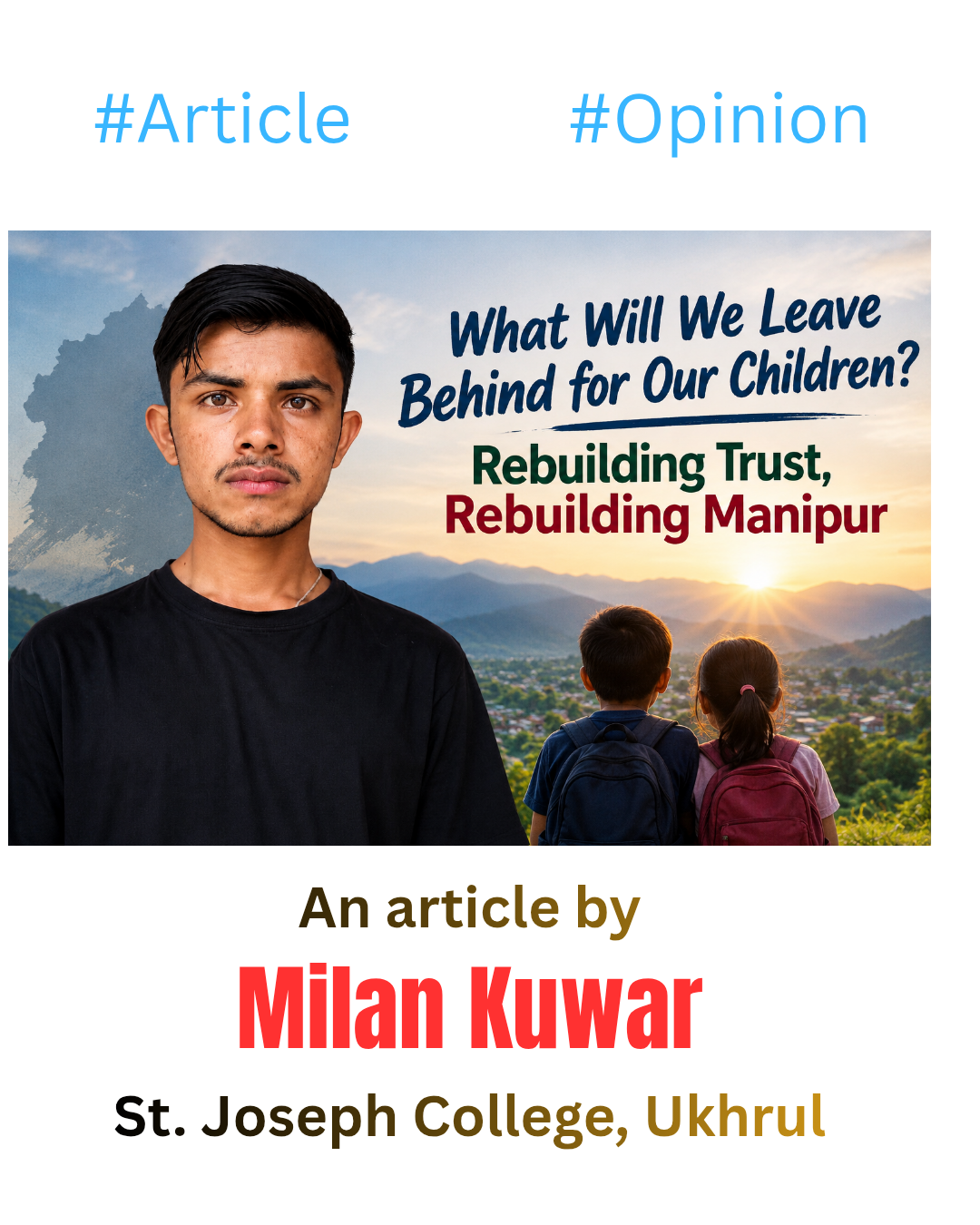
Milan Kuwar
7th Semester
Political Science Department
St. Joseph College, Ukhrul