
“If we are ashamed of being Hao, then we are running away from the truth.”
Stephen Angkang, Songs of Mashangva (documentary), 2013, quoted by Mawon Somingam in “Understanding the Origins of the Terms ‘WUNG’, ‘HAO’ and ‘TANGKHUL” International Research Journal of Social Sciences, Vol. 3(5), May 2014, pp. 36-40.
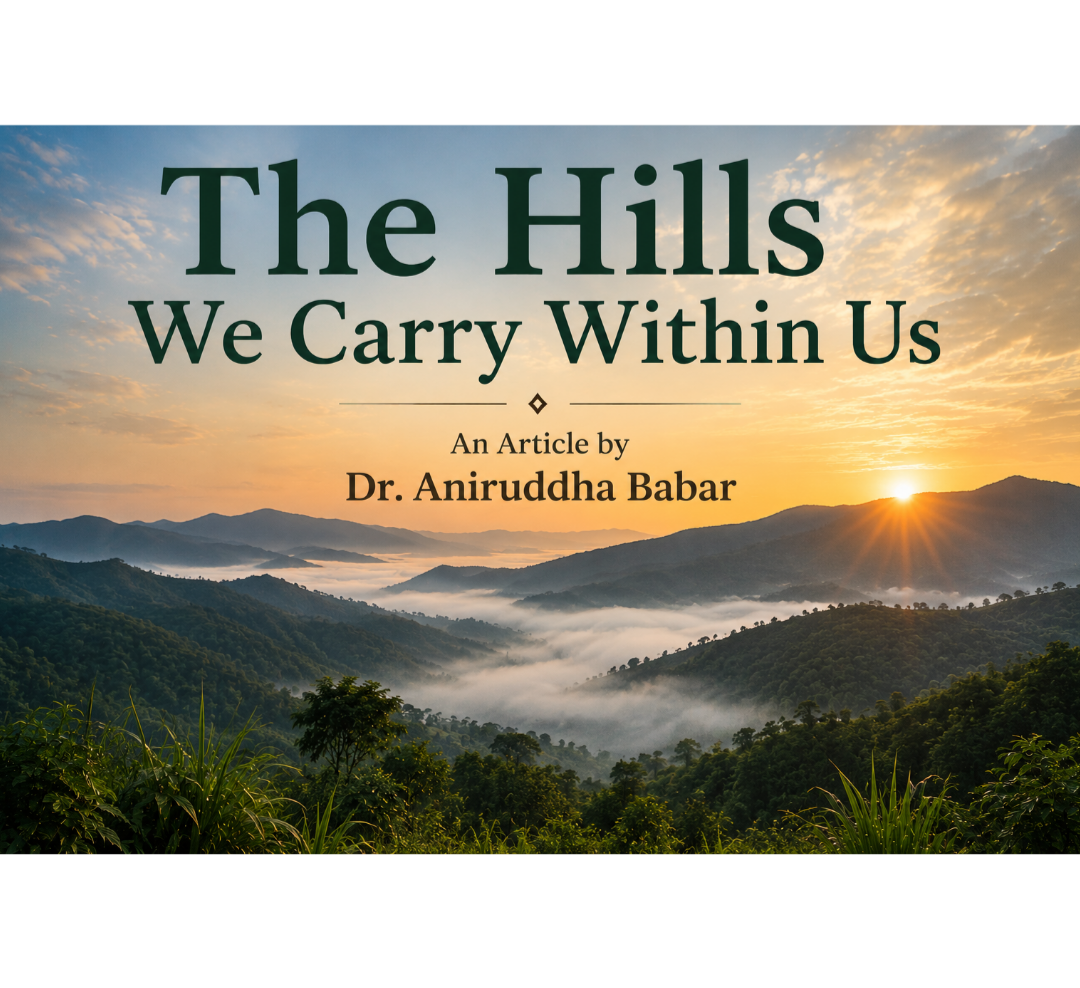
Morning comes to Ukhrul in its own time. On the ridges above Hunphun, the light begins to touch the roofs and fields before the town has fully stirred. Around the town lie settlements, forests and cultivated slopes, while Shirui rises beyond them, its name inseparable from the landscape and from the Shirui Lily that has become closely associated with Ukhrul. Each village has its own memories. and its own ways of speaking. Tangkhul belongs to the Tangkhulic branch of the Sino Tibetan. language family and is spoken in numerous village varieties. The speech associated with Ukhrul, or Hunphun, has developed an important role as a common language among Tangkhuls. Above all of this stands the mountain, familiar to generations who have grown up beneath it. A mountain seen every morning becomes part of ordinary life. A path remembers the children who once walked along it to school. A field carries the labour of families who have cultivated it for years. A particular bend in a road may bring back someone who left long ago. This is how a landscape becomes part of a person. It happens slowly, often without our noticing. Then one day we leave and discover that the hills have gone with us. This may be one of the simplest ways to begin thinking about what it means to be Tangkhul today. The young Tangkhul lives in a world of universities, smartphones, social media, cities and opportunities that earlier generations could hardly have imagined. English may be the language of education and professional life. Other languages enter through travel, friendship, work and migration. A person may grow up in Ukhrul and later build a life in Mumbai, Delhi, Bengaluru, Pune or somewhere much farther away. Yet the village remains present in ways that are difficult to measure. It survives in speech, food, songs, names, stories, friendships and memories. The question is not whether the Tangkhul will change. Every generation has changed. The more interesting question is what will remain with them as they do.
There are places a person leaves and somehow continues to inhabit. For many Tangkhuls, the village is such a place. Someone can spend years away and still remember the sound of rain on a roof at home, a particular road, the smell of food cooking in the evening or the voice of an elder calling from another room. Sometimes the memory is so ordinary that it seems insignificant until it returns unexpectedly. A word heard in a crowded city can take a person back to childhood. A song can bring back a face. A photograph can make a distant hillside feel close again. Home is often made of these small things. It is less a single location than a collection of experiences that remain with us.
The Tangkhul have lived with movement and change for generations. Their principal homeland in India lies in the hills of Manipur, particularly in present day Ukhrul and Kamjong districts, while Tangkhul communities are also found elsewhere in Manipur, Nagaland and across the international boundary in Myanmar. The political map determines citizenship, administration, movement and security. Family histories and cultural memories have their own paths. A person may know the name of a village because a grandparent came from there, or recognise a place because it has appeared in family stories for as long as anyone can remember. Geography becomes personal in this way. A map shows where a place is. Memory tells us why it matters.
The village was once the centre of Tangkhul political and social life. Historical accounts describe Tangkhul villages as organised communities guided by customary laws and institutions. The Awunga, or village headman, traditionally worked with a village council, while village territory, agriculture, forests and water sources formed part of an integrated social world. These were not simply resources surrounding a settlement. They were places where people worked, met, remembered and raised their families. A child growing up in such a community learnt much without anyone formally teaching it. One watched older people. One listened to conversations. One learned how people behaved towards neighbours, elders and guests. Much of culture entered the mind in this unannounced way.
The past of a people is preserved in many forms. There are written histories, government records and scholarly accounts, but there are also family stories, songs, place names and memories carried by elders. They do not always agree, and they do not need to. A family may remember an event differently from another family. One village may tell a story in a form that another village does not know. Oral history changes as it travels. A detail may disappear and another may become more important. What matters is that the conversation continues. A person tells a story because there is something worth remembering. Someone younger listens, perhaps without fully understanding its importance at the time. Years later, that same story may return with a different meaning.
For earlier generations, education was integrated into everyday life. Children learnt through the household, the fields, village gatherings, stories and songs. They learnt the language by using it. They learnt responsibility by watching adults perform it. They learnt the landscape because they walked through it. A hill had a name. A spring had a place in village life. A field was associated with particular families. A path could lead to another village, a field or a childhood memory. Knowledge was often inseparable from relationships.
The traditional dormitory institution also had a role in preparing young people for community life. Modern education has transformed the possibilities available to Tangkhul youth. Schools, colleges and universities have opened paths into professions and fields of knowledge that earlier generations could scarcely have imagined. Education is no longer confined to the knowledge acquired within the village. Yet an older question remains valuable: what sort of person does education help create, and what does a young person carry from home while entering the wider world?
Christianity brought another major transformation. William Pettigrew arrived among the Tangkhul in 1895, and missionary education became associated with the spread of Christianity and literacy. Written language gave Tangkhul memory another form. Stories that had lived primarily through speech could be written down. Songs could be recorded. New forms of education became possible. Christianity, literacy and formal schooling became part of a changing social landscape that would shape generations of Tangkhuls.
Writing changed the life of memory. A story could move from a person’s voice to a page. Later it could move from a page to a recording, a photograph, a website or a digital archive. Each generation. has found another way of keeping something. Tangkhul oral literature, including tales, songs, proverbs and riddles, has also been documented, allowing aspects of older cultural knowledge to continue to be studied and remembered.
The question eventually returns to language, because language is perhaps the most intimate form of home. Tangkhul is spoken through numerous village varieties, and linguistic research has described substantial variation across the Tangkhul area. Hunphun, the language associated with Ukhrul town, has developed an important lingua franca function among Tangkhul communities. For someone who grows up speaking a particular village variety, these differences may seem ordinary. To a linguist they reveal histories of contact and change. To a family, they may simply be the way grandmother speaks.
This is why language preservation cannot mean putting a language behind glass. A language remains alive when people use it to talk about the things that matter to them now. It should be able to speak about university examinations, jobs, relationships, technology, politics, music, humour and the frustrations of daily life. It needs writers and readers. It needs songs and conversations. It needs young people who feel that speaking it belongs naturally to their lives.
The linguistic world of a young Tangkhul is already multilingual. English is important in education and professional life. Hindi enters through migration, media and wider communication in India. Other languages appear through travel, friendships, work and family life. Knowing several languages can be a strength. The challenge is to ensure that the language of home remains part of everyday life rather than becoming something associated only with older generations.
Today, even this intimate world of language is entering a new technological age. Recent work on Tangkhul English machine translation points towards a new stage in the digital life of the language. For a smaller language, computational representation matters because digital systems increasingly shape how languages are searched, translated, recorded and shared. The appearance of Tangkhul in such systems gives another generation another place in which to use it.
Yet no technology can replace the person who gives language its meaning. A machine may store a sentence. It cannot know why a grandmother chose that particular word. It may translate a story. It cannot remember the person who first told it. It can preserve a recording. The meaning of the voice still comes from the relationship between the people who hear it.
That is why the old act of listening remains important.
An elder tells a story. A child listens. The story moves a little farther.
It is a simple exchange, but much of culture depends on it.
And it can be lost easily. An elder dies before a story is recorded. A word falls out of everyday speech. A song is no longer sung. Someone remembers the melody but not the meaning. A place retains its name while the story behind it fades. Cultural loss rarely arrives as a dramatic event. Often it happens through small absences.
Music has long given Tangkhul memory another way to travel. Songs have carried seasonal experiences, historical memories and philosophical ideas, while festivals such as Luira Phanit, Yarra and Mangkhap remain part of Tangkhul cultural life. A song can outlive its composer. It can change slightly in the mouths of different singers and still remain recognisable. Someone born decades later can hear it and feel that they have encountered something older than themselves.
The land has its own language. The Tangkhul hills are forests, fields, streams, ridges and mountains, but they are also memories. Shirui Kashong is famous for the Shirui Lily. Yet for a person who has grown up near Shirui, the mountain can mean much more than a botanical rarity. It may be the view from a house, the destination of a journey, the background to childhood or simply the mountain that was always there.
The same is true of agriculture. Farming remains hard work and young people understandably look towards education and employment that can offer greater security. A better road to a village, a reliable market for its produce, improved storage or a small processing facility can sometimes determine whether a young person sees farming as a future or as something to leave behind. Development can strengthen the relationship between people and land rather than making that relationship irrelevant.
Traditional crafts also deserve a place in that future. Nungbi black pottery carries knowledge of materials, technique and place. If younger generations find an economic and creative reason to learn such skills, the craft can remain part of contemporary life rather than becoming something remembered only through photographs.
Migration has become part of Tangkhul life too. Young people leave for education and work. Some return. Some establish permanent lives elsewhere. A Tangkhul doctor in Delhi is still Tangkhul. So is a student in Bengaluru, a professional in Mumbai or a researcher living overseas. Distance changes people’s relationship with home. Sometimes it makes its absence more noticeable.
I have been fortunate to have many Tangkhul friends over the years, from Ukhrul, Mumbai, Dimapur, Kohima and Pune. More than once, friends have told me, with a warmth I have come to treasure, “You are a Naga just like us.” I have always remembered those words. Since I began living in Ukhrul, they have come to mean something more to me.
Living here has allowed me to know the Tangkhul through ordinary life rather than through books alone. There are conversations that continue long after one thought the evening was over. There are meals shared without ceremony. There are stories about families and villages, jokes that make sense only after one has spent enough time with people, disagreements that reveal how strongly people care about their communities and acts of hospitality that need no explanation. These are small experiences, but they are the experiences through which a place becomes familiar.
I have also discovered that some of the things one learns in a community cannot easily be written. down. They are found in the way people remember elders, in the way neighbours respond when someone needs help, in the patience required by village life and in the ability to maintain a sense of humour when circumstances are difficult. Living among the Tangkhul has made me aware of how much I have learnt without intending to learn it.
I came to Ukhrul as a Professor and researcher. Over time, I have found myself becoming a student of the place and of the people who have welcomed me into their lives. I feel that the ancient wisdom carried by the Tangkhul has helped me grow as a human being.
That realisation has changed the way I look at belonging. Perhaps belonging is sometimes given to us by other people before we know how to name it ourselves. A friend says, “You are one of us,” and the sentence stays. It does not erase the differences between people. It creates a place for affection and trust.
For me, the generosity and strong brotherhood of Tangkhul friends from national workers to common shopkeepers, from senior statesmen, student leaders to retired civil servants, pastors, scholars, writers, journalists, artists, farmers has made Ukhrul increasingly familiar. That familiarity has changed the way I see the hills, the roads and the everyday life around me.
Tangkhul life has travelled with migrants into cities. Festivals, food, music, language and family relationships continue beyond the hills. A gathering in Mumbai or Pune cannot reproduce the landscape of Ukhrul, but it can reproduce something else: the feeling of being among people who understand the same references, remember the same songs or recognise a familiar way of speaking. A young person surrounded by the noise of a large city may suddenly hear a Tangkhul greeting and feel, for a moment, that home is close.
This becomes particularly meaningful when thinking about Tangkhul communities across the India Myanmar border. The political circumstances on the two sides are different and the border has real consequences for people’s lives. Yet family histories, language and memory have their own histories. People can remain connected to places they may no longer be able to visit easily. A political boundary can change the circumstances of belonging without erasing the memories through which belonging was formed.
For a Tangkhul, belonging can gather several places and relationships into the same life: the village, the wider Naga world, India and family memories that reach across the international boundary. These layers can exist within the same person.
Young Tangkhuls are growing up with all of this. They have access to global culture through their phones. They study subjects their grandparents never encountered. They enter professions that earlier generations could not have imagined. They move between languages and cities. Some marry outside the community. Some remain at home. Others return after years away.
Their lives will not look like the lives of their grandparents. They are not supposed to.
The task is not to keep the present frozen. It is to make sure that change does not make people strangers to their own inheritance.
Women have a particularly important place in this story. Much of culture is passed through ordinary domestic and community life. Women carry language, food practices, songs, family memories, craft knowledge and countless habits that rarely enter official histories. A grandmother correcting a child’s pronunciation is doing more than correcting a word. A mother telling a family story is preserving something that may never appear a book. A woman who continues a craft keeps alive knowledge that otherwise might disappear.
Much of cultural continuity happens in such ordinary moments.
Perhaps this is also why Tangkhul literature matters. Tangkhul writers and poets are writing about the present as well as the past, about faith, identity, love, history, loss, place and change. Collections of Tangkhul oral literature have preserved tales, songs, proverbs and riddles, while contemporary writers continue to find new forms in which the community can speak.
A.C. Kharingpam, reflecting on Tangkhul poetry in his introduction to The Red Rhododendron Songs, observes that each poet can reveal “a thousand stories that have never been told in any form”. The thought seems especially relevant to a culture whose memories have travelled for generations through voices, songs and stories.
Literature gives a people another way to look at itself. It can remember the past and question it. It can celebrate and grieve. It can tell younger people that their experiences are worth putting into words.
A language needs dictionaries, but it also needs poems. A community needs historians, but it also needs storytellers. Old songs deserve to survive, and young musicians should be free to create songs their grandparents never heard.
That is what keeps a culture alive.
Perhaps Tangkhul identity is best understood as a conversation between generations. The older generation leaves behind words, memories, songs, institutions and ways of seeing the world. The younger generation receives these things and decides what to do with them. Some are retained. Some are changed. Some are forgotten. Others are rediscovered years later.
There is no single Tangkhul experience. A person from one village may understand the world differently from someone from another. Someone who has lived all their life in Ukhrul may see home differently from someone who grew up in Mumbai. A young person born outside the hills may have a different relationship with the language from an elder who has never lived elsewhere.
These differences are part of contemporary Tangkhul life.
This is why the question of what it means to be Tangkhul today cannot have one final answer. It is being answered in villages and cities, in homes and universities, in churches and workplaces, in conversations between grandparents and grandchildren, in songs, books, phones and photographs.
It is being answered every time a young Tangkhul decides to learn something that an elder feared might be forgotten. It is also being answered when that same young person takes an entirely new path..
Preservation matters, but so does creation.
There is a danger in thinking of culture only as something that must be protected from change. The Tangkhul experience offers another way of seeing it. The community has already lived through profound changes in religion, education, politics, economy, technology and mobility. It has continued to recognise itself through those changes.
The future will bring more.
Some young Tangkhuls will remain close to the land. Others will become doctors, teachers, lawyers, engineers, researchers, artists, entrepreneurs and public servants. Some will live in Ukhrul. Others will live in Imphal, Delhi, Mumbai, Bengaluru, Pune or abroad. Their lives will be different. Their relationship with home will also be different.
Yet a common language, a remembered story, a family name, a song or a familiar landscape may still create a thread between them.
The work of keeping that thread alive begins with attention. Listen to elders while they are still here. Record stories. Learn the village words. Write down songs. Ask where a place name came from. Photograph the old houses before they disappear. Encourage children to speak their language without making them feel that doing so means turning away from the wider world. Let technology serve memory. Let schools teach local history. Let universities document linguistic diversity. Let writers and musicians make new work.
These are not acts of nostalgia. They give the future more choices.
A homeland can become a place from which people leave and to which they can return. It can offer education without demanding cultural amnesia. It can create modern livelihoods without making older knowledge irrelevant. It can give young people the freedom to become citizens of the wider world while remaining rooted in a place they can still call home.
The Tangkhul have already carried their identity through enormous changes. They will carry it through more. The forms may change. The language will acquire new words. Songs will be written. differently. Young people will live in places their grandparents never saw. Families will become more dispersed. Technology will change how stories are recorded and shared.
And still, somewhere, an elder will tell a child the name of a hill.
Someone will sing an old song.
Someone will speak a word that has travelled through generations.
Someone who has been away for years will return and recognise the road home.
Perhaps that is where the meaning of being Tangkhul today lies. Not in remaining exactly as one’s ancestors were, but in knowing enough about where one came from to recognise something of home while moving forward.
I think of the young Tangkhuls I see today. Some will travel very far. They will enter universities, professions and cities whose scale is difficult to imagine from these hills. They will speak English and Hindi, perhaps several other languages, even Marathi (i accidentally met someone in Tusom Village at Indo-Myanmar Border, who lived in Pune for more than eight years who spoke Marathi with native fluency). They will work with technology their grandparents could not have imagined. They will make choices that may sometimes surprise their elders.
Years from now, one of them may be sitting somewhere far from Ukhrul when a familiar word reaches them unexpectedly. Perhaps it will be spoken by an old friend. Perhaps it will come from a song. Perhaps they will see a photograph of Shirui, or remember the third class shattered road through the hills after rain.
For a moment, they may stop.
They may remember a face, a voice, a meal, a village road, the shape of a mountain.
And home will be there, not as a place preserved unchanged, but as something that has travelled with them.
That, perhaps, is what we carry within us.
(Dr. Aniruddha Babar is a Senior Academician, Public Policy Expert & Social Development Specialist, Writer, and Researcher currently serving in the Department of Political Science, St. Joseph College, Ukhrul, Manipur. He is also the Co-Founder and Deputy Director of the Centre for North-East Development and Policy Research (CNEDPR), St. Joseph College, Manipur.)