
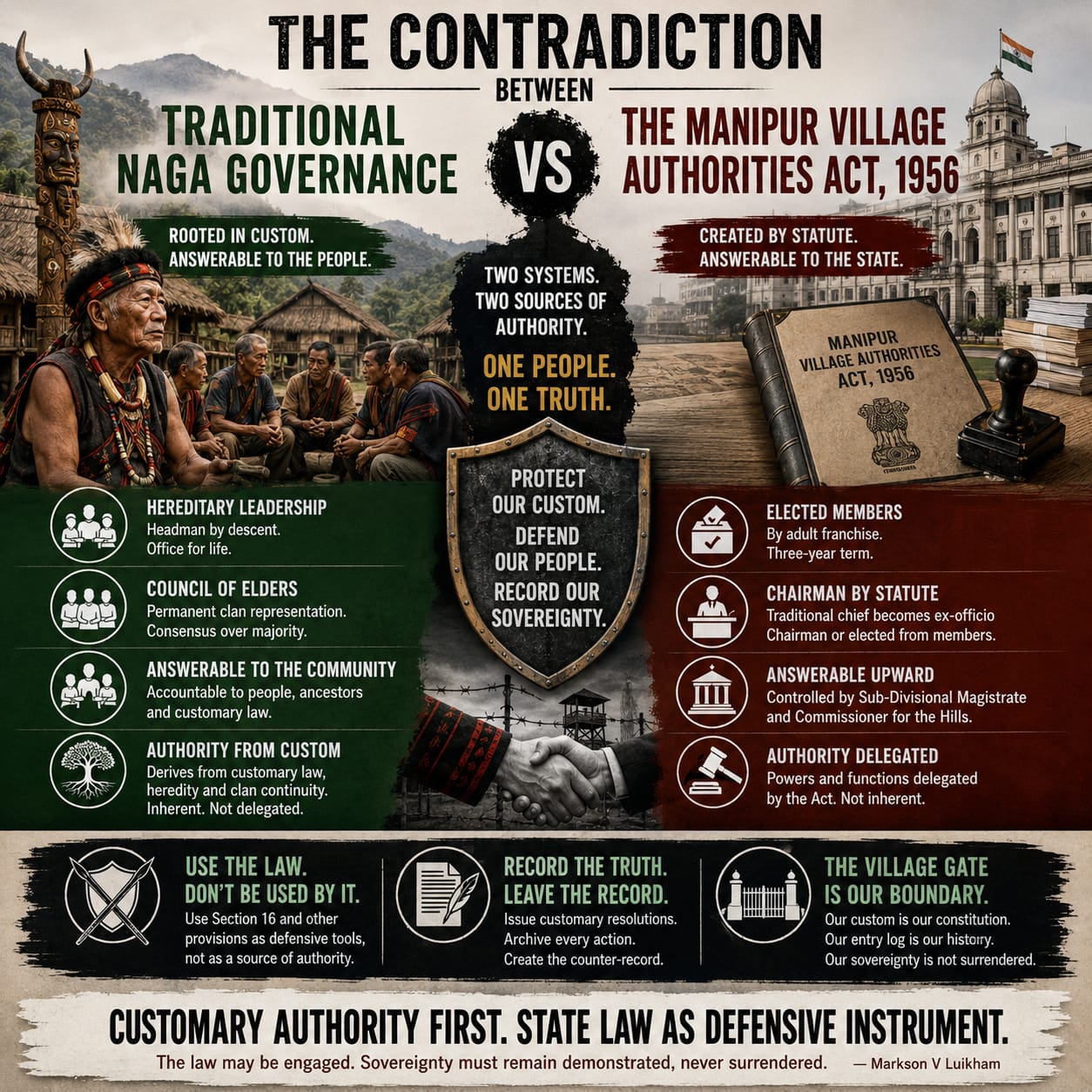
𝗧𝗵𝗲 𝗖𝗼𝗻𝘁𝗿𝗮𝗱𝗶𝗰𝘁𝗶𝗼𝗻 𝗕𝗲𝘁𝘄𝗲𝗲𝗻 𝗧𝗿𝗮𝗱𝗶𝘁𝗶𝗼𝗻𝗮𝗹 𝗧𝗮𝗻𝗴𝗸𝗵𝘂𝗹 𝗡𝗮𝗴𝗮 𝗚𝗼𝘃𝗲𝗿𝗻𝗮𝗻𝗰𝗲 𝗮𝗻𝗱 𝘁𝗵𝗲 𝗠𝗮𝗻𝗶𝗽𝘂𝗿 𝗩𝗶𝗹𝗹𝗮𝗴𝗲 𝗔𝘂𝘁𝗵𝗼𝗿𝗶𝘁𝗶𝗲𝘀 𝗔𝗰𝘁, 𝟭𝟵𝟱𝟲
𝗧𝗵𝗲 𝗔𝗰𝘁, 𝘁𝗵𝗲 𝗥𝗲𝗷𝗲𝗰𝘁𝗶𝗼𝗻, 𝗮𝗻𝗱 𝘁𝗵𝗲 𝗣𝗿𝗲𝘀𝗲𝗻𝘁 𝗖𝗿𝗶𝘀𝗶𝘀
The Manipur (Village Authorities in Hill Areas) Act, 1956, was legislated by the Indian Parliament to bring hill villages of the then Union Territory of Manipur under a uniform, state administered framework. Its stated object was to set up statutory Village Authorities with elected members, a state recognised chairman, and powers delegated from above. But to the Tangkhul Naga and other Naga communities across the Naga hills of Manipur, the Act represented a deliberate attempt to dismantle the village republic system, subordinate customary headmanship to bureaucratic control, and replace permanent clan governance with temporary electoral majorities.
The rejection was principled and enduring. Naga villages, including the Tangkhul Naga villages, rejected the Act because it violated the inherent rights of headmanship and contradicted tribal laws inapplicable to their system of governance. This was a defence of a whole way of life. The effect of the Act was to recast the hereditary Awunga, the village headman, as a statutory chairman, dissolve the Hangva, the traditional council of clan representatives, into elected members with fixed terms of three years, and place the entire structure under state supervision. Tangkhul Naga villages refused a law that claimed to constitute what already existed by custom, and did so on terms that denied the source of their own authority.
For centuries, the Awunga and the Hangva governed village life, operating through an indigenous system of administration that remained independent of any external statute. But the escalating violence today, including the cross border attacks in the Kamjong corridor, the state’s apparent shielding of the attackers, and the collapse of protective governance, has forced a reassessment. As learned individuals among us now use legal and statutory instruments during this conflict, the question is no longer whether to look at the 1956 Act, but how to do so without being trapped by it.
This engagement compels us to face a historic tension. The Act does not erase custom; it absorbs and restructures it within a statutory framework. A blanket adoption would contradict the traditional system, but a principled navigation is possible if we understand precisely where the two systems diverge. What follows compares the two systems, examines the Act’s key clauses, shows how it co-opts custom, recalls the historic rejection, and explores the political and legal implications of any defensive engagement today.
𝗧𝗵𝗲 𝗖𝗼𝗿𝗲 𝗖𝗼𝗻𝘁𝗿𝗮𝗱𝗶𝗰𝘁𝗶𝗼𝗻: 𝗦𝗼𝘂𝗿𝗰𝗲 𝗮𝗻𝗱 𝗦𝘁𝗿𝘂𝗰𝘁𝘂𝗿𝗲 𝗼𝗳 𝗔𝘂𝘁𝗵𝗼𝗿𝗶𝘁𝘆
The fundamental difference lies in where authority comes from and how it is organised.
Head of Village.
In the traditional Tangkhul Naga system, the village is led by a hereditary Awunga. He holds office for life and is the sacrosanct representative in rites, land stewardship, and administration. His authority stems from descent, not election. The headmanship passes through the male descendants of the founding clan, and no other clan may claim it.
The VA Act, 1956, uses the generic Meitei administrative term “Khullakpa” to refer to the village chief. If such a chief exists, the Act makes him the ex officio Chairman. Where no recognised chief exists, the Chairman is elected by VA members. The Act does not erase the Awunga but repurposes him as a statutory officeholder whose position is now a creature of law, not solely of custom.
Composition of the Authority.
Custom rests on the Hangva, a council of representatives sent by every clan in the village. These representatives are neither nominated nor elected in the modern sense; their right derives from history and clan membership, and they serve as ministers to the Awunga. The Act replaces this with members elected by adult franchise for a fixed term of three years. Majority preference displaces clan standing; time bound tenure replaces permanence. A majoritarian and temporary logic is introduced into a system historically grounded in consensus and enduring responsibility.
Accountability.
The traditional Hangva answers to the community, ancestors, and customary law, with no higher outside body. Under the Act, the Village Authority is accountable upward to the Sub Divisional Magistrate and the Commissioner for the Hills, who exercise supervisory and disciplinary control. The locus of accountability shifts from the village assembly to the state’s administrative hierarchy.
Basis of Authority.
Traditional authority derives from customary law, heredity, and clan consensus, and the Awunga’s legitimacy from the continuity of the village itself. The Act, by contrast, is statutory law of the Indian Parliament; any authority under it is legally delegated from the state, not independently possessed by the village.
𝗞𝗲𝘆 𝗖𝗹𝗮𝘂𝘀𝗲𝘀 𝗼𝗳 𝘁𝗵𝗲 𝗩𝗶𝗹𝗹𝗮𝗴𝗲 𝗔𝘂𝘁𝗵𝗼𝗿𝗶𝘁𝗶𝗲𝘀 𝗔𝗰𝘁, 𝟭𝟵𝟱𝟲
Section 3: “There shall be a Village Authority in each village in the hill areas and such Village Authority shall be constituted in the prescribed manner.” The VA is a state created institution imposed uniformly; “prescribed manner” opens the door to further state regulation, removing the village from the design of its own governance.
Section 5: The Chairman is the chief or khullakpa, or if none, elected from among the members. The traditional Awunga is acknowledged only by folding him into a statutory post using a Meitei administrative term; the Chairmanship is not an inherent right but a statutory designation.
Section 4 sets a fixed term of three years from the first meeting, directly overriding life tenure and permanent clan membership. Authority becomes renewable by electoral cycle, not by inheritance or social permanence.
Section 6 lists functions including managing village property and administering petty civil and criminal justice. These resemble traditional roles of the Awunga and Hangva but are now framed as delegated duties, not inherent rights.
Section 15 places every VA under the control of the Sub Divisional Magistrate and general superintendence of the Deputy Commissioner. Section 18 empowers the Chief Commissioner to call for records and modify, set aside, or confirm decisions. These provisions formally subordinate the village authority to the state’s hierarchy. The traditional Awunga and Hangva, by contrast, derive their legitimacy internally and cannot be dissolved or suspended by an outside bureaucratic authority.
Section 16 vests the VA with the power “to maintain law and order and for that purpose exercise and perform the powers and duties generally conferred and imposed on the police by or under the Police Act, 1861.” This authorises arrests, searches, and maintenance of public order, but as statutory delegation, not customary attribute. The challenge is to activate it without accepting the state’s framing.
𝗛𝗼𝘄 𝘁𝗵𝗲 𝗔𝗰𝘁 𝗧𝗿𝗶𝗲𝘀 𝘁𝗼 𝗖𝗼-𝗼𝗽𝘁 𝗖𝘂𝘀𝘁𝗼𝗺
Making the hereditary Awunga the ex officio Chairman appears to recognise custom, but it transforms his role. His authority now derives from the Act, not the village’s social order; he becomes a statutory officer within an externally imposed framework.
Elected members with fixed terms introduce temporary majorities. The Hangva, a body once balancing permanent clan representation with consensus, is replaced with a structure where authority can shift every three years with electoral outcomes. The Act also remains silent on financial autonomy beyond meagre provisions, and its village court powers are restricted and subject to appeal to state courts, leaving the VA weaker than a true village government.
𝗧𝗵𝗲 𝗛𝗶𝘀𝘁𝗼𝗿𝗶𝗰 𝗧𝗮𝗻𝗴𝗸𝗵𝘂𝗹 𝗡𝗮𝗴𝗮 𝗥𝗲𝗷𝗲𝗰𝘁𝗶𝗼𝗻: 𝗡𝗼𝘁 𝗝𝘂𝘀𝘁 𝗮 𝗟𝗲𝗴𝗮𝗹 𝗢𝗯𝗷𝗲𝗰𝘁𝗶𝗼𝗻
The resistance of Tangkhul Naga villages to the VA Act is well documented. As one senior advocate noted, the Act was “rejected by Hill peoples” because it “violated the inherent rights of headmanship and contradicted tribal laws which is not applicable in our system of governance.” The core objection is that the Act is a tool designed to dismantle the village republic system, headed by the Awunga and governed by the Hangva, that is foundational to Tangkhul Naga life.
The effect of the Act was to reduce the autonomy of traditional chiefs and integrate hill villages into a state supervised framework. Its clauses, from the Deputy Commissioner’s power of control to the three year electoral term, replace permanence with state regulated turnover. The Tangkhul Naga rejection, therefore, is an assertion of sovereignty, a refusal to let an external legal instrument define the shape of village governance.
𝗣𝗿𝗶𝗻𝗰𝗶𝗽𝗹𝗲𝗱 𝗡𝗮𝘃𝗶𝗴𝗮𝘁𝗶𝗼𝗻: 𝗨𝘀𝗶𝗻𝗴 𝘁𝗵𝗲 𝗔𝗰𝘁 𝗪𝗶𝘁𝗵𝗼𝘂𝘁 𝗔𝗱𝗼𝗽𝘁𝗶𝗻𝗴 𝗜𝘁
A blanket adoption of the Act would be a political and symbolic error, implying surrender on customary self rule. But a targeted activation of its provisions is possible if several lines are drawn clearly, and if the engagement is accompanied by a deliberate counter measure against misrepresentation.
First, using Section 16 does not require adopting the whole Act. The village can state that it is not constituted under the Act but will exercise police powers as an inherent right confirmed by custom, historical practice, and continuous exercise of authority under the Awunga and Hangva. The notification to the District Magistrate can be framed as a declaration of existing customary authority, not a request for state authorisation.
Second, the Act has a history of inconsistent application. Some Tangkhul Naga villages have accepted the statutory VA structure with the Awunga as ex officio Chairman, while others have rejected it entirely. This patchy legal landscape creates ambiguity, allowing a village to assert its own interpretation of the custom–statute relationship without conceding the state’s framing.
Third, the traditional Hangva council must always remain the central body exercising authority, with the Awunga at its head. Any reference to the VA Act in formal communications should be phrased as “confirming powers already inherent in the traditional Village Authority,” never as “constituting a new authority under the Act.” The legal shield is borrowed; the authority remains ancestral.
Fourth, the state’s own judiciary has ruled that the government has no independent power to declare who a village headman is. By exercising police powers, recording entries, and documenting refusals, the village creates a legal record that it is the source of authority, not a recipient of state delegation. Functioning governance is the strongest evidence of sovereignty.
𝗔 𝗖𝗼𝘂𝗻𝘁𝗲𝗿-𝗺𝗲𝗮𝘀𝘂𝗿𝗲 𝗔𝗴𝗮𝗶𝗻𝘀𝘁 𝗔𝗱𝘃𝗲𝗿𝘀𝗮𝗿𝗶𝗮𝗹 𝗗𝗶𝘀𝘁𝗼𝗿𝘁𝗶𝗼𝗻
Every defensive engagement with a state law carries the risk that hostile actors will selectively quote fragments to argue the opposite of what the document intends. The most predictable line of attack will be the claim that Tangkhul Naga youth are now “accepting the Indian Constitution and the 1956 Act.” That claim can only succeed if the villages themselves produce no counter record.
To forestall this, any village that exercises statutory police powers under Section 16 must simultaneously issue and archive a public resolution of its traditional Hangva council, under the authority of the Awunga. That resolution must state, in plain terms, that the village does not recognise the 1956 Act as the source of its governing authority; that the police powers are being exercised as an extension of its pre existing and unextinguished customary jurisdiction; and that this protective measure in no way diminishes the village’s inherent sovereign rights. The statutory notification and the customary resolution must be kept together, as twin documents that define the act in its correct frame.
When the adversary claims surrender, the village produces not a rushed denial but an already archived public record that refutes the claim. The measure is thereby insulated against distortion before distortion can take root.
𝗖𝗼𝗻𝗰𝗹𝘂𝘀𝗶𝗼𝗻: 𝗖𝘂𝘀𝘁𝗼𝗺𝗮𝗿𝘆 𝗔𝘂𝘁𝗵𝗼𝗿𝗶𝘁𝘆 𝗙𝗶𝗿𝘀𝘁, 𝗦𝘁𝗮𝘁𝗲 𝗟𝗮𝘄 𝗮𝘀 𝗗𝗲𝗳𝗲𝗻𝘀𝗶𝘃𝗲 𝗜𝗻𝘀𝘁𝗿𝘂𝗺𝗲𝗻𝘁
The traditional village system, the Awunga and the Hangva, is the unwritten constitution of Tangkhul Naga life. The VA Act is merely a problematic state statute. No defensive engagement with that statute should blur the truth that the village’s authority flows from the people, their ancestors, and their continuous history, not from an Act passed in 1956 by a parliament in New Delhi.
The approach outlined here uses the state’s own legal instruments to shield Tangkhul Naga communities while never forgetting that those instruments are not the source of our right to exist. Navigating this tension with clarity makes possible a defensive architecture that is legally formidable, politically unmistakable, and historically coherent. The village gate remains a boundary of custom; the entry log kept there becomes a record of custom in action. The law may be engaged. Sovereignty must remain demonstrated, never surrendered.
Markson V Luikham
(The views and opinions in this article are solely those of the author and do not necessarily reflect the official stance of Rural Post)